2025 Is the Year to Bust the Billionaires
The late President Jimmy Carter warned repeatedly that oligarchy was threatening democracy in the United States. He was right.
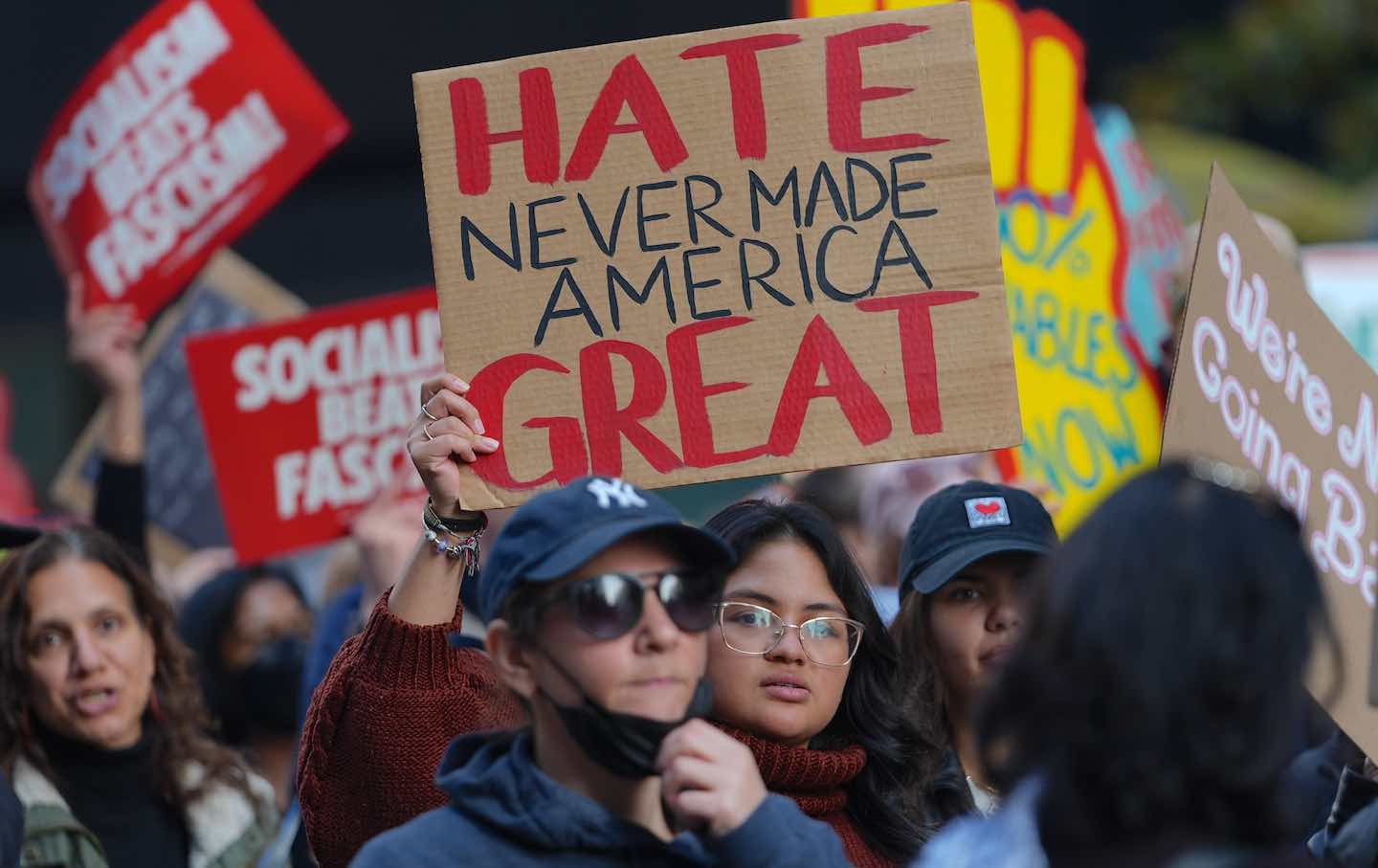
Thousands gather for the Protect Our Futures march in New York City on November 9, 2024, protesting Republican Donald Trump’s reelection as president.
(Selcuk Acar / Anadolu via Getty Images)
Media coverage of mega-billionaire Elon Musk’s increasingly tempestuous relationship with Donald Trump’s MAGA movement turned into a political soap opera as 2024 ended, with a blow-up over whether to grant H-1B skilled-worker visas to certain migrants. Things got so heated that Musk promised, “I will go to war on this issue the likes of which you cannot possibly comprehend,” while longtime Trump adviser Steve Bannon dismissed Musk as “a toddler” and accused him of advancing an agenda that was “about taking American jobs and bringing over essentially what have become indentured servants at lower wages.” Right-wing influencers charged that Musk was censoring them on his X platform, and Britain’s Telegraph reported that “supporters of President-elect Donald Trump teeter on the brink of a civil war over immigration.” When Musk’s wealthy sidekick in the Trump administration’s “Department of Government Efficiency” boondoggle, Vivek Ramaswamy, referred to American workers as mediocre, Fox News joined the fray, reporting, “The wealthy businessmen now find themselves butting heads with Trump’s most ardent base.”
It is a safe bet that this sort of bad craziness will escalate as clashes between Republicans become a dominant political story of 2025.
Trump won the presidential election by a narrow margin, after cobbling together a coalition that ran the gamut from immigrant-bashing xenophobes to tech giants who are more than happy to expand their fortunes by exploiting workers of all backgrounds. Trump’s billionaire backers paid his way during last year’s campaign—for which Musk, the richest man in the world, made himself the largest donor, with his pro-Trump spending reaching roughly a quarter billion dollars. (And that’s not even counting the impact of Musk’s relentless pro-Trump advocacy on X, the platform formerly known as Twitter, which he purchased as the campaign was getting started.)
No surprise then that Trump sided with Musk as the conflict erupted. Trump’s position on the visa question was uncharacteristically reasonable. Downplaying his past criticisms of the H-1B program, the former president said, ”I’ve been a believer in H-1B. I have used it many times. It’s a great program.”
The reality is that Trump is a believer in Musk. The president-elect bows to the mega-billionaire for the same reason that Trump bows to the other big-money interests that have sustained his political endeavors.
Though he has played a billionaire on TV, Trump’s tumultuous financial record, including six bankruptcies for his hotel and casino businesses, has often left him in economically vulnerable spots. He has a long history of playing up to billionaire-class oligarchs, and during his first term he made a point of giving them massive tax cuts.
There’s little doubt that Trump will seek to do so again in his second term, providing further confirmation of the late former president Jimmy Carter’s observations from almost a decade ago about the damage done by billionaire-guided governance. “It violates the essence of what made America a great country in its political system. Now it’s just an oligarchy, with unlimited political bribery being the essence of getting the nominations for president or to elect the president,” explained Carter in the summer of 2015, just weeks after Trump launched his first presidential bid.
“And the same thing applies to governors and U.S. senators and congress members. So now we’ve just seen a complete subversion of our political system as a payoff to major contributors, who want and expect and sometimes get favors for themselves after the election’s over.… The incumbents, Democrats and Republicans, look upon this unlimited money as a great benefit to themselves. Somebody who’s already in Congress has a lot more to sell to an avid contributor than somebody who’s just a challenger.”
During Trump’s first term, Carter said the United States had become more of an “oligarchy than a democracy.”
Carter’s death on Sunday robbed the United States of one of its most prominent critics of this country’s plutocratic politics. But there are others, including Bernie Sanders, the US senator from Vermont who has argued in recent weeks, “We are in a pivotal and unprecedented moment in American history. Either we fight to create a government and an economy that works for all, or we continue to move rapidly down the path of oligarchy and the rule of the super-rich.”
Another stark critic of America’s oligarchical turn is Ro Khanna, the US representative from California who finished the 118th Congress with a powerful address to the House in which he warned, “There is an unholy alliance between soulless wealth and power that has stripped Americans of freedom.”
The fact that 150 billionaires spent $1.9 billion to influence the results of the 2024 election shows that the influence of the ultrarich is not just “corrupting the soul of our democracy.”
“The money,” said the congressman, “has become more important than votes.”
Illustrating his point, Khanna explained to his colleagues, “When you look at why politicians sold our jobs overseas, why Wall Street raided our manufacturers and hollowed out industry after industry to worship shareholder profits, then you have to look at the influence billionaires have had on our democracy.”
Making a patriotic appeal for sweeping campaign finance reforms, Khanna argued, “We did not fight a revolution to be spectators in a game of billionaires putting ads on our television sets and on our mobile phones… Our founders would be rolling over in their graves if they saw what has become of modern American democracy.”
The representative, who was elected to Congress in 2016 with a rare endorsement from Carter, frequently amplified Carter’s messages in the former president’s later years. Like Carter and Sanders, Khanna knows that the time has come to upend oligarchy and renew democracy. In an era when elections and now governance are being defined by the chaotic power politics of Trump and Musk, the congressman is making an urgent call to “ban PAC and lobbyist money, overturn Citizens United, and return power to the people.”
Support independent journalism that does not fall in line
Even before February 28, the reasons for Donald Trump’s imploding approval rating were abundantly clear: untrammeled corruption and personal enrichment to the tune of billions of dollars during an affordability crisis, a foreign policy guided only by his own derelict sense of morality, and the deployment of a murderous campaign of occupation, detention, and deportation on American streets.
Now an undeclared, unauthorized, unpopular, and unconstitutional war of aggression against Iran has spread like wildfire through the region and into Europe. A new “forever war”—with an ever-increasing likelihood of American troops on the ground—may very well be upon us.
As we’ve seen over and over, this administration uses lies, misdirection, and attempts to flood the zone to justify its abuses of power at home and abroad. Just as Trump, Marco Rubio, and Pete Hegseth offer erratic and contradictory rationales for the attacks on Iran, the administration is also spreading the lie that the upcoming midterm elections are under threat from noncitizens on voter rolls. When these lies go unchecked, they become the basis for further authoritarian encroachment and war.
In these dark times, independent journalism is uniquely able to uncover the falsehoods that threaten our republic—and civilians around the world—and shine a bright light on the truth.
The Nation’s experienced team of writers, editors, and fact-checkers understands the scale of what we’re up against and the urgency with which we have to act. That’s why we’re publishing critical reporting and analysis of the war on Iran, ICE violence at home, new forms of voter suppression emerging in the courts, and much more.
But this journalism is possible only with your support.
This March, The Nation needs to raise $50,000 to ensure that we have the resources for reporting and analysis that sets the record straight and empowers people of conscience to organize. Will you donate today?