
Water Infrastructure in Texas Is Failing. A Surge of New Funding Can Fix It.
As the state promotes industrial expansion and costly seawater desalination projects, advocates want to prioritize fixing aging pipes and supporting public health.
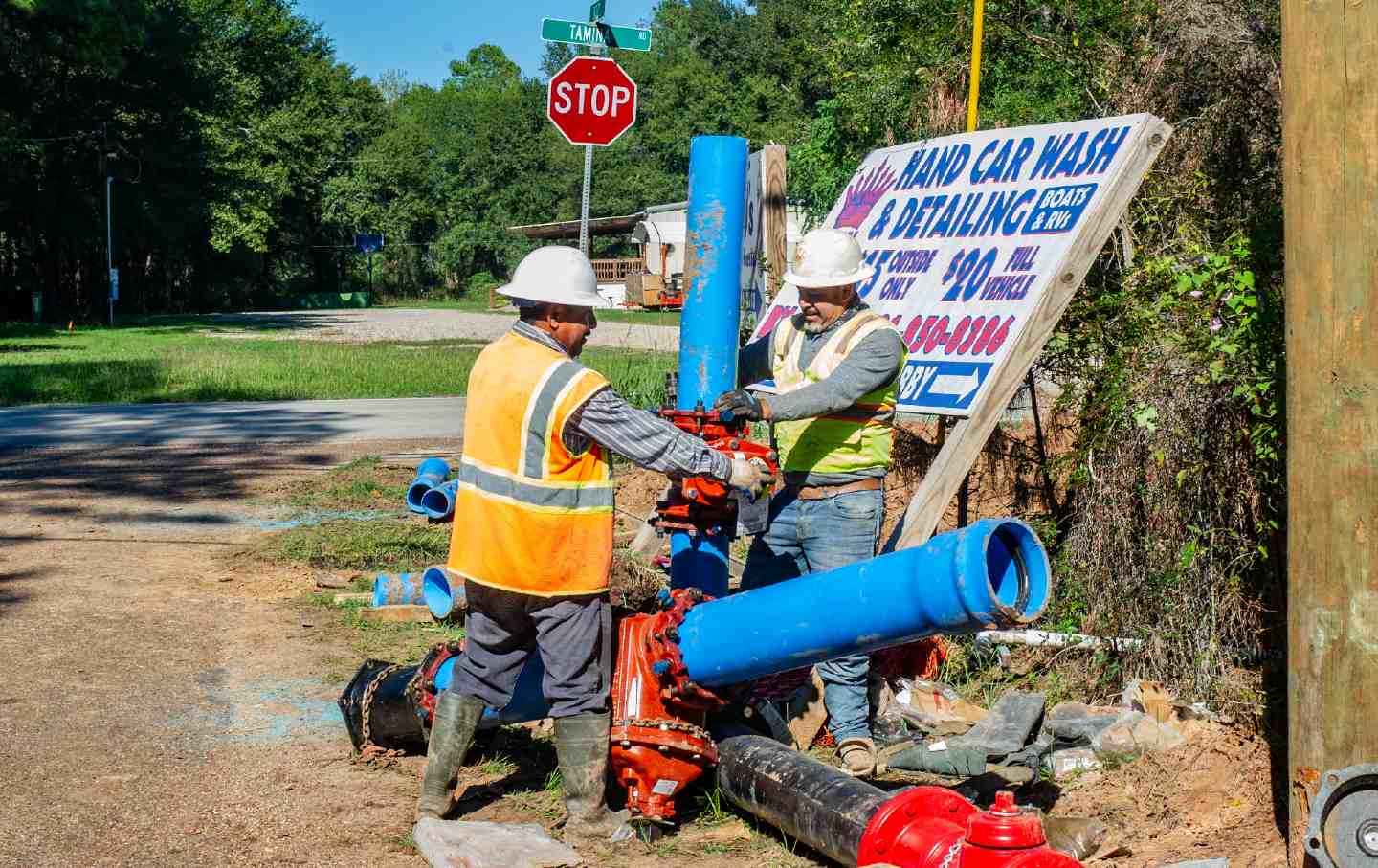
How does Houston, Texas, lose more than 30 billion gallons of water a year? With the entire state facing scarcity, the cause isn’t drought alone. “It’s really because the infrastructure is so old,” said Usman Mahmood, a policy analyst at Bayou City Waterkeeper, a Houston nonprofit that works on water policy and enforcement tied to water quality. “You’re dealing with leaking pipes and maintenance issues.”
After persistent infrastructure problems in and around her home made daily life feel unmanageable, Sade Hogue, who lives in northeast Houston, joined the group. “I found out that a lot of people, not just in my neighborhood but all over Houston, are dealing with exploding toilets, overflowing sewage coming back into our homes, really bad water pressure, and homes flooding, because the drainage is so bad,” she said. According to the Houston Chronicle, there were more than 4,400 private sewer leaks from April 2021 to June 2023, primarily in areas where the median household income tended to be lower. “There is real trauma attached to living like that,” said Hogue.
Last year, the organization joined a community-led coalition that helped shape deliberations over Proposition 4, a constitutional amendment that would authorize up to $20 billion over two decades for water infrastructure and creates a recurring funding stream for the Texas Water Fund. “We had to band together as residents and say something to the city,” Hogue said. “Once people learned more about it and educated themselves, we moved into going to City Hall on a regular basis.” In November 2025, voters approved the proposition by 70 percent.
“The vote exposed a gap between Texas’s political branding and what voters will support when asked directly about basic public need,” said David Griscom, the author of The Myth of Red Texas, an upcoming book on Texas political history. Ballot measures, Griscom said, can bypass the “cultural or partisan lens” that often structure debate in the state. On an issue like water, he argued, voters are responding to an immediate material concern, which can reveal the “latent, progressive, and solidaristic aspects” of Texas society.
“What I think this shows is that there is a kind of political common sense that exists in Texas that is very rarely given an avenue,” Griscom said, adding that the vote points to the promise of “a more solidaristic and community-focused politics in the state.”
Community pressure, showing up to hearings, and staying in steady contact with legislative staff shaped the final version of the amendment and assured this enormous victory. When Proposition 4 was first introduced, lawmakers planned to steer most of the funding toward new water-supply projects, leaving a smaller share for fixing existing systems. Environmental groups and community advocates pushed back, and lawmakers ultimately shifted the split to half and half for new supply and existing infrastructure. “When the bill was first filed, 80 percent of the funding was going to go toward new water supply,” said Tom Entsminger, policy director of the National Wildlife Federation’s Texas coastal water program.“That shift mattered because fixing leaky infrastructure is foundational.”
But the proposition is just a down payment on a much larger bill. For advocates, that makes oversight the next phase. “The real work begins now,” Entsminger said. “It’s important to stay engaged and make sure the money gets spent wisely.” Texas water infrastructure needs are estimated at roughly $154 billion over the next 50 years. Mahmood put the gap in practical terms: the State Revolving Fund, which allocates funding to water infrastructure projects, is already oversubscribed, with demand many times larger than what is available.
The state is promoting rapid population growth and water-intensive industrial expansion, including new data centers, while also pushing large-scale supply projects such as seawater desalination. “Seawater desalination is extremely expensive,” Mahmood said. And these types of projects offer limited near-term relief to communities dealing with broken pipes and unsafe drainage. “It takes a very long time to build, and even if a project were approved today, you probably would not see it operating until the early 2030s.”
Mahmood said the next year will be central for groups pushing the state to prioritize repairs. “This coming year is going to be really pivotal for organizations like ours to make the case for how that money should be distributed,” he said. “We’re going to continue emphasizing that existing infrastructure has to take priority so that clean water and public health gaps don’t keep expanding.”
Long-term pressures remain, including climate stress and demand growth. “We’re starting to see communities say that even if they build every project in the state water plan, they still won’t have enough water,” Entsminger said. “Conservation stops being a best practice and starts becoming necessary.”
For advocates, the immediate priority is the condition of existing systems. “Cities should be leveraging this funding strategically to fix leaky pipes, reclaim water, and treat that reclaimed water as a new supply instead of rushing into expensive new projects,” Mahmood said.
With Proposition 4, Texas now has institutional tools that most states lack, including a long-standing state water planning framework and multiple funding programs targeted to different infrastructure needs. Entsminger said that depth is unusual nationally. “A lot of states don’t have much in terms of state funding for infrastructure, and Texas has this relatively long list of programs that are targeted for different purposes,” he said. He added that Texas’s 50-year state water plan gives it a longer planning horizon than most states.
Popular
“swipe left below to view more authors”Swipe →Proposition 4 builds on that foundation at a scale Entsminger described as nationally exceptional. “It’s the biggest state-initiated recurring investment of its kind in the United States,” he said.
For Hogue, the real work starts now. “Now that it has passed,” she said, “accountability is the main thing.
Become a Sustaining Donor This September
Between the reemergence of right-wing red-baiting and Donald Trump’s use of the chilling National Security Presidential Memorandum–7 to criminalize left political organizing, we’re seeing McCarthyism reborn before our eyes.
This assault on democracy cannot be ignored or wished away. Resisting it requires bravery in the face of threats and repression, a steadfast commitment to the truth, and the unwavering belief that we can—and will—overcome this darkness.
We must have an independent media that sets the record straight, unearths corruption and abuses of power, and advances a politics of justice and dignity for all if we’re to win this fight.
That’s why I’m writing to you today. This September, The Nation needs to add 100 monthly donors to sustain our progressive journalism. Your contribution makes the next investigative report, the next truth-speaking column, and the next pathbreaking essay all possible.
I hope you’ll support our work with a recurring donation today. If you donate $10 or more a month, we’ll send you a brand new “Hands Off the Free Press!” sticker to recognise your commitment to our cause. Please, donate today.
Onward,
Katrina vanden Heuvel
Editor and Publisher, The Nation
More from The Nation

Gavin Newsom Comments on Climate Gavin Newsom Comments on Climate
On the sidelines of the UN General Assembly meeting and New York Climate Week, the California governor called AOC “the real damn deal.”

Cities as Climate Labs: Inside the U20 Summit Cities as Climate Labs: Inside the U20 Summit
Mayors at the Urban 20 Summit worked across borders to confront the climate crisis at the local level.
Big Oil’s Origin Story Big Oil’s Origin Story
Amy Westervelt’s new book, Brought to You By, exposes the deep history of today’s “information pollution.”
Two Years After Helene, North Carolina’s Unsettled Recovery Two Years After Helene, North Carolina’s Unsettled Recovery
The state has become a testing ground under an eviscerated FEMA and a missing-in-action “recovery czar,” Michael Whatley, with big political ambitions.

A Reckoning Comes for Nepal A Reckoning Comes for Nepal
A year after its Gen Z uprising, Nepal faces a struggle not only for democracy and human rights but for climate survival.

How a Creative Mind Lives in Nature How a Creative Mind Lives in Nature
Working in the wilderness could not satiate my intellectual impulses. But for the protagonist of Hothouse Bloom, the binary between mental and physical labor is what calls her.

