
Have We Forgotten Covid’s Lessons?
This summer’s deadly heat calls for news coverage based on science, not ideology.
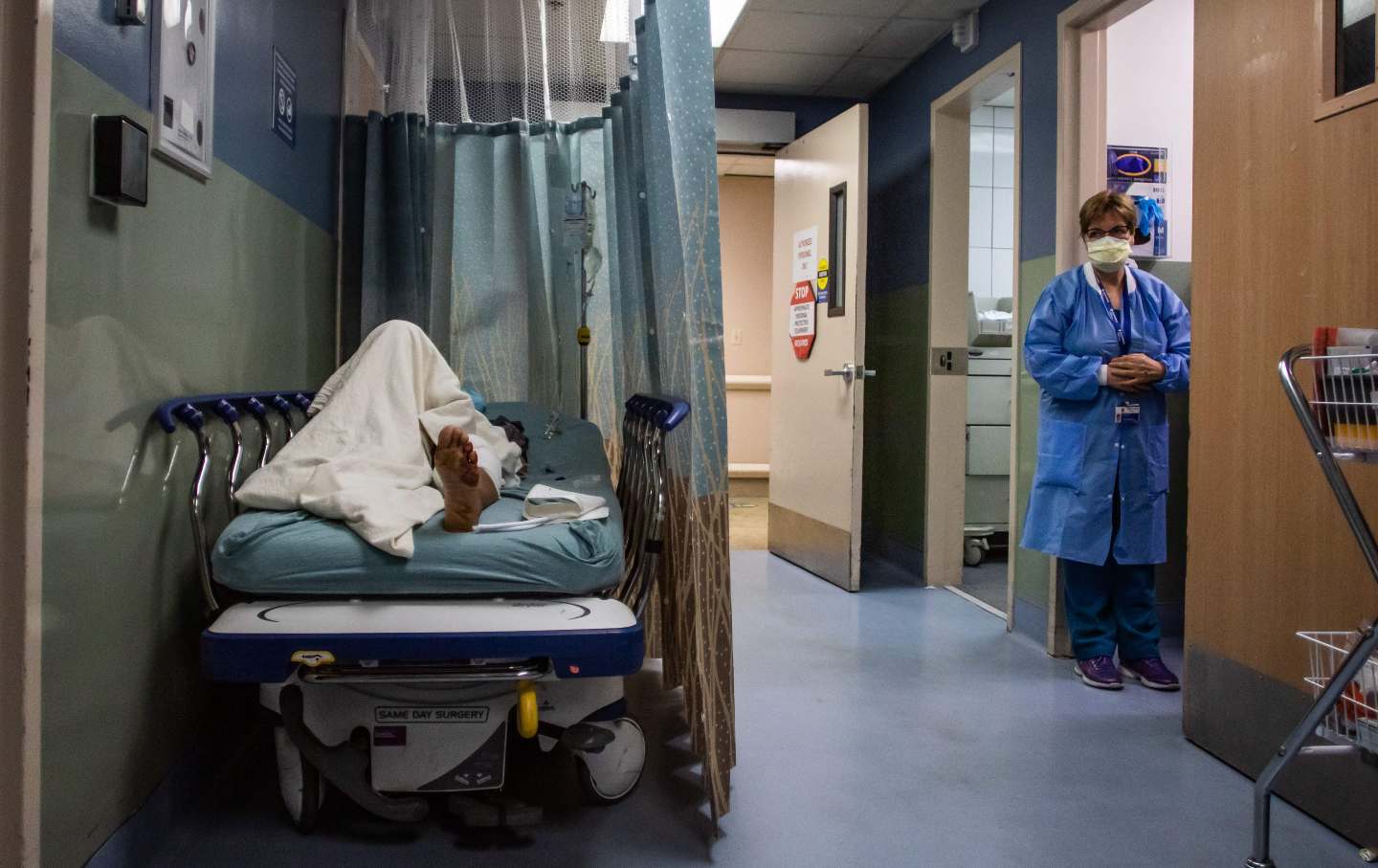
A patient rests in a corridor waiting for a room at Providence Cedars-Sinai Tarzana Medical Center in California on January 3, 2021.
(Apu Gomes / AFP via Getty)In June, during the first of the record heat waves to scorch Europe this summer, “the London Ambulance Service fielded over 53,000 calls, surpassing the number received when the Covid-19 pandemic was at its height in March 2020,”Bloomberg Green reported this week. Conditions inside UK hospitals were “far worse” than during Covid, Fiona Brennan, an anesthetist in Cardiff, told Bloomberg. It was so hot inside surgery rooms for cancer patients that basic procedures faltered, Brennan continued, adding that some patients were so sweaty that she had to constantly check that intravenous drips were not “slipping out” of their bodies.
Also, as with Covid, early mortality figures dramatically understated the death tolls to come. The UK Health Security Agency initially estimated that 2,877 people died from heat-related ailments in May and June. France estimated that there were 5,700 excess deaths between June 17 and July 2. Other analyses, benefiting from more complete data and advanced methodology, blamed the heat for as many as 20,000 deaths. And that was before the June heat wave was followed by an additional four heat waves that surely boosted the number of sick and dying.
And Europe, as we’ve reported, is not the only hot spot. In India, temperatures in Delhi soared to 129 degrees Fahrenheit, pushing the limits of human survival, especially for the city’s poor, again illustrating a core injustice of the climate emergency: The people who did the least to cause it are the ones who tend to suffer the most.
There are critical differences, of course, between the Covid and climate emergencies. In the opening weeks of the pandemic, scientists weren’t sure how the virus spread, or how to treat it. By contrast, science is unequivocal that today’s extreme heat waves—and the drought and fires they’ve kindled—would be “all but impossible” without human-caused global warming driven primarily by burning oil, gas, and coal. “Summer of 2026 is another step in the escalation of our world into a sort of hotter, more dangerous planet that climate scientists have been telling us about for decades,” Jeff Goodell, the author of The Heat Will Kill You First, said on CBS.
When Covid emerged in early 2020, much of the media rose to the challenge, providing science-based reporting that helped both the public and policymakers make informed decisions about how to respond. Journalists held governments to account, puncturing claims of miracle cures and explaining the value of physical distancing and getting vaccinated.
But, with notable exceptions like those cited in this article, news coverage of this summer’s extreme weather has fallen well short of the Covid standard. Two-thirds of the articles that major UK newspapers published about the summer’s fires did not even mention climate change, much less explain how record heat makes fires more likely and deadly. In the US, the evening newscasts of ABC, CBS, and NBC during the week of July 13 to 19 lavished airtime on the extreme weather but did not utter the words “climate change.”
The Guardian, as usual, has kept the climate connection front and center, and on August 8, it published an opinion piece by the mayor of London, Sadiq Kahn, who urged government leaders in Britain and around the world to treat climate change as the emergency that scientists say it is—something Khan began doing as mayor in 2018. Khan’s call for leaders to “reduce our reliance on oil and gas” did not name names, but commentators interpreted it as pressing the new British prime minister, Andy Burnham, to rule out more North Sea oil drilling, a question Burnham has studiously avoided since taking office on July 20. Meanwhile, a petition demanding that the government present a televised emergency briefing on the climate crisis has attracted 100,000 signatures, the threshold for getting it debated in Parliament, whose next session begins September 1.
Kahn was only half right, however, when he opined that “the climate emergency is here, and no one can say they didn’t see it coming.” Yes, the emergency is here, and “coming faster and harder” than even scientists expected, economist Matthew Argawala of the University of Sussex said on Britain’s Channel 4. But as Kahn’s own article goes on to lament, a small but noisy chorus of climate deniers still deny that climate change is happening at all.
Now, as the summer of 2026 brings record heat to much of the world; as thousands die and many thousands more endure various degrees of misery, White House reporters do not even ask Trump about climate change, much less challenge his scientifically disproven assertion that it’s a hoax. In the UK, press coverage largely ignores the climate argument against more North Sea oil drilling, instead framing Burnham’s upcoming decision as the latest battle in the culture wars.
Kahn cites Donald Trump’s dismissal of climate change as “a con job” and calls out unnamed “opposition politicians and rightwing populists” in the UK. He does not point out that these obstructionists represent only a small fraction of public opinion. More 83 percent of Britons and 74 percent of Americans want their governments to take stronger climate action, according to Gallup polling that informs Covering Climate Now’s 89 Percent Project. But the deniers appear to be more numerous than they actually are, both because they have access to far-reaching megaphones and because most news coverage does not point out how wildly their claims are contradicted by science.
Again, the contrast with media coverage of Covid is striking. On April 23, 2020, as Covid’s death toll was mounting, Trump suggested at a White House press briefing that injecting disinfectant into the body might kill the virus. News outlets responded with a flurry of stories quoting incredulous experts lambasting Trump’s idea as dangerous nonsense. Trump quickly retreated, claiming that he’d been speaking sarcastically (though video of his remarks showed he was serious.)
Most journalists did better than this during Covid, and the public needs us to do better now.
More from The Nation
Germany and California Make Up an Environmental Superpower Germany and California Make Up an Environmental Superpower
The world’s third- and fourth-largest economies have pledged to environmental protections. Will others follow suit?

Gavin Newsom Comments on Climate Gavin Newsom Comments on Climate
On the sidelines of the UN General Assembly meeting and New York Climate Week, the California governor called AOC “the real damn deal.”

Cities as Climate Labs: Inside the U20 Summit Cities as Climate Labs: Inside the U20 Summit
Mayors at the Urban 20 Summit worked across borders to confront the climate crisis at the local level.
Big Oil’s Origin Story Big Oil’s Origin Story
Amy Westervelt’s new book, Brought to You By, exposes the deep history of today’s “information pollution.”
Two Years After Helene, North Carolina’s Unsettled Recovery Two Years After Helene, North Carolina’s Unsettled Recovery
The state has become a testing ground under an eviscerated FEMA and a missing-in-action “recovery czar,” Michael Whatley, with big political ambitions.
A Reckoning Comes for Nepal A Reckoning Comes for Nepal
A year after its Gen Z uprising, Nepal faces a struggle not only for democracy and human rights but for climate survival.

