Gloria Steinem’s Many-Splendored Feminist Life
The feminist icon lived the struggle for gender equality and always found time to lend support and solidarity to other women leaders, even in her final days.
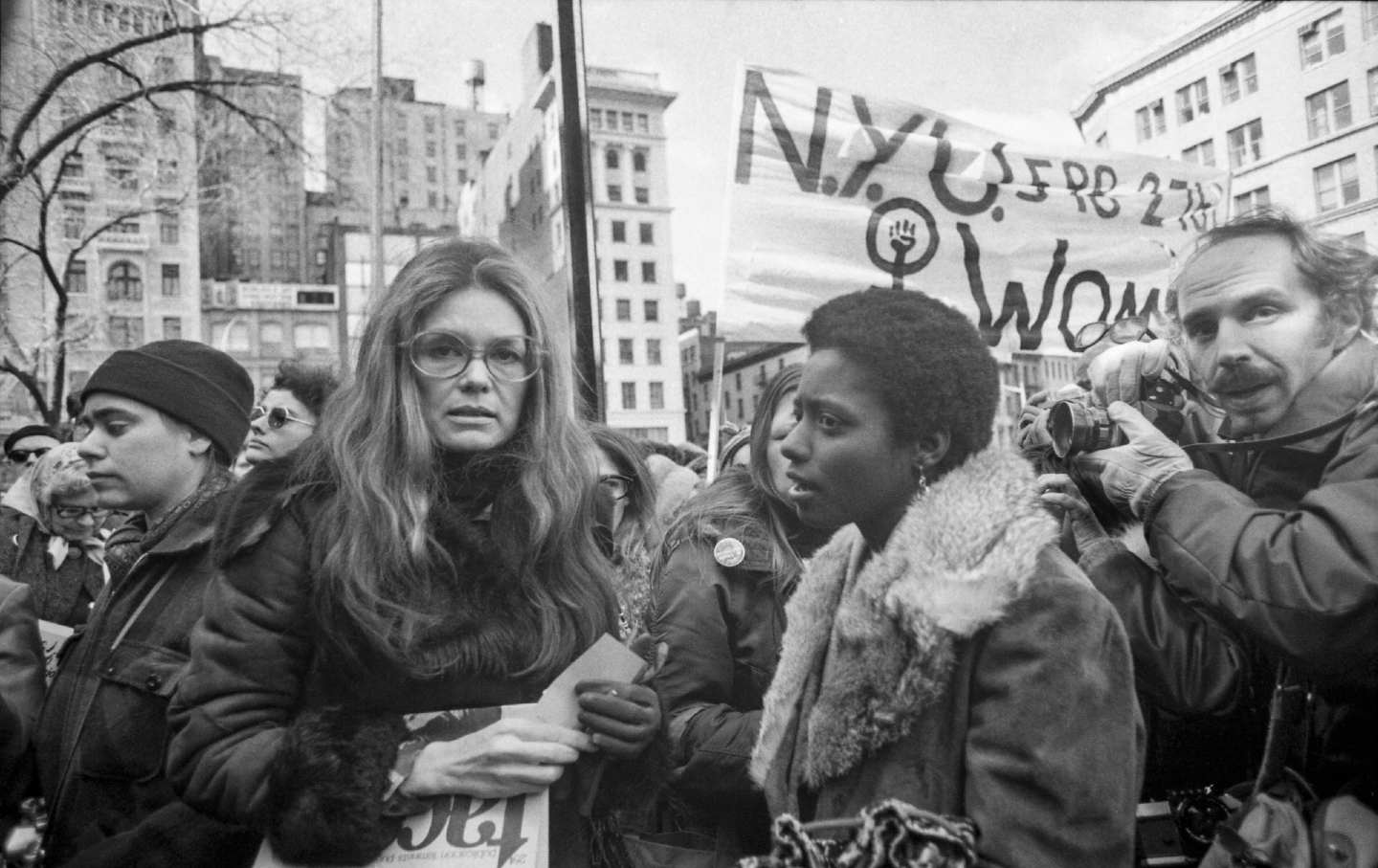
Gloria Steinem at the 1975 International Women’s Day March in Midtown Manhattan.
(Bettmann Archive / Getty Images)
There is no way to do justice to the 92 astonishing years of the incomparable feminist Gloria Steinem, who died at home, surrounded by friends, Wednesday night. I knew she had been weakening, and yet I still regularly heard of her meeting with women leaders and helping anyplace and anytime she could.
Most recently, I got invited to a small New York reception with Minnesota Lieutenant Governor Peggy Flanagan and actor-activist Jane Fonda, that I hoped might include Steinem. Flanagan slipped over to Steinem’s home early for a private meeting with the Ms. founder and Fonda. That was Steinem, I thought: always making time for new women leaders, in this case the 46-year-old progressive who will become the first Native senator if she is elected in November.
Today, social media has been full of women, young and old, of every race, posting photos with Steinem taken over the last few years. She had not been well; I hadn’t seen her in a little while. But if you had a feminist book out, a documentary, a cause, or if you were a woman running for a major office, Steinem made time for you.
The author, organizer, feminist and friend to so many grew up, struggling, in East Toledo, Ohio, caring for her ill mother. It made her a many-splendored feminist, a gorgeous woman who traveled in elite circles but championed the working class, the vulnerable, women who weren’t white, and women who weren’t straight. (Her AOL e-mail name was EastToledo; whenever that address graced my inbox, I felt thrilled.) Caring for her mother, Steinem didn’t finish a full year of school until the sixth grade but was a voracious reader. She eventually followed her sister Suzanne to Smith College, where she graduated Phi Beta Kappa.
Steinem ultimately wrote 11 books and in addition to founding Ms. she was a cofounder of New York magazine, along with Clay Felker, who also backed Ms. Felker famously told a reporter he gave Steinem her first assignment because she had “great legs.” Cataloguing the list of sexist slurs, sometimes dressed up as compliments, that she suffered is not worth my time or yours. She mostly got over them.
Steinem often said she was awakened to the feminist cause by covering a meeting of women discussing their illegal abortions. She’d had one herself in 1957, in England. The experience of listening to what these women suffered for what would later (until the Dobbs decision) be a right led to her famous essay, “After Black Power, Women’s Liberation.” She was one of the first prominent white feminists to make a point of reaching out to and including Black women, from Flo Kennedy to Dorothy Pitman Hughes to Alice Walker to the legendary Rep. Shirley Chisholm, for whom she was a delegate to the 1972 Democratic presidential nominating convention.
On the other hand, Steinem drew a lot of criticism for supporting Hillary Clinton over Barack Obama for president in 2008, and writing in The New York Times that gender was a greater barrier than race in running for president. “What worries me is that she is accused of ‘playing the gender card’ when citing the old boys’ club, while he is seen as unifying by citing civil rights confrontations,” she wrote. Like Steinem, I supported Clinton in 2008; and in 2016 we were united behind her again. That year, Steinem made a rare stumble by suggesting young women were supporting Bernie Sanders because “that’s where the boys are,” an error she was led into by non-feminist Bill Maher during an appearance on Real Time but for which she fervently apologized. (There were some sympathetic e-mails between me and “EastToledo” in those years.)
Maybe it seems odd that the woman who wrote “After Black Power, Women’s Liberation” in 1969 would support Clinton over Obama roughly 40 years later. Not to me. I would later wonder if I’d been on the wrong side in that race, and of course Steinem and I would fervently support Obama in 2008 and 2012. But the obstinacy of gender barriers, the enduring double standards facing women politicians, and lately the absolute erosion of women’s rights have made me understand even more deeply her frustration with the way women supporting Clinton “were seen as biased if they did and disloyal if they didn’t.” Since then, Steinem (and I) have supported another woman for president, Vice President Kamala Harris; since then, we have been disappointed again.
Also since then, Steinem and I have gotten to support the historic Senate candidacy of Peggy Flanagan, and I wish she could have lived to see what I expect to be her victory. Here’s what Flanagan wrote me this morning:
“Gloria Steinem spent her life changing this country for the better. She helped generations of women believe they belonged in rooms where decisions are made, and she never stopped fighting for equality, dignity, and opportunity for everyone. It has been an incredible honor to get to know her over the last year and I’m forever grateful for her friendship, her courage, and the example she set. I’ll keep doing the work she dedicated her life to—for my daughter and for generations of women to come.”