Environment / July 24, 2025

Desperate for Fuel in Gaza

An extraordinary eyewitness report reveals that food isn’t the only thing Palestinians are starved of. Fuel is almost as scarce.
Mark Hertsgaard

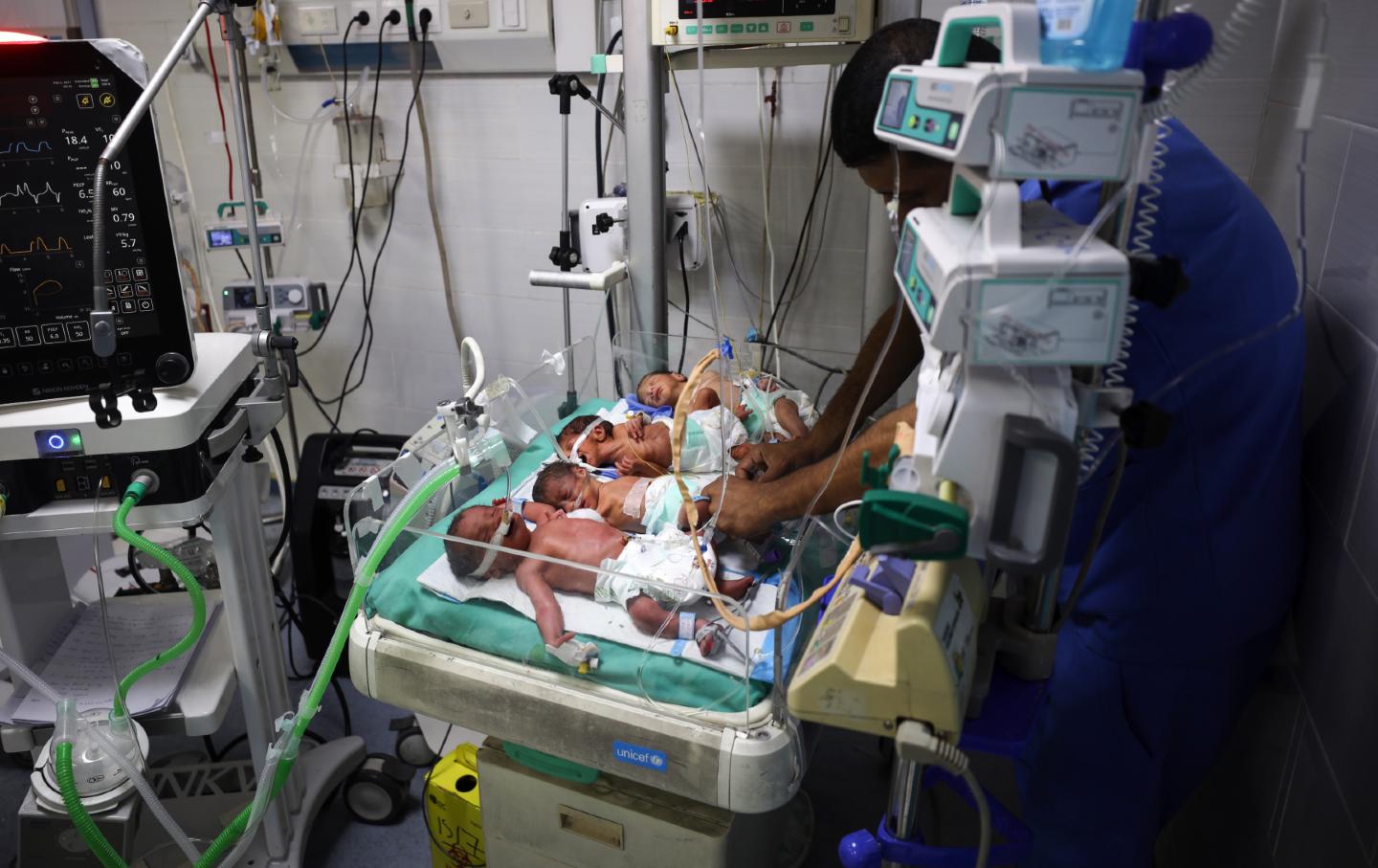
Premature babies receive care in an incubator at Al-Helou Hospital, where they are at risk due to fuel shortages, in Gaza City, on July 17, 2025. The fuel crisis affecting all hospitals may lead to the shutdown of generators and vital medical equipment.

(Majdi Fathi / NurPhoto via Getty Images)

“You cough and it’s all black. Blackness in blackness,” says a Palestinian man wearing a blue cotton Covid mask in Toxic Fumes: Gaza Under Siege, a six-minute video shot inside Gaza and presented on Al Jazeera English. The video is part of “Climate & War,” a series of eyewitness reports commissioned by Arab Reporters for Investigative Journalism that highlights how war, beyond its terrible human costs, “drives carbon emissions, destroys ecosystems, and spreads toxic pollution.” The reports provide valuable context for yesterday’s landmark International Court of Justice ruling requiring all countries to reduce planet-heating emissions sufficiently to limit global temperature rise to the Paris Agreement’s 1.5 degree Celsius target.

Toxic Fumes opens with billowing refugee tents against a blackened landscape. Smoke wafts over piles of concrete rubble and twisted metal, the remains of bombed buildings. The camera zooms to a worker raking a fire in a makeshift furnace. The man in the Covid mask and a third worker feed pieces of plastic scavenged from the bombed buildings into an air-tight barrel. Plastics are made from petroleum; these men are, in effect, reversing the refining process, vaporizing plastic into crude forms of gasoline and diesel that will be sold in liter bottles at roadside stands.

Israel’s blocking of food supplies into Gaza has sparked widespread condemnation, with 28 nations on Monday taking the extraordinary step of calling for an immediate end to Israel’s war in Gaza and rebuking the “drip feeding of aid” that has left two-thirds of Gaza’s prewar population at risk of severe malnutrition or starvation, with children particularly suffering. “There is no case since World War II of starvation that has been so minutely designed and controlled,” said famine scholar Alex De Wall. Toxic Fumes brings an additional dimension to the story, revealing that fuel is almost as scarce in Gaza as food is and what desperate things people will do to cope.

The men burning plastic know their work is very dangerous. Incinerating plastic produces some of the most carcinogenic pollution known to man, and their work site could “catch on fire at any moment,” says one crew member. Nevertheless, the man tells the interviewer, “Don’t ask about danger. It’s not as dangerous as the bombs that fall on us.”

Gaza has become the most dangerous place on Earth to be a journalist. “Almost 200 reporters were killed in Gaza by the Israeli army over the first 18 months of the war,” Reporters Without Borders said in May. Because Israel has forbidden international media from entering Gaza, virtually the only firsthand reporting has come from journalists already on the ground, many if not most of them Palestinian.

The director of Toxic Fumes is Mohammed al-Sawwaf, a veteran documentary maker who has won an Edward R. Murrow Award and a Royal Television Society award. In 2006, his father founded Felesteen, the largest-circulation daily newspaper in Gaza. Both of al-Sawaf’s parents, along with two of his four brothers and the brothers’ children, were killed when Israel bombed their family home in November 2023. Al-Sawwaf’s two remaining brothers were killed in a second Israeli attack that also left him temporarily paralyzed. “Their deaths drained my desire for life,” al-Sawwaf told The Intercept. “Yet, I am still trying to rise and continue our work and mission.”
Time is running out to have your gift matched 

In this time of unrelenting, often unprecedented cruelty and lawlessness, I’m grateful for Nation readers like you. 

So many of you have taken to the streets, organized in your neighborhood and with your union, and showed up at the ballot box to vote for progressive candidates. You’re proving that it is possible—to paraphrase the legendary Patti Smith—to redeem the work of the fools running our government.

And as we head into 2026, I promise that The Nation will fight like never before for justice, humanity, and dignity in these United States. 

At a time when most news organizations are either cutting budgets or cozying up to Trump by bringing in right-wing propagandists, The Nation’s writers, editors, copy editors, fact-checkers, and illustrators confront head-on the administration’s deadly abuses of power, blatant corruption, and deconstruction of both government and civil society. 

We couldn’t do this crucial work without you.

Through the end of the year, a generous donor is matching all donations to The Nation’s independent journalism up to $75,000. But the end of the year is now only days away. 

Time is running out to have your gift doubled. Don’t wait—donate now to ensure that our newsroom has the full $150,000 to start the new year. 

Another world really is possible. Together, we can and will win it!

Love and Solidarity,

John Nichols 

Executive Editor, The Nation

Mark Hertsgaard

Mark Hertsgaard is the environment correspondent of The Nation and the executive director of the global media collaboration Covering Climate Now. His new book is Big Red’s Mercy:  The Shooting of Deborah Cotton and A Story of Race in America.

More from The Nation

Salmon swimming against the current to spawn in the streams in Alaska in August 2025.

The Fight for the Last Wild Salmon The Fight for the Last Wild Salmon

In Alaska, the last stronghold for wild salmon, Native tribes and conservationists are working to save the fish from both climate change and decades of corporate greed.

StudentNation / Colin Warren

What Your Cheap Clothes Cost the Planet

What Your Cheap Clothes Cost the Planet What Your Cheap Clothes Cost the Planet


A global supply chain built for speed is leaving behind waste, toxins, and a trail of environmental wreckage.

Feature / Sachi Mulkey and Rebecca McCarthy

Chris Packham addresses the audience at a National Emergency Briefing on the climate and nature crisis, at Central Hall Westminster on November 27, 2025, in London, England.

The UK’s Climate National Emergency Briefing Should Be a Wake-Up Call to Everyone The UK’s Climate National Emergency Briefing Should Be a Wake-Up Call to Everyone

The briefing was a rare coordinated effort to make sure the media reflects the science: Humanity’s planetary house is on fire, but we have the tools to put that fire out.

Mark Hertsgaard

A man on a rooftop looks at approaching flames as the Springs fire continues to grow on May 3, 2013, near Camarillo, California.

AI Will Only Intensify Climate Change. The Tech Moguls Don’t Care. AI Will Only Intensify Climate Change. The Tech Moguls Don’t Care.

The AI phenomenon may functionally print money for tech billionaires, at least for the time being, but it comes with a gargantuan environmental cost.

Juan Cole

People participate in a demonstration in front of the main entrance of COP30 in Belém, Brazil, on November 10, 2025.

Backsliding in Belém Backsliding in Belém

Petrostates at COP30 quash fossil fuel and deforestation phaseouts.

Mark Hertsgaard

Nun stands in front of Cop30 Mural in Brazil

Wake Up and Smell the Oil. Your Nation’s Military Is Hiding Its Pollution From You. Wake Up and Smell the Oil. Your Nation’s Military Is Hiding Its Pollution From You.

A fact all but ignored at COP30.

Ashley Gate