Global Leaders Are Glad the US Isn’t Attending COP30
Momentum behind decarbonizing the global economy has built to the point where it is inevitable—with or without the United States.
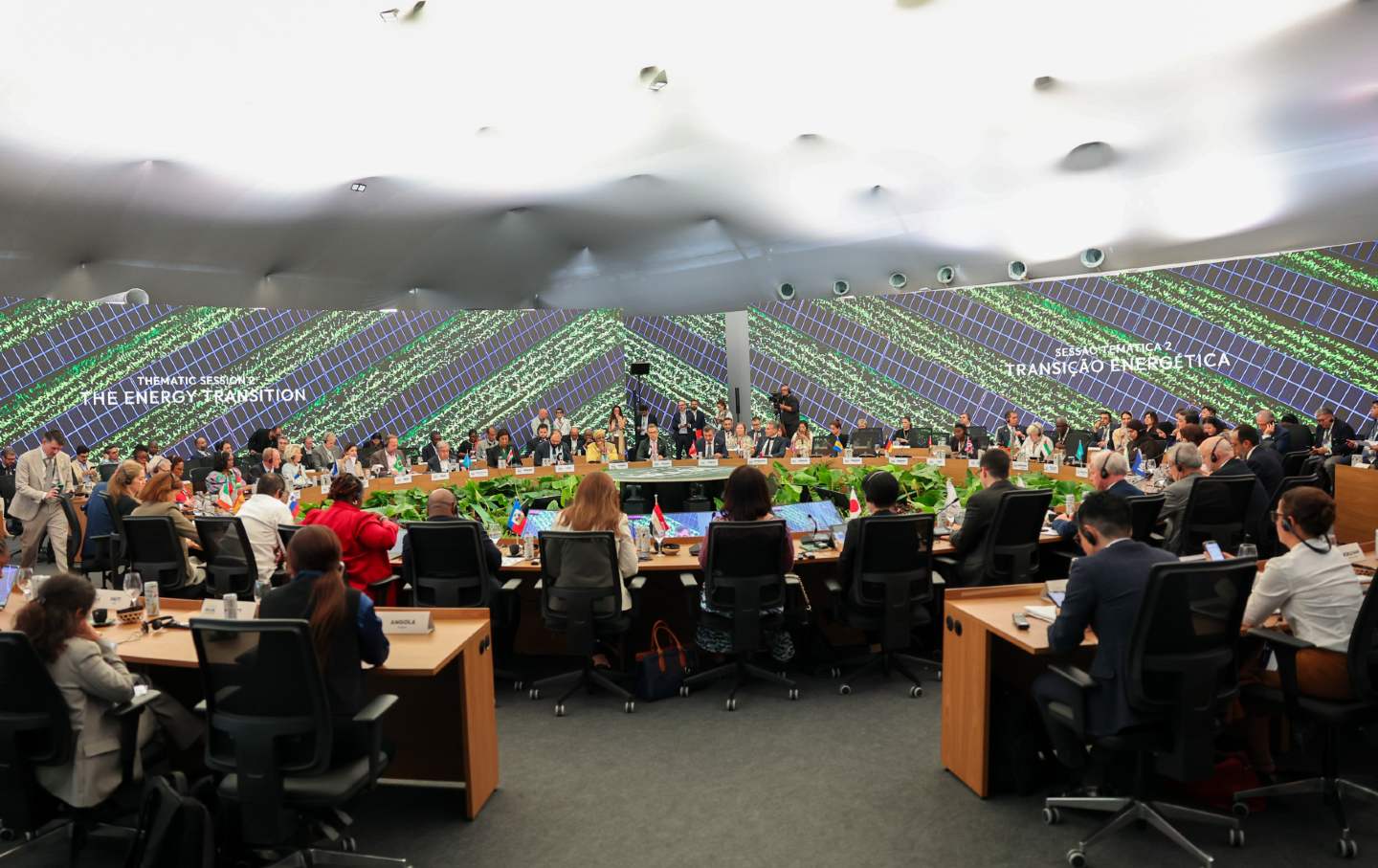
World leaders attend a session on the energy transition on the second day of COP30 on November 7, 2025, in Belém, Brazil.
(Ahmet Okur / Anadolu via Getty Images)Here at the UN climate conference in Belém, sentiment is growing that US president Donald Trump’s boycott of these talks is, in fact, a blessing. “I actually think it is a good thing” that the US didn’t send a delegation to COP30, said Christiana Figueres, a key architect of the 2015 Paris Agreement, at a Covering Climate Now press briefing on November 11. If the United States were here, she explained, it would only try to obstruct progress. “I do think they’ll be working through the Saudis [to obstruct behind the scenes],” she said, “but they won’t be able to do their direct bullying.”
Figueres noted that the Trump administration has decided not to be a party to the Paris Agreement, “To which I go, ‘Ciao, bambino!’”—Italian for “Bye-bye, little boy!”—”You want to leave, leave.”
Clean energy technologies are attracting twice as much global investment as fossil fuels, Figueres pointed out, even as the prices of solar and wind power keep plummeting and regenerative agriculture is surging across the Global South. “The decarbonization of the world economy is irreversible,” she declared. “The momentum is building to the point where it is simply unstoppable, with or without the United States.”
Hours later, California Governor Gavin Newsom applauded Figueres’s comments about Trump, telling CCNow that “that is a hell of a statement coming from the mother of the Paris Agreement. We [California] will fill that void.”
Newsom had just addressed a packed press conference where US-based reporters were overwhelmingly outnumbered by their international counterparts. “Don’t let what happens in Washington, DC, shape your perception of my country,” Newsom urged. Calling Trump’s withdrawal from the Paris Agreement “an abomination,” the governor said California has grown from the world’s sixth largest to its fourth-largest economy while getting two-thirds of its electricity from clean sources. Newsom, a likely 2028 presidential candidate, said that California is determined to compete with China for the global market in green technologies, adding, “Donald Trump doesn’t understand how enthusiastic President Xi is that the US is nowhere to be found at this conference.”
At a time when deadly hurricanes and heat waves are becoming ever more frequent yet mainstream media coverage is dwindling (not one US TV network sent reporters to Belém), developments at COP30 demonstrate that the climate fight is nevertheless very much alive. Plenty of news is being made here at the mouth of the Amazon River, a location chosen by Brazil’s president Luiz Inácio Lula da Silva to underscore the urgency of protecting the world’s largest rain forest from a catastrophic, fast-approaching tipping point.
Forest clearance in Brazil has fallen by 50 percent over the last three years, due to increased enforcement overseen by Marina Silva, a former deforestation activist now serving as the country’s environment minister. At COP30, Silva has been championing an innovative if controversial approach to combatting deforestation, the Tropical Forest Forever Facility. Developed with advice from an odd-bedfellows coalition of Indigenous leaders, climate scientists, and international financial specialists, the TFFF “is a game changer,” Garo Barmanian, the director-general of Brazil’s forest service, told The Guardian’s Jonathan Watts. The TFFF “aims to disrupt the financial logic for deforestation by raising $125bn (£95bn), investing it in bonds, and paying out the returns as a reward for countries and communities that conserve their standing forests,” wrote Watts. In an unprecedented shift, the TFFF will channel 20 percent of its returns directly to Indigenous people, bypassing the governments, international organizations, and consultants that typically gobble up most foreign aid. Peer-reviewed science demonstrates that protecting the human and property rights of Indigenous peoples is the single most effective way to protect the forests they inhabit from being destroyed.
There’s still time and opportunity for journalists and news outlets not present in Belém to cover COP30, and the following resources can help. Many official proceedings are streamed on the UN’s YouTube channel. The Guardian provides up-to-the-minute coverage via its COP30 live blog. Info Amazonia, a network of 21 news outlets across the Amazon, provides daily dispatches in Portuguese, English, and Spanish that offer invaluable regional and Indigenous perspectives on the summit, including the activities and proposals of civil society groups. In Tuesday’s press briefing, which was part of The 89 Percent Project, Figueres was asked why the massive international support for climate action isn’t always reflected in election results. “There continues to be a perceptual gap” between people’s recognition of the problem and what they think they can do about it, she said. Showing people how their individual choices—“my choices of transport, my choices of what I purchase, my choices of how I vote”—can make their own lives better while also safeguarding the planet is key. And the press, she added, plays a vital role.