
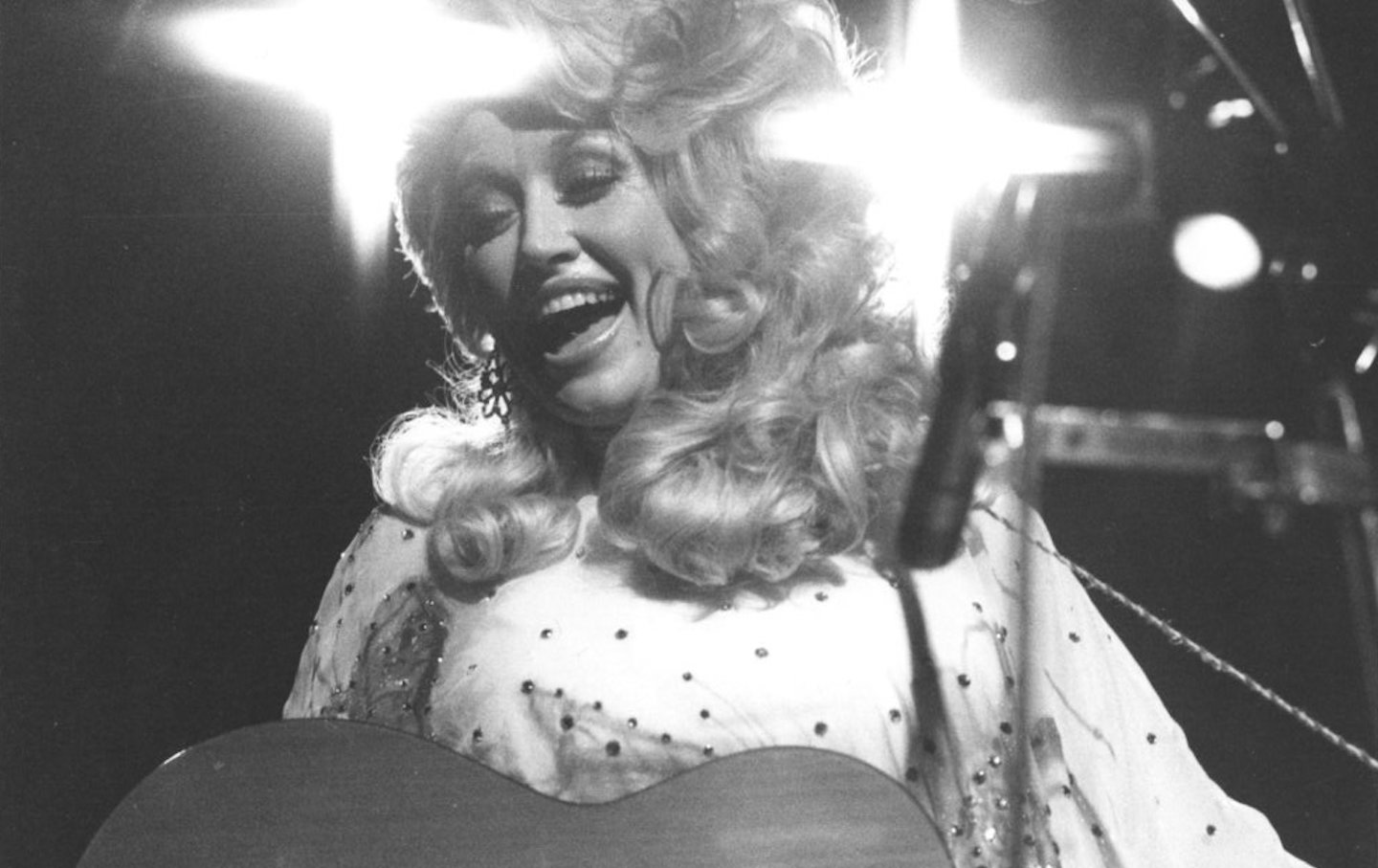
Dolly Parton at the Roxy in West Hollywood in 1977.
(Nancy Barr Brandon / MediaPunch / IPX)Dolly Parton, the country artist best known for songs like “Jolene” and “9 to 5,” died last week at the age of 80. Though she herself would have been too modest to publicly make such a claim, she belongs, by all accounts, on the short list of musicians who should be considered among both the greatest singers and greatest songwriters in the genre’s century-plus history. A recent YouGov survey put Parton’s favorability rating at 77 percent, higher than any other musician, living or dead, and up there with Christmas (75 percent) and Thanksgiving (78 percent). Her beatification was complete well before her passing, confirmed by countless articles along the lines of “Dolly Parton, Secular Saint” (Vox) and “Everyone Loves Dolly” (oddly, Vice).
Even as a fan—and later, as a journalist covering country music—I sometimes found this to be a bit over the top. It was as if, for some, Dolly had ceased to be Dolly and had become instead an avatar of the desire for a celebrity who was truly good. Her philanthropy and her local investments were both extensive, but they are still best served by clear-eyed appraisal. Is Dollywood, her signature amusement park, really the rising tide that has lifted all boats in Sevier County, Tennessee, her childhood home, as its boosters proclaim? On the one hand, it is the county’s largest employer; on the other, it’s hard to live like a rhinestone cowboy when you make $14 an hour working seasonally parking cars.
This sort of adulation was especially unnecessary for Parton, because her life was remarkable enough without it. Born on January 19, 1946, in a cabin in the Great Smoky Mountains, she was delivered by a doctor who arrived on horseback, and her father, a sharecropper, paid for his services with a sack of cornmeal. Her family’s poverty—and the search for joy and dignity amid it—was one of the enduring themes of her work, the subject of songs like “Coat of Many Colors,” “Daddy’s Working Boots,” “In the Good Old Days (When Times Were Bad),” and “Applejack.”
The last of those, off her 1977 album New Harvest…First Gathering, tells the story of an old man who played banjo for her when she was a girl. It’s a window into the deep musicality of the community in which she was raised. Her mother sang church songs and old ballads; her grandfather was a fiddling preacher. (His song “Singing His Praise” would be recorded by Kitty Wells and Johnny Wright, and later on Parton’s final album, Smoky Mountain DNA.) She got her first guitar from one uncle, and she made her radio debut at 10 years old, with another uncle, her longtime collaborator Bill Owens, playing beside her.
Parton moved to Nashville the day after she graduated high school, boarding a Greyhound bus with her belongings stuffed into brown paper bags, which she would later describe as her matching luggage. She went to Music Row, the stretch of 16th Avenue South that was home to most of the city’s country music publishing houses and recording studios, in search of a record deal, but she couldn’t find a label that was interested in signing a new female singer.
Around this time, Parton had begun to base her appearance on that of a woman who had acquired a certain reputation in her hometown. “She had high-heeled shoes, little floating plastic goldfish in the heels of them, short skirts, low-cut tops, and I just thought she was beautiful,” Parton said in a 2023 interview. Her lifelong project of both fulfilling and challenging the expectations that accompanied this image began with “Dumb Blonde,” her 1966 Nashville debut. “This dumb blonde ain’t nobody’s fool,” goes the perfectly executed reversal. The era’s prevailing sexism is exemplified in Paul Hemphill’s book The Nashville Sound, a New Journalism–indebted survey of country music that was published three years later and was once regarded as one of the best books on the subject. Parton is only mentioned briefly, in an aside within a long chapter about Porter Wagoner. She is only “girl singer Dolly Parton, a petite blond of incredible vanilla-ice-cream beauty.”
Parton had become Wagoner’s duet partner in 1967, after his previous partner, Norma Jean, got married and resigned from his show. The pair shared a fondness for cornpone humor and flashy clothes—two things that were going out of fashion in an industry chasing uptown audiences. They recorded 12 albums together. Parton wrote many of the songs, despite what Hemphill’s book might lead you to believe. None of these LPs run longer than 30 minutes, and they are for the most part indistinguishable from one another. But this music is Nashville product at its very best: tight, sharp lyrics elevated by first-rate playing from studio hands like Johnny Gimble, Pete Drake, and Hargus “Pig” Robbins and by the vocal performances of the two leads, Wagoner’s forthright baritone an anchor for the wide range and tight vibrato of Parton’s early singing style. Like Hollywood movies of an earlier era, they remain some of the strongest evidence that can be marshaled in defense of the Fordist mode of cultural production.
Yet, just as that mode of production was challenged in the factories, so it was in the studios. In Nashville in the early 1970s, a rebellion was building among the musicians on the country music assembly line, taking its most visible form in the so-called Outlaw movement of singers like Willie Nelson and Waylon Jennings. For Parton, this fight took form of a break from Wagoner, who, having gotten her signed to his label, RCA, refused to grant her permission to work with producers or managers of her choosing. Jerry Bradley, the head of RCA Nashville, later recalled a secret meeting Parton had scheduled to advocate for her artistic emancipation; it was cut short when Wagoner arrived and “grabbed her like she was a little girl.”
Dolly announced the conclusion of their creative relationship with “I Will Always Love You,” a number-one hit in 1974. (She may have written it, she later recalled, on the same day that she wrote “Jolene.”) Unlike, say, every Taylor Swift song, it is improved rather than diminished by knowledge of its scandal-sheet backstory. The emotional appeal remains big and real—as exemplified by Whitney Houston’s 1992 cover—but there is a shrewdness underneath. Read the lyrics again: These are the kind of things you say to someone as you slowly back out of a room.
Parton will forever be associated with the idea of the flirty, busty blonde. But if the story ends there, it’s incomplete. The wigs and makeup also granted Parton access to another Southern archetype, one with an interracial, working-class lineage: the trickster, the wily subaltern who uses geniality and guile to outfox betters who don’t even realize they’ve been had. Parton was smarter and more talented than anyone who tried to diminish her, yet by letting them think otherwise, she found a way not just to put up with their terrible jokes but reply with ripostes more cutting than anything thrown at her. Onstage, she covered her outfits with tassels and rhinestones and crammed her sets full of songs, gags, and instrument changes, taking turns not just on guitar and banjo but also piano, flute, and alto sax.
“I wanted to be free,” Parton told Rolling Stone in a 1977 cover story, explaining why decided to become a musician. Her LPs from this era, records like Here You Come Again and 9 to 5 and Odd Jobs, expanded her sound toward R&B, soft rock, and, cautiously, disco, inventing the female country crossover, and the moves she made—de-twanging her melodies to attract Top 40 radio, making a CMA Awards appearance or two to the reassure the base—have been repeated by every artist who has tried it since. “Islands in the Stream,” Trio, and White Limozeen kept her star burning through the ’80s, and she scored her final number-one hit with 1991’s “Rockin’ Years,” one of the great songs about boomers growing old—and a relic of an era when growing old was an acceptable topic on country radio. To date, she has sold more than 100 million records.
Parton herself seemed to feel ambivalent toward the more over-the-top expressions of adulation she was subject to later in life. She asked lawmakers not to consider a bill that would have put a statue of her likeness on the grounds of the Tennessee State Capitol, and three times she turned down the Presidential Medal of Freedom. Was this the maneuvering of a savvy politician, unwilling to make a choice that might alienate some of her fans? Or did it reflect a genuine discomfort in the uses of her celebrity? It’s hard to know. Celebrity—particularly Nashville celebrity—demands access. Today’s stars are expected to show off their families not just on social media but in magazine spreads and music videos too. Parton played that game while also giving up, it seemed, as little as possible. She insisted that her life was an open book, though sometimes you had to wonder, as with the suspect in a detective novel who arouses suspicion because his alibi is a little too tight.
Popular
“swipe left below to view more authors”Swipe →If Parton ever felt trapped by her persona, she denied it whenever asked. That was the right thing to say: To do otherwise would have been to break character, to cross the limit that separates the trickster from the clown. Maybe the more relevant question would have been whether it took a toll to be so underestimated. In the public eye, she was a model of toughness and grace, as if it hardly affected her at all. Then again, one of her greatest moments came when, under the guise of a different character—the secretary Doralee Rhodes in 9 to 5—she threw all that to the wind and hogtied her abusive boss.
The one time I shared a room with Dolly Parton I was in the underbelly of Nashville’s Bridgestone Arena for the 2016 CMA Awards, filing copy from a makeshift press area. That was the year the Country Music Association presented her with a lifetime achievement award, though the honor was overshadowed by a performance by the Chicks and Beyoncé and the minor controversy it stirred. Like most of us, I can only speculate as to what thoughts were going through Parton’s head. But I can report that even seated behind a folding table, fielding questions from journalists, she cast a spell over the room to a degree I have rarely seen. She called on the different beat writers by name—without name tags—and she brought with her a lightness that remained in the room even after she exited, to loud applause. A few minutes earlier, Parton had suffered the apparent indignity of having her acceptance speech cut short. “They say they’re behind, but you’re talking about a lifetime here!” she told the crowd, perhaps betraying some small amount of frustration. Backstage, however, she refused to be offended. “It wasn’t all about me,” she said in response to a question about the slight. “It was just a moment of mine and I appreciate it.”
More from The Nation

The Architectural Follies of Trump’s Washington, DC The Architectural Follies of Trump’s Washington, DC
The president plans to remake the capital in his own image, but is all he is doing destroying what’s already there?
The Genius of Charli XCX The Genius of Charli XCX
On her new album, Music, Fashion, Film, the musician embraces rock.

The Carnival of Venice Biennale The Carnival of Venice Biennale
That so much of the art of “In Minor Keys” is muted in effect is ironic, because so much of it is overproduced, aspirationally eye-catching, and so big.

