
Doctor and Detective
The exposure therapy of A Private Life
The Exposure Therapy of “A Private Life”
In her new film, Jodie Foster transforms into a therapist-detective.
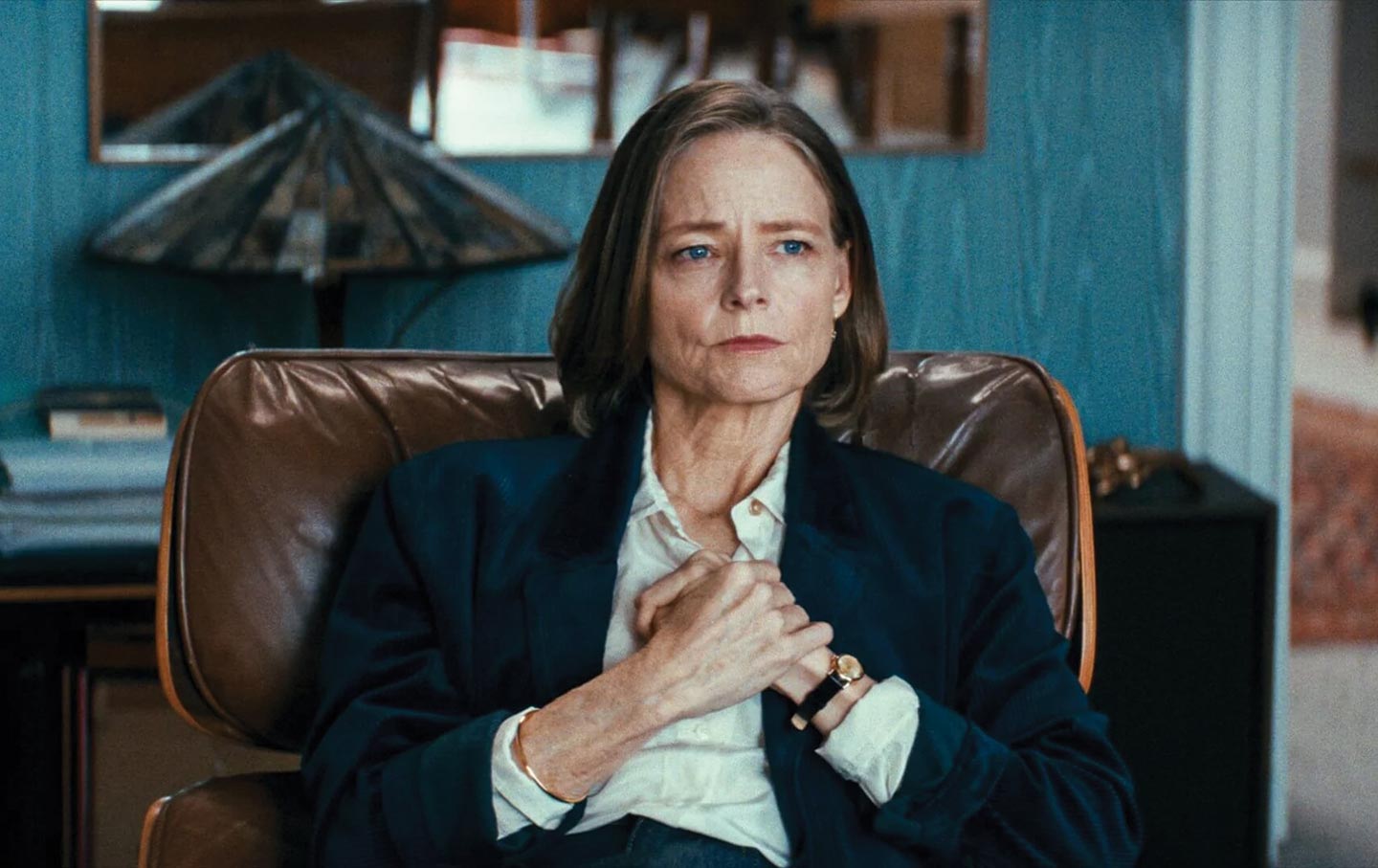
Since her breakout role in Taxi Driver, Jodie Foster has been known for delivering steely performances of impenetrable women. From the adolescent runaway turned sex worker in Martin Scorsese’s gritty New York thriller to the FBI trainee negotiating with a cannibalistic serial killer in The Silence of the Lambs, her characters are defined by a compelling recessiveness and relative social isolation. But lately, Foster has been trying to come out of her shell. “For somebody who is interested in privacy,” she told The Atlantic in 2024, “I am obsessed with being understood.”
This desire for a more legible interior life has led Foster to some unexpected roles. Take her turn in Nyad, an odd film about the athlete Diana Nyad’s attempts to swim from Cuba to Florida. Foster plays Diana’s friend, coach, and (at one point) partner, Bonnie Stoll, with a charming optimism, shedding her withdrawn, often self-protective posture to reveal an endearing lightness. Not only was this a rare display of on-screen exuberance, but it was the first time Foster—quiet about her own sexuality—had played an openly gay person.
If Nyad signaled Foster’s interest in a different narrative, then A Private Life, her latest film, represents an unabashed commitment to self-exposure. Here she plays Lilian Steiner, an American psychoanalyst living in France, whose wayward investigation into a patient’s death leads her down a path of intense vulnerability and reflection. The role is Foster’s first lead performance completely in French, and it transforms her almost entirely into a different person. Her voice gains an airy lilt, her eyes seem softer when the camera closes in on her face, and she brings verve and a sense of order to an otherwise scattered film.
APrivate Life kicks off with a dismissal and a death. Early in the film, one of Lilian’s patients fires her, claiming that a hypnotist has cured him of his cigarette addiction more efficiently and at a fraction of the cost. Lilian, who maintains an inscrutable affect, seems more amused than hurt by the encounter. After all, she has plenty else to do: She must order blank tapes (she records every one of her therapeutic sessions) and figure out why another patient, Paula (Virginie Efira), has missed three sessions. Through these opening moments, Foster offers her audience a portrait of an emotionally reserved woman, a person tasked with helping others navigate their psychic landscape while remaining distant from her own.
This intimidating posture slackens after Lilian learns that her truant patient died by suicide not too long after their last session. The news launches her into an unfamiliar despair and a gnawing obsession. While A Private Life is by no means a noir, the work ahead of the analyst is now primarily detection. As much as Lilian is trying to understand why Paula decided to take her own life, she is also trying to understand herself. Soon the cracks in Lilian’s cold exterior grow more apparent.
After learning about Paula’s death, Lilian tries to go about her day. She visits her adult son, Julien (Vincent Lacoste), so he can purchase the blank tapes for her (the technology she uses is so old it must be ordered online). When Julien, harboring an obvious desperation for maternal affection, asks if Lilian would like to come see his baby, the practitioner refuses: Her eyes are wet; she’s worried that she might have a cold. Later, Lilian becomes concerned that her vision might be impaired. But when she visits her optometrist, who also happens to be her ex-husband, Gabriel (Daniel Auteuil), who is still deeply devoted to her despite their years of separation, the diagnosis is unexpected: Lilian, much to the surprise of both, is crying.
Desperate to stop this steady stream of tears, which now begins to plague her during her sessions and while she runs errands, Lilian resorts to the hypnotist who cured her other patient of his smoking habit. The encounter between Lilian and Jessica (Sophie Guillemin), a faux-bohemian type with long acrylic nails and tousled blonde hair, operates like a showdown between a heretic and an evangelist. “Stop confusing skepticism and intelligence,” Jessica says to Lilian. “Your irony is an expression of fear.”
Whether fueled by minor disdain or by desperation, Lilian submits to the rules of the session, which require the psychoanalyst to close her eyes and conjure images based on a series of prompts. The exercise plunges Lilian into a labyrinthine vision, set in the 1940s, that convinces her that Paula was her lover in a previous life and that what the police have ruled a suicide might actually be a murder.
As Lilian continues her hunt for the truth—about Paula and ultimately about herself—she sublimates the visceral feelings accompanying this dream scenario into her real-world investigation. She revisits the tapes from her sessions with Paula and conscripts Gabriel to go on a reconnaissance mission in the countryside. During her fact-finding journey, Lilian becomes the target of strange attacks—someone burglarizes her office, then her car gets keyed—which convinces her that she just might be onto something. But is she?
As she continues to collect evidence of Paula’s murder, Lilian becomes haunted by a combination of guilt (for not being able to save her deceased patient) and longing. She thinks constantly of Paula and has flashbacks to their sessions, in which their banter develops a flirtatious tone. In those moments, which the film’s director, Rebecca Zlotowski, and her cinematographer, George Lechaptois, imbue with dreamy tones, Foster’s voice is pitched slightly higher, she smiles more easily, and her eyes—those expressive gems—twinkle with desire.
Outside of these phantasmagoric visions, Lilian finds that the reality around her is equally puzzling and dreamlike. Her feelings of guilt make it more difficult to trust in herself, and she starts to question her ability to read the world. A vulnerability begins to take root in Lilian’s otherwise confident interior life, and an increasing psychic desperation comes to the fore. Foster’s face becomes a striking vehicle for these signs of ambient stress, her performance defined by an evident restlessness: Once calm and stable, Lilian now seems increasingly frantic and obsessed.
As Lilian continues her downward spiral, brainstorming new reasons why Paula’s husband (Mathieu Amalric) or daughter (Luàna Bajrami) might have wanted her dead, Zlotowski renders her obsession with a mix of Hitchcockian suspense and theatrical whimsy. On paper, this sounds like a wonderful blend of the horror and detective genres, a thriller in which the central character is thrust into a world of increasing uncertainty and insecurity. But despite its protagonist’s psychoanalytical skills, A Private Life suffers from insufficient psychological probing. Key aspects of Lilian’s life—such as her relationship with her late mother or her attraction to Paula—remain too oblique, as if the filmmakers’ desire to avoid the risks of cliché far outweighed the need to provide satisfying character development. Highlighting the sapphic elements of Lilian’s obsession or exploring the psychic frenzy of a therapist on the verge of a breakdown might have helped smooth out the dissonance between the film’s psychologically acute hero and its own narrative obtuseness.
Thankfully, Foster’s captivating performance dominates the film, and her unexpected charm becomes the real star of A Private Life. The actress surrenders to the waves of Lilian’s temperamental journey: In one particularly striking moment, Foster brilliantly guides her character through a brutal scene in which Lilian relays some of the details of her psychic vision to her family—in particular, that her helpful, tape-ordering son Julien was actually a member of a Nazi-allied French Militia in a prior life and tried to arrest her. She also offers up her own interpretation of the dream: It was all about her stunted maternal instincts and why she’s never felt comfortable around her own son. Lilian’s self-analysis in this scene is cutting, bordering on cruel (even if accurate), and it ends with the American analyst feeling even more frustrated and defeated.
Popular
“swipe left below to view more authors”Swipe →As A Private Life comes to an end, one begins to sense that the moments of revelation followed by long periods of fear or frustration are not only reflections of Lilian’s internal psyche but a comment on life lived through a second language: The parts of a self that remain hidden in a primary language can emerge in surprising ways in a secondary one. In her memoir In Other Words, the English-language novelist Jhumpa Lahiri notes that when she writes in Italian, it’s “without style, in a primitive way. I’m always uncertain. My sole intention, along with a blind but sincere faith, is to be understood, and to understand myself.” One might say the same of Lilian—and of Foster, as well. No matter the calm assurance and confidence with which its protagonist opens the film, A Private Life is ultimately a study of the uncertainty and anxieties caused by embracing new modes of self-expression.
Your support makes stories like this possible
From Minneapolis to Venezuela, from Gaza to Washington, DC, this is a time of staggering chaos, cruelty, and violence.
Unlike other publications that parrot the views of authoritarians, billionaires, and corporations, The Nation publishes stories that hold the powerful to account and center the communities too often denied a voice in the national media—stories like the one you’ve just read.
Each day, our journalism cuts through lies and distortions, contextualizes the developments reshaping politics around the globe, and advances progressive ideas that oxygenate our movements and instigate change in the halls of power.
This independent journalism is only possible with the support of our readers. If you want to see more urgent coverage like this, please donate to The Nation today.
More from The Nation
The Riotous Worlds of Thomas Pynchon The Riotous Worlds of Thomas Pynchon
From “The Crying Lot of 49” to his latest noirs, the American novelist has always proceeded along a track strangely parallel to our own.

Letters From the March 2026 Issue Letters From the March 2026 Issue
Basement books… Kate Wagner replies… Reading Pirandello (online only)… Gus O’Connor replies…
Molly Crabapple's Time Capsule of Resistance Molly Crabapple's Time Capsule of Resistance
A new set of note cards by the artist and writer documents scenes of protest in the 21st century.
How to Build a Moon Garden When the News Is All Horror How to Build a Moon Garden When the News Is All Horror

Barbara Pym’s Archaic England Barbara Pym’s Archaic England
In the novelist’s work, she mocks English culture’s nostalgia, revealing what lies beneath the country’s obsession with its heritage.

