
Somali Americans Aren’t Going Anywhere
Trump keeps targeting Minnesota’s Somali community. But as one organizer says, “What we’ve built here, we’re not going to let it be easy for people to take that away from us.”
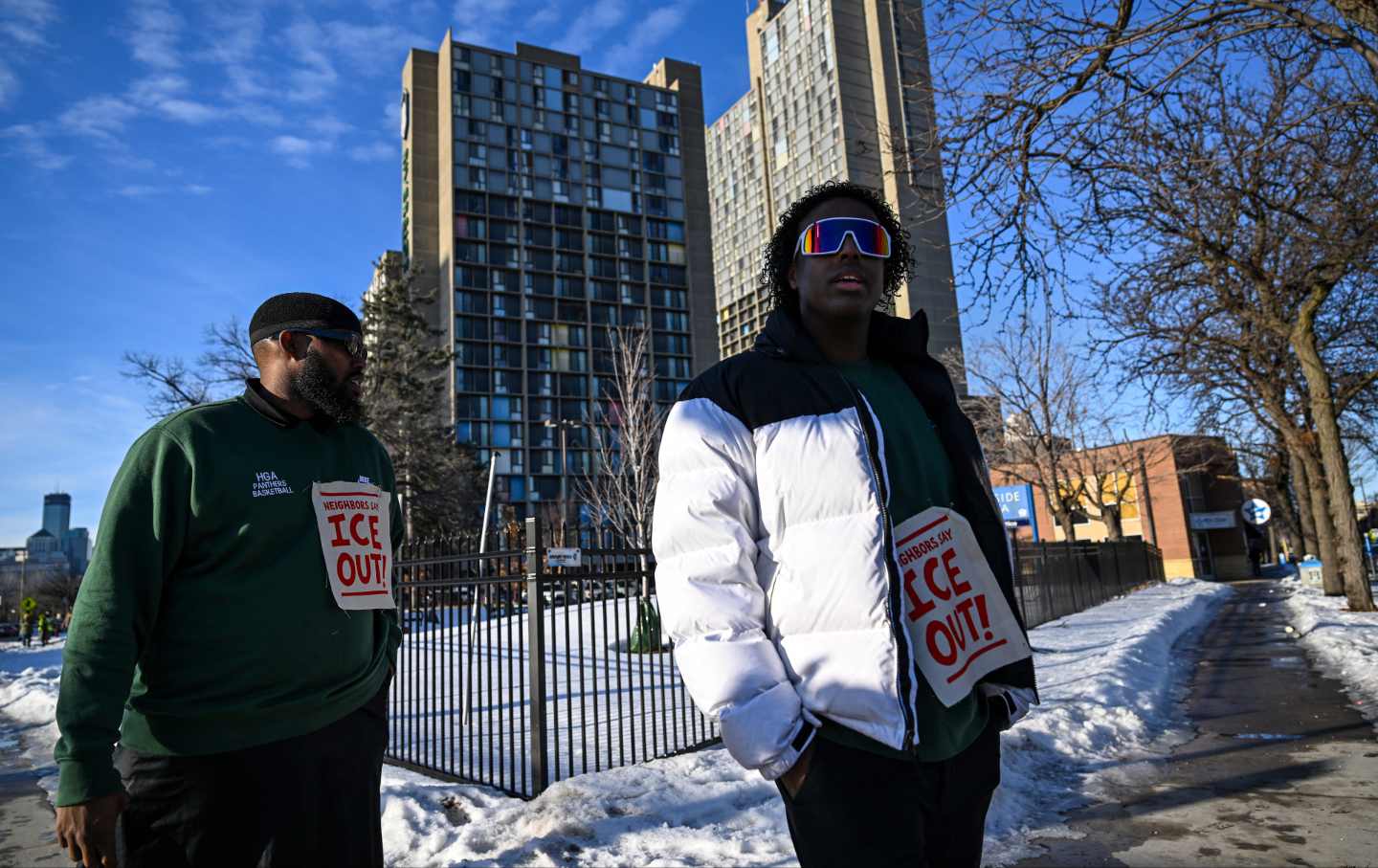
ICE watchers Mustafa Mohamed (L) and Mahad Ahmed patrol their community around the Riverside Plaza complex in the Cedar-Riverside neighborhood on January 9, 2026 in Minneapolis, Minnesota.
(Joshua Lott / The Washington Post via Getty Images)After weeks of scrolling through a dizzying flood of anti-Somali hate online, Hamza turned his phone on himself. It was December 3, 2025, and the 22-year-old Somali American was parked in his car on his way to work. He had just seen a clip of Donald Trump saying Somalis had “destroyed” the state of Minnesota. With his seat belt still on, he pressed record.
“Yo, Minnesota was promised to Somalis 3,000 years ago,” Hamza (who requested to be identified only by his first name for this piece to protect his identity) said in the video. “And if you read Genesis 12:3, it says those who bless Somalis will be blessed.”
He posted the video and carried on with his day. By the next day, it had gone viral.
Somalis in Minnesota remixed the joke in their own ways—filming themselves in the snow and building ornate skits around the concept. By parodying the idea—so often used to justify state violence against colonized communities, like Palestine—that land can be “promised” to a specific group, the joke resonated across many diasporas.
“It was like, what can we even do?” Hamza tells me over the phone. “They’re using us as a scapegoat, trying to turn us into the most hated group in America.”
In hours, Hamza saw the power of the Somali community, diaspora, and solidarity networks in action. In the two months since then, as ICE’s deadly and brutal invasion of Minnesota has intensified, Somali communities have relied on this vibrant network more than ever. It’s a reflex that has guided them since their arrival.
In Minneapolis’s Cedar-Riverside neighborhood, often called “Little Mogadishu,” many streets these days are marked by an unusual quiet punctuated by moments of chaos. The area is home to the largest Somali population in the United States. In recent weeks, the world has seen what residents describe as an overwhelming amount of immigration enforcement, along with a parallel flood of right-wing agitators.
Behind the scenes, community patrols and rapid-response networks remain active. Volunteers coordinate to warn residents about nearby enforcement activity and help people access legal information and support when needed. Others check in on families who have stopped leaving their apartments, delivering food and basic supplies.
“It feels like a second Covid,” says Farhan Badel, an organizer primarily with United Renters for Justice, a tenant-led housing nonprofit currently working for an eviction moratorium as ICE enforcement threatens housing stability across immigrant communities.
After federal enforcement fatally shot legal observers Renee Good and Alex Pretti, their deaths were widely filmed and shared on social media to the point of ubiquity. The panic has turned into a nationwide call to banish ICE. For many Somali Americans like Badel, these deaths underscored how far the government might go to target communities and those working to protect them.
“This was a white woman that was literally out there defending our community,” Badel says of Renee Good. “I think that gave us more courage, knowing that there was a human being who died defending you.”
Like many Somali organizers in Minnesota, Badel moves between roles depending on the needs of the day. Some days, he spends hours checking in with residents. Other days he’s calling landlords, sharing know-your-rights information, or responding to messages from people who are afraid to answer their doors. He says that much of today’s organizing against ICE comes from cities that have faced a similar surge of agents, like Chicago, along with strong community efforts from the past.
Every day, Badel says, he sees how fear reshapes daily life: weddings postponed, daycares closed, shopping centers sitting almost empty. When Badel goes door to door to share information, he says what hurts most is seeing the fear in people’s faces knowing they can’t live their normal daily lives.
“I am a refugee,” he says, audibly choking up. “I remember being in the back of a pickup truck, with men with guns. I came to this country for safety and for a better life. Seeing armed agents now, those memories come back. People are reliving trauma.”
Abdi Mohamed, a filmmaker, organizer, and lifelong Minneapolis resident, says today’s community mobilization didn’t happen overnight. Mohamed was born in a refugee camp, but came to the US when he was two months old.
Mohammed recalls how Somali communities in Minneapolis have long been mischaracterized. The Clinton administration’s 1993 “Black Hawk Down” raid killed hundreds of Somalis, but the media coverage—and the raid’s subsequent portrayal in the 2001 Ridley Scott film—painted Somalis solely as violent and chaotic. This portrayal has carried on in cinema and the news for decades. Today, Mohammed screens films in Minneapolis that show Somali lives beyond the gaze of suspicion.
After September 11, Somali communities became targets of surveillance, informant programs, and federal monitoring. Over time, the community adapted, passing information through trusted networks and relying on mutual care. These networks endured and were refined through right-wing attacks and events like the George Floyd protests. Mohammed says the current moment has highlighted the need to sustain and strengthen these foundations for the future.
“Here in Minnesota, we’re lucky because we have the underground infrastructure and community activism that’s been built up over the years with the murder of George Floyd and others who were killed in police violence,” he says. “What we’ve built here, we’re not going to let it be easy for people to take that away from us.”
Many Somali Americans arrived in the 1990s, fleeing a country that was unraveling at a startling speed. In the late 1980s, Mohamed Siad Barre, who had ruled Somalia continuously after a 1969 military coup, attempted to reclaim Somali-populated regions in Ethiopia, weakening the state. Opposition grew, and Barre responded with escalating violence and genocide. By 1991, the state had fully collapsed. Mogadishu descended into factional fighting. Hundreds of thousands of Somalis fled across the world, from East Africa to Europe, New Zealand, and North America.
US officials initially welcomed Somali resettlement, touting it as proof of American humanitarianism. But, some scholars argue, there were other motives at play. Somalia had previously aligned with the Soviet Union, and, in the post–Cold War era, resettling Somali refugees fit a pattern of US “strategic humanitarianism”—using refugee policy to extend influence abroad while claiming moral leadership. One evidence of this has been that the US accepted fewer refugees from Muslim countries after September 11.
Decades later, US policy has taken a sharp turn. Under the Trump administration, Somali Americans—and their most prominent leaders, such as Minneapolis Representative Ilhan Omar—have become prime targets for Trump’s racist policy agenda. In January 2026, the Department of Homeland Security announced that it would end Temporary Protected Status for Somali nationals, a designation first granted in 1991. Homeland Security Secretary Kristi Noem justified the move by saying Somalia’s conditions “have improved,” even as the State Department continues to issue a Level 4 “Do Not Travel” advisory for the country.
But Somalis cannot be erased from the United States so easily. They have built deep roots here—especially in Minnesota.
In the 1990s, after struggling to find work in the US, a group of Somali men came to Minnesota to work at a poultry factory. Word spread that there were jobs to be had in the Land of 10,000 Lakes, and many more Somalis came to Minnesota. Eventually, the state became home to the largest Somali population in the US.
Cedar-Riverside was an anchor for this community, as families spread into Twin Cities suburbs. Businesses opened where others had closed. Grocery stores, restaurants, childcare centers, and transport companies reshaped commercial corridors.
Somali Minnesotans filled essential jobs in healthcare, food processing, education, and transit. During the pandemic, many were on the front lines. The community also built institutions: nonprofits offering housing, youth programs, and legal aid. Mosques, media outlets, and cultural centers.
Political milestones followed. In 2010, Hussein Samatar, my uncle, became the first Somali elected official in the state. Omar became the first Somali woman elected to the Minnesota House and Congress.
Popular
“swipe left below to view more authors”Swipe →Minnesota didn’t just take in Somali refugees, but refugees helped shape the state into what it is today.
Farah (who also requested that only his first name be used) is a 33-year-old Somali American poet and organizer who has been working to connect people in the community with resources and services. He is originally from the Bay Area and says that, having been one of the few Somalis where he grew up, he immediately found the community he was always missing when he came to Minnesota.
“The shared sense of humor, the same blankets growing up…how we’ve all kind of lived, these shared similar lives of survival,” he reflects. “Even though time and place may not necessarily bind us, culture and community still does.”
Farah has felt the calling to protect his community during this time of crisis. He spends his days patrolling for ICE agents, connecting people to legal aid, and providing mentorship to younger community members, among many other activities.
One story stuck with Farah the most. A colleague did a grocery run to deliver rice and basics to a group of Somali men who hadn’t left their apartment in days. When they arrived, the colleague told him, the men were overwhelmed with joy because they didn’t think anyone remembered them.
“That shattered me,” Farah says. “The stripping away of autonomy and the hope that your survival is based on other people’s generosity is incredibly surreal.”
Despite the incredible efforts of the Somali community through the years, many have told me that mutual support is exhausting. Since his video went viral, Hamza says all he wants is to work, go to school, and support his family. This has become harder as ICE’s tactics have become more violent in the news of two deaths of legal observers.
“What is scary is that this administration has no plans to de-escalate the situation, but instead are gaslighting the American public about videos we literally saw with our own eyes,” he tells me via text. He’s since made his TikTok account private to focus on his immediate community.
Farah, who says that part of the work he does is to talk to young men about the emotional toll the government’s actions are taking, tells me that he reflects on the days before Somalis in Minnesota were an object of attention. “Anonymity is a gift.”
And Mohamed says that what keeps him going is thinking of the long-term future during his hectic day-to-day routine.
“We’re such a tight-knit community. Degrees of separation are small,” Mohammed says. “This moment has built a foundation and given us direction for the future.”
More from The Nation

What’s It Like Inside a Data Center? What’s It Like Inside a Data Center?
Northern Virginia is laden with structures that house data for Fortune 500 companies. I went inside just one of those monstrosities that bothers its neighbors.
What Trump and Tucker Carlson Have in Common What Trump and Tucker Carlson Have in Common
Carlson has broken with Trump largely over the war in Iran. But on Ukraine and immigration, the two speak very much the same language.
The Jewish Case Against AI The Jewish Case Against AI
Haredi rabbis and the secular left agree: This technology is a threat to the entire social fabric.
The Fight for Educational Equality Is Also a Fight for a Just Supreme Court The Fight for Educational Equality Is Also a Fight for a Just Supreme Court
The court has severely weakened our ability to make an education system that fulfills the promise of Brown.
The Fall of “Scientific American” The Fall of “Scientific American”
When the beloved science publication got too political, its corporate owners stepped in. Now its future is uncertain.
The Bookstore Revolution in Taiwan’s Conservative Heartlands The Bookstore Revolution in Taiwan’s Conservative Heartlands
After Taiwan legalized same-sex marriage, gender-themed bookstores are working to build the social acceptance that the law alone couldn’t deliver.

