
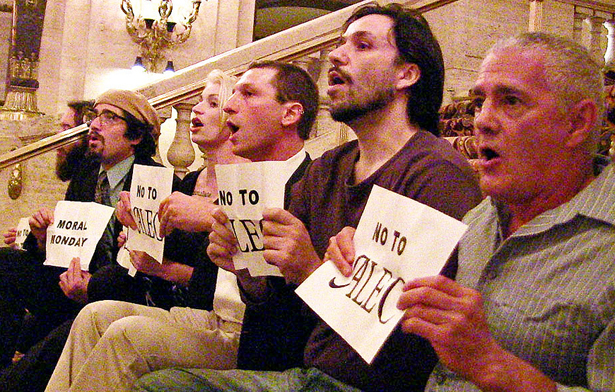
ALEC protesters in Chicago on August 6, 2013. (Courtesy of Flickr)
The American Legislative Exchange Council is better known today than at any time in its forty-year history.
For most groups that seek to influence the governing process that would be something to celebrate. But ALEC, the corporate-funded project that develops “model legislation” to be introduced by conservative legislators across the country, historically worked off-radar.
No more.
The group highlighted by the 2011 “ALEC Exposed” project of the Center for Media and Democracy and The Nation has in recent years been the subject of investigations and inquiries by media outlets across the country. It has been the focus of a nationally broadcast “United States of ALEC” documentary by Bill Moyers & Company. It has been called out by groups such as Color of Change and Common Cause. It has been abandoned by forty-nine corporations (from Amazon.com to Walmart) that once paid for its initiatives.
ALEC has been decried by labor, environmental and clean government groups in state capitols across the country. National political figures, such as Illinois Senator Dick Durbin, are launching inquiries into how the group promotes its legislative agenda. And this week, as ALEC gathers its corporate and legislative “members” in the city of its founding to celebrate four decades of service to special interests and ambitious politicians, demonstrations against the group have drawn thousands of union members, civil rights activists and social justice campaigners into the streets of Chicago.
Popular
"swipe left below to view more authors"Swipe →
An organization that once held its annual meetings virtually unnoticed is now met with mass protests so large that streets around its hotel were closed Thursday as activists staged “die-ins” recalling ALEC’s role in the passage of so-called Stand Your Ground laws and headlines screamed, “ALEC convention protests: Labor vs. lobbyists.”
ALEC has felt the pressure of public scrutiny. Last year, the group distanced itself from some of its more controversial initiatives, such as restrictive voter ID laws and the Stand Your Ground measures that gained national attention after the killing of Trayvon Martin in Florida.
Yet, with continued backing from longtime allies such as the Koch brothers and the support of corporations that have disregarded calls from civil rights groups for them to quit the council, ALEC remains a defining force in statehouses across the country. A new report from the Center for Media and Democracy details the extent of the group’s ongoing engagement.
CMD has identified 466 ALEC bills that were introduced in state legislatures during 2013 sessions. At least eighty-four of these measures have become law.
According to CMD:
• One hundred and seventeen ALEC bills that seek to restrict worker rights, weaken unions, promote privatization and undermine advocacy for wage hikes. At least fourteen of these measures have become law.
• One hunded and thirty-nine ALEC bills that address education issues with proposals to use taxpayer dollars to fund private schools among the favorites. At least thirty-one ALEC education measures have become law.
• Seventy-seven ALEC bills that CMD says “promote a fossil fuel and fracking agenda and undermine environmental regulations.” At least seventeen of these measures have become law.
ALEC’s influence is broad, as is its legislative legacy. The CMD report explains: “Despite ALEC’s effort to distance itself from Voter ID and Stand Your Ground by disbanding its controversial Public Safety and Elections Task Force, 62 of these laws were introduced: 10 Stand Your Ground bills and 52 bills to enact or tighten Voter ID restrictions. Five states enacted additional Voter ID restrictions, and two states passed Stand Your Ground.”
Indeed, among the featured speakers at ALEC’s fortieth annual meeting is former Florida Governor Jeb Bush, who signed the Stand Your Ground law that provided the outline for the group’s model legislation.
So ALEC is still very much what ALEC has been for decades: a key player, perhaps the key player, in advancing the corporate agenda on a host of issues in statehouses across the country.
What has changed for ALEC is that a lot more Americans are now paying attention to its advocacy.
New national campaigns to get corporations and foundations to quit ALEC are ramping up.
So, too, are efforts to ask whether ALEC, which says it is not a lobbying group, should have to follow federal and state rules that are supposed to regulate groups that seek to influence the legislative process.
Legislators in a number of states have proposed that ALEC be required to follow existing lobbying laws when, as Center for Media and Democracy executive director Lisa Graves says, they are “[advancing] the lobbying agenda of special interests to the detriment of ordinary Americans.”
On Monday, Common Cause and CMD submitted a joint letter to the IRS requesting “an immediate investigation into the American Legislative Exchange Council’s massive underreporting of payment for state lawmakers’ travel on its Form 990s, filed with the Internal Revenue Service.”
The letter charges that ALEC “engaged in an impermissible amount of lobbying and served private rather than public interests.”
In addition to asking for the federal examining of whether ALEC’s approach is appropriate in light of its 501(c)(3) tax-exempt status, the groups are also asking state ethics officials to determine if ALEC’s “scholarship” programs complies with state gift and disclosure laws.
Common Cause and CMD argue that the conflict is clear.
“Ultimately,” the groups argue in their letter to the IRS, “ALEC’s scholarship fund activity provides private benefits to two core constituents: (1) state legislators, who receive all-expense-paid vacations, and (2) corporate donors, who are able to obtain “business-friendly” legislation through this influence peddling.”
John Nichols is the author, with Robert W. McChesney, of Dollarocracy: How the Money and Media Election Complex is Destroying America (Nation Books), which examines the role played by ALEC and other national groups in shaping policy at the state and local levels of government.
Can Chris Christie change the gun control debate?

