
The Radical Texas War Against the “Devil’s Rope”
An excerpt from the new book The Myth of Red Texas.
The Radical Texas War Against the “Devil’s Rope”
An excerpt from the new book The Myth of Red Texas.
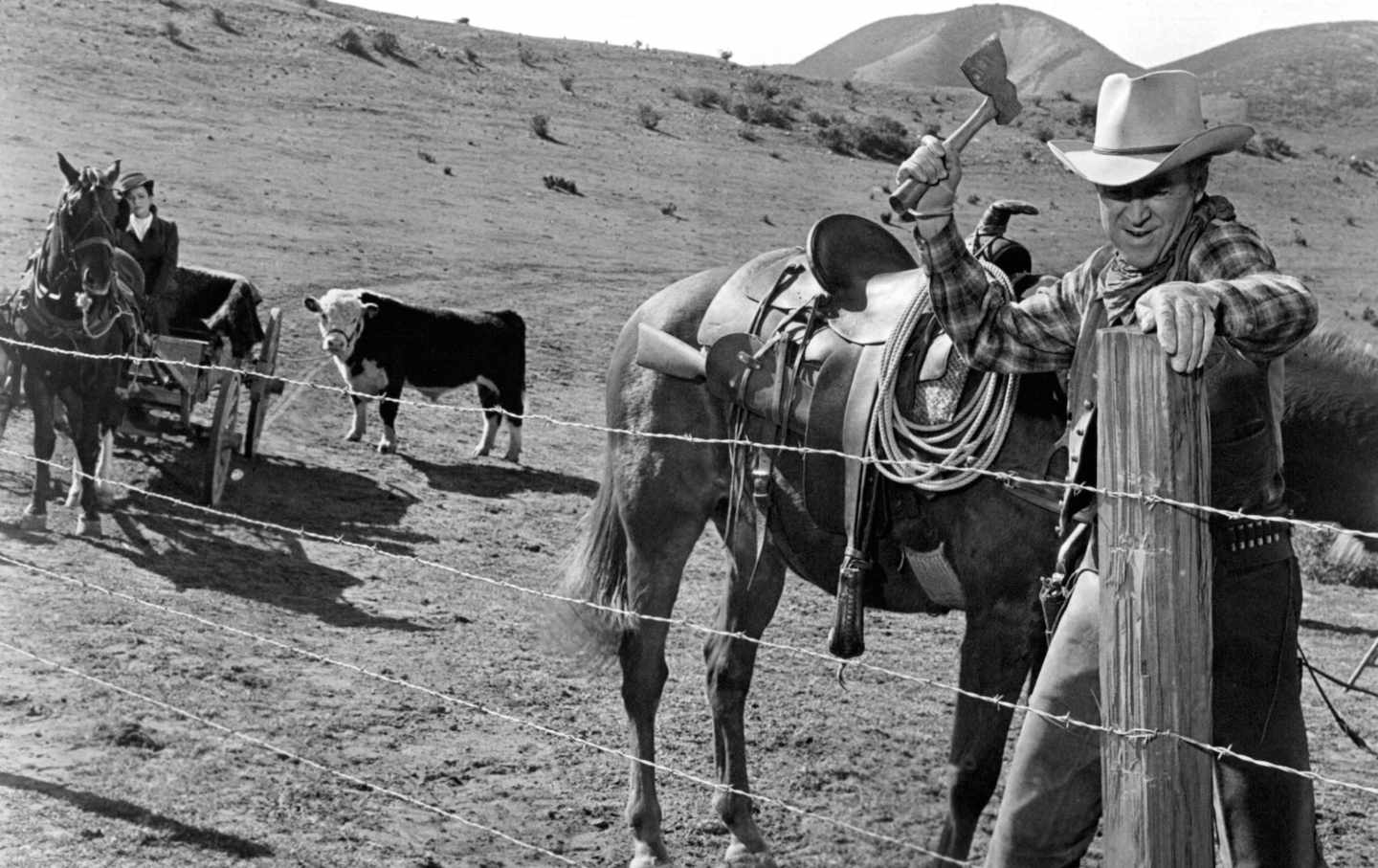
A scene from the film The Rare Breed showing James Stewart cutting a barbed wire fence in 1880s Texas.
(Universal Pictures / Getty Images)Before the rise of the modern GOP, Texas was a hotbed of cowboy strikes, socialist organizers, and radical populists. The following is an excerpt from The Myth of Red Texas: Cowboys, Populism, and Class War in the Radical South by David Griscom, a new title from Nation Books x OR Books. Order your copy here.
In 1885, two years after the Great Cowboy Strike, blizzards swept from the north across the Texas Panhandle. Unlike the buffalo, who turn to face the bad weather, when cattle smell a storm like this one, they (quite reasonably) move in the opposite direction. Picture these massive herds shuffling southward, toward safety and warmth of the canyons and valleys they traditionally sought in bad weather. Unbeknownst to them, they were marching to their death.
The once open-range grasslands were now covered with miles upon miles of so-called “drift fences,” consisting largely of barbed wire, which landowners used to stake their claim on broad swaths of territory. As a result, these herds pushed up against the fences but were unable to pass. They walked the seemingly never-ending fence line as the freezing winds cut through them. Eventually, the panicked cattle pressed against each other for warmth, a final respite as the cold closed in. When the storms receded, cowboys found mountains of frozen cattle huddled upon one another. One cowboy in the Texas Panhandle described the scene:
“I could have walked for miles on dead animals, stepping from one to another. These were mostly natives belonging to northern ranges which had drifted across the burned prairie. As long as they could travel, cattle kept alive. Finally, the drift fence halted them. Here they stopped … bunched close together as for a last protection, helplessly dropped in their tracks and froze.”
This was the great “Die-Up” of 1885-86. The land in Texas and across the West was changing. The previous decade had seen abundant rain, which nourished the grasslands of the Southern Plains. Capitalists invested heavily in the cattle industry, and ranchers felt their fortunes were made. But this climate was only temporary, and soon came the extreme weather—fire, droughts, and blizzards. Land became even more precious. Defending your finite grasslands from your competition’s hungry cattle became a business necessity. As a result, big Texas ranchers had gone crazy for barbed wire; to them, this new technology meant security, prosperity, and property rights. The cattle weren’t the only casualty; barbed wire was also killing off a way of life. The idea of the open range, that land and water belonged to all, was on its last breath. For the landless cowboys, the sheepherders, and the small landholders, this tool was choking off the land. They knew it as the “devil’s rope.”
When barbed wire first came to Texas, it was so controversial that it led to what’s called the Fence Cutter Wars: conflicts mainly between the big ranches and rag-tag associations of the dispossessed who opposed the privatization of the land on principle. Over half of Texas counties were involved in some form of fence-cutting, with damages against the big ranchers estimated at over $20 million. It was a time when Texas cowboys joined together to take on private poverty.
Barbed wire was cheap, and miles could be laid daily. Soon, many were blanketing their slice of grassland with the devil’s rope. Indeed, large ranchers fenced so much land that they often cordoned off roads, schools, and waterways, which were public. In Archer County, Texas, the route to the courthouse was completely covered by barbed wire, rendering it impossible to reach the county seat without cutting a fence. In other cases, they’d fence over land that did not belong to them. Ranchers who held land with rivers and creeks monopolized their hold on precious resources. Seeing what was coming, those who grazed their cattle upland of the enclosures argued that “the water should belong to all the land, since the rain which filled the streams fell on the whole plains region.”
This plea fell on deaf ears. It should come as no surprise that, as barbed wire won out against the open range, many ranches consolidated into the hands of a few large speculators, with little concern for what that meant for the other cowboys of the region. By fencing in access to water, the big ranchers made the land upstream worthless—at which point they could swoop in to purchase it at a much lower price.
Fence-cutting was, at first, a practical measure. Landless cowboys were not doing anything new; they had always moved cattle from place to place. When they came across fencing, they would cut it, simple as that. Eventually, as the “devil’s rope” spread across the plains, this individual action evolved into an organized project. Fence-cutters structured themselves into secret vigilante groups known as the Owls, the Javelinas, the Blue Devils, and the Knights of the Knippers. Come nightfall, they would rip and cut out the scourge of barbed wire as an act of protest, opening a new front in the class war against the land barons. A note on a Waco-area rancher’s land, read:
You are ordered not to fence in the Jones tank, as it is a public tank and is the only water there for stock on this range… No good man will undertake to watch this fence, for the Owls will catch him.
The legislature, of course, wanted to align with the landed elites. But there was a problem: The fence cutters had broad support among regular Texans. Many who aspired to have land for themselves, from small farmers to cowboys afraid of losing work, joined in or silently supported the fence cutters.
As one writer noted at the time,
“Fence cutting never would have become so great and destructive if it had not met with such popular sentiment. Men of influence gave expression of favor. Many good men ‘winked’ at it until it had gone from the highest to the lowest. It found its way to the fireside of every home, and the greviences [sic] of the lawless element of the communistic fence-cutters were held up in glowing colors.”
In 1884, Governor Ireland called a special session of the Texas legislature, where all kinds of denunciations of the anarchistic and communistic fence cutters were heard. A colorful legislator named Thomas Lawson Odom condemned the Fence Cutters as “the rag-tag and bob-tail and Hell-Hounds of Texas, no mercy should be shown to the midnight marauders.”
The legislature sided with the landowners and made fence cutting a felony punishable by five years; at the same time, they decreed that those who fenced in land that didn’t belong to them was a simple misdemeanor. Many questioned the fairness of the decision. “What!” exclaimed one newspaperman in the Fort Worth Daily Gazette, “Is the glory of Texas to be destroyed because the legislature refuses to legislate in favor of a section and a class?” He went on to invoke the Texas revolution: “not while the history of San Jacinto remains…shall it be said that Texas must be parcelled up because a few cattle kings are not permitted to…inclose and fence in lands not their own.”
The new felony charge kneecapped the broad communitarian activity among unorganized groups, though members of the clandestine fence-cutting gangs continued their crusade, albeit with less frequency. Drought and blizzards often resulted in flare-ups between fence cutters and cattle barons.
The fence cutters’ activities had forced Texans to, if not take sides, at least consider which side they were on. Whether or not you agreed with their acts of vandalism, it led people to consider the question of land in Texas. The railroad, barbed wire, and finance capital were flocking to Texas, leading to a change of life for all, from the cowboys in the Panhandle to the cotton farmers in Central Texas. The land question, and the question of labor versus capital, cut along racial lines, would combine to become the defining political conjuncture of the coming decades. One verbose but cutting letter in the Galveston Daily News got to the heart of the political question around land. Enraged by a previous letter that blamed the chaos around fence cutting on the “devilish spirit of communism in the country,” one resident, writing under the pseudonym “Rancho,” responded:
“The spirt of communism never maliciously cut a wire fence or perpetrated any other mischief by infringing upon the rights of any person in a wanton usurpation of authority arising from the power of wealth or money, and manifesting itself in the monopoly of the God-given heritage of the people and thus lay the foundations of a state of things in human society that forces its millions to starve, beg or steal.… The demon I call agrarianism, aggressive greed on the part of a few wealthy monopolists, has done all this. It first moved the merciless money god to gobble up the lands, fence them, and thus virtually compel the small fish to get out of this murky pool of strife made turbid by the foe of human happiness—selfishness, or be swallowed up.”
Without the disruptive effects of fencing, there would be no need for conflict. He proposed that the issue could be solved simply, through the creation of public land that the common people, “the real producers of wealth of the country,” could share. Concluding, Rancho argued that this state of affairs was the most Christian and could lead Texas to educate itself and to reach a “more exalted moral plane,” under this commonwealth: “For, every man being a law unto himself, distribution will be made to every man according to his necessities. And the bestowment will be directed in such manner as will conduce most to the good of the recipient, and will therefore prove a benediction to the giver—the people.”
Popular
“swipe left below to view more authors”Swipe →The “money-god” had come to Texas, and it wouldn’t be satiated by the enclosure of the open range. Yet, contrary to popular belief, this new religion wasn’t unanimously embraced. The fence cutters are but one piece of a vast Texas tradition of everyday people standing up against the abuses of the rich and powerful, even when the chance of victory is slim. The fight of the common people against its many onslaughts would soon take shape in the rise of Texas Populism.
Become a Sustaining Donor This September
Between the reemergence of right-wing red-baiting and Donald Trump’s use of the chilling National Security Presidential Memorandum–7 to criminalize left political organizing, we’re seeing McCarthyism reborn before our eyes.
This assault on democracy cannot be ignored or wished away. Resisting it requires bravery in the face of threats and repression, a steadfast commitment to the truth, and the unwavering belief that we can—and will—overcome this darkness.
We must have an independent media that sets the record straight, unearths corruption and abuses of power, and advances a politics of justice and dignity for all if we’re to win this fight.
That’s why I’m writing to you today. This September, The Nation needs to add 100 monthly donors to sustain our progressive journalism. Your contribution makes the next investigative report, the next truth-speaking column, and the next pathbreaking essay all possible.
I hope you’ll support our work with a recurring donation today. If you donate $10 or more a month, we’ll send you a brand new “Hands Off the Free Press!” sticker to recognise your commitment to our cause. Please, donate today.
Onward,
Katrina vanden Heuvel
Editor and Publisher, The Nation
More from The Nation
The Promises and Compromises of the University of California The Promises and Compromises of the University of California
I grew up in a neighborhood manufactured by the University of California, Irvine. It felt like a utopia for academics—until the university forsook its mission of serving the publi...

Is Platonic Co-Parenting the Future of the Family? Is Platonic Co-Parenting the Future of the Family?
Disillusioned with the nuclear family and apprehensive of tethering their reproductive futures to the bleak hellscape of modern love, young people are seeking a different way.
How Trump’s Crackdown on Speech Has Damaged the Student Press How Trump’s Crackdown on Speech Has Damaged the Student Press
I serve as editor in chief and president of The Stanford Daily. Our newsroom has keenly felt the effects of Trump’s campus crackdown, which is why we sued the federal government.

Treat Spotify Like a Public Utility Treat Spotify Like a Public Utility
Music streaming platforms have way too much control over musicians and music lovers. It’s time to rein them in.
What’s the Matter With Effective Altruism? What’s the Matter With Effective Altruism?
President Trump has decried the techbro creed for indulging in AI doomerism, but its excesses are far worse than that.

