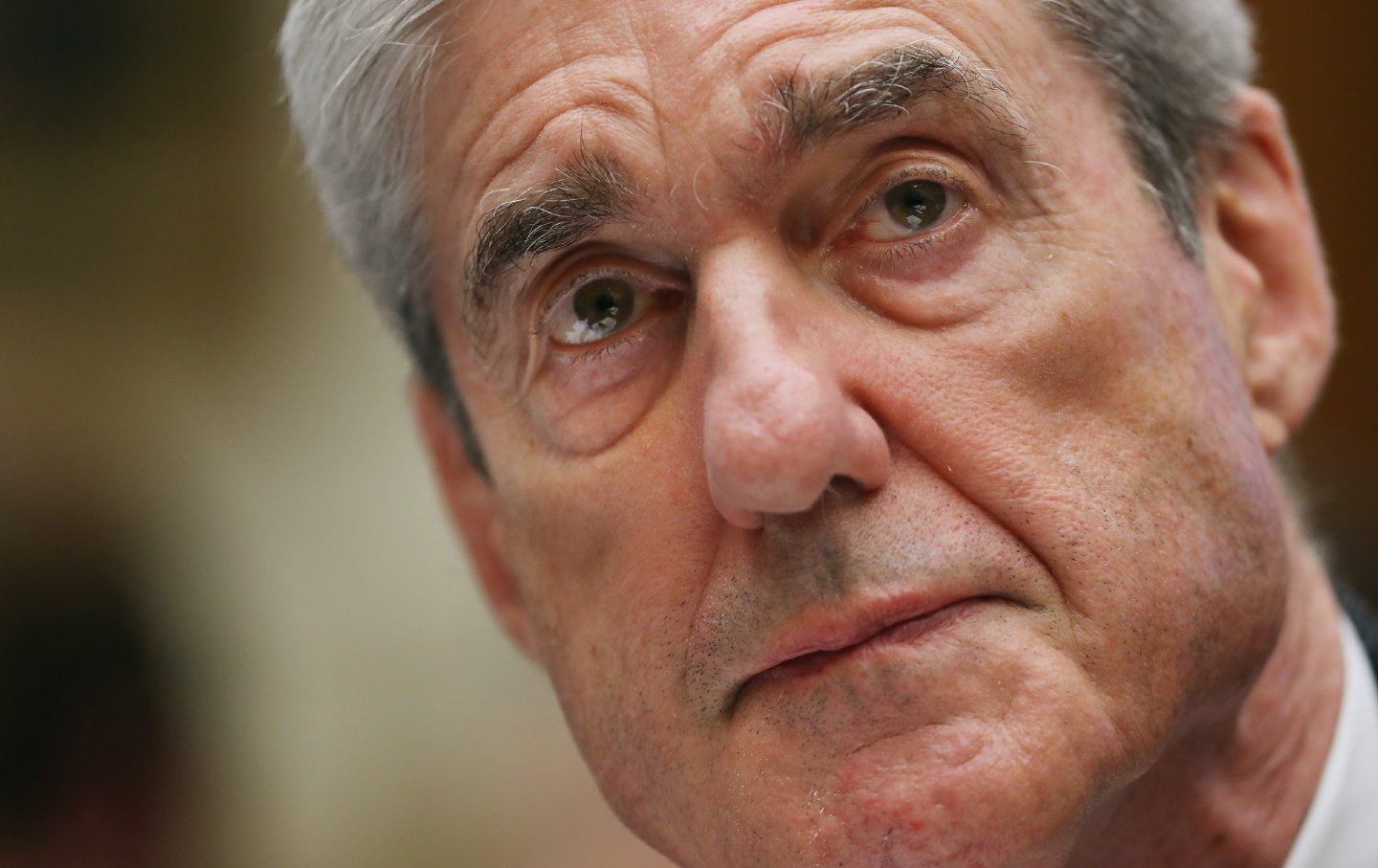
For most of his life, Robert Mueller was a pillar of bipartisan comity, an institutionalist respected by both major US political parties, but in the last decade, he became emblematic of polarized politics. Liberals lionized Mueller as a patriotic public servant who bravely tried to defend the rule of law, while MAGA maligned him as part of a “deep state” conspiracy to destroy Donald Trump. Mueller, who died on Monday at age 81, had been FBI director from 2001 to 2013 but is more famous for being the special prosecutor who oversaw from 2017 to 2019 the investigation into possible collusion between the Trump campaign in 2016 and the Russian government.
Displaying his usual magnanimous spirit, Trump reacted to the news of Mueller’s death by posting on Truth Social, “Robert Mueller just died. Good, I’m glad he’s dead. He can no longer hurt innocent people!” The “innocent people” Trump was thinking about were his cronies—notably his 2016 campaign adviser Paul Manafort, his longtime associate Roger Stone, and his national security adviser Michael Flynn—who had been convicted of various offenses during the investigation. Manafort was found guilty of fraud while both Stone and Flynn were convicted of lying to investigators. Trump pardoned all three in late 2020.
In contrast to Trump’s post, former presidents George W. Bush and Barack Obama both paid handsome tribute to Mueller’s transformative term as head of the FBI. According to Obama, Mueller deserved commendation for “his relentless commitment to the rule of law and his unwavering belief in our bedrock values that made him one of the most respected public servants of our time.”
Speaking on MS NOW, Rachel Maddow, a journalist who had placed great hope in Mueller’s investigation into Russiagate, remembered the former law enforcement official as “the last in a line of people that I don’t think we’ll ever see the likes of again.” For Maddow, Mueller “belonged to a now extinct class of lifelong rock-ribbed Republican public officials who are most known for their propriety and their nonpartisan competence and willingness to rise…above party.”
Maddow’s effusive words seemed like the product of a time warp: They recalled the heady days of Trump’s first term when liberals widely hailed Mueller as a savior. These liberals saw Trump as fundamentally illegitimate and alien to US politics, an intrusive force who could have defeated Hillary Clinton only thanks to the dark machinations of a foreign tyrant, Vladimir Putin.
In the context of the Russiagate narrative, Mueller was perfectly cast to be the hero: He was an old-school establishment Republican who would legitimize the critique of Trump by putting nation above party. As The New York Times notes, Mueller even looked the part, being a “button-down, lockjawed, rock-ribbed exemplar of a vanishing caste, liberal Republicans.”
A veritable cult of Mueller flourished during his investigations, when you could light Mueller votive candles, play with Mueller action dolls, and wear Mueller T-shirts while listening to podcasts called Mueller, She Wrote. There was a kids’ book featuring a heroic and buff Mueller as well as cartoons showing him as a caped superhero flying through the sky. Saturday Night Live regularly featured skits where the greatest actor of our age, Robert De Niro, played Mueller as a tough-as-nails cop about to put the cuffs on the miscreant president. De Niro eventually came to regret the fact that Mueller didn’t live up to the ideal image presented on the comedy show.
The cult of Mueller was ridiculous, and it reflected badly on liberalism. It showed that too many liberals had more faith in nonpartisan proceduralism than in politics. At a time when they should have been organizing against authoritarianism, they took comfort in the easy fantasy that an old, white establishment prosecutor would solve the problem of Trumpism.
In truth, Robert Mueller was never going to risk everything to challenge a sitting president. As his New York Times obituary makes clear, he rose up the ranks by never upsetting the status quo, often by covering up embarrassing state secrets.
As the Times notes, Mueller was
a scion of what was once known as the Eastern Establishment.
His patrician parents first lived on Park Avenue, and later in a stately manor on Philadelphia’s Main Line. His father, a Navy officer in the Atlantic and the Mediterranean during World War II, became an executive at DuPont, America’s oldest and most powerful chemical company. His mother was a first cousin of Richard M. Bissell Jr., later chief of the C.I.A.’s clandestine service, the creator of both the U-2 spy plane and the plan for the disastrous 1961 Bay of Pigs invasion.
Two incidents illustrate Mueller’s habit of protecting established power well before Russiagate. In 1991, a federal agent named Robert Muzer who had played a lead role in investigating the corrupt Bank of Credit and Commerce International (BCCI), spoke in front of a Senate committee. According to the Times, Muzar complained that the investigation “failed to follow ‘hundreds of leads’ that the foreign bank may have been involved in other cases of handling drug money, arms deals and secretly owning American banks.” Muzar’s testimony was challenged by Mueller, then assistant attorney general.
In the years after the 9/11 attack, when Mueller served as FBI director, he came across evidence of serious crimes by the administration, including spying on Americans and torture. He never went to the public with this information but rather, as the Times obituary argues, tried to pressure Bush to reform from inside.
The Times account paints too rosy a picture of Mueller as a reformer. As journalist Laila Al-Arian noted, “Under [Mueller’s] leadership, the FBI entrapped countless vulnerable Muslims, including those with developmental delays and literally wearing adult diapers, in manufactured plots concocted, funded, and planned by the FBI in order to justify their massive budgets.”
Popular
“swipe left below to view more authors”Swipe →In truth, Mueller was a lifelong cover-up artist. His handling of the Russiagate file was part of a pattern.
In investigating Trump, Mueller was so eager to obey the rules of comity that he made a few major errors. One was his reluctance to investigate Trump’s finances. Writing in The Washington Spectator in 2024, Bob Dreyfuss pointed out that “Andrew Weissman, Mueller’s lead prosecutor and a former FBI general counsel, blames Mueller and his deputy, Aaron Zebley, for an overcautious, even fearful, approach related to anything involving Trump’s money.” In his 2020 book Where the Law Ends, Weissman wrote, “Our office was put on notice, early on, that engaging in…a broad-based financial investigation might lead to our firing.”
Further, as the Times reported, Mueller “did not issue a grand-jury subpoena to compel Mr. Trump’s sworn testimony. He settled for written questions, and allowed the White House lawyers to limit them to events before Mr. Trump became president.”
Finally, Mueller allowed William Barr, Trump’s attorney general, to sandbag the release of the report. Rather than releasing the full report at once, Barr released redacted version and added his own conclusion that Trump had been exonerated. In fact, the actual Mueller report stated, “While this report does not conclude that the President committed a crime, it also does not exonerate him.”
Even Maddow admits that Mueller was “blindsided” by Barr’s tactics and that “Barr absolutely buried him in terms of the impact of that report.”
Ultimately, Mueller concluded that Russia systematically interfered with the election and that the Trump campaign was happy to benefit from their actions. But the report could not confirm widespread coordination between Trump campaign and the Russian government.
The problem was not just that Mueller was not up to the job but that cult of Mueller was based on a misunderstanding of politics. Throughout the Trump era, it has been clear that the only thing that can block authoritarianism is mass mobilization, as seen in the George Floyd protests of 2020 and the current anti-ICE protests. The cult of Mueller placed faith in elites to police misconduct. But figures such as Mueller can’t really be expected to punish wrongdoing. Elites, as the saga of the Jeffrey Epstein and his network makes clear, are too vested in protecting their own interests to ever do a real house cleaning.
The Mueller report was a perfect example of how elites cover up crimes: It found a few convenient scapegoats (Manafort, Stone, and Flynn), but let Trump himself escape any consequences.
Donald Trump is undeniably the most corrupt president in American history. In the grand scheme of things, Russiagate was one of his lesser sins. His financial ties to Middle Eastern autocracies to the tune of billions of dollars far outweigh any sway Putin might have and seem to be a hidden backdrop to Trump’s foreign policy. Russiagate appealed to liberals as a way of creating a bipartisan consensus that brought in hawkish Republicans. But focusing on Russiagate came at the expense of investigating and mobilizing against more serious Trump transgressions.
Mueller was neither the villain that Trump complains about nor the hero that Maddow now grieves over. He was simply an exemplary and pathetic figure showing that the current US elite lacks the political skill to defend democracy and fight authorities.
Become a Sustaining Donor This September
Between the reemergence of right-wing red-baiting and Donald Trump’s use of the chilling National Security Presidential Memorandum–7 to criminalize left political organizing, we’re seeing McCarthyism reborn before our eyes.
This assault on democracy cannot be ignored or wished away. Resisting it requires bravery in the face of threats and repression, a steadfast commitment to the truth, and the unwavering belief that we can—and will—overcome this darkness.
We must have an independent media that sets the record straight, unearths corruption and abuses of power, and advances a politics of justice and dignity for all if we’re to win this fight.
That’s why I’m writing to you today. This September, The Nation needs to add 100 monthly donors to sustain our progressive journalism. Your contribution makes the next investigative report, the next truth-speaking column, and the next pathbreaking essay all possible.
I hope you’ll support our work with a recurring donation today. If you donate $10 or more a month, we’ll send you a brand new “Hands Off the Free Press!” sticker to recognise your commitment to our cause. Please, donate today.
Onward,
Katrina vanden Heuvel
Editor and Publisher, The Nation