
How the Trump Administration Is Downgrading Women’s Citizenship
Gender isn’t just a matter of individual identity. It’s an axis of governance—and for the last year, across a range of policies, the Trump administration has punished women.
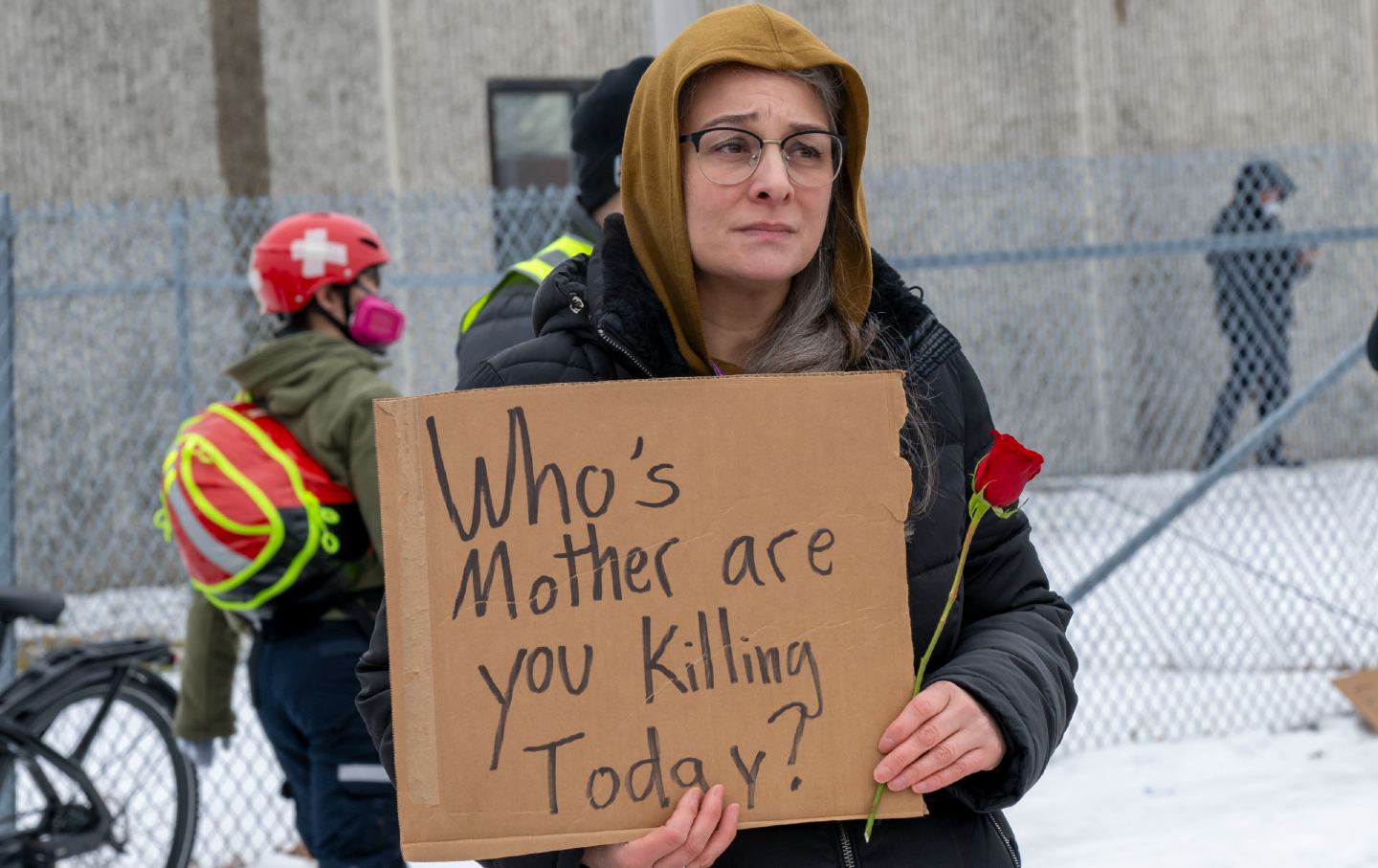
Today is the first anniversary of Donald Trump’s inauguration. From ICE deportations to the dismantling of DEI to the criminalization of pregnancy to environmental rollbacks, the administration has narrowed whom it protects and who, through degradations to citizenship, it has determined is expendable.
In this country, gender often determines who bears risks, absorbs costs, and is rendered responsible for the failures of markets and the state. This administration’s policies are, accordingly, especially harrowing for women as well as those who won’t or can’t conform to its gender regime.
When people think of “women’s issues,” they tend to think of abortion, childcare, or day-to-day costs of living. But these issues are defined by who has political centrality and how we define citizenship.Historically, citizenship has been defined in patriarchal terms and activated by conformity to colonial, white, and hegemonic masculine norms. Trump’s policies don’t only reflect this legacy; they are restoring it.
There is perhaps no more obvious example than the overhaul of the “Department of War.” There is no notion of citizenship embraced by this administration that isn’t grounded in martial manhood, which it materially and symbolically pursued by purging experienced women and minority leaders, expelling trans service members, wiping public records of diverse histories, and reestablishing cis-male bodily standards to ensure superior “readiness and lethality.”
As is the case across issues, these changes are predicated on inelastic gender roles that standardize policy around men—ideally white, cis, and heterosexual—granting them greater status, political influence, and a monopoly on violence. Doing this stigmatizes femininity and people associated with femininity—women, LGBTQ people, and racial minorities—making their rights negotiable, their safety contingent, and their citizenship conditional on the desires of cis het men.
In this ideology, femininity is synonymous with vulnerability, and so the way to make populations less powerful is to feminize them.
Gender is most often considered a matter of individual identity, but it is also an axis of governance, and male supremacism is arguably the beating heart of fascism. The administration’s gender essentialist ideology, explicitly stated 20 minutes into Trump’s inauguration speech, is implicit across all policy areas. Exactly a year ago, he promised to end government policies trying to socially engineer “gender into every aspect of public and private life” and stated that the US government would recognize “only two genders: male and female.” While this assertion was a direct erasure of trans people and threat to LGBTQ people, it also articulated the separate spheres beliefs—one of mutually exclusive, binary, hierarchical gender rules—that governs the administration’s agenda.
What media and policy analysts parse as isolated issues—the economy, immigration, criminal justice, affordability, education, taxes, housing—combine to generate specific entitlements for men while curtailing women’s autonomy, mobility, safety, income, education, political engagement, and survival.
Abortion, the issue most identified as a “women’s issue,” is the clearest illustration. Abortion exists at the intersection of health, work, family, financial security, and freedom. Safe and legal access to the full spectrum of reproductive health services improves women’s education, wages, wealth, labor-force participation, mobility, and long-term well-being and security, with particularly strong effects for Black and young women. Abortion bans do the opposite: They depress earnings and employment, raise health risks and costs, and increase maternal mortality rates.
Because employer-sponsored insurance still dominates, pregnancy that disrupts employment produces coverage gaps, dependence on male partners, medical threats, and debt—entrenching poverty, dangerous relationships, and risk of criminalization. Every policy issue not considered a women’s issue is affected by whether a person has the right to control what happens to their own bodies and futures.
Housing affordability, by contrast, is rarely considered a “women’s issue,” but it should be. Standard housing debates—rent, mortgages, commutes—are calibrated to men’s standards of mobility, financial concerns, and risk assessments. But for women housing is often ruled by a different set of metrics that include not only affordability but also pregnancy, childcare, elder care, safety, and intimate violence. As in other cases, Trump is trying to reimpose institutional biases. If the administration goes through with its proposed changes to the Equal Credit Opportunity Act and eliminates disparate impact liability for loan lenders, housing loans for women, especially Black women, will become costlier and harder to get.
As the Trump administration tears apart already limited safety nets, women are being conscripted into subsidizing men, corporations, and the government through anti-DEI programs, abortion bans and pro-natal policies, the erosion of paid leave and childcare, privatization of care, and cultural–religious policy guidelines that recast caregiving as women’s duty. Women bear the cost of the administration’s strategy: privatize costs, impose those costs on households, and then within households push the consequences onto women.
For women, the effects of issues represented as siloed, compound to reduce their ability to work for money, plan for the future, and secure long-term security. Today men are joining the US workforce at three times the rate of women, who are, instead, dropping out of it at alarming rates. In December, 91,000 women exited the labor market, while 10,000 men entered it. A 2025 analysis found that mothers of young children experienced the sharpest January–June labor force decline in more than 40 years of tracking, with college‑educated mothers of very young children seeing the largest job exit rates since 2023. We are being engineered back into “flexible” and unpaid care work and are supposed to ignore that “flexibility” has always been a euphemism for precarity.
Student-debt policy changes intensify this issue. Women, who pursue higher education as a hedge against persistent wage gaps, currently hold roughly two-thirds of student loan debt. New laws regarding repayment terms and loan forgiveness undermine women’s mobility and independence, shifting education away from a path to stability and mobility toward a one that discourages risk-taking and delays leaving bad jobs or relationships. Likewise, attacks on public-sector unions and downsizing federal agencies similarly strip women of work, economic security, and collective power.
In every arena, the winnowing of DEI programs has been critical to engineering these outcomes. More of us are now at the mercy of systems in which our advancement again depends on men’s good graces, a problem made worse by the weakening of protections against harassment, assault, and ableism. Women’s healthcare, which even before last year, was under-resourced, is similarly being degraded. The barring of “prohibited” DEI words, the withdrawal of “DEI” grants for medical studies, eliminations of gender-affirming care, and closing of women’s health clinics are accelerating inequities and leaving vulnerable populations with fewer safeguards and resources.
The past year’s creeping institutional abandonment of women and minoritized people extends into civil rights, voting rights, immigration, public health, labor laws, and more. Strict voter‑ID laws, felony disenfranchisement, and inaccessible polling places disproportionately hurt women, especially women of color, low‑income women, and disabled women. Immigration enforcement weaponizes fear and trauma and forces women to be silent in the face of exploitation. Detention and deportation additionally expose women to medical and sexual abuse.
Even as climate and environmental policy changes hit vulnerable communities the hardest, women take on greater costs. Heat waves, floods, fires, and blackouts intensify care pressures and the work of survival—securing water, medicine, shelter, transport, and communication. Evacuation is a luxury if you are tethered to child and elder caregiving, an old car, a job that won’t pay if you are absent, or a partner who controls your movement. Environmental degradation also imposes specific embodied costs, including pronounced reproductive health risks and long‑term harm.
Underlying everything is the manner in which the administration has approached violence and crime. During the past year, the administration has focused its energies on sensational law-and-order displays, violent ICE raids, and legally questionable militarized policing, all while expanding the likelihood of the most predictable and widespread violence—intimate partner abuse, sexual violence, stalking, and coercive control.
Today, women’s risk of intimate and state violence with no recourse is higher now than a year ago, a situation worsened by rollbacks of protections for victims of violence, shelter and clinic closures, weaker restraining orders, anti-trans legislation, deportations, and rising incarceration rates. Worse, thanks to anti-abortion laws, rapists and intimate abusers now have greater rights over our bodies and reproduction than they have in decades, raising risks of abuse. During the past 12 months, protections against sexual and intimate assault and violence have been worn away, even as pregnancy outcomes, obstetrics, and gender-affirming care are being criminalized. Men still make up the large majority of people behind bars, but during the past decade, women’s incarceration has grown roughly at twice the rate of men’s, spurred by criminalization of trauma and women’s self-defense.
In assessing the first year of Trump’s second term, what emerges is the defining shape of the MAGA regime: necropatriarchy. An adaptation of Achille Mbembe’s necropolitics, necropatriarchy here describes a white-supremacist patriarchal order achieved not only by engineering women’s forced dependence and vulnerability through violence but by structurally exposing us—especially racialized, poor, queer, disabled, and trans women—to slow, premature, and normalized harm, abandonment, and death. In this context, both the state and men have the power to determine what happens to women, and which ones are deemed useful enough or expendable. The effect is to shorten women’s lives and constrain their futures, especially along racial, class, citizenship, disability, and queer/trans lines.
The past year was marked, for instance, at one end, by Adriana Smith, put on life support after being declared brain-dead to sustain a pregnancy, and, at the other, by an ICE agent’s murder of Renee Nicole Good. Adriana Smith’s treatment garnered less public outrage because the harm was unspectacular and private. The violence was slow, medicalized, and rhetorically coded as “protecting a baby’s life,” even as Smith’s own life, personhood, and dignity were ignored as she became yet another casualty of a racialized maternal mortality crisis. Good’s death, marked by both misogyny and homophobia, was more legible because it took place within a more familiar—and masculinized—template. It was a public confrontation culminating in a brutal killing by an armed state agent.
In the face of all this, most American women, particularly the youngest and oldest, are responding with self-aware self-defense. In private as well as in public, women are disrupting necropatriarchal power by reducing our exposure to risk, by raising the social costs of imposed harms, by building our own escape paths, and, when possible, by reassigning responsibility back to institutions, including, notably, political parties.
You see this in our refusals and in our organizing. We are funding new media; forming interethnic, interracial, queer communities; and leading protest movements. Women of all ages are fleeing patriarchal religious institutions and institutions. We are building abortion networks and mutual-aid societies, protecting immigrant neighbors and trans communities, engaging in rapid-esponse fact-sharing, building legal literacy kits, amassing emergency savings accounts, and starting childcare co-ops. More and more of us are running for office.
Popular
“swipe left below to view more authors”Swipe →In growing numbers, women are saying no to the right’s gender mandates—and its compulsory heterosexuality, heterosexual marriage, childbirth, and childrearing. They are living in ways that renounce the social pressures, cultural mores, and political mandates that would otherwise cultivate their own erasure and slow death.
Gen Z women, more progressive and intersectional in their feminism than any other generation or cohort, are the most diverse in the nation, and they’re defending democratic ideals and norms, even as their male peers veer right. Their intersectional resistance—think of the connections between reproductive justice, Gaza support, Black Lives Matter, and disability rights—doesn’t always take the form most often recognized in the media. It is intimate and takes place in the day-to-day, but that doesn’t mean it isn’t making an impact. It just means we are refusing to participate in oppressive systems. It is not that we aren’t seeking ways to make change—but that we are the change.
When women, especially young white women, fight racism; refuse to date, marry, and have babies; initiate divorce; and form queer families, they threaten the intergenerational transfer of white supremacy. This is a direct challenge to an administration sodden with white Christian nationalism.
For many people—especially Indigenous, Black, queer, disabled, undocumented, incarcerated, and poor women—the refusals I describe are not new and aren’t choices but long-standing survival strategies that are now being taken up more broadly, for example, by white women, as their privileges are being eroded.
Today, 40 percent of women ages 15 to 44 say they would leave the United States if they could, twice the share of men and a fourfold increase since 2014. This desire should not be read as a measure of individual unhappiness but as a class‑based diagnosis: We recognize what is happening and know that our autonomy, safety, and ability to pursue viable futures are being structurally withdrawn.
Women are being disproportionately disadvantaged today, but entire populations are being made vulnerable—feminized—by a misogynistic agenda. And yet, a common response to both the administration and president’s misogyny is still that “women need to support other women.” We do need greater solidarity, but this expectation ignores the complexity of our lives and doubles down on the Trump movement’s separate, gendered spheres.
What we need is for cis het men to act in solidarity with us, so we can collectively expand the foundations of justice and equality beyond patriarchal and white-supremacist frameworks.
Asking women, for instance, to sacrifice fundamental freedoms at a “big tent” altar, is nothing more than thinly veiled liberal patriarchal insistence on men’s defining what counts as political success. Retaining the centrality of men—usually cis, straight, and majority white—is how “necessary compromises” that impose life-degrading costs on other people’s bodies, labor, safety, or futures are deemed reasonable. This is how a patriarchal left cedes structural and ideological power to the right. It’s how compromise ceases to be democratic and instead becomes abusive and extractive. It’s not that women don’t understand politics or are rejecting “compromise.” It’s that we are demanding that our society include us as full citizens and political agents on terms we define.
Until our society acknowledges that placing girls and women, and in particular the most vulnerable girls and women, at the center of political life is essential, democracy and equality will remain deferred promises and a brutish, brutalizing macho fascist politics will continue to hold sway.
Support independent journalism that does not fall in line
Even before February 28, the reasons for Donald Trump’s imploding approval rating were abundantly clear: untrammeled corruption and personal enrichment to the tune of billions of dollars during an affordability crisis, a foreign policy guided only by his own derelict sense of morality, and the deployment of a murderous campaign of occupation, detention, and deportation on American streets.
Now an undeclared, unauthorized, unpopular, and unconstitutional war of aggression against Iran has spread like wildfire through the region and into Europe. A new “forever war”—with an ever-increasing likelihood of American troops on the ground—may very well be upon us.
As we’ve seen over and over, this administration uses lies, misdirection, and attempts to flood the zone to justify its abuses of power at home and abroad. Just as Trump, Marco Rubio, and Pete Hegseth offer erratic and contradictory rationales for the attacks on Iran, the administration is also spreading the lie that the upcoming midterm elections are under threat from noncitizens on voter rolls. When these lies go unchecked, they become the basis for further authoritarian encroachment and war.
In these dark times, independent journalism is uniquely able to uncover the falsehoods that threaten our republic—and civilians around the world—and shine a bright light on the truth.
The Nation’s experienced team of writers, editors, and fact-checkers understands the scale of what we’re up against and the urgency with which we have to act. That’s why we’re publishing critical reporting and analysis of the war on Iran, ICE violence at home, new forms of voter suppression emerging in the courts, and much more.
But this journalism is possible only with your support.
This March, The Nation needs to raise $50,000 to ensure that we have the resources for reporting and analysis that sets the record straight and empowers people of conscience to organize. Will you donate today?
More from The Nation
Jesse Jackson Still Provides Light in These Dark Times Jesse Jackson Still Provides Light in These Dark Times
We would be wise to follow the path he forged.
Jesse Jackson Gave Peace a Chance Jesse Jackson Gave Peace a Chance
The iconic civil rights leader, who has died at 84, made anti-war and pro-diplomacy politics central to his presidential bids and his lifelong activism.
ICE Melts in the Minneapolis Winter ICE Melts in the Minneapolis Winter
Now it’s time to abolish the agency and impeach Kristi Noem.
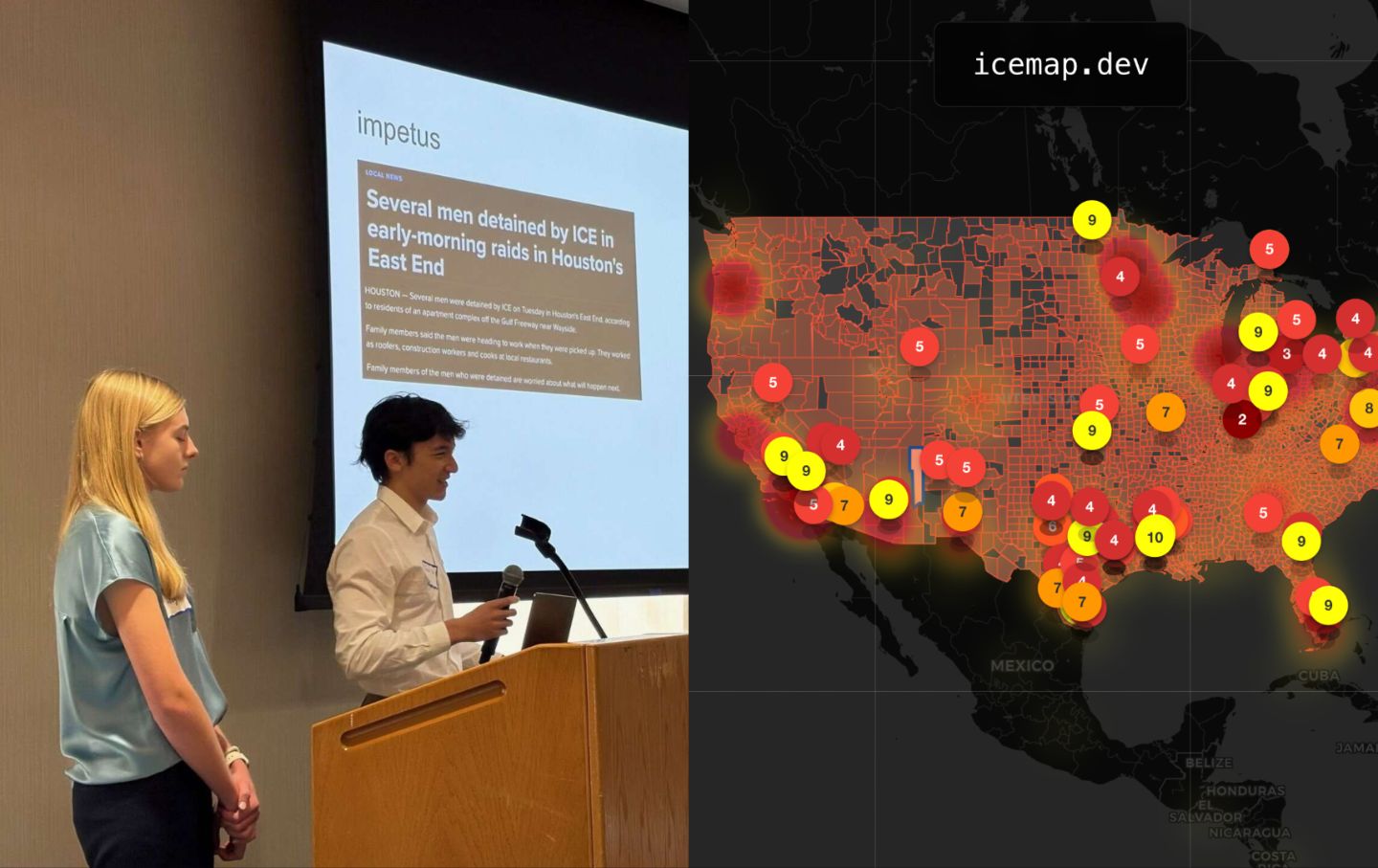
How 2 University Freshman Are Tracking ICE Enforcement Actions Across the Country How 2 University Freshman Are Tracking ICE Enforcement Actions Across the Country
With ICE Map, Rice University students Jack Vu and Abby Manuel hope to help communities understand where immigration enforcement activity is happening and how it unfolds in real t...
Meet the Young Organizers Survival Corps Meet the Young Organizers Survival Corps
Young organizers from around the country gathered at Haley Farm to study past social movements and train in the tactics of nonviolent resistance and grassroots organizing.
I Fled the US to Escape the Security State. Instead, It Followed Me. I Fled the US to Escape the Security State. Instead, It Followed Me.
My recent detention at Heathrow shows that the architecture of state repression knows no borders.

