
The Weapons Manufacturer Next Door
It’s been six years since I began attending pro-Palestine demonstrations. The most recent campaign at the Brooklyn Navy Yard feels different.
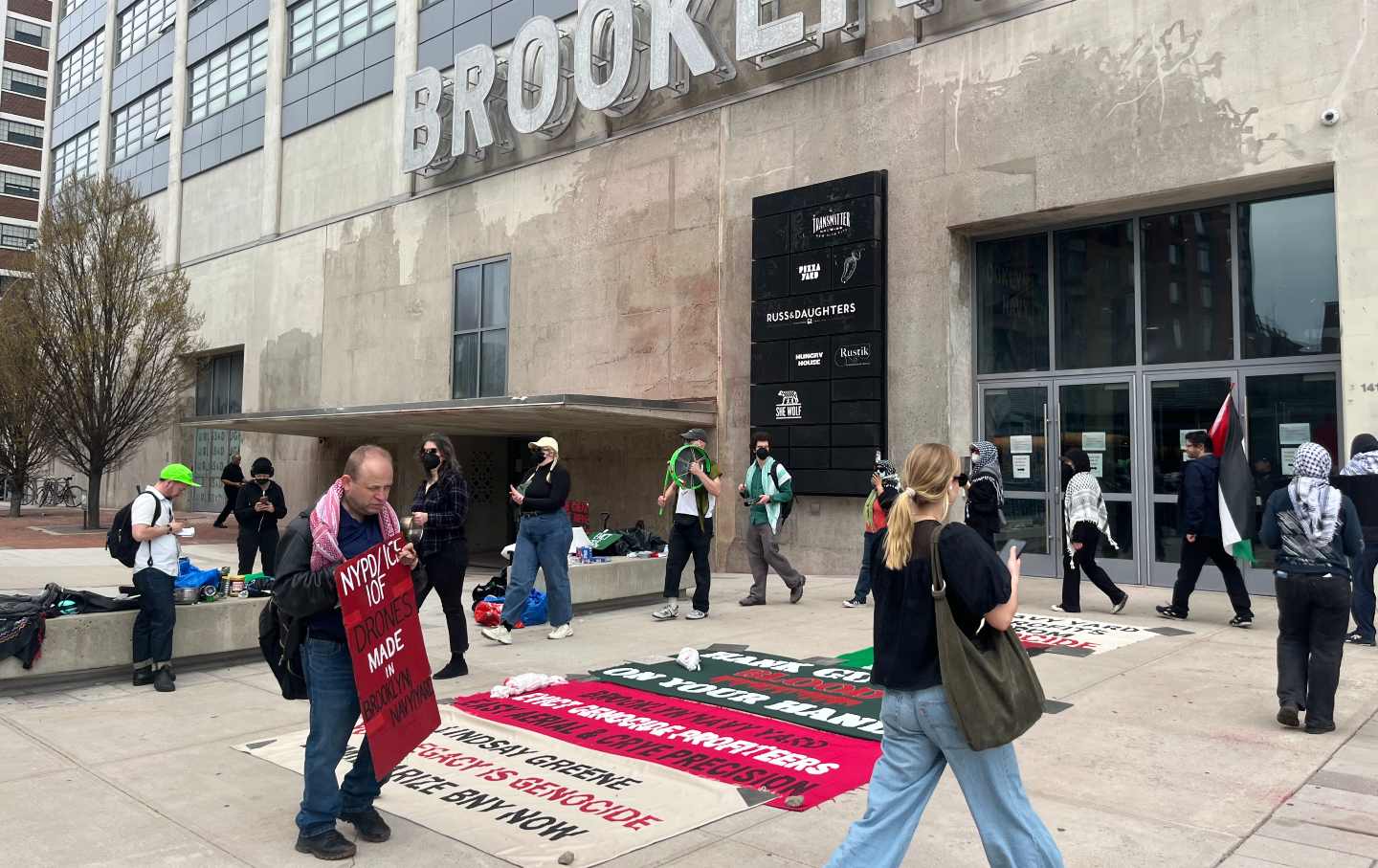
Demilitarize this: Protesters at the Brooklyn Navy Yard this past April.
(Diana Kruzman)On a warm Wednesday morning in early April, I stood with around two dozen masked protesters outside an entrance to the Brooklyn Navy Yard, an industrial park on the New York City waterfront. I knew by now to bring earplugs, since the goal of this biweekly demonstration was to make as much noise as possible. Beneath the screech of whistles, the blaring of an air horn, and the banging of pots and pans, activists waved Palestinian flags and handed out flyers to workers exiting the complex. The protesters were there because they had found evidence that companies operating out of the massive property were supplying the Israeli military, which for over two years had been carrying out a genocide in Gaza.
The protests, led by an autonomous group called Demilitarize Brooklyn Navy Yard, targeted Easy Aerial, a drone manufacturer, and Crye Precision, which makes tactical gear. Because the Navy Yard sits on land owned by the city of New York, the DBNY picket extends to the complex as a whole, with the organizers arguing that military contractors should not receive tax breaks or be allowed to operate on public-owned property. For over a year, they demanded that the two companies be evicted from the Navy Yard; after reports broke that Easy Aerial’s lease wouldn’t be renewed once it expired in May, they focused their campaign on getting rid of Crye Precision.
These weekly protests ebbed and flowed as groups from around the city answered DBNY’s call to mobilize at the Navy Yard, and they sometimes escalated into more direct confrontations. Earlier on that April morning, a brief scuffle had broken out after a cop slapped a demonstrator blowing an air horn in his face. Toward the end of the demonstration, I watched as a protester in a hooded sweatshirt and green keffiyeh stood atop a picnic table and spoke into a megaphone.
“Politicians and international bodies have not stopped the genocide in Palestine, or of the oppressed masses of the world, and they were never willing to stop it,” the speaker declared, their voice partially muffled by the keffiyeh. “To fight US imperialism, we have to choke its flow of supplies.”
Their sentiment reflected how I’d been feeling for months—as well as many others I knew who cared about Palestine. During Israel’s two-year genocidal campaign in Gaza, protests around the United States focused on stopping the daily bombardment and killing of Palestinian civilians. As the official death toll rose to more than 70,000 (likely a severe undercount), “Ceasefire now!” became the rallying cry of most major actions in cities like New York, alongside the more radical demands from student encampments, which called on their universities to divest from Israel.
But despite the ceasefire that was announced last October, the killings have not stopped. The United States continues to send weapons to Israel, which is still targeting Palestinians in both Gaza and the West Bank, the latter flush with armed settlers. By 2025, the war for American popular opinion, it seemed, had been won: For the first time since polling began, more Americans had an unfavorable view of Israel than a favorable one. Meanwhile, aside from some major victories for pro-Palestine politicians in cities like New York and Washington, DC, this sentiment has not translated to a shift in policy. Logic and historical precedent both seemed to suggest that it was just a matter of time. But as with our planet in the climate crisis, Palestine was running out of time.
It was during this period of frustration over the United States’ continued material support for Israel, and the perceived ineffectiveness of mass protest, that I first came across Demilitarize Brooklyn Navy Yard in August of last year. Rather than occupying a massive public space, such as Times Square, to express discontent and raise awareness on the issue, the DBNY campaign was doing something different: pushing for targeted actions at the local level to end the flow of weapons to Israel. Such protests have always been a part of pro-Palestine organizing, but in the nine months since the ceasefire was announced, I’ve seen them take on much more prominence, applying pressure to specific people and businesses with financial ties to the Israeli military.
There was something, too, in the fact that this was all taking place at the Brooklyn Navy Yard, a former military shipyard that after a multi-decade transformation is now home to more than 550 businesses, including a film studio and a craft brewery. The Brooklyn Navy Yard Development Corporation, a nonprofit that administers the property on behalf of the city of New York, has made a concerted effort to draw young people to the area, offering the space as a venue for electronic-music events. The Navy Yard borders traditionally working-class communities as well as gentrified neighborhoods filled with transplants from a generation that is statistically more likely to support Palestine. This is perhaps why the DBNY protests felt different, both to me and the other demonstrators that I saw there. At the Navy Yard, I had the chance to channel my frustration into something that felt concrete and tangible: getting weapons manufacturers out of Brooklyn, the borough where I also lived.
But protests like this were not exceptional. In 2024, a similar effort in Cambridge, Massachusetts, pushed for the eviction of a local office of Elbit Systems, an Israeli weapons manufacturer. In California and New Jersey, activists and dockworkers have united under the Block the Boat movement, which uses blockades and teach-ins to prevent ships carrying Israeli military cargo from docking at international ports. And, of course, the Boycott, Divestment, and Sanctions (BDS) movement has long sought to apply pressure on Israel by targeting the flow of money, goods, and people to and from the country.
Learning about these successful campaigns gave me hope that DBNY was just one prong in a multifaceted movement, one that was just gathering steam rather than fading out. And unlike previous campaigns, DBNY is escalating at a time when Americans everywhere are being introduced to direct action under the second Trump administration. DBNY has revealed that Crye Precision, which makes uniforms worn by the Israeli army, also supplies Immigration and Customs Enforcement, the agency tasked with carrying out the Trump administration’s anti-immigrant operations in places like Minnesota. The mass pushback against Operation Metro Surge beginning late last year made it clear that many Americans are willing to engage in direct action and organize at the grassroots level to resist authoritarianism. DBNY can harness that energy by demonstrating that militarism abroad and militarism at home are one and the same.
Demilitarize the Brooklyn Navy Yard was formed in September 2024 with the goal of materially disrupting the supply chain of weapons and technology between the United States and Israel. The group decided to narrow its focus to two companies, starting with Easy Aerial, which has publicly advertised that its drones are used by the Israel Defense Forces. Crye Precision, meanwhile, produces camouflage gear for the Israeli military supplier Agilite. Both Easy Aerial and Crye Precision have also supplied the Department of Homeland Security; aside from searching publicly available federal contracts, the DBNY campaign identified ICE and Border Patrol officers wearing Crye Precision uniforms and gear through photos, videos, and news reports.
Campaign organizers told me that early on, they attempted a dialogue with the Brooklyn Navy Yard Development Corporation. In June of last year, activists met with Lindsay Greene, the organization’s president and CEO, and Hank Gutman, its board chair, to urge the BNYDC to evict the two companies, as well as to ban any military contractors from leasing space in the Brooklyn Navy Yard in the future. At the meeting, according to the organizers, Gutman and Greene said the board could not evict tenants without a legal or financial reason. Producing weapons that kill civilians might be morally wrong, but it is neither illegal nor against the BNYDC’s policy. (Through a spokesperson, the BNYDC also denied that any weapons are manufactured in the Navy Yard, despite evidence to the contrary).
Popular
“swipe left below to view more authors”Swipe →Since then, the BNYDC has demonstrated a clear lack of interest in engaging with the campaign, organizers told me. Although its meetings are supposed to be open to the public, last year the BNYDC quietly removed the public-comment period from its board-meeting agendas and began limiting the number of people who could sit in on meetings to avoid any potential disruption from protesters. The attendees are also siphoned off into a separate room where they can watch the meeting take place over video link, as I did several times in the past year. At no point during the board meetings I witnessed were the protesters outside the building acknowledged.
As their frustration with the BNYDC grew, the protesters decided to escalate their tactics. At their weekly demonstrations, they have held up signs denouncing Greene and Gutman as “genocide profiteers.” In June of last year, four activists were arrested after blocking the entrance to the elevators in the building that housed Easy Aerial and Crye Precision. That same day, a Crye Precision employee was captured on video physically assaulting a protester.
Over the course of the past year, I’ve seen the campaign’s protests draw in various pro-Palestine groups from around the city, from the borough-wide Brooklyn Families for Palestine to the national anti-war organization Code Pink. But the core of the Demilitarize campaign is hyperlocal, consisting of community organizers, Brooklyn Navy Yard workers and tenants, from woodworkers to designers, and residents of the surrounding neighborhoods. Organizers have made a sustained effort to connect support for weapons manufacturing at the Navy Yard and lack of investment in the nearby community.
“There really is no manufacturing space anymore in New York. This is why places like the Navy Yard were created,” said Maisha Morales, whose family has lived in the neighborhood since 1931, speaking to the crowd at a protest in September that drew well over 100 people and resulted in eight arrests. “Yet there are still no spaces for people who look like us, but they find a way to give thousands of square feet to companies who profit off of genocide and war.”
It’s been six years since I began attending pro-Palestine demonstrations. Raised in a decidedly apolitical household and trained in the norms and practices of mainstream American journalism, which prioritize distancing oneself from any subjects of potential coverage to maintain “objectivity,” I did so tentatively at first, simply watching from the sidelines as an onlooker rather than an activist or reporter. Eventually, I began to participate more openly, joining in on the chants of “From the river to the sea, Palestine will be free.” For a long time, this felt like a radical act in and of itself, and in many ways it still is. But after October 7, it no longer felt like enough. And I wasn’t the only one feeling this way.
“For many decades, Palestine was a fringe issue in the US,” Eman Abdelhadi, an activist and professor at the University of Chicago, told me on a recent phone call. “There wasn’t really a path toward actual cutting of material ties” to Israel, and the movement instead focused on “symbolic wins” and political education. That changed after October 7, 2023, Abdelhadi said. Even as public opinion turned decisively against Israel for the first time in their decades of organizing, it became clear that this would not be enough to stem the flow of weapons to the country, which was still being promoted by many in the Democratic Party despite opposition from their constituents. “There’s a shift within the [pro-Palestine] movement to wanting to make a material impact,” Abdelhadi added, “to move beyond the symbolic and the rhetorical, to actually impose a cost on Israel.”
DBNY organizers told me that their campaign was started as a direct response to what they viewed as “symbolic and performative solidarity,” such as electoral campaigns and protests that, in their view, don’t call for material change. “The Palestine solidarity movement in NYC has largely focused on mobilizations, without any long-term strategy around a larger goal,” the group said in a written statement. “The goals of the DBNY campaign have been very clear, focusing on disrupting the supply chain of imperialism by targeting weapons companies, rather than asking politicians and institutions to end the genocide.”
I’ve also had numerous conversations with friends in the movement who see protests without direct action as funnelling popular anger and organizing energy away from campaigns that could make a material impact, and in many ways I sympathized with their frustration. However, I learned from speaking to experts that previous successful organizing efforts, such as the boycott of apartheid South Africa, incorporated action at all levels.
Rama Kased, an associate professor in Race and Resistance Studies at San Francisco State University who was born and raised in Brooklyn, told me that as the repression against pro-Palestine organizing rises, decentralized direct action like the kind undertaken by DBNY will need to be supplemented by electoral work and legal advocacy.
Abdelhadi emphasized that the next step is for campaigns like DBNY to share materials and organizing strategies with other groups around the country. “These campaigns are often more successful when they can maintain pressure locally at the starting point and replicate across different places,” Abdelhadi said. DBNY has talked to groups in Philadelphia, Chicago, and upstate New York, the group told me. I also found parallels between Demilitarize Brooklyn Navy Yard and the Cancel Capital Factory campaign in Austin, Texas, which similarly targets a tech hub with ties to Israeli weapons manufacturing.
DBNY is still calling for a full cultural and economic boycott of the Brooklyn Navy Yard, emphasizing that people should avoid spending money in the complex or hosting events there until its demands are met. Because it’s a decentralized group, there are many ways to participate in DBNY: Some people join the weekly noise demos, which aim to divert people away from shopping or dining at the Navy Yard, while others organize autonomous actions such as sit-ins or blockades. The group is hopeful that its strategy is paying off after Easy Aerial was forced to leave after its lease expired and the Brooklyn Navy Yard Development Corporation declined to renew it. DBNY has also called on the administration of Mayor Zohran Mamdani, whose rhetoric has been supportive of Palestine, to take action (although Mamdani has not publicly acknowledged the group and recently reappointed Greene as the BNYDC’s chief executive). In the words of the DBNY organizers, their campaign is here to stay.
Become a Sustaining Donor This September
Between the reemergence of right-wing red-baiting and Donald Trump’s use of the chilling National Security Presidential Memorandum–7 to criminalize left political organizing, we’re seeing McCarthyism reborn before our eyes.
This assault on democracy cannot be ignored or wished away. Resisting it requires bravery in the face of threats and repression, a steadfast commitment to the truth, and the unwavering belief that we can—and will—overcome this darkness.
We must have an independent media that sets the record straight, unearths corruption and abuses of power, and advances a politics of justice and dignity for all if we’re to win this fight.
That’s why I’m writing to you today. This September, The Nation needs to add 100 monthly donors to sustain our progressive journalism. Your contribution makes the next investigative report, the next truth-speaking column, and the next pathbreaking essay all possible.
I hope you’ll support our work with a recurring donation today. If you donate $10 or more a month, we’ll send you a brand new “Hands Off the Free Press!” sticker to recognise your commitment to our cause. Please, donate today.
Onward,
Katrina vanden Heuvel
Editor and Publisher, The Nation
More from The Nation
The Impossible Will Take a Little While: The Power of Persistence The Impossible Will Take a Little While: The Power of Persistence
In troubled times, history offers a lesson: Seemingly impossible change can begin with ordinary people who refuse to give up.
Gloria Steinem’s Many-Splendored Feminist Life Gloria Steinem’s Many-Splendored Feminist Life
The feminist icon lived the struggle for gender equality and always found time to lend support and solidarity to other women leaders, even in her final days.
No, Woke 1 Was Not Crazy No, Woke 1 Was Not Crazy
AOC and others are laughing off 2020 as a wild, isolated moment. None of that is true.
How Occupy Wall Street Still Explains Politics Today How Occupy Wall Street Still Explains Politics Today
It sowed the seeds for a new era of social movements—but its politics of powerlessness should act as a cautionary tale.
Abdul El-Sayed’s Win Is a Landmark. But the Fight Is Far From Over. Abdul El-Sayed’s Win Is a Landmark. But the Fight Is Far From Over.
Even though the Palestine movement is on the march, we can’t afford any complacency.
Mamdani’s Team Redefined Political Video. Now They’re Betting on Short Films. Mamdani’s Team Redefined Political Video. Now They’re Betting on Short Films.
Premiering exclusively in The Nation, a new short film produced by City Hall and narrated by Morgan Spector highlights the efforts of the biggest tenant-led union in New York City...

