
Mapping the Unsung History of Puerto Rican Resistance
Hunter College students explore the story of El Barrio using the new app Radical Atmospheres.
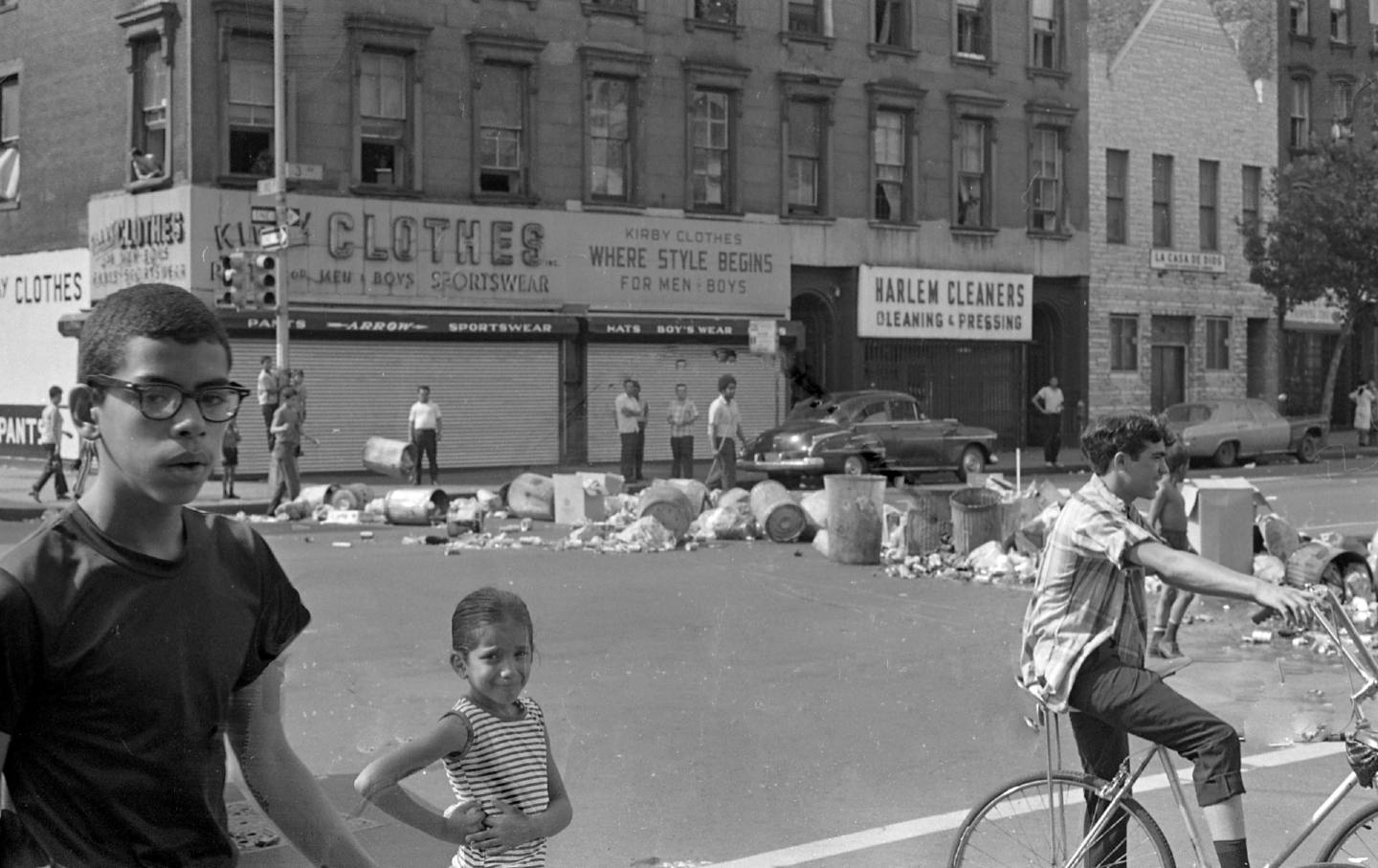
Children in El Barrio stand before the Young Lords’ 1969 Garbage Offensive.
(Bev Grant / Getty Images)Alana Gonzalez, a student at Hunter College, stood at the corner of Third Avenue and 120th Street in East Harlem, New York City, with her phone in hand and wired headphones wrapped loosely around her fingers. After pressing play on the Radical Atmospheres app, the streets of Harlem quickly transformed around her into a living memory of the Young Lords, a Puerto Rican political organization focused on housing, education, and healthcare issues. Through her headphones, voices recalled a march the group had organized in East Harlem in 1970 to protest colonial rule in Puerto Rico. Crowds moved up Third Avenue chanting slogans like “Puerto Rico sí, Yankee no” and “Pa’ arriba, pa’ abajo, los Yankee pal carajo,” where they expressed frustration with the US government’s influence over the island. Gonzalez closed her eyes briefly, taking in everything she heard before continuing down the block.
Radical Atmospheres is an audio augmented reality project created by Andrew Demirjian, a professor at Hunter College, in collaboration with the Center for Puerto Rican Studies. The app transforms East Harlem, known to many residents as El Barrio, into a living archive of Puerto Rican radical activism. The app layers oral histories, poetry and immersive soundscapes over the streets in El Barrio, guiding listeners through sites where movements of protest and liberation took place.
During a walking tour through these streets on May 7, students from Hunter College used the app to hear these stories in the very places they unfolded. Soundscapes and layered historical art pieces were activated at multiple sites, turning these “ordinary” streets into historical markers. The experience connected Puerto Rican radical activism to urgent present-day conversations around immigration, Immigration and Customs Enforcement, and Latino social justice movements.
The Young Lords expanded to New York City from Chicago, where the group focused on political organizing in El Barrio during the late 1960s and early ’70s.
The audio introduced students to key figures from the Young Lords movement like Felipe Luciano and Miriam Jiménez Roman, and framed East Harlem as more than just another neighborhood in the city. Near 116th Street, students paused at a crowded intersection while the app explained the Young Lords’ free breakfast program, which combined equal food distribution with political education.
For some students, hearing those histories through their headphones while standing in the same streets where they occurred changed how they viewed Puerto Rican activism and how those movements are preserved and remembered.
Hunter College student Zahir Lara said the app challenged the tendency to reduce groups like the Young Lords and Black Panthers to labels such as “radical” or “militant” rather than recognizing the community work they organized around issues of housing, gentrification, and sanitation. “The app humanized them,” Lara said. “It showed how focused they were on dignity and community.”
As the group continued through the streets of upper Harlem near the Silberman School of Social Work, stories about surveillance, policing, and community displacement pushed students to relate the archival material to today’s political climate. For Gonzalez, the project became more than a history lesson. Hearing stories about solidarity and survival in El Barrio made her reflect on the importance of community-based spaces. She said that during a time when many immigrant families continue to face uncertainty and fear surrounding immigration enforcement, these spaces leave room for growth.
“It’s hard to have hope right now,” Gonzalez said. “But seeing how strong community solidarity once was makes it feel possible again.”
Lara said the app changed the way he thought about policing and the treatment of Latino communities in the United States. He linked the surveillance of Puerto Rican activists discussed throughout the audio tour to present-day rhetoric surrounding immigration and criminalization.
The project grew through collaboration between Hunter College students, faculty, and community voices involved in Puerto Rican activism. Demirjian said he created Radical Atmospheres to move Puerto Rican history beyond textbooks and archives and place it directly where those histories unfolded.
“This piece functions as an alternative to the videos you see online about activism,” Demirjian said. “We wanted to bring out the day-to-day aspect of activism, the not-sexy work, like being in the rain selling newspapers but still showing up and making a difference.”
While students moved through 116th Street, many described the app as more immersive than they expected, particularly in the way it shifted between overlapping audio experiences at different sites along the route. Gonzalez said she was surprised by how the app responded to the physical environment rather than following a single linear narrative. Before using it, she expected the experience to be tied strictly to specific landmarks, but she found it to be more complex. “I wasn’t exactly sure how it would work on the street,” Gonzalez said. “I expected it to trigger at landmarks, which it did, but there were places where we could each be hearing different audios.”
One of the most striking moments for Gonzalez came at a Harlem Art Park, where poetry layered over archival narration prompted her to stop and reflect. She said the shift in tone stood out from most oral histories and added an emotional reflection to the experience.
Popular
“swipe left below to view more authors”Swipe →As the walking tour continued, students like Gonzalez and Lara moved through the blocks around East Harlem, where past and present blended all together. For them, it seemed as though the Young Lords were present with them and leading the tour themselves.
Gonzalez said the overlap stayed with her even after the audio tour ended. She said the experience made it difficult to separate what she was hearing from the neighborhood she stood in: “It didn’t feel like something I was learning about. It felt like it was happening around me.”
Proud Hunter College students Gonzalez and Lara found that experiencing the Radical Atmospheres app made their experience feel more intimate and authentic.
At the end of their tour, Gonzalez and Lara returned to their starting point on Third Avenue and 120th Street. They removed their headphones, looked at each other and smiled, realizing that the very streets they had just walked through were the same ones where Puerto Rican communities had and continue to come together in times of adversity.
After Gonzalez and Lara parted, their personal playlists, from heavy metal to reggaeton replaced the curated sounds of the Radical Atmospheres App. Yet, even with their own music flowing, El Barrio now appeared in a new light. Their walk to their next destinations carried an entirely different feeling from when their tour began. As they left El Barrio, they felt as though they had lived there for decades, a feeling perfectly captured by one of the speakers whose words had resonated with Gonzalez throughout the entire tour: “America doesn’t always feel like home, and Puerto Rico doesn’t always either, but Harlem does.”
Become a Sustaining Donor This September
Between the reemergence of right-wing red-baiting and Donald Trump’s use of the chilling National Security Presidential Memorandum–7 to criminalize left political organizing, we’re seeing McCarthyism reborn before our eyes.
This assault on democracy cannot be ignored or wished away. Resisting it requires bravery in the face of threats and repression, a steadfast commitment to the truth, and the unwavering belief that we can—and will—overcome this darkness.
We must have an independent media that sets the record straight, unearths corruption and abuses of power, and advances a politics of justice and dignity for all if we’re to win this fight.
That’s why I’m writing to you today. This September, The Nation needs to add 100 monthly donors to sustain our progressive journalism. Your contribution makes the next investigative report, the next truth-speaking column, and the next pathbreaking essay all possible.
I hope you’ll support our work with a recurring donation today. If you donate $10 or more a month, we’ll send you a brand new “Hands Off the Free Press!” sticker to recognise your commitment to our cause. Please, donate today.
Onward,
Katrina vanden Heuvel
Editor and Publisher, The Nation
More from The Nation
The Impossible Will Take a Little While: The Power of Persistence The Impossible Will Take a Little While: The Power of Persistence
In troubled times, history offers a lesson: Seemingly impossible change can begin with ordinary people who refuse to give up.
Gloria Steinem’s Many-Splendored Feminist Life Gloria Steinem’s Many-Splendored Feminist Life
The feminist icon lived the struggle for gender equality and always found time to lend support and solidarity to other women leaders, even in her final days.
No, Woke 1 Was Not Crazy No, Woke 1 Was Not Crazy
AOC and others are laughing off 2020 as a wild, isolated moment. None of that is true.
How Occupy Wall Street Still Explains Politics Today How Occupy Wall Street Still Explains Politics Today
It sowed the seeds for a new era of social movements—but its politics of powerlessness should act as a cautionary tale.
Abdul El-Sayed’s Win Is a Landmark. But the Fight Is Far From Over. Abdul El-Sayed’s Win Is a Landmark. But the Fight Is Far From Over.
Even though the Palestine movement is on the march, we can’t afford any complacency.
Mamdani’s Team Redefined Political Video. Now They’re Betting on Short Films. Mamdani’s Team Redefined Political Video. Now They’re Betting on Short Films.
Premiering exclusively in The Nation, a new short film produced by City Hall and narrated by Morgan Spector highlights the efforts of the biggest tenant-led union in New York City...

