
The Small-Town Revolt Against Big Tech
Rural communities are leading the charge against AI data centers.
When a data center developer offered a northern Kentucky family $26 million for half of their 1,200-acre farm, the response was a hard no. “Stay and feed the nation,” said Delsia Bare. “Twenty-six million dollars doesn’t mean anything.”
There are currently 4,320 data centers across all 50 states, with some of the densest clusters in Virginia, Texas, Ohio, Illinois, California, and Georgia. But even though all of America is being affected, two-thirds of future data centers are slated for rural areas.
Until recently, data centers were modest in scale, not that different from any light industrial campus. But the exponential growth of AI is driving demand for “hyperscale” facilities with backup diesel generators and, in some cases, on-site power generation.
Lax zoning has allowed these gargantuan centers to be built in agricultural and residential areas and adjacent to hiking trails, posing threats to wildlife and noise and light pollution nuisances for residents. In the West, data centers’ heavy water usage compounds our dire water shortage. And, in case electricity bills weren’t already high enough, data centers’ energy use is sending them through the roof.
The scale of that electricity consumption is astonishing. It already surpasses that of all of Pakistan and is predicted to double by 2030, resulting in rising rates for households and small businesses. Between 2013 and 2023, electricity consumption in Oregon rose 20 percent, driven largely, if not entirely, by the rapid influx of data centers. Portland General Electric raised residential rates by 50 percent to pay for the new infrastructure needed to keep up with increased demand. Things got so bad that, last year, Oregon became one of only four states to require data centers to absorb rising utility costs.
And it’s not just Oregon. Georgians got hit with a 24 percent electricity rate increase in 2024, according to Patty Durand, founder of Georgians for Affordable Energy. In Mansfield, Georgia, Beverly Morris, who lives 400 yards from a data center, saw her monthly electric bill shoot up by $150. “Every month, it’s a struggle,” she told More Perfect Union. “[The data centers] should have to pay for that difference. It’s hard enough for a regular person to pay their electric bill as it is. I don’t think that’s right at all.”
She’s not alone.
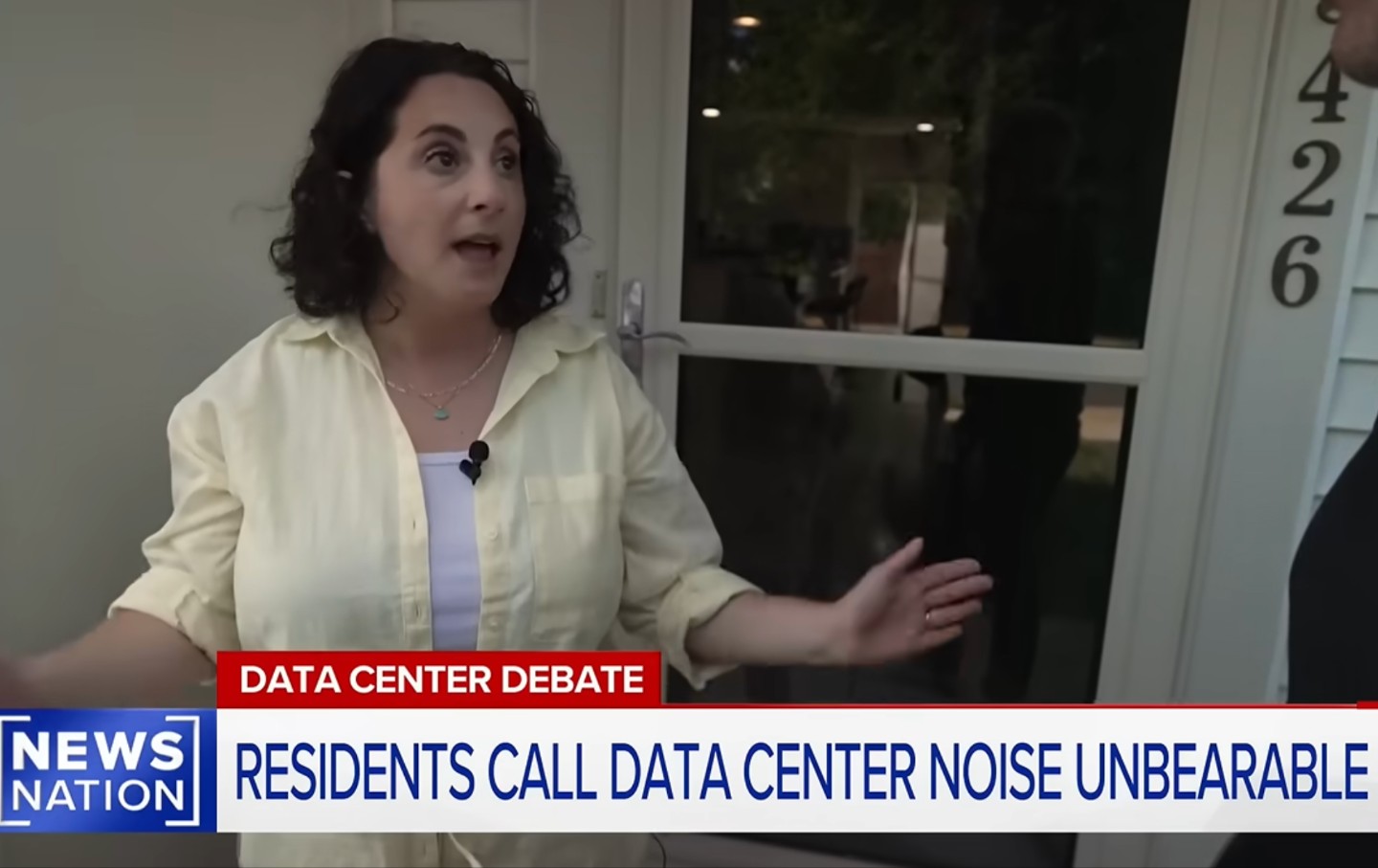
In response to vehement opposition, on May 27, La Pine, Oregon’s city council unanimously nixed the sale of public land to a developer called Boxminer. City and county residents showed up en masse at council meetings (the mayor characterized it as a “pitchforked riot”) to voice concerns about energy and water use and the irritating 24/7 humming noise they’d heard recordings of from existing data centers. One member of the public, wearing a red Trump hat, suggested that data centers “chose small towns because they are easier to manipulate the people.” But Boxminer picked the wrong small town.
In his due diligence report to the city council, La Pine’s city manager questioned Boxminer’s promise of “up to” 200 high-tech jobs, suggesting that, while more information was needed, the actual number might be more in the vicinity of five. And, in measured language I’ll paraphrase more bluntly here, he cautioned against counting on job growth from an industry hell-bent on replacing humans with AI.
Two thousand and six hundred miles from La Pine, the Southwestern Virginia Data Center Transparency Alliance is fighting against proposed data centers in seven rural counties. Left, right, and center, many residents of these counties worry that data centers’ notoriously heavy use of water and energy will threaten their water supply and put a dent in their wallets.
Last month, Hill County, Texas, placed a moratorium on data centers. On June 1, Cedar Hill, Tennessee, population 304, followed suit. I could go on for pages, but it’s the same story where’er I roam: Small towns are worried about the impacts and are not buying the promise of jobs, tax revenue, and other goodies developers dangle. At least 48 local moratoriums are in place, 33 of them in rural municipalities.
Not all rural residents are against data centers. Some welcome the tax revenue and relatively high-paying jobs. If the data center is located in an industrial zone or, better yet, an abandoned brownfield, perhaps the economic benefits outweigh the downsides.
Thirty-six states are wooing data center developers with tax exemptions. In Virginia, data centers in “distressed localities” that make a minimum $70 million capital investment and create at least 10 jobs are exempt from sales and use taxes. The giveaway, which amounted to $1.9 billion in 2025, is the subject of a heated battle in the state legislature. If it’s not resolved by the end of the month, it could lead to the state’s first-ever government shutdown.
Industrial tax exemptions are premised on the expectation that the economic growth and tax revenue will exceed the amount of forfeited tax revenue. But the math often doesn’t add up. An audit in Virginia concluded that the state was getting back 48 cents on the dollar.
The numbers are even worse in Georgia, where the state brought in only nine cents on the dollar. According to Good Jobs First, Georgia is on course to lose $2.6 billion in state and local sales tax exemptions during the current fiscal year.
In an unexploded bombshell of a paper, Michael Hicks, director of Ball State University’s Center for Business and Economic Research, calculated that net tech sector and construction job growth in Texas between 2020 and 2024 was zero. Jobs weren’t added—they were transferred, from other parts of the tech and construction industries to the data center sector. Hicks concludes, “What is very clear from the results of these causal estimates of employment effects is that fiscal incentives for data centers cannot be justified on the grounds of job creation.”
Popular
“swipe left below to view more authors”Swipe →Dubious economic benefits aside, the data center land rush is swallowing up prime farmland and pricing out would-be farmers. The area surrounding Hillsboro, Oregon, blessed with some of the richest soil in the world, used to be dotted with farms. Today, its 21 data centers have earned it the nickname “data center alley.”
According to Aaron Nichols, a Hillsboro vegetable farmer, land prices have soared out of reach thanks to the data center boom. Nichols’s 15-acre farm employs 10 people and feeds 550 households who subscribe to its Community Supported Agriculture program. His dream of expanding by another 30 acres has run headlong into speculators holding on to land in hopes of a gigantic payout.
Ida Huddleston, the 82-year-old matriarch of the Kentucky family that turned down the $26 million offer, said, “They call us old stupid farmers, you know, but we’re not. We know whenever our food is disappearing, our lands are disappearing, and we don’t have any water.”
I’m with Ida. I need food and water more than I need extra cloud storage or AI assistants. As far as tech oligarchs are concerned, the more time we spend online and the more human tasks we offload to robots, the better. No, thank you.
Become a Sustaining Donor This September
Between the reemergence of right-wing red-baiting and Donald Trump’s use of the chilling National Security Presidential Memorandum–7 to criminalize left political organizing, we’re seeing McCarthyism reborn before our eyes.
This assault on democracy cannot be ignored or wished away. Resisting it requires bravery in the face of threats and repression, a steadfast commitment to the truth, and the unwavering belief that we can—and will—overcome this darkness.
We must have an independent media that sets the record straight, unearths corruption and abuses of power, and advances a politics of justice and dignity for all if we’re to win this fight.
That’s why I’m writing to you today. This September, The Nation needs to add 100 monthly donors to sustain our progressive journalism. Your contribution makes the next investigative report, the next truth-speaking column, and the next pathbreaking essay all possible.
I hope you’ll support our work with a recurring donation today. If you donate $10 or more a month, we’ll send you a brand new “Hands Off the Free Press!” sticker to recognise your commitment to our cause. Please, donate today.
Onward,
Katrina vanden Heuvel
Editor and Publisher, The Nation
More from The Nation
The Impossible Will Take a Little While: The Power of Persistence The Impossible Will Take a Little While: The Power of Persistence
In troubled times, history offers a lesson: Seemingly impossible change can begin with ordinary people who refuse to give up.
Gloria Steinem’s Many-Splendored Feminist Life Gloria Steinem’s Many-Splendored Feminist Life
The feminist icon lived the struggle for gender equality and always found time to lend support and solidarity to other women leaders, even in her final days.
No, Woke 1 Was Not Crazy No, Woke 1 Was Not Crazy
AOC and others are laughing off 2020 as a wild, isolated moment. None of that is true.
How Occupy Wall Street Still Explains Politics Today How Occupy Wall Street Still Explains Politics Today
It sowed the seeds for a new era of social movements—but its politics of powerlessness should act as a cautionary tale.

Abdul El-Sayed’s Win Is a Landmark. But the Fight Is Far From Over. Abdul El-Sayed’s Win Is a Landmark. But the Fight Is Far From Over.
Even though the Palestine movement is on the march, we can’t afford any complacency.

Mamdani’s Team Redefined Political Video. Now They’re Betting on Short Films. Mamdani’s Team Redefined Political Video. Now They’re Betting on Short Films.
Premiering exclusively in The Nation, a new short film produced by City Hall and narrated by Morgan Spector highlights the efforts of the biggest tenant-led union in New York City...

