
Columbia Expelled Student Protesters for the First Time in Over 50 Years. But Activists Won’t Back Down.
On March 5, protesters were arrested after dozens formed a sit-in at Milstein Library to demand the reinstatement of three expelled students.
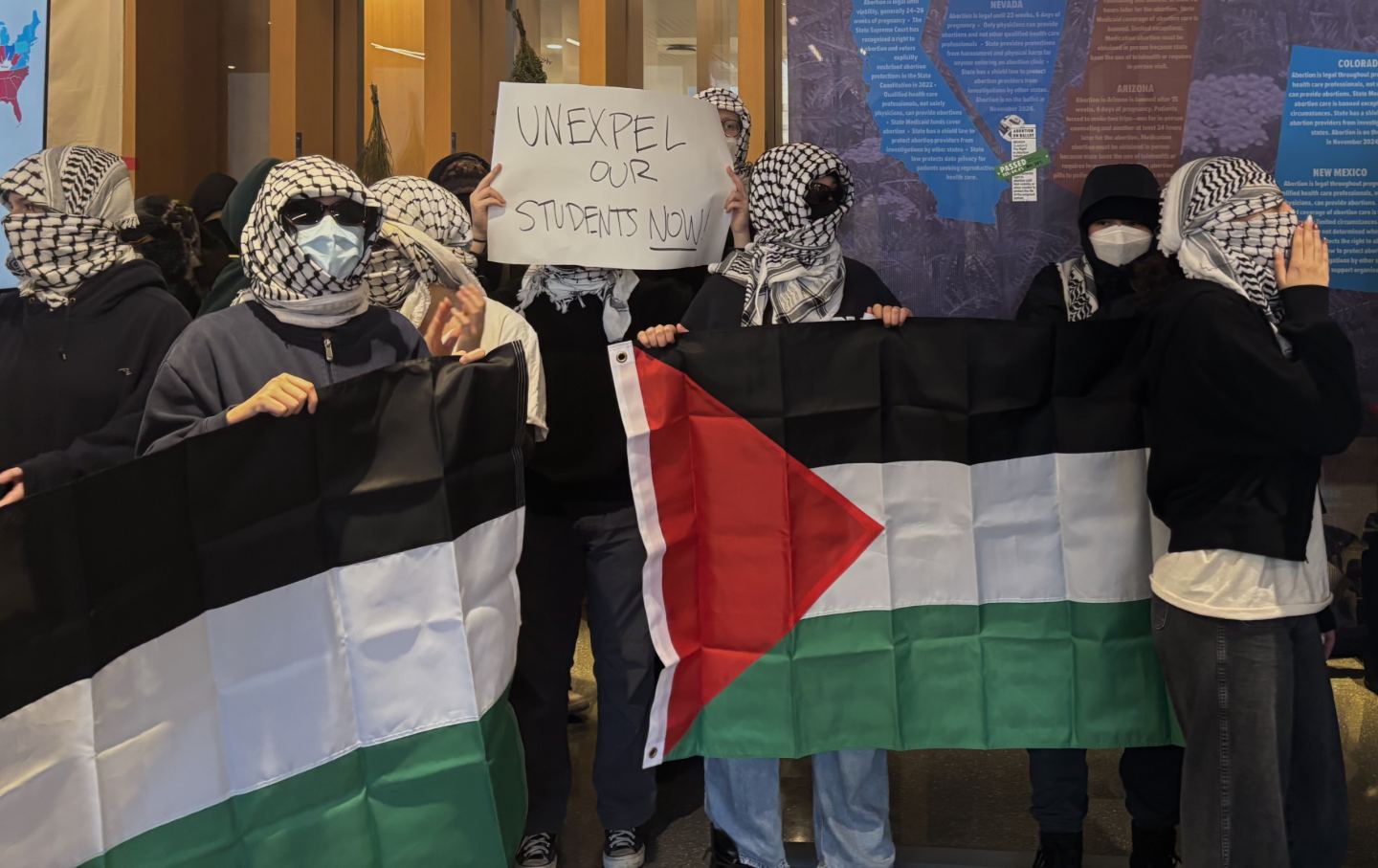
Students staging a sit-in at Milstein Library on March 5.
(Lara-Nour Walton)
Barnard College of Columbia University has now expelled three students in less than two weeks. On February 21, the school expelled two protesters for allegedly disrupting a course on the History of Modern Israel taught by Avi Shilon, a former IDF soldier. The latest expulsion, issued on February 28, is the first directed at a participant of the Hamilton Hall occupation, which took place on April 30 last year.
This is the first time in 57 years that the university has expelled anyone for protest, and the only official expulsions associated with Israel’s war on Gaza. Columbia University Apartheid Divest notes that this string of harsh punishments is “completely unprecedented,” noting that the last expulsion for nonviolent political protest was in 1936 when Robert Burke was expelled for rallying against Columbia’s ties to Nazism.
The last recorded expulsions for non-peaceful demonstrations were in 1968, when students fought against the Vietnam War and Columbia’s gentrification of Harlem by occupying buildings and taking a dean hostage. Even then, acting Columbia President Andrew W. Cordier advocated “maximum leniency” in the cases of the nearly 400 arrested and reinstated more than half of the suspended students.
In following years, 1972, 1985, 1987, 1996, and 2016, students have engaged in sit-ins, multi-building takeovers, and blockades over issues of public concern—including American foreign policy, South African apartheid, on-campus racism, and the university’s associations with the fossil fuel industry—without suffering the same disciplinary outcomes as those opposing Israel’s war on Gaza. Indeed, the punishment of these earlier activists, who engaged in similar forms of protest as pro-Palestine demonstrators, included disciplinary warnings or being forced to write apology letters, or led to dropped charges. No repercussions approached the severity of expulsion facing protesters today.
“Students have a right to protest in all settings, including academic ones, particularly when those protests center liberation movements and call for universities to divest from genocide and warmongers,” a CUAD spokesperson told The Nation. Columbia University did not respond to a request for comment.
At Barnard, “I was told countless times the value of voicing my opinions and standing up for what I know to be true and good,” one of the students facing expulsion said. “The fact that my removal has taken place so baselessly, simply because I believe that a holocaust of the Palestinian people is unequivocally wrong has completely shattered the illusion of what I thought Barnard stood for.”
In response to Columbia’s historic expulsions, a national petition to reinstate the expelled Barnard students has garnered more than 120,000 signatures. Campus actions have also swelled accordingly. CUAD held an over-six-hour sit-in on February 26, with roughly 100 Barnard and Columbia students demanding that the university reverse the expulsions, provide amnesty for those disciplined for their pro-Palestine activism, hold a public meeting between activists and Barnard administrators, and abolish the college’s opaque disciplinary procedures. During the sit-in, which took place outside of Barnard Dean Leslie Grinage’s office, demonstrators reported being physically assaulted by “really aggressive” public safety officers.
The students left the sit-in “only after Barnard agreed to negotiate over expulsions”; however, organizers claim that the school “reneged on these terms 25 minutes before negotiations were set to begin the next day.” The following afternoon, CUAD assembled a university-wide sick-out protest calling, once again, for Barnard to reinstate expelled students.
On March 5, dozens of students staged a sit-in at Milstein Library, rechristening it “Dr. Hussam Abu Safiya Liberated Zone” in honor of a Gazan hospital director who the Israeli military arbitrarily detained in December of 2024. The disruption was a continuation of the February 26 action, which called for the reinstatement of expelled pro-Palestine students. Before the sit-in hit the one-hour mark, Barnard administrators—including executive vice president for strategy and chief administrative officer Kelli A. Murray, and vice president of community engagement and lifelong success A-J Aronstein—passed out “final” disciplinary notices informing participants that they were “in violation of College rules and policies.”
Activists proceeded to rip up the flyers and tossed the shreds into a recycling bin. “The university has never pursued expulsion…for Zionist students. Even when hundreds of reports have been made with undeniable evidence,” said one activist with a bullhorn.
In January of 2024, two Israeli students sprayed a chemical agent at a Gaza solidarity rally resulting in several hospitalizations. Neither was expelled. Instead, they were both suspended for 18 months and, in April, one of the two perpetrators sued Columbia leading to a reduction in discipline to probation and a $395,000 settlement payout.
Around 4:50 pm, amid a suspicious bomb threat and torrential downpour, the New York Police Department streamed onto Barnard’s campus, pushing out members of the press and arresting nine sit-in participants.
Popular
“swipe left below to view more authors”Swipe →CUAD attributes the recent acceleration of such punitive measures against pro-Palestine activists to the US Department of Justice’s Friday announcement that it will be visiting 10 college campuses that “experienced incidents of antisemitism since October 2023.” Columbia was informed that, pursuant to a Trump executive order, it would be one of the universities on the Federal Task Force to Combat Antisemitism’s docket.
“Columbia and Barnard are cracking down on student protesters to appease the Department of Justice and billionaire donors because they are afraid of losing their funding,” said the CUAD spokesperson. “Barnard handed down an expulsion to one of the students just one day after the Justice Department announced it planned to visit campus as part of a sham investigation into pro-Palestine protest.”
After the university was briefed about the imminent DOJ visit, The Department of Education, the Department of Health and Human Services, and the General Services Administration announced that the Task Force to Combat Antisemitism is also considering Stop Work Orders for $51.4 million in contracts between Columbia University and the federal government, while putting under review the more than $5 billion in federal grant commitments.
Amid mounting student and government pressure, Barnard president Laura Ann Rosenbury wrote an op-ed for The Chronicle of Higher Education asserting that the sit-in was her “line in the sand” and pledged to remove “from our community those who refuse to share our values of respect, inclusion, and academic excellence.” The article said that student activists have “exploited the conflict in the Middle East to try to tear our campus community…apart.”
In response, CUAD said that Rosenbury’s op-ed was “whitewashing the deaths of thousands of Palestinians, financially cosigned by our University’s refusal to divest from weapons manufacturers and Israeli corporations.”
Additionally, “it is she who evicted dozens of students last spring,” CUAD noted—emphasizing the college president’s role in destabilizing the campus community by eliminating over 50 Barnard activists’ access to education, food, housing, and medical care via interim suspension. “Her willingness to demonize protesters whose demands were simple transparency in the disciplinary process, which resulted in the unprecedented removal of…their classmates…should concern current students and alumni alike.”
The Barnard expulsions have set, according to CUAD, a “dangerous precedent” and epitomize the “Palestine exception” to free speech. In light of Israel’s continued onslaughts on Gaza, which most recently include a fatal blockade of humanitarian aid into the besieged strip and violations of the purported ceasefire, CUAD says that “students still feel it is their duty to fight for a free Palestine, and have implemented various methods to dodge Columbia’s repression,” in order to continue the fight.
More from The Nation
The Accidental Activists of Data Center Alley The Accidental Activists of Data Center Alley
These would-be rebels in Northern Virginia joined the fight against data centers mostly to stop the encroachment on their homes and exclusive private communities.
An Effective Movement for Palestine Needs Allies Like Zohran Mamdani An Effective Movement for Palestine Needs Allies Like Zohran Mamdani
In order to build a broad-based coalition, we need to work together—not practice purity politics.
The First Amendment Applies to Concert Stages Too The First Amendment Applies to Concert Stages Too
Protests like that of Macklemore on Palestine should never be silenced by billionaire owners.
France’s Students Won’t Back Down France’s Students Won’t Back Down
Without full-time teachers, temperature-regulated classrooms, or school nurses, French students are turning their grievances into a national movement.
Inside Cornell’s Week of Protest Inside Cornell’s Week of Protest
“We won’t be silenced anymore. Our university needs to start protecting us, like they should’ve with Jane Doe and all other survivors on campus.”
Netanyahu Came to New York. New Yorkers Were Ready for Him. Netanyahu Came to New York. New Yorkers Were Ready for Him.
Scenes from the defiant protest against the genocidal leader’s UN speech.

