
 Reuters Photos
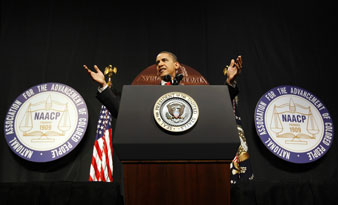
Obama speaks at the NAACP anniversary convention in New York.
In an environment that resembled a revival much more than a conference, the NAACP repeatedly and enthusiastically sought to reaffirm its relevance last week as it celebrated its centennial anniversary. Speaker after speaker insisted, somewhat defensively, that we need the NAACP “now more than ever” and with its young and charismatic new CEO, Benjamin Jealous, the organization made a significant push to court more youthful members. But every speech and presentation was inevitably overshadowed by the most prominent person of color on the planet–President Barack Obama.
Naturally, no event during the week conjured up more anticipation than the president’s address. After nearly six years of being snubbed by George W. Bush, the NAACP’s community was sure to offer a hero’s welcome to the nation’s first black president–and he did not disappoint them. In one of his most emotionally charged, relaxed and almost conversational speeches he proclaimed it was “good to be here among friends.”
This performance truly would halt any pundit opining about Obama’s supposed lack of passion and conviction in their tracks. In front of the first predominately black audience he has addressed since his inauguration, the president did not shy away from tough questions and from examining the ugly side of life in America for people of color.
“I stand here on the shoulders of giants,” declared Obama as he wove through the NAACP’s storied history and name-checked heroes like W.E.B. DuBois and Thurgood Marshall. But after starting with effusive praise for the NAACP, Obama transitioned into his patented nuanced prose. It was the politics of personal responsibility that he preached and while some have argued that the president appears pompous when he delves into these matters–the audience he addressed was grateful for the message.
When Obama speaks to a black audience his voice drops an octave, he allows himself to swagger, he breaks from his script and he appears to genuinely be having a good time. But he was also deadly serious. Too many young black children grow up with an “internalized sense of limitation,” he said, and as minorities grow to become majorities in America, we can not afford to let these children fall behind. He made it clear that what’s needed to improve education will be both more money and more reform.
Popular
"swipe left below to view more authors"Swipe →
“I want our kids to aspire to be a Supreme Court justice, to be the president of the United States,” Obama said to overwhelming applause. He spoke of riding by street corners and seeing the young men presumably dealing drugs and how he often thinks to himself, “there but for the grace of God go I.” He credited the perseverance of his mother, who kept a rebellious and troubled young Barack in line. And he earnestly stressed his personal desire to see “all the other Barack Obamas and Michelle Obamas out there have a chance” to succeed.
Beyond the anxieties of African-Americans, who he acknowledged are “out of work more than anybody else,” Obama mentioned “Latinos made to feel unwelcome in their own country,” “Muslim Americans viewed with suspicion simply because they kneel down to pray to their God,” and “our gay brothers and sisters, still taunted, still attacked and denied their rights.” “We want everybody to participate in the American Dream.” These are all unassailable sentiments, but they have far too rarely been expressed by an American president–so the effect was refreshing, encouraging but also a little bit ambiguous.
The theme of the speech, if so broad and expansive a message can be boiled down, was more or less “no excuses.” There’s no excuse for discrimination of any kind, no excuse for bad parenting, for wage disparity and racial profiling. It was not a lecture or a harangue, more a declaration of principles. However, since we are now in the business of not making any more excuses, what excuse is there for lack of antidiscrimination policy initiatives emanating from the Obama White House? If “prejudice has no place in the United States of America,” as Obama emphatically declared–then why has his administration not just turned a blind eye but enforced the Defense of Marriage Act and the Don’t Ask, Don’t Tell military discrimination policy?
For many progressives the era of making excuses for Obama and accepting excuses from him is rapidly coming to a close. Few could have expected that he would have thoroughly altered the country’s civil rights landscape just six months into his presidency, but even his most skeptical supporters did not expect him to be the foot-dragger in chief on gay rights or legislation that would help poor people of color facing eviction renegotiate bad loans. Amid the cheers and the resurgent hope there is a bit of a bitter aftertaste and the realization that even with a black president it’s not a good time to be black in America.

