Democrats Finally Ran as Economic Populists—Thanks to Newcomers
We analyzed 16 years of Democratic campaigns. The 2026 surge in attacks on billionaires and corruption came from newcomers, not party leaders, and they’re about to remake the caucus.

Rep.-elect Rebecca Cooke (D-WI) poses for a portrait on the steps of the House of Representatives on November 12, 2026.
(Anna Moneymaker / Getty Images)
Ten years after Bernie Sanders’ first presidential run, the left’s argument that economic populism is the way to win back working-class voters has gone mainstream. Within days of the November 3 midterms, a consensus had formed that economic populism was why Democrats won. “The simplest summary,” the New York Times editorial board wrote on November 9, “is that they ran as economic populists and cultural moderates.” The board granted that Trump’s unpopularity was “the main engine” of Democrats’ victories, but in the Times’ telling it was the populist message that allowed Democrats in places like Kansas and Texas to “persuade many voters who previously considered their party unacceptable,” which made their campaigns “a road map” for Democrats.
Along similar lines, Data for Progress titled its post-election memo “How Democrats Rode Economic Populism to Landslide Victory,” concluding that “candidates who ran on bold, economic populist agendas won competitive races.” Senator Elizabeth Warren wrote in Time that Democrats won as “populist economic fighters” who called out the corrupt politicians and corporate interests that had rigged the system.
At the Center for Working-Class Politics, we have spent years urging Democrats to make exactly this turn toward economic populism, ideally delivered by working-class candidates. Economic populism starts with basic economic concerns like affordability, but it does not stop there. It also speaks to the sense that government serves a wealthy few rather than ordinary people. By blaming economic elites and the politicians who serve them, economic populism connects pocketbook concerns with anger about corruption and political unresponsiveness, and promises to take them on.
A 2021 survey we conducted found that economically populist messages did better with working-class voters than the Democratic establishment’s usual fare, and a 2023 follow-up found that “economic populism can help progressives win more working-class voters,” including in Trump country. After the 2024 election, we argued that Kamala Harris had turned away from economic populism at her peril. Last fall, our survey of voters in four Rust Belt states found that economic populism had broad appeal, especially when it named corporate greed and mass layoffs. And this year, an enormous survey experiment we conducted found that Democrats who placed themselves on the side of working people and took on corporate and political elites won more working-class support than Democrats who stuck to more traditional Democratic messaging.
But is it really true that Democrats of all stripes at last took our advice and turned to economic populism in 2026? And if they did, was it incumbents who changed their tune, or a new wave of challengers committed to a break with the party’s past messaging failures? To find out, we measured the populist content of Democratic campaigns going back to 2010.
What we found runs against much of the post-election conventional wisdom. Democrats really did run as economic populists in 2026, a major shift from previous years. But that shift came largely from a new class of candidates, not from incumbents or party leaders like Hakeem Jeffries and Chuck Schumer, whom the Washington Monthly‘s Bill Scher credited with “colossal midterm victories.”
Still, it is much harder to say how much economic populism helped Democrats win in a year when all Democratic candidates rode the same wave. Candidates who ran more populist campaigns do not appear to have performed better than those who ran less populist ones. If economic populism mattered electorally, beyond what might mostly have been a national backlash against Trump, it may have worked by shifting the party’s brand as a whole rather than by boosting individual candidates. What is clear is that the candidates driving this populist shift were disproportionately newcomers, including many who won and will now pull the Democratic caucus in a direction that sounds much more like Bernie Sanders than Chuck Schumer.
Democrats Turned Up the Economic Populist Dial Dramatically in 2026
To see just how differently Democrats campaigned in 2026 compared with past cycles, we scraped and analyzed the campaign websites of more than 6,000 Democratic candidates who ran for Congress between 2010 and 2026. Campaign websites are one place where nearly every candidate lays out what they stand for in their own words, which lets us compare the whole field of Democratic candidates from one cycle to the next.
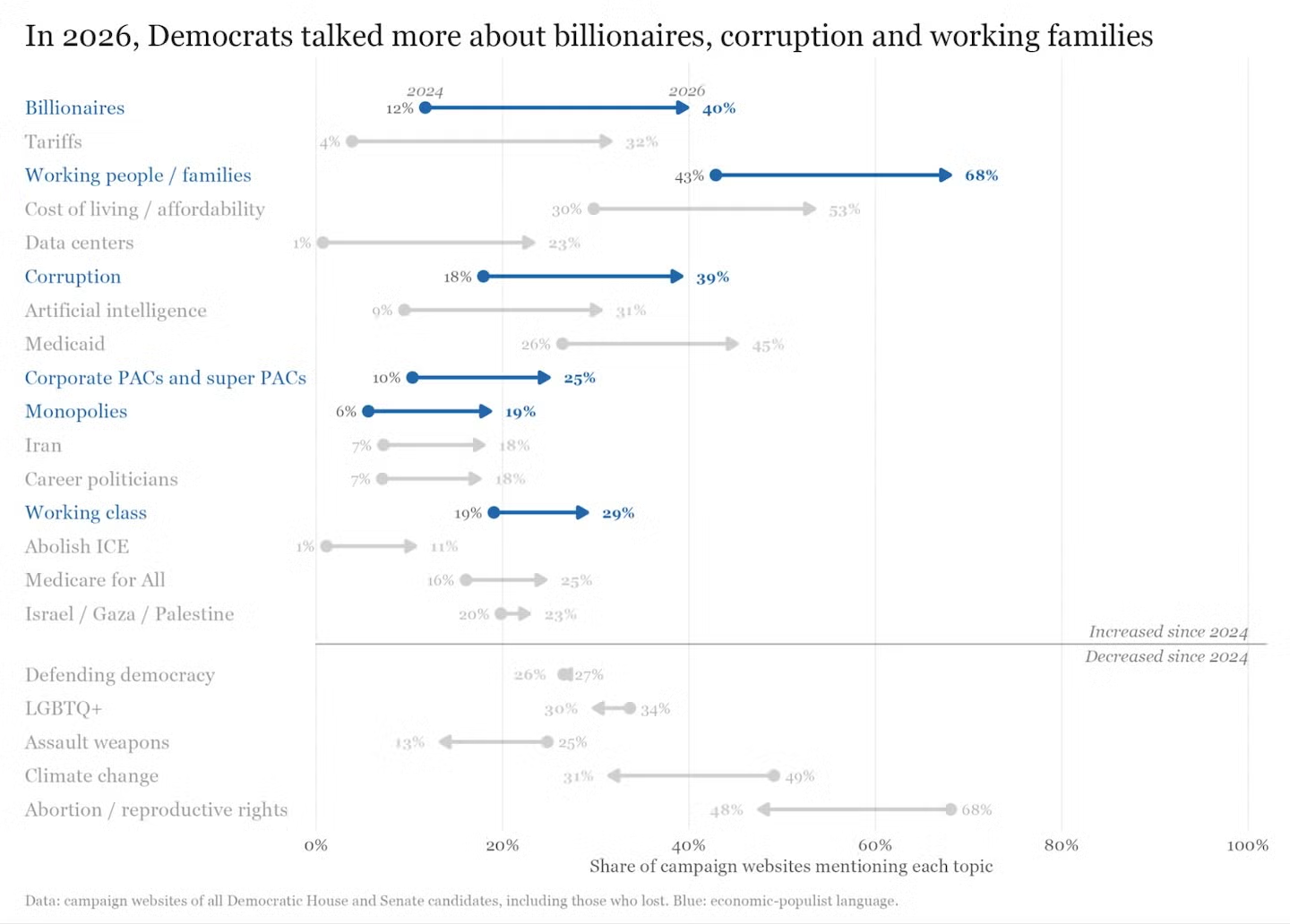
The chart below shows a striking shift from 2024 to 2026. The share of Democrats who mentioned billionaires more than tripled, from 12 percent to 40 percent. Mentions of corruption rose from 18 to 39 percent, corporate PACs from 10 to 25 percent, monopolies from 6 to 19 percent, and working people and families from 43 to 68 percent. Democrats also talked much more about affordability, tariffs, Medicaid, and other economic issues, while abortion, climate change, and several cultural issues appeared less often.
But more talk about the economy does not necessarily mean more economic populism. Economic populist messages also blame economic elites for making ordinary people’s lives harder. So we built a model to identify anti-elite sentences that specifically blamed economic elites, rather than simply attacking Trump or Republicans.
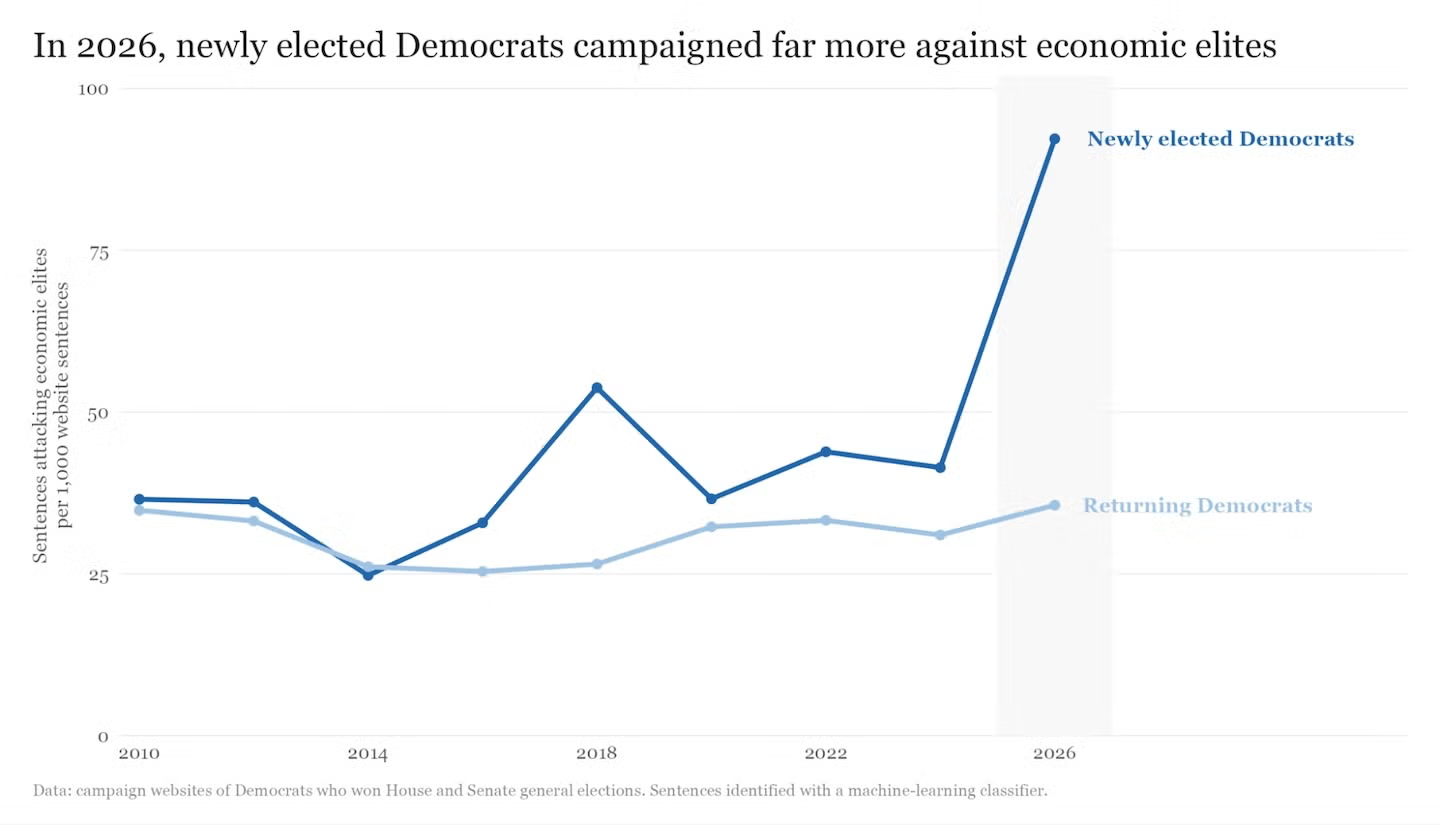
That measure shows an even clearer break in 2026, as well as which candidates drove the surge in economic populism. Among Democrats who won House and Senate seats, newcomers used about 93 anti-elite sentences per 1,000 sentences on their campaign websites, compared with about 36 for incumbents. Incumbents changed relatively little. The big jump came almost entirely from candidates who were not already in office.
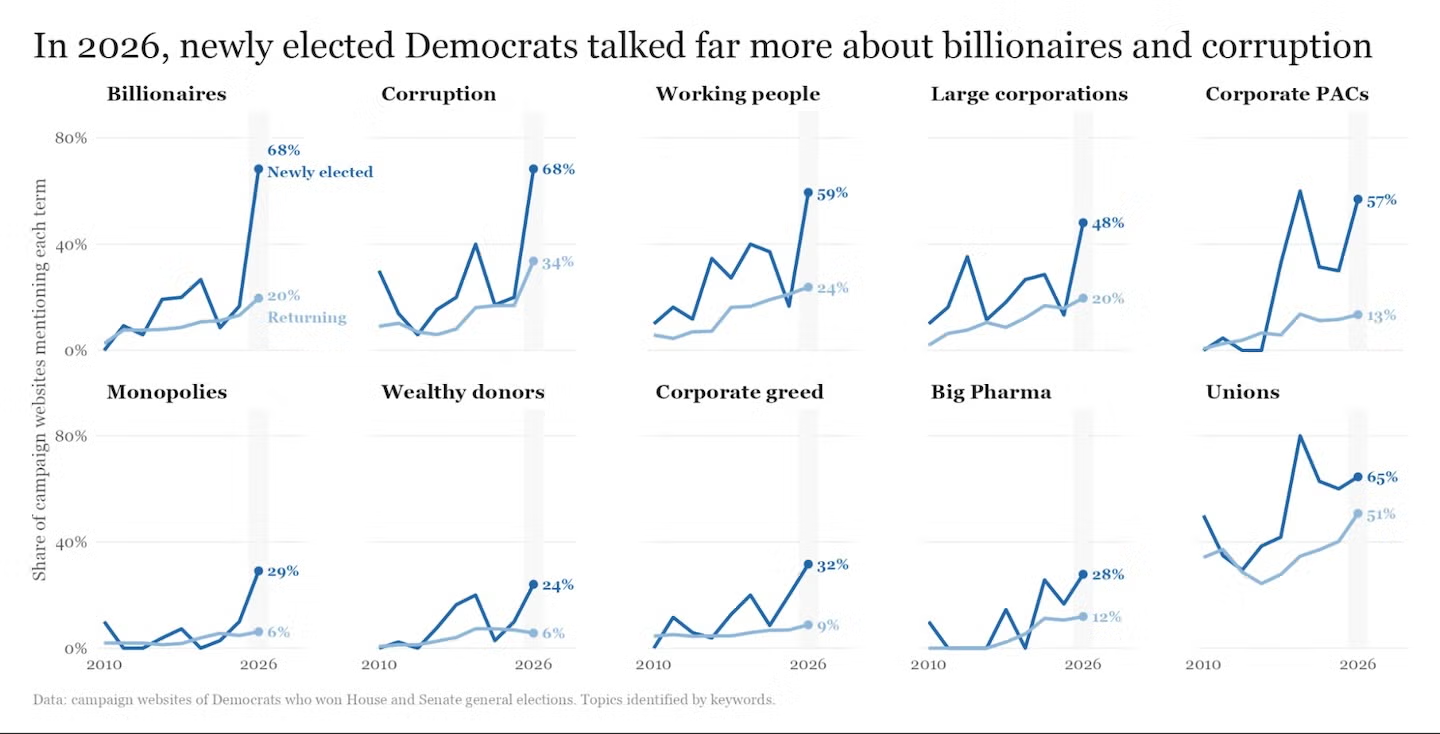
Breaking the pattern down by issue tells the same story. Among Democrats elected in 2026, newcomers were much more likely than incumbents to talk about billionaires, corruption, working people, large corporations, corporate PACs, monopolies, wealthy donors, and corporate greed. This difference appears on almost every economic populist theme we measured.
Popular
“swipe left below to view more authors”Swipe →The sharpest populist shift came from newcomers. Sitting Democrats did not suddenly remake themselves in the image of Sanders. Instead, a new class of Democrats brought a much more anti-elite message with them and will now make up a substantial part of the Democratic congressional caucus.
To be clear, campaign websites do not capture everything candidates do or say, and candidates may strategically emphasize certain issues or types of language on websites that they wouldn’t foreground in higher-stakes settings like paid media. So we also collected a much broader set of campaign materials for the 56 Democrats in the most competitive House and Senate races, including ads, debates, press releases, and social media posts.
In that fuller record, anti-elite rhetoric was widespread: virtually every candidate used economic populist language at least to some degree, 43 percent of the roughly 400 ads we analyzed attacked economic elites specifically, and at least 44 of the 56 candidates ran at least one ad attacking elites of one kind or another. The populist turn was broader than the website data alone suggest. But the websites still show who leaned into it most heavily and made it central to their campaigns: overwhelmingly, the newcomers.
The Most Populist Candidates Did No Better Than Other Democrats
A thornier question, however, is whether individual candidates were rewarded for leaning furthest into economic populism. Much of the post-election commentary assumes they were. The Times editorial board held up candidates like Josh Turek, who won Iowa’s open Senate seat as a self-described “common-sense prairie populist,” and Bobby Pulido, who flipped Texas’ 15th Congressional District after telling voters that “the people in office have sold us out,” as models for the party. Data for Progress went further, concluding in its post-election memo that candidates with bold economic populist agendas had won competitive races.
That is a much harder claim to test. Congressional races differ in all kinds of ways, and in 2026 Democrats everywhere benefited from the same national swing. So we cannot cleanly say how much any one message caused a candidate to do better. But we can ask a simpler question: did the Democrats who leaned hardest into economic populism clearly outperform those who leaned into it less?
Our own research gave us reason to expect a mixed answer. In the large survey experiment we fielded this year, Democrats who put themselves on the side of ordinary people did better with working-class voters than Democrats who used conventional, technocratic language. But once they had done that, adding sharper attacks on economic elites barely pushed voters’ support up any further.
We see something similar in the election results. We sorted nearly every Democratic House and Senate nominee into thirds based on how much of their campaign website attacked economic elites. If turning up the populist dial gave candidates an extra boost, the most populist third should have gained more ground over Harris’ 2024 margin than the least populist third. They did not. All three groups ran about 14 to 15 points ahead of Harris, almost exactly the same improvement. Adjusting for incumbency gives the same result.
In the chart below, we also highlight candidates with working-class backgrounds, shown in green. Democrats elected more working-class candidates in 2026 than in any recent cycle, and our past research finds that working-class voters tend to prefer candidates with working-class backgrounds because they see them as more likely to understand voters’ everyday problems. But here too, there is no obvious electoral bonus. Working-class candidates, while running more economic populist campaigns than the typical Democrat, performed neither better nor worse than expected.
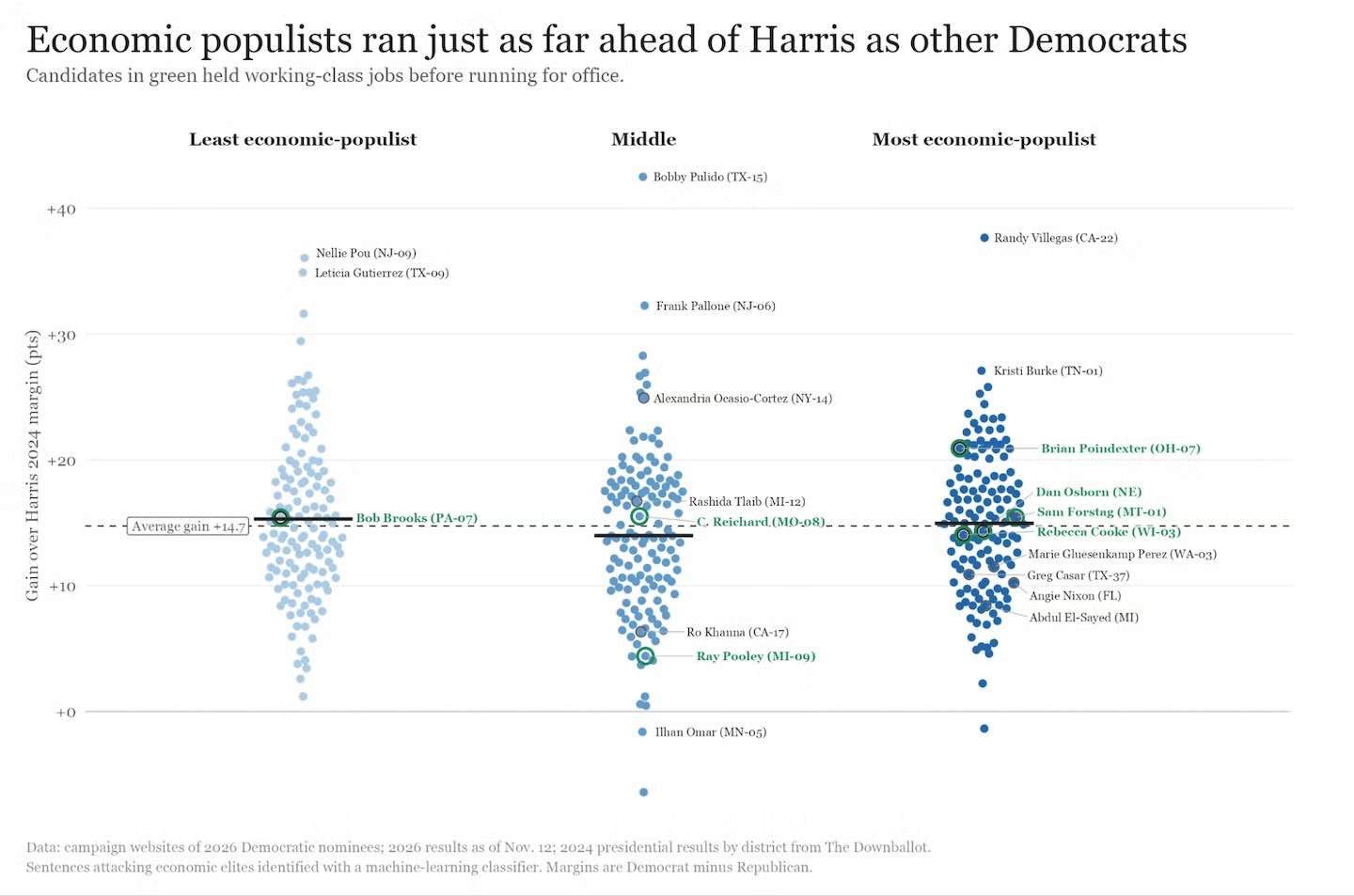
We then looked more closely at the 56 most competitive House and Senate races, where we had much richer data. Here we could also compare each result with what a typical Democrat would have been expected to do in the same race, given the district, incumbency, and the national political environment.
Again, there was essentially no relationship between how populist a candidate sounded and how far they ran ahead of or behind expectations. Our sentence-level measures of anti-elite rhetoric told the same story. Some of the biggest overperformers, including Henry Cuellar in South Texas, were among the least populist candidates in the group, while some of the most populist ran behind expectations.
None of this shows that economic populism hurt Democrats, or even that it did not help them. The comparisons are too noisy for that. But they do show that the candidates who leaned into economic populism most heavily did not clearly separate themselves from the rest of the Democratic field. Whatever economic populism did for Democrats in 2026, it does not look like individual candidates could simply ratchet up their economic populist messaging to win more votes.
Voters Knew Which Candidates Were Working-Class Populists, but Partisanship Drove Their Support
If voters had never noticed which candidates were running as economic populists, it would be no surprise that the populists did no better than other candidates. But our tracker surveys show that many voters did notice.
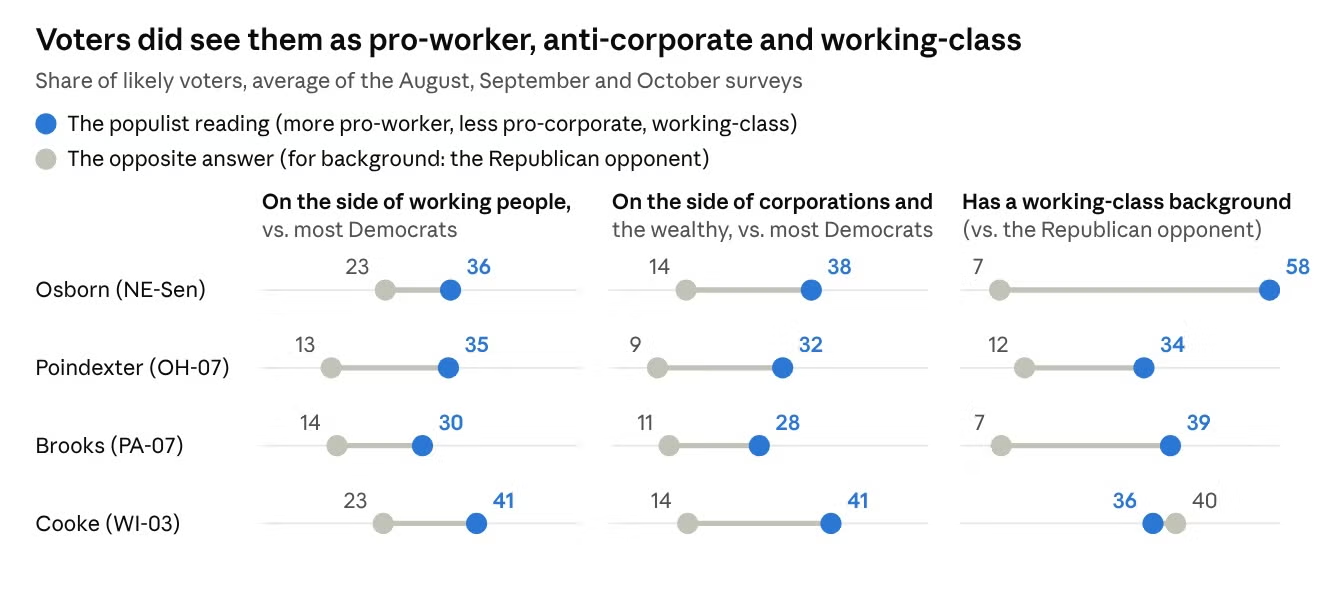
To see this up close, we tracked four races through the fall with The Nation and the polling firm Nira Data, interviewing likely voters each month from August through October. Dan Osborn, an independent running for Senate in Nebraska, Brian Poindexter in Ohio, Bob Brooks in Pennsylvania, and Rebecca Cooke in Wisconsin were chosen because each candidate paired a working-class biography with a campaign built around economic populism. We asked voters whether each candidate was more or less on the side of working people, and of corporations and the wealthy, than most Democrats, and what kind of work they had done before politics.
We found that the candidates’ populist messages and their working-class biographies both registered with the electorate: voters were much more likely to say each candidate was more on the side of working people than most Democrats and less on the side of corporations and the wealthy.
Many voters also recognized the candidates’ working-class backgrounds, though far from all did. In Nebraska, 58 percent said Osborn had done working-class work before politics, compared with 7 percent for Republican Pete Ricketts, and Brooks and Poindexter opened smaller but still sizable gaps over their opponents. The exception was Wisconsin, where Republican Derrick Van Orden, a retired Navy SEAL, was about as likely as Cooke to be seen as working class.
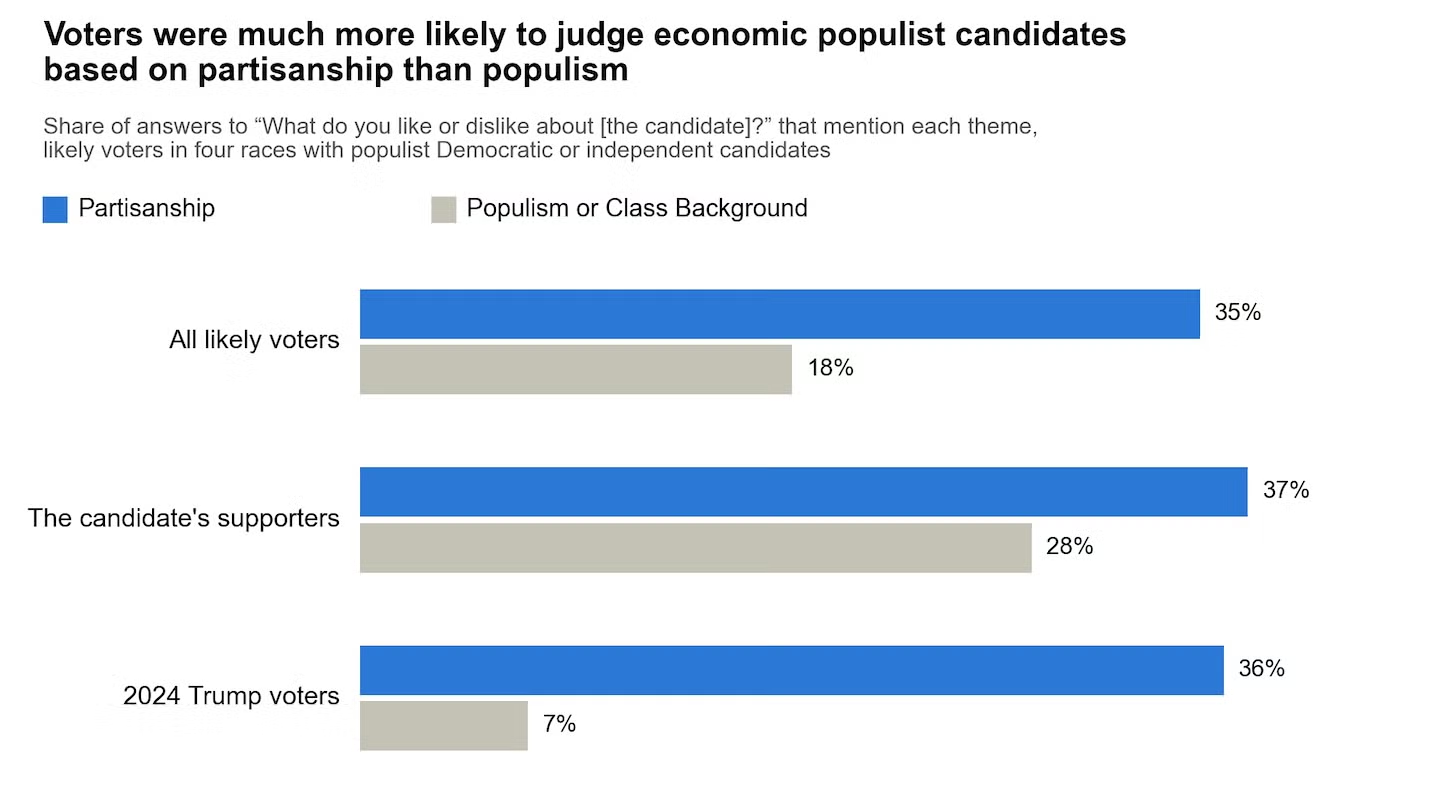
Yet when we asked voters in their own words what they liked or disliked about these candidates, few talked about economic populism or working-class backgrounds. Across the four races, 35 percent mentioned the candidate’s party, Trump, or the Republican opponent, compared with 18 percent who mentioned the candidate’s background or economic populist messaging.
So these candidates’ economic populist messaging did reach voters; many saw these candidates as more pro-worker, less corporate, and more working-class than the typical Democrat. But those perceptions rarely seemed to be the driving force behind voters’ support for candidates. Party labels, Trump, and the candidates’ Republican opponents mattered more.
These results fit a broader story about the election. Trump was deeply unpopular, and much of the Democratic wave was plainly a backlash against him and the Republican Party. CNN’s post-election analysis found that more than three-quarters of voters who backed Harris in 2024 said they used their House vote to express opposition to Trump, while only about a third of Trump’s own 2024 voters said they used their 2026 vote to show support for the president.
When the national political environment is so strongly tilted against the party in power, there is less room for differences between individual Democratic candidates to matter. So the fact that the most populist candidates did not clearly outperform the rest does not mean economic populism was irrelevant. It may simply mean that, in 2026, voters were responding more to the parties as a whole than to which Democrats leaned the hardest into economic populist messaging.
Economic Populism Won Inside the Democratic Party
While it is hard to say how much economic populism helped Democrats win in 2026, it clearly changed the Democratic Party itself.
Voters seem to have noticed the shift at the party level. In Data for Progress’s survey of likely voters in the last days of the campaign, the populist lines Democrats used reached far more voters than their moderate ones, and they did so across party lines.
Seventy-eight percent said they had heard Democratic candidates say billionaires and the wealthy should pay more in taxes, and 71 percent had heard them say big corporations were raising prices to boost their profits. Fewer than half had heard Democrats call for an all-of-the-above energy policy (49 percent) or talk about securing the border (42 percent), and only 37 percent remembered hearing Democratic candidates promise to work with Republicans.
And the messaging shift voters heard showed up in who Democrats sent to Congress. The chart below compares the Democrats serving in Congress after the 2016 and 2026 elections. In 2016, only about 10 percent had mentioned billionaires in their campaigns. Sanders was one of them. By 2026, that share had tripled to 33 percent, with newcomers accounting for much of the growth. Attacking billionaires and corporate power once marked a Democrat as a Sanders insurgent. In 2026, it was something Roy Cooper, Chris Pappas, and Josh Turek’s campaigns had in common with Dan Osborn’s.
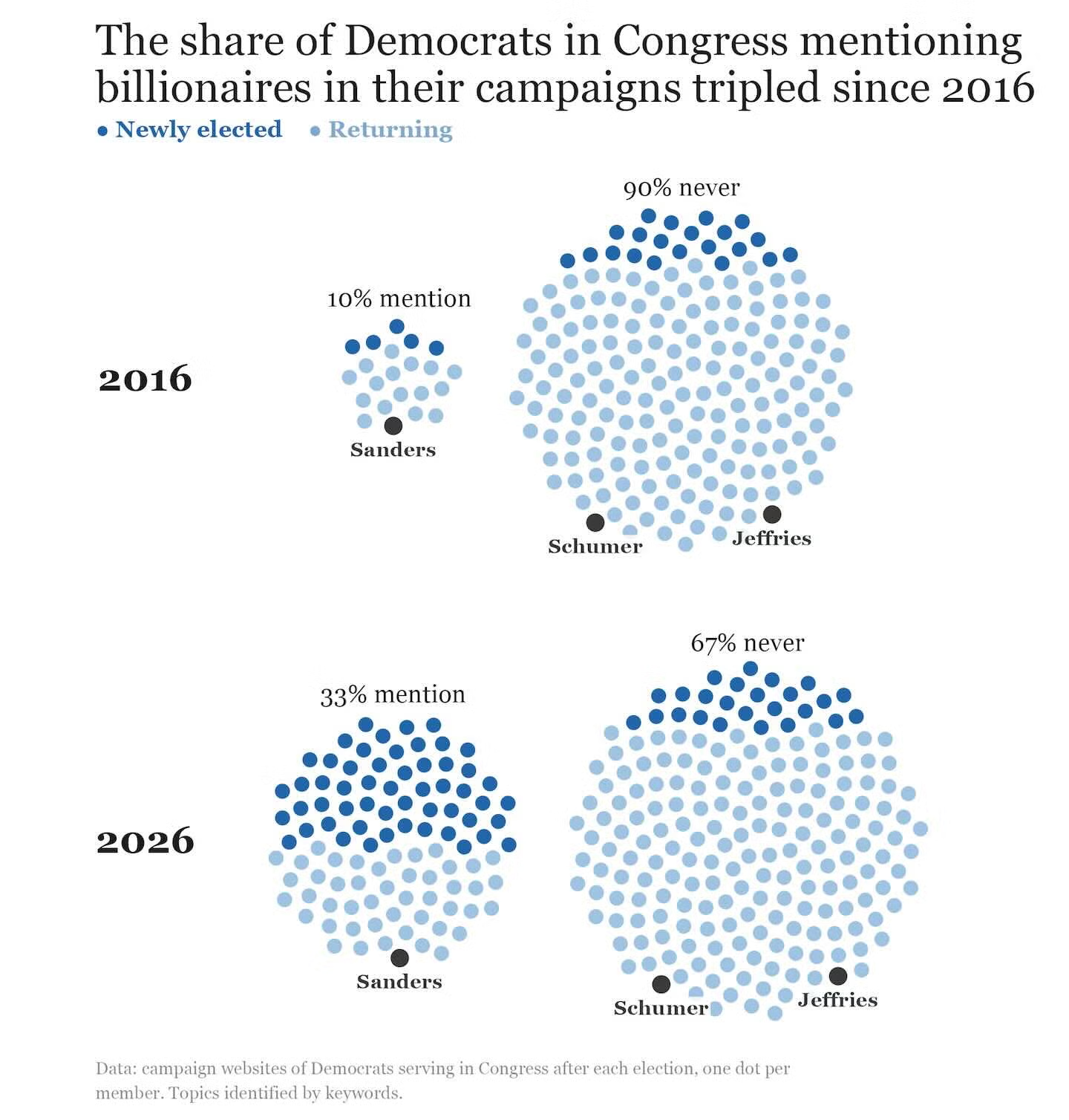
Moving economic populism to the center of the Democratic Party did not happen by accident. Sanders and the movement around him spent years pushing Democrats toward economic populism, as did researchers and organizations like ours. The evidence from 2026 suggests that this effort succeeded in changing how much of the party talks and how Democrats are perceived by voters.
The Sanders wing is no longer a lonely corner of the Democratic Party. It is growing, many of its newest candidates are winning, and its language is increasingly the party’s language. The next question is what Democrats do with that victory.
More from The Nation

Sean Duffy and the Perils of Trump's Made-for-TV Cabinet Sean Duffy and the Perils of Trump's Made-for-TV Cabinet
The Secretary of Transportation was a reality-TV "star" and a Fox Business cable host. But when the American aviation system was grounded, he lost it.
Chuck Schumer Is Yesterday’s Man Chuck Schumer Is Yesterday’s Man
The Senate Democratic leader just keeps showing why he needs to be replaced.

Democrats Should Not Give an Inch to the Lame-Duck Congress Democrats Should Not Give an Inch to the Lame-Duck Congress
In this week’s Elie v. U.S., our justice correspondent makes the case for Democrats to block Trump’s attempt at judiciary-stuffing. Plus, boycott Harry Potter!
Why Progressives Are Backing Chris Van Hollen Why Progressives Are Backing Chris Van Hollen
The senator netted key endorsements from progressives, activists, and unions in his quest to oust Chuck Schumer. But he still faces an uphill battle.

