My Journey Through San Francisco’s Internet Archive
To most people, the archive is just a portal on their computer. But it’s also a physical space made by a person who has never cared more about the preservation of digital history.
I was in San Francisco late this summer, against my will. My husband has family there, and when we visit, we stay at the townhouse in Inner Richmond where his mother, her mother, and her mother before her all grew up. His great-great-grandmother, Carolina, sailed from Genoa to New York in early 1889, and, for whatever reason, continued west—perhaps to farm or to reunite with relatives, though the family only speculates, since the details went unrecorded.
But evidence of her existence is sprinkled all over the townhouse. I am told by my mother-in-law that the interior looks the same as always: the parquet floors and pink-tiled bathroom are a portal to Carolina’s time. There is a metal chute in the kitchen for disposing of gas-stove matches, and a fold-out booth in the hall where you can sit to make telephone calls. We use a plastic lighter these days, and the landline is disconnected, but my mother-in-law ensures that the chute and the booth remain. She lives in Michigan now and becomes more wistful in San Francisco, as if everything there is asking her to remember a time before. In the morning, she asks us over coffee if we heard the foghorns last night: As a child, she had kept her windows open to hear them boom out as she fell asleep.
I love staying there, in that apartment. But I do not love staying in that city. People say that, because I’m Australian, I should like the eucalyptus and the swell from the Pacific. But there are the Teslas and the Waymos and the coolers with blinking faces delivering food that was probably 3D-printed in an automated ghost kitchen. I saw a billboard walking down Geary for a start-up that said “THAT’S SO AGENTIC.” Their CEO had recently posted a selfie with Benjamin Netanyahu on X, while opining about how artificial intelligence is enhancing Israel’s defense forces.
Near the billboard were clusters of people milling about the Safeway parking lot, people in vans with the engines running, and people counting change at the Chinese butcher. I wondered what they thought about being “agentic,” or about self-driving cars and coolers with pixelated heart eyes. I wondered, in other words, how a handful of nerds had terraformed the city, and what their despotic ambitions mean for everyone else. I can ignore that thinking more easily once I am out of San Francisco; it helps to live in a place like Brooklyn, and to work with people who are obsessed with books—people who, I imagine, would also treasure match chutes and telephone booths.
And yet: Just the other day I was chatting with my neighbor, who happened to share that they worked as a programmer at an AI start-up called “Writer.” I did not care to reciprocate what I do for work in response. As we spoke, the precious binary I had constructed between San Francisco and New York began to fray. I had to acknowledge what I already knew: Geographical distance from Silicon Valley is increasingly irrelevant as its political economy widens. But if there are AI people in Brooklyn, there must be people who still read and write books in San Francisco, too, I thought. Which is why I decided, when I was there, to visit the Internet Archive.
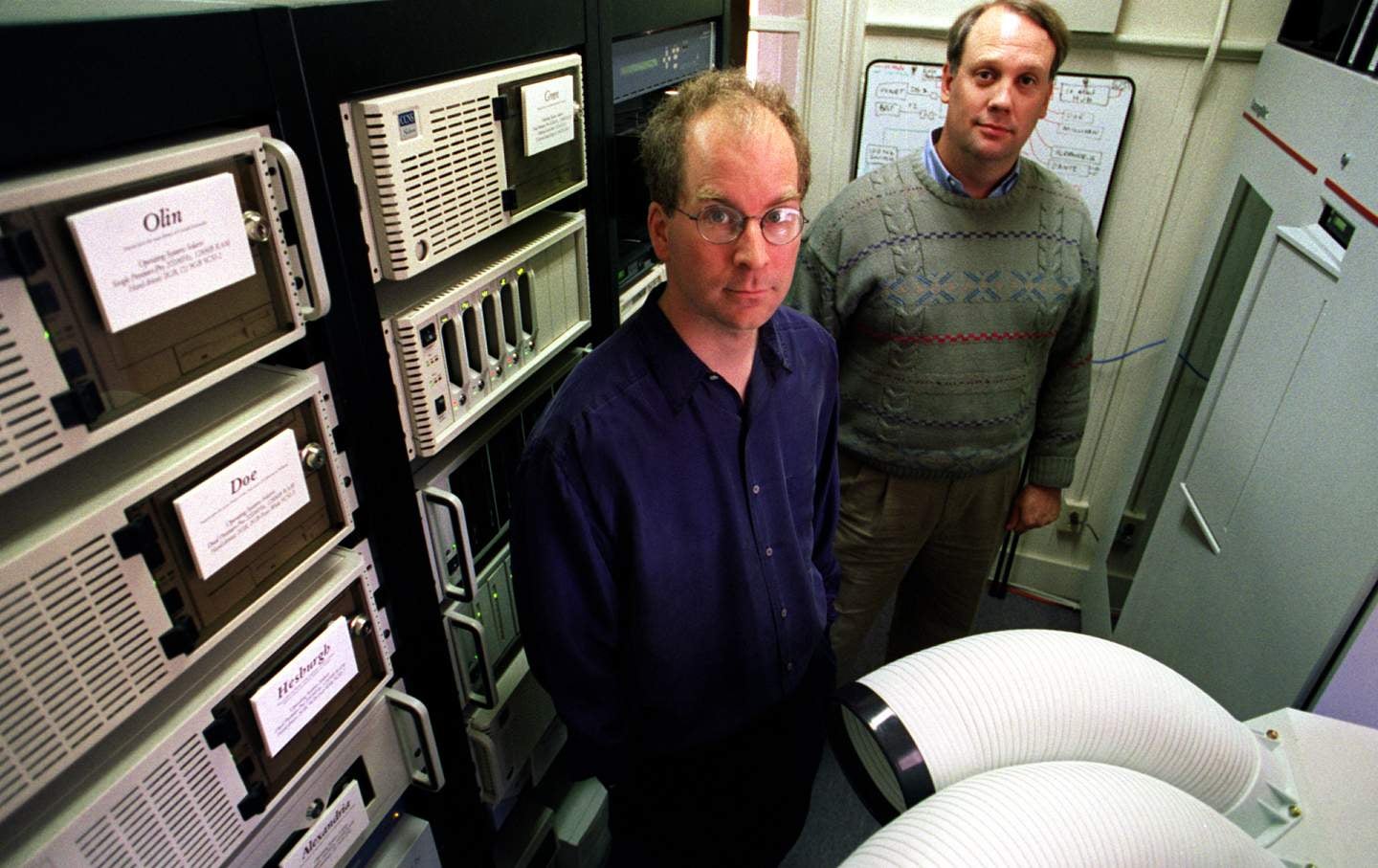
The Internet Archive, a digital library website, began 30 years ago in San Francisco. But in other, less obvious ways, it does not belong to its city of origin. A portion of its servers are housed in a Greek Revival building, formerly a Christian Science church, whose crowning acroteria break with the rows of pastel townhouses. The site was chosen as Archive headquarters for its vast Corinthian columns, which lend it a resemblance to the Library of Alexandria: fated real estate for a nonprofit striving for “Universal Access to All Knowledge,” which its founder, Brewster Kahle, calls “Alexandria 2.0.” When I enter through the iron doors for a tour one Friday afternoon, Kahle welcomes me in belted khakis and thick-soled tennis shoes. He is a bespectacled, ruddy-faced figure, whose general vigor—and frizzy tonsure of gray hair—suggests that he has been electrocuted in a minor, even pleasant way. He remarks, while rising to his tiptoes, that our group is filling out the foyer.
I have technically visited the Archive several times before. On my laptop, I frequently use the Wayback Machine in the process of my research to view old websites and books and magazines. A good portion of the group here, I learn, has also visited the Archive online. So why have all of us pilgrimaged here—some of us for the second time—in real life? Kahle begins the tour by playing an obsolete record on a gramophone; then he shows us, across the foyer, a 1980s arcade game called Prince of Persia. I find myself, improbably, next to a family from Australia, who tell me they planned their visit around a week-long computer programming conference. “What a name,” says their mother, “Brewster Kahle. It’s almost mythical, don’t you think?”
Kahle summons us, like disciples, to ascend to the building’s former nave: a grand rotunda that slopes toward an altar bathed in stained-glass-filtered light. I slot into a pew behind some incoming Berkeley freshmen, who are taking a summer English class titled “Language, Culture, and the Media.” Their teacher has assigned them a list of media-literacy terms to consider: things like “bias” and “deepfakes” and “truth” and further down the page, “power and control.” Kahle walks up to the altar to introduce the Wayback Machine, a software robot that crawls the Internet taking snapshots of what it finds for posterity. Some of its 1 trillion archived Web pages are stored on the servers arranged behind us, black towers that flicker blue whenever someone, from anywhere in the world, is accessing those archives from their device. Kahle loads the machine from his computer and projects his view on a screen that spans the altar. It lights up with scrollable thumbnails—a small sample of the million archived webpages—from which he chooses, at random, the homepage for a wildcat conservation organization in the Netherlands.
Kahle shares that he named the Wayback Machine after a segment of Rocky and Bullwinkle that he watched while growing up in Scarsdale in the early 1960s. In “Peabody’s Improbable History,” Mr. Peabody, a polymath Harvard graduate—and, it bears clarifying, a bowtie-wearing beagle—introduces his human, Sherman, to a gizmo-laden portal. “Open the door and there we are—or were, really,” he explains, walking on all fours through the WABAC Machine into an Ancient Grecian agora. At the Archive, our own Peabody scrolls back in time on his computer, raising bygone versions of the leopard conservation homepage: a streamlined menu followed by a photo of a leopard followed by blocks of black text on a solid white screen. “Here we are,” he says, “a good 1990s look,” as if we followed him through the portal. “The idea is to help people see what the world really looked like in the past.”
In the 1990s, Kahle was in the midst of moving from Cambridge, Massachusetts, to Menlo Park. He had studied at MIT and was working at Thinking Machines Corporation, where he spent the ’80s devising a system to connect their supercomputers to one another in an “interconnected network”—literally an early version of the Internet. With Wide Area Information Servers, or WAIS, you could search through text that was indexed on that network, and receive a list of documents ranked according to how they matched. By the end of that decade, Kahle was looking to California, with intentions to take his system to the market.
Then Tim Berners-Lee, a British computer scientist, came along with a protocol called the World Wide Web. The Web supplanted WAIS partly because of its streamlined design, which enabled the routine ease with which we continue to browse: URLs offer users a standardized language for describing where files live, and when you visit a file’s address, embedded hyperlinks lead you to others. It’s a system that prevails for good reasons, though it made some real trade-offs, too. WAIS, which became obsolete, was underpinned by a time axis: this enabled “version control,” which recalled past versions of a page. Berners-Lee had at one point considered something similar for his Web. It was ultimately not a priority, as users seemed more excited to access up-to-date information.
Berners-Lee and other scientists have grown more concerned about digital transience, or the way that things on the Internet frequently disappear for good. But Kahle belongs to a group for whom that has always been a priority. He started the Archive from his attic in 1996, a year before Terry Kuny, an information and communication specialist, published an academic article on the possibility of a “digital dark age”—the idea that a lack of information could seriously compromise the historical record. By and large, however, most people were just acquainting themselves with the Internet rather than thinking of how to preserve it, and were thrilled with the prospect of life online as we know it: a place that pulses along in the present without much regard for the past.
Kahle describes these conditions as akin to “standing on shifting sand.” At the altar, he points to the shelves that once displayed numbers of hymns: 314, 404, and 451, for the kind of congregation that gathers these days. Most of our group gets 314: pi. Fewer of us get 404: the code for link rot, which is when a web page no longer lives at the address that is linked in a URL. Kahle says that the lifespan of a Web page is, on average, 100 days. But the fact of its expiration is only stated when the cause of death is rot, which produces the explicit, if enigmatic message “Page Not Found.” It is far more common, instead, for a page to be simply overwritten, which bears no similar indication that the original page is lost. In these cases, the grain of sand is buried, disappearing permanently without a trace.
As someone who has plastered images of their life all over MySpace and Facebook and Instagram, this comes as a surprising and in some ways welcome fact: Nothing on the web lasts forever—not braces or ex-boyfriends or overpenciled eyebrows. Though I am privy, too, to the ways in which this generates other problems. I edited at The Believer shortly after it had been sold, first to an Internet marketing company, then back to the publisher McSweeney’s: Its online archive contained the essays that lit up my interest, as a teen, in magazines, but during my time on staff were replaced by listicles of sex toys (the marketing company kept contractual rights to the domain). Web pages are, in this way, frequent collateral to commerce. Mountains of data were lost when MySpace, Friendster, and Tumblr reconfigured. I only grasped the implications, however, as magazines moved from print to online, and parts of Hairpin, Catapult, Gawker, and Curbed went dark. These do not include the conscious deletions made at Buzzfeed in 2014, when four thousand older posts were judged to conflict with new editorial standards.
No one from our tour group correctly guesses 451: the specific kind of rot that occurs when a page is removed for legal reasons. Downstairs, where the tour concludes over tubs of ice cream from Mitchell’s, I find Kahle savoring a cone of his favorite Macapuno. I introduce myself as a reporter from New York. “Fuck The New York Times!” he blurts out.“Sorry, I mean, I love journalists. But seriously, fuck those guys.”
The outburst seems to reveal the cumulative stress that various media and publishing conglomerates have wrought for the Archive in recent years: it was brought to court for alleged copyright violations, first by Hachette in 2020, then by UMG Recordings last year. The Archive settled with UMG but lost to Hachette in a costly appeal that threatened to bankrupt the organization. Now, news outlets like the Times—and the Financial Times and The Guardian—have limited the Archive from accessing their content. They have argued that the Wayback Machine allows their archive to be mined for LLM training. But Kahle refuses to take this on face value. “Copyright is about fair pay,” he says. “But they don’t care about paying their people. They only care about paying themselves.” Last year, to his point, Reddit gave the familiar reasons when it decided to limit the Wayback Machine from crawling its web pages—all while licensing that content to Google, as data sets, for tens of millions of dollars.
But undermining the Archive at this moment might be especially debilitating to the historical record. While it is typical for new governments to make changes to federal websites, the scope and pace of deleted government data has been unprecedented under Trump. In his first week back in office, more than eight thousand web pages vanished: guidelines for overdose prevention; statistics on hate crimes; research on experimental medicines and vaccines. Analysts observed that the deletions may have been triggered by certain terms: this might account for the wholesale purge of pages about the Enola Gay, the aircraft that dropped the atomic bomb on Hiroshima in WWII. The Wayback Machine was able to catalog most of these otherwise defunct details; it remains the only place where the public can access a detailed timeline of January 6, produced by the Congressional Committee that reviewed the attack on the Capitol.
This is compounded by the ease with which the government has deputized Big Tech. Shortly after the United States sanctioned three Palestinian human rights groups last year, YouTube deleted the accounts that belonged to them, adding to censorship by Meta of thousands of posts of the atrocities in Gaza. Meta was later found to have also complied with the Israeli government, which requested that it censor posts that opposed its involvement in the conflict in Iran. Domestically, Google Maps has deleted reviews of ICE detention centers. Every day provides more reasons, in Kahle’s mind, for news outlets to work with the Wayback Machine: Restricting the public record further undercuts their own goal to distribute information. He reminds me that 451 is also the number of degrees, in Fahrenheit, at which paper is said to ignite automatically—made famous by the Ray Bradbury novel about a government that burns books.
At the end of Fahrenheit 451, a group of exiled “Book People” make their return to a bombed-out city. They are led by a former government fireman. When he makes a fire at their campsite for the night, he considers how those flames will be used for warmth instead of destruction. I had walked into the Archive with a narrow idea of who constitutes “Book People.” As it turns out, many technologists study the Internet because they were captivated, first, by books. Right before the Internet Archive was founded, about an hour away at Stanford, two doctoral students in computer science dreamed of a digital library project. Larry Page and Sergey Brin later founded the company Google. In 2002 they started scanning books under the codename Project Ocean.
Kahle was a vocal opponent of this project, which we know now as Google Books—in short because it was billed as a library while largely privatizing potential public resources. I realize, after we talk, that I cannot simply look for people in this new era of technology who work with books: Sometimes people with books still want to burn libraries down (or in Anthropic’s case, shred them en masse with hydraulic guillotines). The “Book People” I am looking for are preoccupied specifically with libraries, which is another way of saying that they are devoted to the past and to the public—to ensuring that everyone can access the archive. I assumed that most of these “Book People” worked in publishing or media and lived in New York. But I learn in San Francisco that they might look different to how I’d imagined them: They might be engineers or even programmers, more fluent in code than in Classics, but just as committed to the project of preserving history.
Popular
“swipe left below to view more authors”Swipe →Jack Cushman, for example, taught himself programming at 13. (He bought C Programming for Dummies and a computer from Sears on an installment plan.) But he has worked for over a decade at the Berkman Klein Center at Harvard, one of several library institutes that works in tandem with the Internet Archive.
I initially came to Cushman through the Public Data Project, which he established just over a year ago to catalog disappearing government data. Cushman formerly worked as a lawyer, which he went to school for in 2005, driven in part by what was happening at Google Books. “It started to seem like law as much as code controlled what was possible in the world,” he told me over the phone. “They were like: We have all the books of the world and we can’t show them to you because that would be against the law. I remember thinking that was not how that was supposed to go.” A decade later, in 2016, Cushman’s instincts were confirmed: Google won a copyright legal battle in which the courts upheld their right to scan millions of books.
After working for a time in appellate courts—the branch of law that depends, in particular, on referencing what came before—Cushman went to work in libraries, where he continues to use technology for preserving public knowledge. I expected that most of our call would be devoted to the Public Data Project—how much data is missing, and what kind. But Cushman instead gently steers me to think beyond the scope of those deletions. He tells me that the problem goes beyond one administration; It is that we have built, both through code and through the courts, a highly privatized Internet, which conflicts with the very notion of a functional public memory, one that enables future generations to retrieve the information they need.
If the architects of the Internet dreamed of a network of interconnected servers, then “Book People,” like Cushman, are dreaming up a network of interconnected archives: where institutions all over the world work to preserve some slice of history, such that the endangerment of one could be protected by the others. The design problem, in his mind, is not technological in nature. It is how to get working people the resources to continue library work, broadly defined. “It’s not about what kind of hard drive we need to buy for storage,” he says. “It’s about what people need so that they can keep these institutions going.” Berkman Klein is university-funded, and independent donors have enabled Internet Archives to open in Canada and Amsterdam. But the private sector, historically backed by the courts—and in collusion with the Trump administration—requires that funding, and protection from litigation, is pursued through multiple governmental channels. (Places like France and Sweden have already sponsored library projects.)
Cushman thinks that we should start looking in places like these to house more archives, where governments are resilient and interested in thinking, not unlike my mother-in-law, about how to preserve the past and pass it down the generations. Though he also thinks the United States should act as a cautionary tale, a reminder about what can happen when administrations change. A truly resilient network of libraries relies on more than one place or a single group of people: beyond San Francisco or New York or even a handful of countries alone. “Of course. there are other places that won’t feel like natural homes,” he says. “But I think it’s still important for us to keep trying, to keep looking everywhere.”
More from The Nation
The End of Russell Brand's Rape Shtick The End of Russell Brand's Rape Shtick
The British celebrity kept reinventing his image to try to cloak his predations.
Scott Colom’s Historic Victory Scott Colom’s Historic Victory
The Mississippi Democrat’s win is more than a joyous occasion—it’s redemption.

Never Let Trump’s Elite Enablers Forget What They’ve Done Never Let Trump’s Elite Enablers Forget What They’ve Done
Universities, scientists, law firms, and many other powerful institutions are about to start pretending they never rolled over for the president. But we know better.
We Have Invited Insane Surveillance Into Our Homes We Have Invited Insane Surveillance Into Our Homes
Aggregated property listings are being weaponized by insidious intelligence outfits. We have ourselves to blame.

How Mona Chalabi Explains Income Inequality How Mona Chalabi Explains Income Inequality
An interview with the data journalist about how she uses numbers and design to illustrate how class weighs on the lives of Americans.
How Did New York Become So Unequal? How Did New York Become So Unequal?
A new history of New York examines how it went from a center of social-democratic experiment to one of neoliberal devastation.