
Faces of Resistance
How ICE still brings fear to Minneapolis.
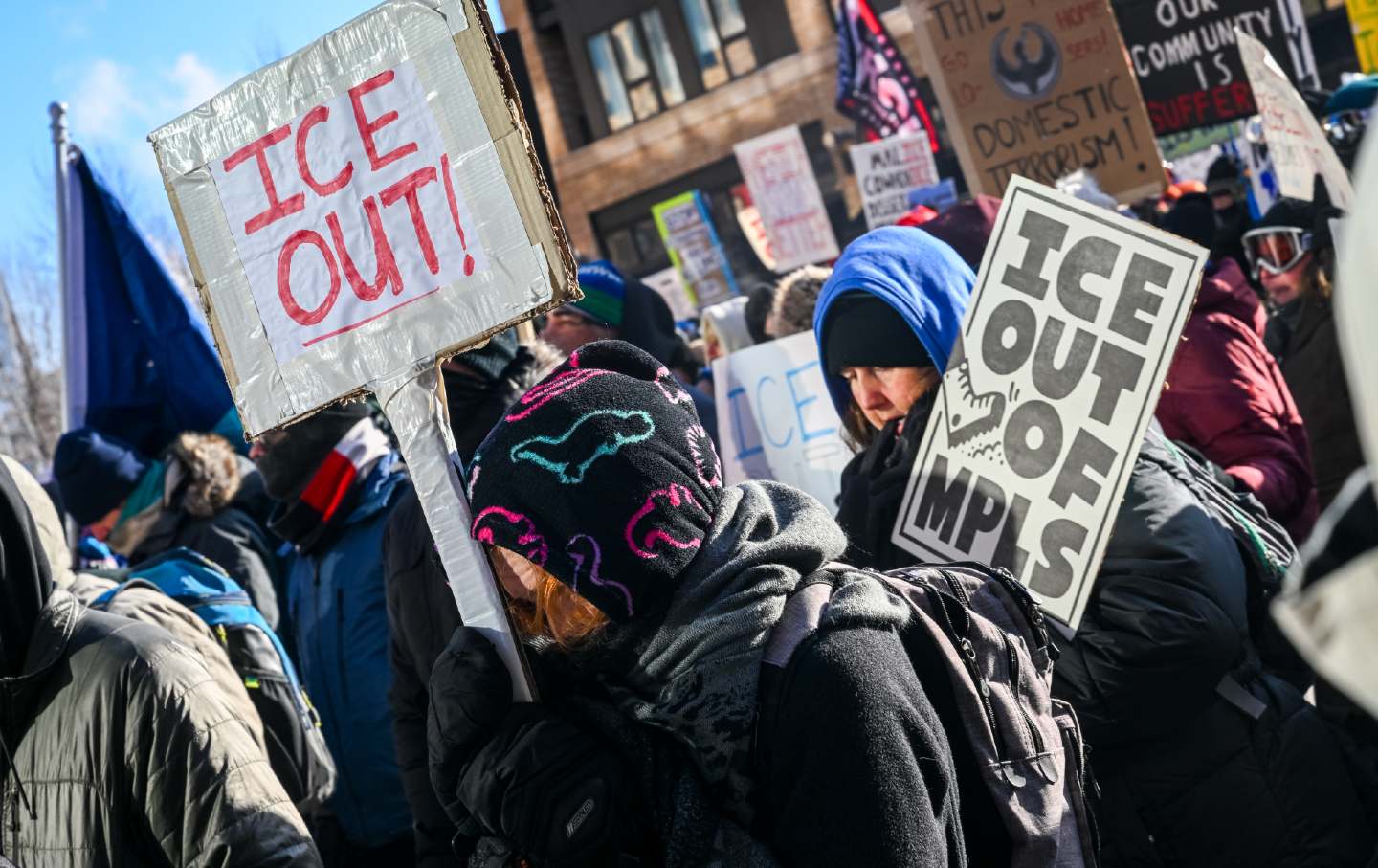
When Operation Metro Surge went into high gear in January, the life of Ana (her name has been changed for her safety) underwent a profound crisis. While she is a US citizen, born in Minneapolis in 2006, she was well aware that she fit the ICE profile: a brown person living in a neighborhood of brown people. She notified her college that she would be taking off a semester, a setback to her ambition of becoming a physician. She had no choice. ICE was everywhere—stopping traffic, waiting for parents to pick up their children at school or daycare, watching at the mall, small businesses, markets, parks.
Her father, who is undocumented, was working at a restaurant when ICE agents entered and interrogated the manager: “Where are the immigrant workers?” Her father called home. “If you don’t hear from me or if I don’t come home, it’s because ICE agents are in the restaurant,” Ana remembers him whispering. He slipped out the back door and never returned. He made it home and did not leave the house for four months. Ana’s mother, who works the graveyard shift cleaning offices, stayed home as well. They were terrified.
One morning, an ICE agent, dressed in what looked like an Amazon deliveryman’s uniform, banged on the front door. Her parents remained still and did not answer. They heard him trying to break into the garage. He left, but his attempted intrusion sent a shudder through the family. “They wouldn’t even take out the trash,” says Ana.
During this period, Ana was busy around the clock. She took and picked up her two younger siblings at school daily. She bought the family groceries, medicines, and other necessities. Their family’s small savings were dwindling fast. Even today, debts from that time are still owed.
Her family was not alone. Ana’s mission extended to six other families, fulfilling their needs as well. She checked Facebook posts daily to know where, and where not, to go. Many Hispanic households in the neighborhood were in hiding at home, including one with a pregnant woman in dire need of doctor visits, trips also undertaken by Ana.
The killing of Renée Good, on January 7, sent a shock wave through the community. The message was clear: No one was safe. After the killing, Ana recalls thinking, “I could only imagine what they would do to me.” News of a toddler used as bait to lure his parents from their home added to the pervasive atmosphere of fear.
Ana’s father’s best friend—“like an uncle to me”—also undocumented, was picked up by ICE in January and put in detention. Later, he related his harrowing experience there, like so many stories told about ICE detention facilities across the country. He told of being held for six weeks in a cell with 30 men, one sink, and one toilet. The meals were inedible, disgusting. Finally he self-deported to Mexico, “dropped in the middle of nowhere,” as he told Ana’s father. All his belongings were left behind. His earnings from work had supported his family back home in Mexico for decades. His life, like so many, was consumed by hard work and family.
Not one immigrant Ana’s family knew had a criminal record. In fact, according to The New York Times, October 10, 2026, “Homeland Security data shows that arrests of people with no criminal record soared over the summer.” This essential fact went largely unnoticed. National Public Radio’s On the Media program reported on October 9, 2026, that “coverage of ICE has decreased since the spring, while the agency’s operations have quietly surged.”
The stress at Ana’s house was overwhelming. Her father could not stop crying, telling her he felt he had put the family in danger. “He could not stop apologizing,” she says. Today, months later, Ana’s mother still incessantly hears the whistles observers blew to warn of the presence of Operation Metro Surge agents.
Ana continued a 9-to-5 job at a retail shop. The family needed money, and her earnings were keeping them afloat—barely. Her mother insisted Ana carry not just her passport but her birth certificate, too.
On one occasion, when Ana was driving, she stopped behind a car where two Hispanic men were being extricated by ICE agents and handcuffed. She could see that the men spoke no English. She rolled down her window, offering to help translate, and an ICE agent started to pull out his gun, looking directly at her. She froze, raised the window, and waited for the ICE vehicle to leave.
Sandy Hood was in touch with her daughter, Leah, in early January, after the shooting of Good. Leah Hood teaches English as a second language at a college in the Twin Cities. Nearly all of her 25 students, a majority of them Hispanic, failed to turn up after the Christmas break. She understood. Operation Metro Surge was at full throttle, and Hispanic residents of Minneapolis, whether they were undocumented, green-card holders, or even US citizens, were staying home if they possibly could. They were learning by word of mouth and social media about the intensity of the ICE presence in their city—initially 3,000 agents acting with a presidential mandate to capture thousands of immigrants and process them for deportation.
Sandy’s husband is a sixth-generation Iowa farmer, now growing corn and feed. Sandy retired as a high school history teacher in the nearby town of Independence, population 5,000. There were just a few Hispanic students in her classes over the years. Nevertheless, what her daughter was relating profoundly affected her. “I believe in justice and treating people kindly. This feels like a leap backward into the 1950s,” she says.
After the shooting of Good, Sandy and her husband decided to drive up to Minneapolis to assist their daughter in her efforts on behalf of immigrants besieged by ICE. They stayed for a month and later two additional weeks delivering groceries, “rice and beans and fruit.” Sandy says, “They were so humble and thankful.” Once, in a trailer court, she observed severe poverty and “school-aged kids not in school.” She learned that many had no heat, “layering up instead.” Both she and Leah handed out winter clothing.
Popular
“swipe left below to view more authors”Swipe →Leah recalled a few years back when armed Proud Boys showed up at a school board meeting. They were “intimidating and scary.” That incident had stayed in her mind, in stark contrast to her experience with the Hispanics she taught—some teens, mostly adults. Their decency was apparent; her respect for their desire to learn and be part of the community was profound.
By the end of February, Leah had handed out her entire life savings—desperately needed cash to housebound immigrants to pay rents, utility bills, and other necessities. Like Ana, she delivered food and medicines to immigrants, took their children to and from school, and accompanied them to doctor visits.
Leah showed no hesitation in joining in the civil disobedience in the streets. “It was remarkable to stand up to an authoritarian force. We are regular, everyday people who had to be involved.”
By March, Leah was exhausted. The ICE patrols no longer at the school remain “vivid memories.” “People were beaten and kidnapped,” she says. Some students were deported.
After the killings of Renée Good and Alex Pretti, Leah says, “We came out of our houses and we stood face to face against these agents and we said, ‘Not here!’ I understand that what happened here is of historic importance.”
ICE agents remain in Minneapolis. Reports of immigrant disappearances continue. Minnesota’s economy has felt the effects. According to the Immigration Research Initiative, “the level of employment among US-born workers is 25,000 lower than it would have been [without Operation Metro Surge].”
In mid-September, Ana noticed that ICE activity had returned to her neighborhood. Still, Ana’s mother had to go back to work. The family was drowning in debt. Ana drove her to the 1 am shift cleaning offices and picked her up at 6 am. “She would pray before going to work.”
“Voting is our way out of this,” Leah says. “This is the most critical election in my lifetime.” She is an election judge, a city-appointed citizen working as a volunteer to “help ensure that the process of voting is lawful, smooth and fair.” Voting is sacred to her.
Sandy says it was a “terrible shame” that Iowa turned over voter lists to the US Department of Justice. “I’m nervous about GOP cheating, not accepting the results if it doesn’t go their way.”
“It’s crucial for people to go out there and vote,” says Ana, who has yet to go back to school. Instead, she is working the phones, telling people that their vote counts. Intensive calling starts October 27, and she’s on board.
More from The Nation

Gina Hinojosa Is Showing Democrats How to Run Against Republican Grifters Gina Hinojosa Is Showing Democrats How to Run Against Republican Grifters
The Democratic gubernatorial candidate has closed the gap in Texas by focusing relentlessly on Greg Abbott’s corruption.

These Working-Class Populists Are Struggling to Win Over the Working Class These Working-Class Populists Are Struggling to Win Over the Working Class
And more insights from the second edition of our Economic Populist Tracker.
When Government Fails, Working People Pick Up the Slack When Government Fails, Working People Pick Up the Slack
This is happening in every working-class and poor community across the country.
We Were Warned in 2001 We Were Warned in 2001
Science-fiction nightmares are now current events.

2028 Democratic Hopefuls Take on Data Centers 2028 Democratic Hopefuls Take on Data Centers
Data center opposition can foster a bigger Democratic tent by aligning red and blue, and rural and urban communities.

