
What’s the Matter With Effective Altruism?
President Trump has decried the techbro creed for indulging in AI doomerism, but its excesses are far worse than that.
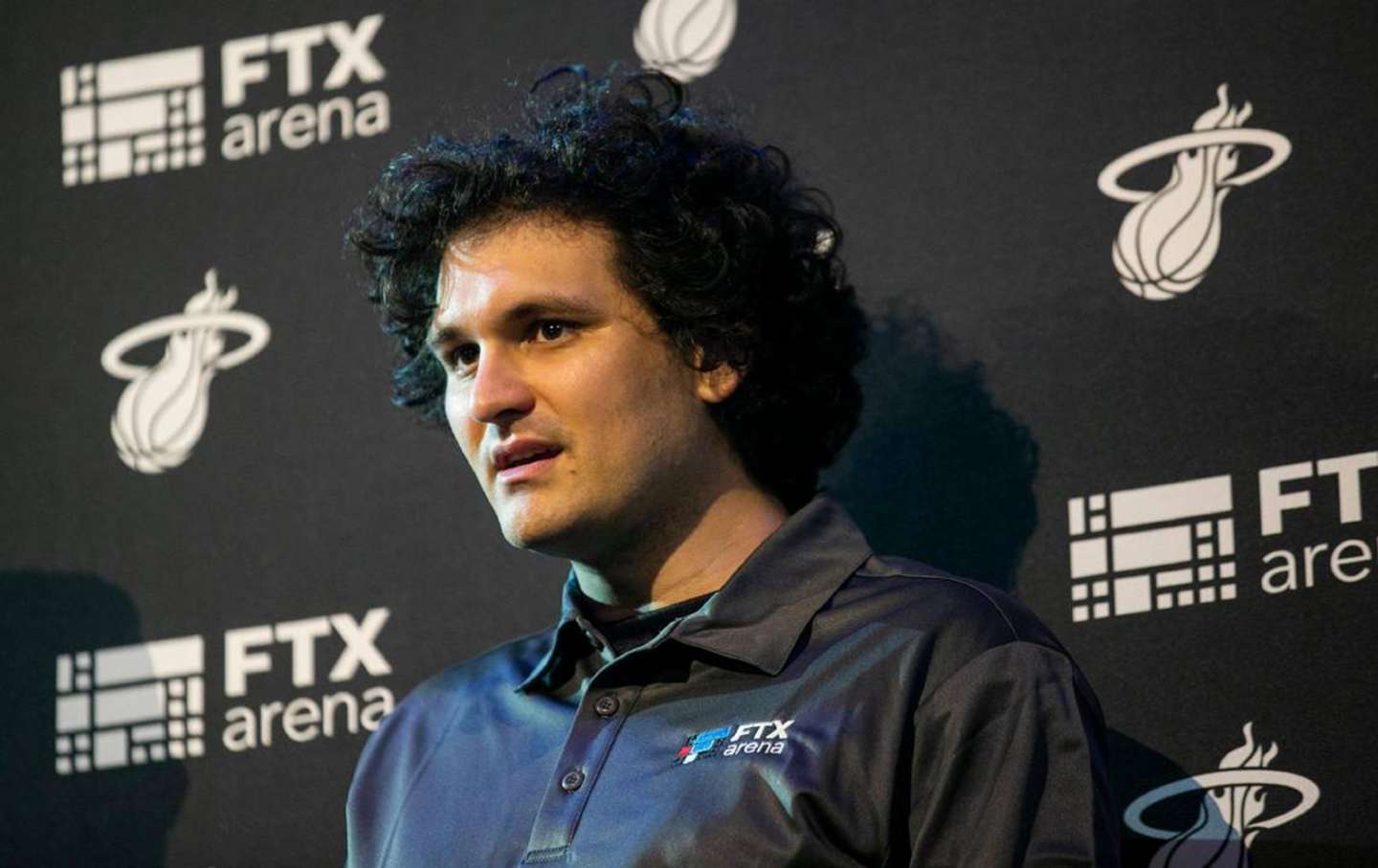
Effective altruism’s fraud-addled poster boy, Sam Bankman-Fried, at a 2021 press conference in Miami.
(Matias J. Ocner / Miami Herald / Tribune News Service via Getty Images)President Donald Trump may not know much about economics; hence his recent chatter suggesting that buying things from other countries is like throwing money down the drain. But he does seem to grasp one central feature of today’s economic scene: Any slowdown in the AI spending that has been propping up an otherwise tippy economy would make the stock market very sad. And if there’s one thing we know about Trump, it’s that he doesn’t much like it when the stock market is in the doldrums.
So on Monday of last week, after Anthropic CEO Dario Amodei’s musings on the need to “pace” AI development sent chip stocks and other investments predicated on the massive buildout of data centers plunging, Trump began railing about the evils of AI doomers—and indeed, anyone not appropriately gung-ho on his brand of AI accelerationism. He claimed that AI risk was a hoax, like other supposed hoaxes, including “RUSSIA RUSSIA RUSSIA,” global warming, and something he insists on calling “Transgender for Everyone.”
“There is a SICK conspiracy going on against AI and Data Centers,” he charged, “and the only one that is happy about it is China.” On Saturday he took up the crusade again, insisting that his administration “will not in any way hinder or stifle the Growth of this incredible Industry,” and announcing the imminent creation of an “AI Force,” whatever that may turn out to be outside the overheated cranium of America’s maximum leader.
The Department of Defense, meanwhile, fingered a more specific suspect behind Trump’s claimed conspiracy: a philosophy called effective altruism (EA) that the vast majority of Americans have never heard of. EA began as an attempt to fine-tune the moral logic of philanthropic spending before morphing into something considerably stranger—but we’ll get to that in a moment. The DoD announced the formal beginning of its counteroffensive against EA with a meme on X featuring a photo of Trump with a raised fist and the caption “Americanism, not effective altruism.” Meanwhile, Defense Department Under Secretary Emil Michael dutifully appeared on Fox News to denounce the philosophy as “pretty dystopian.”
Weirdly, this isn’t the first time the Defense Department has taken on the obscure if influential philosophy, which Defense Secretary Pete Hegseth earlier this year dismissed as “defective altruism,” a crack aimed at AI firm Anthropic, widely seen as a bastion of EA true believers, which had balked at the Pentagon’s demand for no restrictions on the use of its AI in its contract with the company.
Indeed, it turns out that the Trump administration didn’t invent this particular conspiracy theory, which has been floating around the fever swamps of the persecution-addled American right for some time. Venture capitalist, podcaster, and former Trump administration crypto and AI czar David Sacks has been making the case against EA for several years now. He routinely decries what he calls the “doomer industrial complex” and suggests that AI companies like Anthropic that talk too much about safety are doing so only to ensure that whatever regulations are coming will disadvantage their competitors. The ultimate aim? You guessed it: “to further ‘Global AI Governance,’ a massive power grab by the bureaucratic state and globalist institutions,” as Sacks put it in an overheated post on X.
Breitbart News and the New York Post have enthusiastically endorsed this conspiracy theory. Breitbart has been especially energetic on this front, charging that “far-left” Silicon Valley billionaires (as if any such creatures can be said to exist) have been pushing EA as part of a globalist conspiracy to take over the world—or at least the world of AI. As Breitbart columnist John Nolte put it in one particularly florid, if also quite repetitive, rant last May, the real “existential risk [of AI] is letting EA reach its sinister globalist goal and the primary goal of all globalists, which is to use scare tactics to convince the free world to give the globalists their desired control over AI in the name of ‘safety and fairness.’”
Three “globalists” in one sentence: impressive.
Elsewhere in the piece, Nolte accuses what he calls “these fascist tech bros” of doing “whatever it takes to further their fascist cause”—a charge that only makes sense if you remember that many on the right like to pretend that fascism is a left-wing phenomenon.
With critics like these, you might imagine that EA would be something pretty great. But alas, the enemy of your enemy can sometimes be a piece of shit.
EA first developed in the late 2000s with the formation of several organizations devoted to promoting what they saw as a more rational and efficient way to do philanthropy. GiveWell offered a sort of cost-benefit analysis of various charities, while Giving What We Can encouraged those with money to pledge 10 percent to charity. The philosophy got a name in 2011 shortly before the launch of the Centre for Effective Altruism at Oxford University in 2012. The practical money-giving side of EA has done some good in the world, raising several billion dollars for charities promoting low-cost interventions like mosquito nets and deworming pills estimated to have saved several hundred thousand lives.
But there has always been something creepy about EA’s militant utilitarianism, a philosophy that can and often does lead to prioritizing ends over means. Advocates of EA have promoted a dubious strategy they call “earning to give”—the notion that would-be do-gooders should take the highest-paying jobs they can in order to have bigger wads of cash to donate (assuming, of course, that this is something they’ll still want to do after becoming filthy rich). Oxford philosopher William MacAskill, one of the founders of the movement, has suggested that it’s more ethical for a hardcore altruist to take a high-paying if morally questionable job instead of working for a nonprofit with the purest of hearts. He personally pitched “earning to give” to a then-undergraduate at MIT named Sam Bankman-Fried back in 2013, and we all saw how that went. (Bankman-Fried, an enthusiastic EA proponent, became the world’s youngest self-made billionaire after setting up the cryptocurrency exchange FTX—and not long afterward was arrested, and convicted of massive fraud; he is now, of course, petitioning the Trump administration for a pardon.)
Far more concerning than the dodgy-in-application strategy of earning to give is an idea first christened “longtermism” by MacAskill and fellow Oxford philosopher and EA bigwig Toby Ord in 2017. The longtermist creed is rooted in the work of yet another Oxford philosopher named Nick Bostrom, who later became somewhat infamous after an old bluntly racist message of his was discovered in 2023, together with philosopher Nick Beckstead, an early EA insider who later ran Bankman-Fried’s charitable FTX Future Fund, before the company’s collapse cut its own future short.
Like EA itself, longtermism seems innocuous at first glance; it proposes that the prime concern of enterprising philanthropists is to consider charitable conduct in the context of the human species’ big-picture survival prospectus. But longtermism is a toxic and deeply bizarre ideology that ranks the well-being of hypothetical humans (or posthumans, as the case may be) billions of years in the future over the lives of people suffering in the here and now. This idea has taken hold of much of EA and the allied, quasi-sociopathic world of AI safety speculation.
Taking EA’s brand of utilitarianism to its deeply illogical conclusion, longtermists argue that there’s just one way to “maximize the expected aggregate value” of the known universe (that is, to recur to the old utilitarian maxim, to generate the greatest total well-being for all human beings combined): We must spread our seed to the stars to provide the greatest possible living space to an almost incomprehensibly huge population. The basic calculus here is more people equates to more happiness—even if many or even most of these humans aren’t themselves particularly happy.
Popular
“swipe left below to view more authors”Swipe →Longtermists, many of them brought up on science fiction, imagine humans hopscotching from star system to star system until we’ve filled the universe with trillions upon trillions of beings. Humans would essentially become a plague on the galaxy, hoovering up planet after planet to build Dyson swarms around every star in order to capture solar energy. They would then deploy this windfall of galactic fuel to power massive computers hosting trillions of digital beings living in elaborate simulations—and perhaps, if we’re lucky, also provide some actual humans with sustenance.
Did I say “humans”? About that: Longtermists seem to generally assume that in the very long term, which is all they are really concerned about, our descendants won’t look much like humanity does today. We will further evolve or genetically engineer ourselves into possibly unrecognizable creatures. We may accentuate our human bodies with technology, becoming cyborgs; we may upload our brains to the cloud and live in simulations; or perhaps most chillingly, we may allow ourselves to be replaced by AI—if we even have a say in the matter. In his book The Precipice, Ord argues that “forever preserving humanity as it is now may also squander our legacy, relinquishing the greater part of our potential.” Instead, he argues, we should cautiously embrace “transformation,” through which “our descendants, however different, could reach heights that would be forever beyond our present grasp.” Almost as an aside, Ord notes that “developments in artificial intelligence [could allow] us to craft entirely new kinds of beings to join us or replace us.” Yes, “replace us”; he seems cool with this.
Longtermists see our present moment as an unusually fraught and critical time in human history. Humans have acquired the capacity to wipe ourselves out with nuclear weapons, engineered plagues, or a massive rollout of AI that turns on us. Longtermists are obsessively concerned with that latter possibility, and while not all of them think that this sort of doom is likely, others consider the risks almost unsurmountable. This leads effective altruist organizations to use money they could be spending on proven life-saving techniques (like mosquito nets and deworming pills, which they still fund) to subsidize AI-safety organizations obsessed with the prospects of doom from misaligned AI. They claim to be against human extinction, but as philosopher and critic Émile Torres has repeatedly pointed out, their opposition melts away in the scenario of handing things over to a “successor species,” possibly a digital one.
As you may have gathered by now, many in the longtermist movement have rather overactive imaginations and are convinced that they are the only ones who correctly understand the dire situation humanity faces today. They become thereby a version of the sci-fi protagonists they grew up admiring—the real heroes who will protect our human or perhaps post-human legacy. There is more than a little hubris here, grounded in the still greater presumption involved in the conviction that you have been vouchsafed the capacity to correctly predict billions of years of future history. (MacAskill couldn’t even predict where Bankman-Fried would be in a few years.) This may all seem a bit familiar to those who have studied, or God forbid been involved in, vanguardist political sects.
The AI hacking incidents reported over the past several months should make clear to anyone who has been doubtful up until now that AI does, in fact, pose real risks. These hazards could be severe or even catastrophic if we decide, as Trump has, to leave the regulation of this tricky technology up to him and to the CEOs of the leading AI labs, who have so far shown themselves to be utterly incapable of taking the necessary precautions. Really, these are the last people in the world who should be tasked to protect us from the increasingly dangerous AIs that they are racing to develop.
Unfortunately, effective altruists—and particularly the longtermists who permeate the AI-safety world today—are unreliable and often alarmist judges of the real dangers. This wouldn’t matter much if AI were really as unimpressive as many AI doom deniers would have us believe. Given the mistakes and hallucinations that AI is still prone to, it may also be easy enough to imagine that AI isn’t very good at hacking. But it is, thanks in part to its inhuman speed and persistence and its prodigious ability to coordinate new projects such as massive hacking initiatives. Unfortunately, effective altruist thinkers are in no way reliable guides to AI’s true risks; they, too, have been outfitted with powers too great for their grids to contain and are prone to hallucination.
Become a Sustaining Donor This September
Between the reemergence of right-wing red-baiting and Donald Trump’s use of the chilling National Security Presidential Memorandum–7 to criminalize left political organizing, we’re seeing McCarthyism reborn before our eyes.
This assault on democracy cannot be ignored or wished away. Resisting it requires bravery in the face of threats and repression, a steadfast commitment to the truth, and the unwavering belief that we can—and will—overcome this darkness.
We must have an independent media that sets the record straight, unearths corruption and abuses of power, and advances a politics of justice and dignity for all if we’re to win this fight.
That’s why I’m writing to you today. This September, The Nation needs to add 100 monthly donors to sustain our progressive journalism. Your contribution makes the next investigative report, the next truth-speaking column, and the next pathbreaking essay all possible.
I hope you’ll support our work with a recurring donation today. If you donate $10 or more a month, we’ll send you a brand new “Hands Off the Free Press!” sticker to recognise your commitment to our cause. Please, donate today.
Onward,
Katrina vanden Heuvel
Editor and Publisher, The Nation
More from The Nation

As Morale Sags, More Military Service Members Are Having a Crisis of Conscience As Morale Sags, More Military Service Members Are Having a Crisis of Conscience
According to multiple GI rights organizations, service members are inquiring in unprecedented numbers about seeking conscientious objector status.

What Remains of Riis? What Remains of Riis?
A new members’ club has revived Riis Park’s long-vacant bathhouse, reopening old questions about whom the People’s Beach is really for.

When Texas Sex Ed Falls Short, Gen Z Women Turn to Social Media When Texas Sex Ed Falls Short, Gen Z Women Turn to Social Media
A 2025 study found that 70 percent of adolescents sought reproductive health information through social media platforms.

Justice for Macklemore Justice for Macklemore
The rapper has been dumped from Ed Sheeran’s tour for saying “free Palestine.” That’s a disgrace.

We Are Living Under Roy Cohnian Logic We Are Living Under Roy Cohnian Logic
The political fixer created a career for himself as a self-promoting, ubiquitous hustler. Like Trump, he got away with it by having the right friends.

Time Has Run Out for AI Risk Deniers Time Has Run Out for AI Risk Deniers
The recent spate of reports about the technology’s destructive power underline two prime directives: Be afraid, and regulate aggressively.

