
We Are Living Under Roy Cohnian Logic
The political fixer created a career for himself as a self-promoting, ubiquitous hustler. Like Trump, he got away with it by having the right friends.
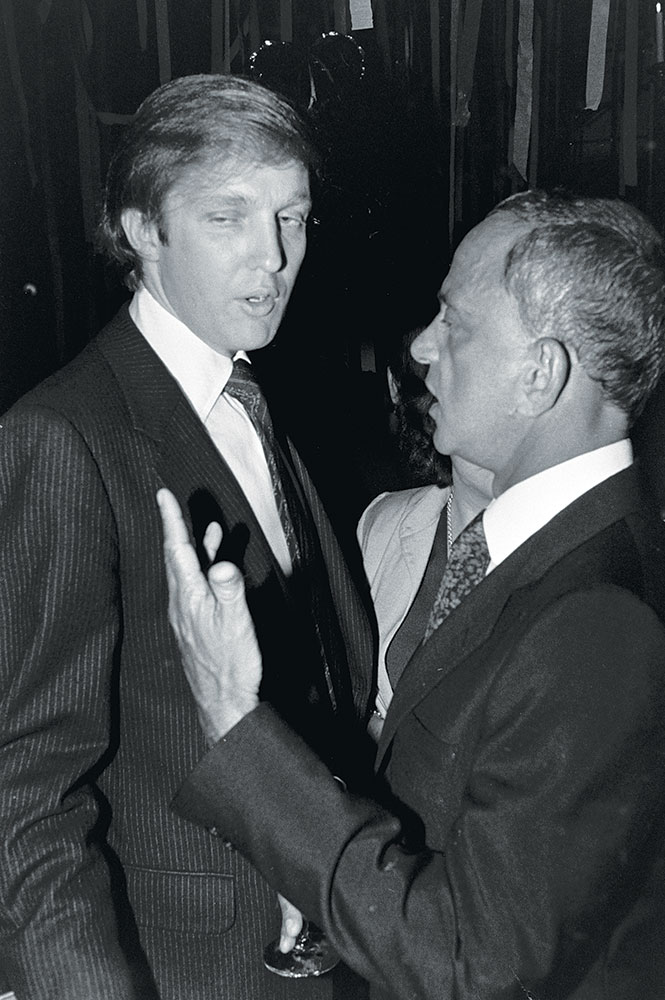
Most New Yorkers, if they remember the name at all, curse the distant memory of Roy Cohn. He died a miserable death from AIDS just 40 years ago, but his ghost has been haunting Americans over the past decade. Back in the 1970s and ’80s, Cohn mentored our current president and taught him his tricks. He molded Donald Trump into both the worst and the most consequential politician of our time. He took us back to the dark side of American political discourse. Only now can we see the direct line between Senator Joe McCarthy and Donald Trump. Roy served as Rasputin for both demagogues.
Some New Yorkers forget about their own complicity in Cohn’s sketchy political project. We forget how much a creature of the Bronx and Manhattan’s Park Avenue he was, and how willingly the city’s elite embraced him. They knew the despicable things he had done during McCarthy’s 1953–54 scourge, but they embraced him anyway. In July 1954, after the 27-year-old chief counsel to McCarthy was forced to resign in disgrace, some 2,000 New Yorkers turned up at a dinner at the Astor Hotel near Times Square—sponsored by the Jewish-American Anti-Communist League—and gave Cohn and McCarthy a standing ovation. This was just the beginning of Cohn’s political rehabilitation.
In the early 1950s, he destroyed the lives of thousands of civil servants: He targeted closeted homosexuals and was the boyish prosecutor who gleefully sent Julius and Ethel Rosenberg to the electric chair. In Washington, he was McCarthy’s attack hound and book burner, known for forcing US Information Service libraries in Europe to purge 30,000 books from their shelves, including titles by Howard Fast and Dashiell Hammett.
Back in New York, Cohn created a career for himself as a ubiquitous, self-promoting hustler, a scheming con man, and a street fighter who somehow always escaped the courts. He could be charming, but he ran what we’d now call a Trumpian “favor bank,” using his photographic memory to keep tabs on who needed what from whom. He was eventually indicted three times for fraud and bribery. (He once brazenly handed an envelope stuffed with cash to a city employee, standing outside the very courtroom in which he was then being tried for said bribery.) And yet, ignoring the evidence stacked against him, New York juries acquitted him in all his trials.
Everyone knew Cohn was a lawyer for the Mafia, representing thugs like Moe Dalitz, Anthony “Fat Tony” Salerno, Carmine Galante, and John Gotti. Many knew he was a closeted gay man and a sex addict who paid high sums to teenage boys for sex. And yet as a powerful lawyer, he hypocritically railed against civil rights for the people whom he called “fags.”
Everyone also knew that Cohn was a racist, who routinely used a Yiddish slur to describe Black people. He left a trail of debts all over Manhattan, stiffing tailors, dry cleaners, and small shopkeepers. He even managed to evade paying the IRS any taxes for the last 20 years of his life and wrote a book calling average citizens “suckers” if they paid the taxman.
But at the time, this didn’t matter. His friends came from New York’s inner circle of influential judges, lawyers, businessmen, and politicians. As the New York Daily News observed in 1979, Cohn “has emerged as the city’s preeminent manipulator. A one-man network of contacts that has reached into City Hall, the mob, the press, the Archdiocese, the disco-jet-set, the courts and the backrooms of the Bronx and Brooklyn, where judges are made and political contributions arranged.”
His network included city politicians like Mayor Abe Beame, Democratic Party boss Meade Esposito, Stanley Friedman, and Andrew Stein. In the 1970s, he called Trump his “best friend” and got the young real-estate developer the tax breaks he needed to build Trump Tower. The judges who routinely socialized with Cohn included Judge Irving Kaufman, Judge Marie M. Lambert, Justice David Peck, Justice Vito J. Titone, and Judge David N. Edelstein. Other friends included media stars Barbara Walters, Cindy Adams, and Walter Winchell, Yankees owner George Steinbrenner, CIA director William Casey, Firing Line’s William F. Buckley Jr., political operator Roger Stone, New York Times executive editor A.M. “Abe” Rosenthal, media baron Rupert Murdoch, Revlon executive Ronald Perelman, lawyer and Harvard professor Alan Dershowitz, novelist Norman Mailer, and dozens of the city’s other luminaries. Every year, Cohn invited 200 of these celebrities to his birthday party, often held at the club Studio 54. They all came, and they all celebrated him—because they all owed him something. They may have privately feared Cohn, but in public, they called him “a lovable rogue.”
Another noted lifelong friend was Si Newhouse, the Condé Nast media magnate and owner of magazines like Vanity Fair, GQ, and The New Yorker. Roy and Si had been classmates at New York’s elite Horace Mann School. They talked on the phone every day. Newhouse’s father had once given Cohn a half-million-dollar “loan” never to be repaid. Cohn fed the notoriously reticent Newhouse the city’s gossip and often managed his social life.
In the spring of 1984, Newhouse read a GQ profile of Donald Trump written by Graydon Carter. Noting that this issue of the magazine had sold phenomenally well, Newhouse quietly suggested to Jason Epstein, his editor at Random House—another institution he owned—that perhaps Trump should “write” a memoir. Newhouse knew, of course, that Trump was a protégé of Cohn’s. “There’s no question the Trump thing was Roy’s idea to Si,” recalled Peter Osnos, then a recent hire at Random House. So Epstein took a meeting with Trump and signed him up to write what became The Art of the Deal in 1987. It quickly became a national bestseller and turned the once-parochial New York developer into a national figure.
“My father got the idea that Trump would be a person of interest to book buyers,” recalled Newhouse’s daughter Pamela Newhouse Mensch. “He was right. Can you imagine? Between Roy and my father, they put Trump on the map. That’s a heavy burden to walk around with these days.”
Cohn deeply resented New York’s intellectuals, its universities, and particularly its white-shoe, elite law firms. “I’ll never have the goodwill of the establishment, the tastemakers of New York.” That was Trump in 1990—echoing his mentor’s hatred of the establishment.
Popular
“swipe left below to view more authors”Swipe →America once had a bipartisan establishment that managed to instill a certain civility in our rough-and-tumble democracy. It’s gone. Today, Cohn’s values—or lack thereof—and his right-wing political resentments have replaced the values of that establishment. It is as if Joe McCarthy had become president: The drunkard senator from Wisconsin later inspired Cohn, and Trump, to tap into the raw populist emotions that have long festered in American society. All three were serial fabulists, shamelessly making up stories to stoke tabloid headlines. They uncorked political resentments against immigrants, intellectuals, scientific expertise, feminists, and most particularly, Blacks and any other non-white minority.
They have taken us to America’s irrepressible dark side. And ironically, New Yorkers always let them get away with it. After dining with Cohn once in 1984, Osnos exclaimed: “Rarely have I met a man whose face was not clearer about what he was…. But what is it about us, that allows a Roy Cohn to navigate in a world, the world of New York, the world of the Hamptons? What is it? I consider it corrupting. They don’t. It’s about money. It’s about access. It’s about a certain glamour. You want to always be identified with the red-hot center.”
More from The Nation
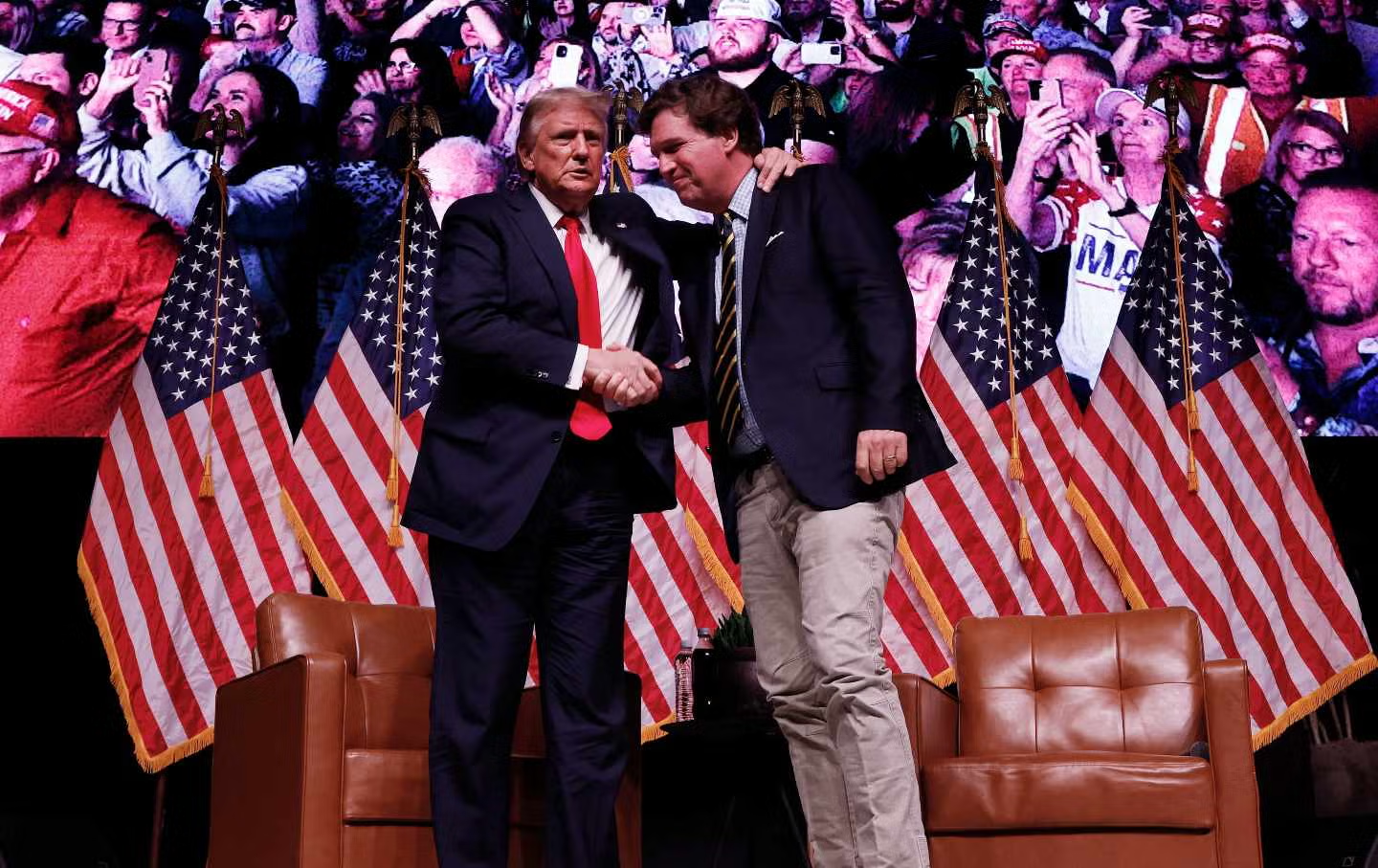
What Trump and Tucker Carlson Have in Common What Trump and Tucker Carlson Have in Common
Carlson has broken with Trump largely over the war in Iran. But on Ukraine and immigration, the two speak very much the same language.

The Jewish Case Against AI The Jewish Case Against AI
Haredi rabbis and the secular left agree: This technology is a threat to the entire social fabric.
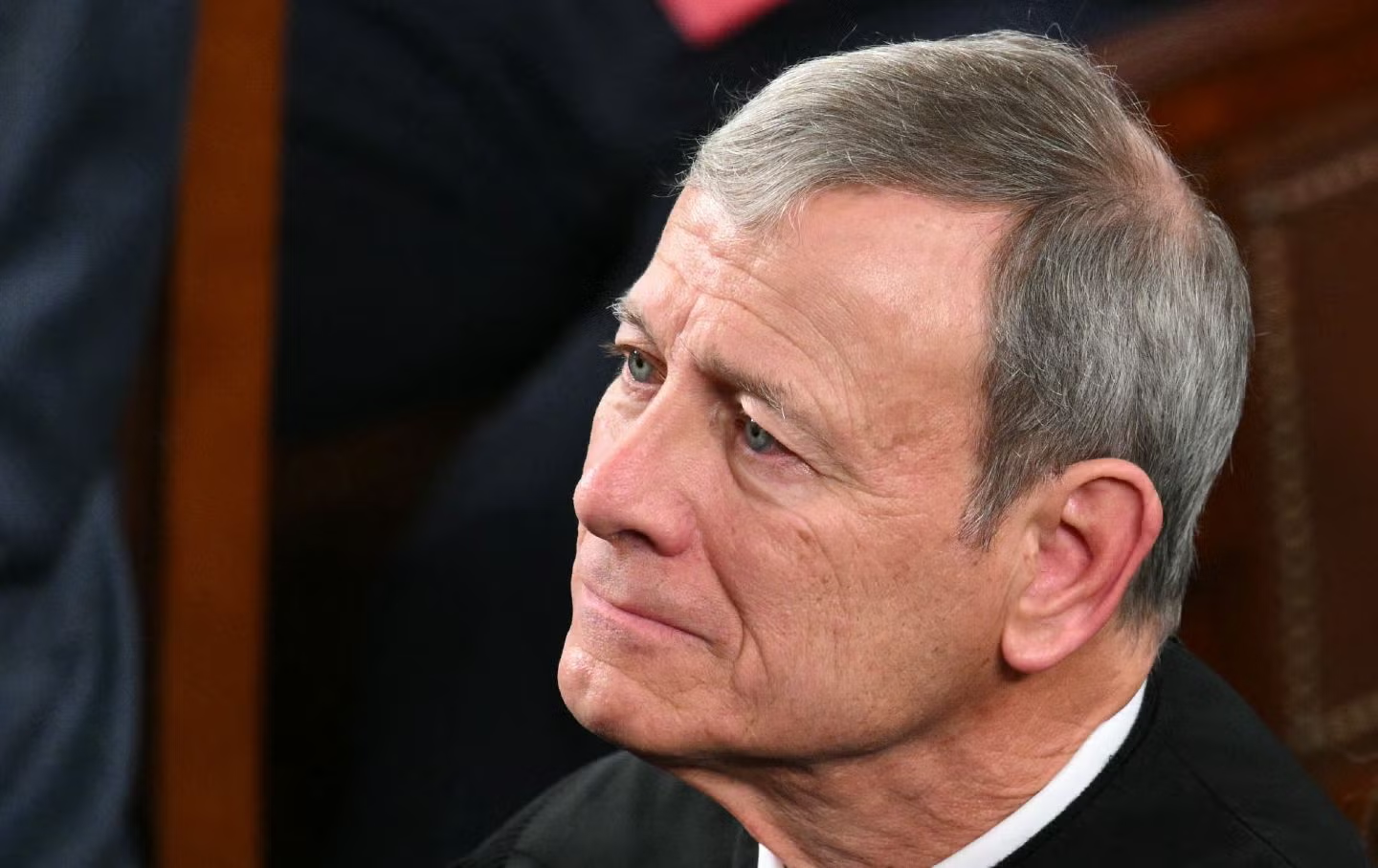
The Fight for Educational Equality Is Also a Fight for a Just Supreme Court The Fight for Educational Equality Is Also a Fight for a Just Supreme Court
The court has severely weakened our ability to make an education system that fulfills the promise of Brown.
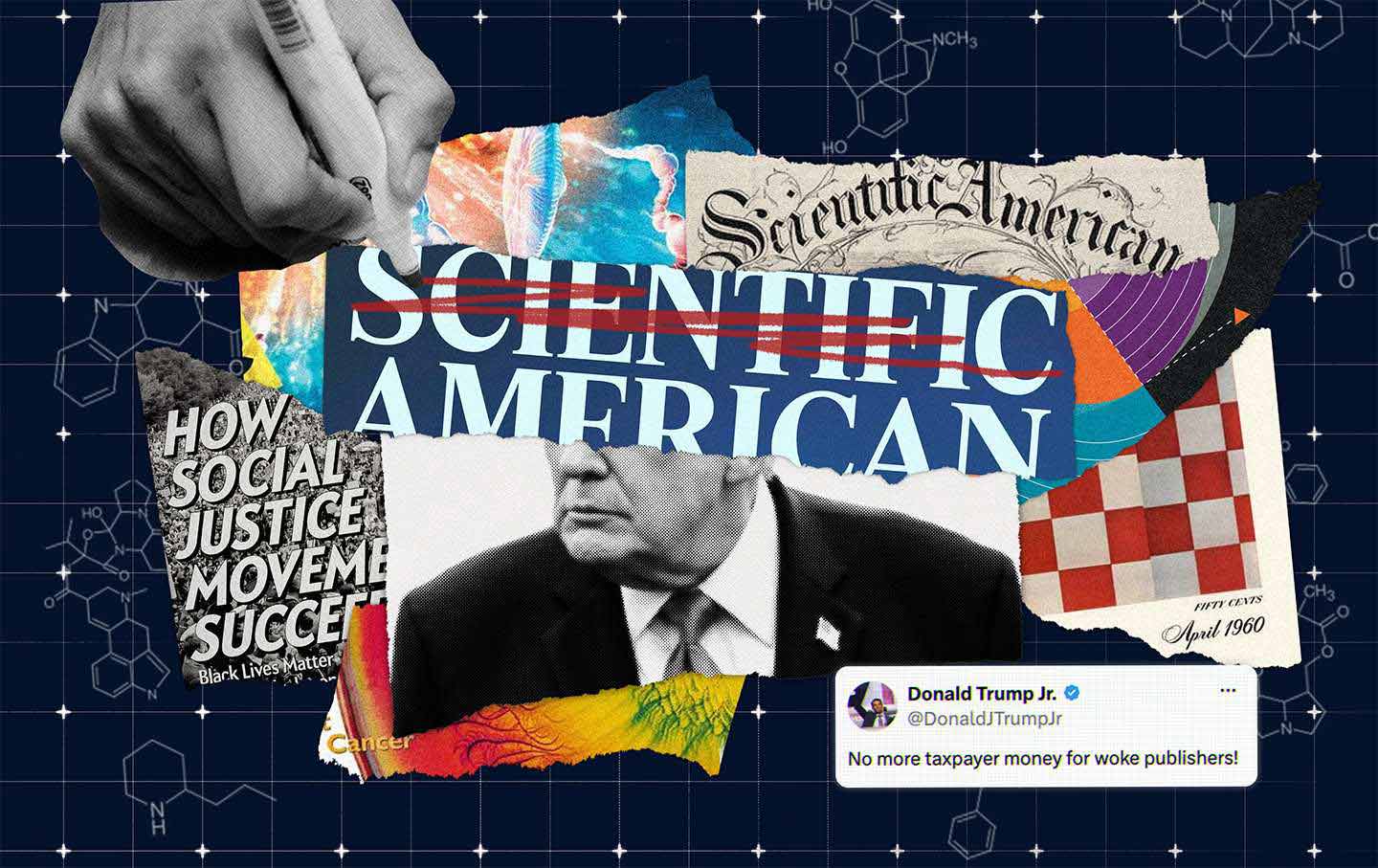
The Fall of “Scientific American” The Fall of “Scientific American”
When the beloved science publication got too political, its corporate owners stepped in. Now its future is uncertain.
The Bookstore Revolution in Taiwan’s Conservative Heartlands The Bookstore Revolution in Taiwan’s Conservative Heartlands
After Taiwan legalized same-sex marriage, gender-themed bookstores are working to build the social acceptance that the law alone couldn’t deliver.
Jalen Hurts Deserved Better. We All Do. Jalen Hurts Deserved Better. We All Do.
In a country that treats workers as expendable parts, Hurts’s playing through a blood clot is just the highest-profile example of the price workers pay in an oligarchy.

