What Starbucks Taught Me About Union-Busting
A new labor nonprofit called Union Now is trying to help workers weather firings, delays, and first-contract battles. We could’ve used their help in our Starbucks campaigns.
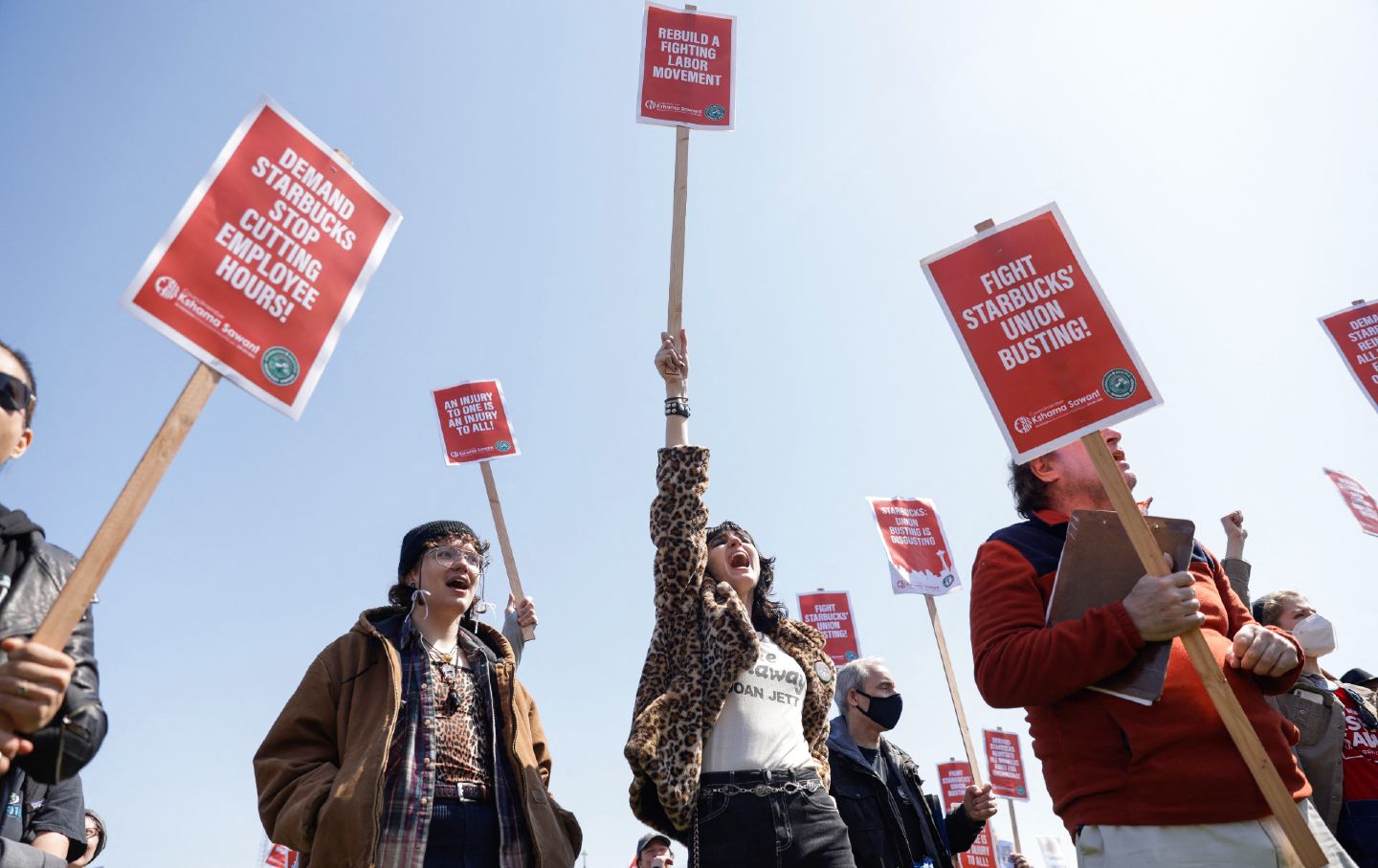
Picket signs are raised during the “Fight Starbucks’ Union Busting” rally and march in Seattle, Washington, on April 23, 2022.
(Jason Redmond / AFP via Getty Images)
“Howdy, y’all, I’m Steve Buckley, I work at the REI store down in Soho, New York, and in 2022, me and my coworkers formed the first union in the history of REI.”
A cheer erupted throughout the hall. I was among a large crowd of labor organizers and activists assembled in a New York City venue for the launch of a nonprofit called “Union Now,” spearheaded by union leaders Sara Nelson, president of the Association of Flight Attendants, and Faye Guenther, who heads UFCW Local 3000. Buckley was one of many worker-organizers—from campaigns ranging from Delta to Amazon to Microsoft—speaking to the urgent need for a union and the challenge of getting one, at a rally bookended by speeches from New York City Mayor Zohran Mamdani and Vermont Senator Bernie Sanders.
Buckley ran through a quick history of the campaign: Shortly after he and his coworkers won their union, 10 more stores across the country followed their lead, spurred by the challenges of working through the pandemic and dealing with harassment from customers.
“Since then, we have experienced a unique type of violence: a constant surveillance and harassment of union leaders, targeted terminations, mass layoffs with no reason, but we’ve not stopped organizing, we’ve not stopped fighting. I am here standing four years after we first unionized, without a first contract. I was part of the worker delegation that announced our union, and I’m still standing here before you today, because we deserve dignity and respect at work, and it’s not going to come unless we keep fighting for it.”
The other worker-organizers’ speeches echoed Buckley’s: Some were currently trying to organize a union; others had already organized only to face continued opposition. Union Now’s goal is to shift the balance of power in organizing campaigns away from corporations by raising funds to provide grants directly to workers—those organizing, those illegally fired for trying, and those striking for recognition or a first contract. Listening to the speakers discuss the obstacles they’ve faced in their efforts, I thought back to the early days of Starbucks Workers United and the organizing wave coming off the height of the pandemic and how Union Now could have filled a critical need.
“Starbucks won’t fire you,” I promised back in summer 2021. Cassie Fleischer, my coworker and the person who had trained me as a barista, looked at me dubiously from across the dining table. “I’ve seen things happen,” she said. I insisted: “You’ll be more protected the more public you are, and there’s so many of us doing this that they won’t be able to single any of us out.”
At the time, I believed every word of what I was saying—and I would repeat the line to nearly everyone I spoke with over the coming weeks: We were going to keep each other safe by moving quickly and announcing a strong organizing committee across the city and gathering union cards before the company had time to put together a response. The impression I had gotten was that the company fired workers when there were a couple of identifiable leaders; they would have a much harder time firing the burgeoning organizing committee, which had grown from 50 workers to more than 100 within the first week.
At first, this theory seemed to hold. The company’s initial response involved sending a swarm of corporate executives and managers into Buffalo to try to stop the union effort. While this influx of management caused a great deal of stress and tension, it also reflected the belief of many in corporate—particularly CEO Howard Schultz—that unionization was a reflection on their personal leadership. If he were doing a good job (Howard wrote in one of his many books), workers would never want to form a union. Maybe by making their presence felt, the corporate executives thought, they could stop the rebellion brewing in Buffalo.
They could not. On December 9, 2021, we won two of three elections, officially becoming the only unionized corporate-owned Starbucks locations in the country. It was a watershed day, both for worker organizing—Starbucks baristas and workers at other companies across the country were watching and would soon organize their own workplaces—and for Starbucks corporate, who saw their strategy fail.
In the weeks that followed, we were in contact with workers at approximately 200 Starbucks locations. New stores were reaching out or filing for elections almost daily. In February 2022, Starbucks showed a new side of its union-busting strategy when it fired seven workers for organizing at the Memphis, Tennessee, store, followed by a spree of firings across the country—starting with Fleischer, the coworker to whom I had promised protection.
Of course, this playbook neither began nor ended with Starbucks. Other companies have displayed a similar willingness to do everything in their power to prevent workers from winning a voice on the job and shared control over the workplace. A robust and lucrative union-busting industry of law firms and consultants helps develop and implement anti-union strategies. When a tactic achieves the desired result at one company, others are quick to follow in its footsteps. As a result, anti-union campaigns often follow a tried-and-true script.
The contrast between the outlook of workers seeking to organize and the response of their bosses is stark. Workers who try to form a union typically do so out of a genuine love for the company and a desire to see it return to its core values—often the mission that made them want to work there in the first place.
Every campaign I’ve worked on, from Nissan to Starbucks to Tesla to Ben & Jerry’s, began with a remarkably optimistic outlook. Workers weren’t naïve about how the corporations we worked for were likely to respond, but we believed that no company was too big to be held accountable. Moreover, while Amazon and Tesla had already established themselves as virulently anti-union, many other companies—including Starbucks, REI, Apple, Trader Joe’s, and Chipotle—either touted themselves as progressive or were more than happy to be perceived as such. Would they really want to risk the reputational damage to their brands that union-busting could bring?
The answer was a resounding yes. Of course, many companies insisted that they could be both progressive and anti-union—a position perhaps best expressed in REI’s notorious union-busting podcast, in which executives began by sharing pronouns and making a land acknowledgement before encouraging workers to vote against unionizing. Starbucks wrote in internal documents that its labor strategy was sourced from “key industry benchmarks” from companies like Walmart and FedEx, “while layering in our Starbucks partner-first principles.” As an illustration of how deep the corporate psychology went, the presentation—branded green and white, with the company’s iconic siren logo making frequent appearances—spelled out one of its comms objectives: “As keepers of the Siren, frame the future by which we are viewed, measured and understood.”
Corporations understand that delay is on their side. Even after workers win a hard-fought election victory, the battle has often only just begun. In the United States, the right to organize is functionally meaningless absent the power to back it up by exerting pressure on a company. Otherwise, companies will try to outlast the union by any means necessary. Some companies, like Amazon and its subsidiary, Whole Foods, spend years challenging the legitimacy of election results in the courts, not because they truly believe the elections were invalid but to prolong the process.
Popular
“swipe left below to view more authors”Swipe →There are no penalties, only remedies, for violating the National Labor Relations Act. The legal process through which workers can try to obtain justice if they face retaliation or other unlawful acts can take years as cases wind through the administrative law process or even end up appealed to the federal courts. These deficiencies in the law mean that companies are effectively incentivized to break the law in pursuit of their union-busting goals.
Once a union is certified, federal labor law says that companies must bargain with workers in good faith. In practice, this means very little. Proving that a company is not living up to their end of the deal is challenging, and the legal process can take years; if a company is found guilty, the only remedy available under the law is a court order that the company go back to the table and bargain in good faith this time.
Worse yet, companies know that retaliatory acts, like firing workers or closing unionizing stores, send a clear message to other workers across the company: If you follow the same path, the same thing could happen to you. Even if workers are reinstated or a store reopened years later, the damage to the union campaign has already been done.
When Starbucks workers were fired in retaliation for organizing, we would scramble to put together GoFundMes and ensure that people were able to survive. Some fundraisers, like the strike fund for our first-ever walkout over Covid-19 safety or the benefit for a heroic store manager fired for whistleblowing, performed well; others struggled to gain traction or had too many people depending on them for relief, such as the fundraiser for Ithaca workers who lost their jobs when the company shut down all of the stores in the only town with 100 percent union density at Starbucks.
If Union Now had existed during our campaign, it could have helped fill the gaps in mutual aid and grassroots fundraising, ensuring that workers could participate in the fight without sacrificing their own livelihoods. Many corporations have seemingly limitless resources with which to fight unionization, while workers are totally reliant on their jobs for income, healthcare, and other basic needs. Whether workers are trying to form a union or remain in the fight after they’ve won recognition, Union Now seeks to provide a safety net to free workers from this dependency and help level the playing field.
Despite the many difficulties of organizing—including a hostile federal government more likely than ever to side with corporations and oligarchs—workers’ desire to build workplace democracy and to create organizations capable of fighting for democracy in society more broadly remains strong. Unfortunately for the “keepers of the Siren” and their friends, workers will frame their own future. Union Now is an important new tool for empowering them to take on the challenge.
Become a Sustaining Donor This September
Between the reemergence of right-wing red-baiting and Donald Trump’s use of the chilling National Security Presidential Memorandum–7 to criminalize left political organizing, we’re seeing McCarthyism reborn before our eyes.
This assault on democracy cannot be ignored or wished away. Resisting it requires bravery in the face of threats and repression, a steadfast commitment to the truth, and the unwavering belief that we can—and will—overcome this darkness.
We must have an independent media that sets the record straight, unearths corruption and abuses of power, and advances a politics of justice and dignity for all if we’re to win this fight.
That’s why I’m writing to you today. This September, The Nation needs to add 100 monthly donors to sustain our progressive journalism. Your contribution makes the next investigative report, the next truth-speaking column, and the next pathbreaking essay all possible.
I hope you’ll support our work with a recurring donation today. If you donate $10 or more a month, we’ll send you a brand new “Hands Off the Free Press!” sticker to recognise your commitment to our cause. Please, donate today.
Onward,
Katrina vanden Heuvel
Editor and Publisher, The Nation