A Burning House, a Quiet Media, a Silenced Majority
A white paper from Covering Climate Now on the state of climate journalism.
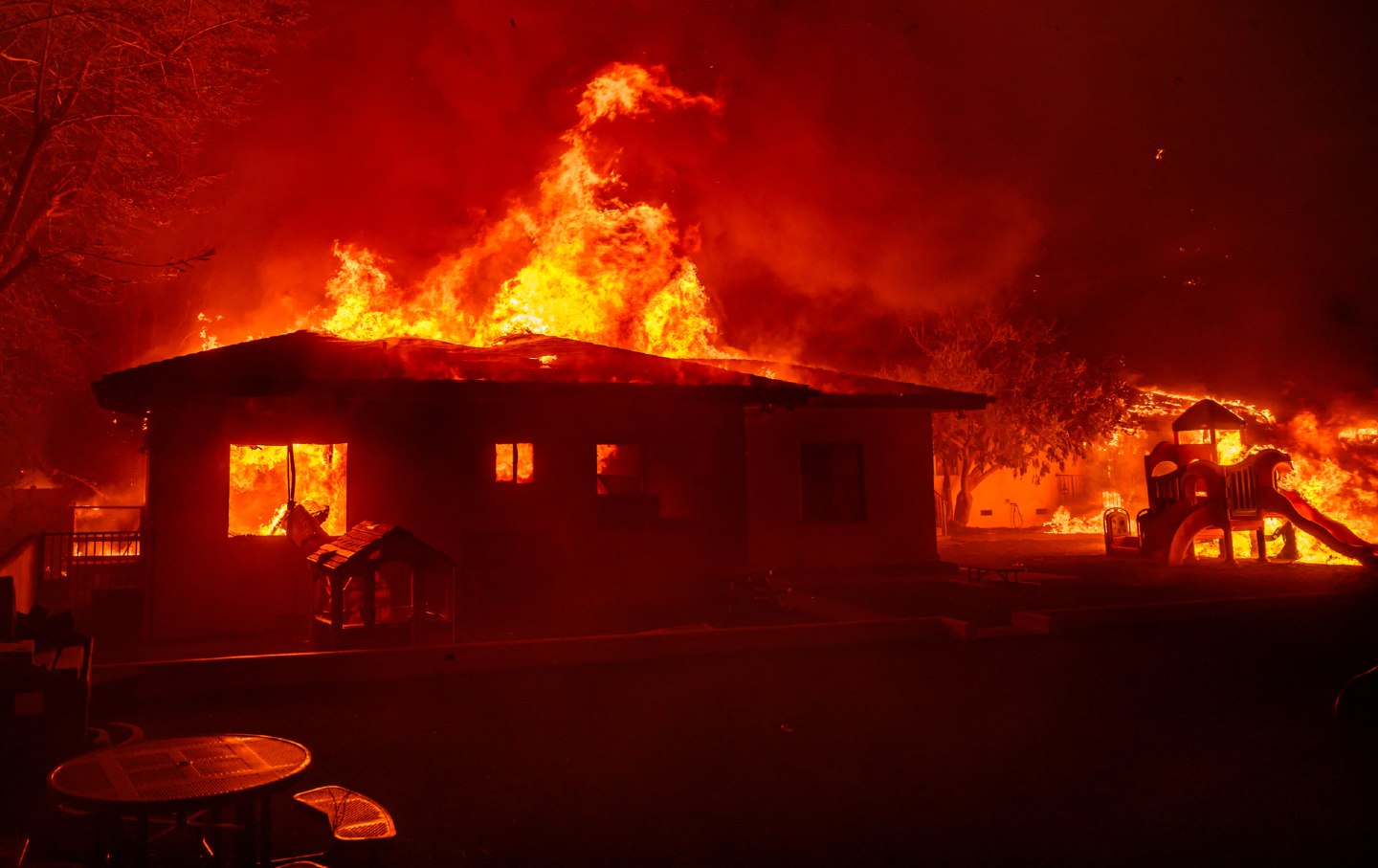
A home is engulfed in flames during the Eaton fire in Pasadena, California on January 7, 2025.
(Josh Edelson / AFP via Getty Images)All parts of the media—news media, social media, entertainment media—play a decisive role in how humanity confronts the climate challenge. These media are largely responsible for what people know and feel about that challenge, and what people know and feel in turn shapes what they say and do: whether and how they vote, what products they buy or don’t buy, how they talk with friends and family, whether they act or not.
News media play a particularly important role, both because huge numbers of people still read, watch, or listen to their reporting and because that reporting shapes the narrative that politicians, social media, and the public engage with. “Literally billions of people know about climate change only because the media has reported it,” Anthony Leiserowitz, the director of the Yale Program on Climate Change Communication, has said.
Voluminous empirical data show that most of the public cares about climate change. And an overwhelming majority of the world’s people—80–89 percent of them, according to peer-reviewed studies that gave rise to Covering Climate Now’s 89 Percent Project—want their governments to take stronger climate action. But this overwhelming majority does not realize it’s a majority, partly because its existence is not reflected in most news coverage. In other words, they have been a silent majority but also a silenced majority.
This white paper, published in April 2026 by CCNow, focuses on mainstream news media and how it has been covering the climate story. Established by journalists, for journalists, CCNow has worked with hundreds of journalists and news outlets to help all of us do a better job of covering the defining story of our time. CCNow was launched in 2019 with the express intent of breaking the “climate silence” that prevailed in most news media. And for a few important years, that silence was broken.
Now much of the media has gone, if not silent, certainly quiet. Climate coverage declined globally in 2025 by 14 percent, according to the Media and Climate Change Observatory at the University of Colorado at Boulder. In the United States, The Washington Post gutted its climate team amid a larger set of layoffs. So did CBS News, where correspondent David Schechter and producer Tracy Wholf had run 61 climate stories during 2025. NBC News also cut back its climate team. Collectively, the three broadcast networks reduced the airtime devoted to climate change by 35 percent, according to the watchdog group Media Matters.
There are, it’s important to note, exceptions to this trend. Major outlets including The Guardian, The New York Times, the Associated Press, Time, Bloomberg Green, CNN, Telemundo, France Télévisions, and the Hindustan Times continue to cover the climate story robustly. Every television station in Japan over the next two years will run public service commercials noting that 89 percent of Japanese people support taking climate action. And journalists across the Global South generally continue to see climate change as a major story—no surprise, given that they’re on the front lines.
To understand this retreat from climate coverage and how it might be remedied, CCNow executive director Mark Hertsgaard held conversations in early 2026 with more than 30 climate journalists at leading TV, radio, newspaper, magazine, and digital news outlets in Asia, North and South America, Europe, and Africa that collectively reach a total audience of billions of people. These conversations took place “on background” so the journalists could speak freely. Journalists quoted here by name have given express permission for CCNow to do so.
This white paper draws extensively on those conversations, as well as on analyses by independent scholars and experts. It is also informed by CCNow’s years of working closely with journalists and news outlets around the world, including our newsroom trainings and live events, our annual Covering Climate Now Journalism Awards, and the exemplary climate reporting we curate in our weekly newsletter, The Climate Beat.
The Findings
The overall picture that emerged was mixed but with general agreement on these points:
- The amount and prominence of climate coverage is indeed down across the news media, but with important exceptions.
- The trend is more evident in the US than internationally.
- One reason for the decline has been a relentless firehose of news on other topics that audiences understandably wanted to know about (e.g., the Iran War); news outlets can produce only so many stories a day, and audiences have only so much time to read or watch the news.
- Another reason: newsroom staff cuts, due to fewer consumers’ paying for news and corporate owners’ prioritizing profits over the public’s right to know.
- Another reason: News coverage often mirrors what political leaders talk about, and US president Donald Trump in particular talks little about climate change except to deny that it’s happening. That denial has emboldened others—in business, in politics, and in media—to downplay the climate threat.
- Despite the backsliding, internal audience data at newsrooms indicates that the public remains interested in the climate story and that audiences respond when journalists tell the story well.
- Many journalists do understand that the world faces a climate emergency (that’s the word thousands of scientists deliberately choose), and they’re committed to telling the story. Some of them labor for news organizations that may or may not be doing justice to the climate story; others have struck out on their own to say what needs to be said.
What’s Needed: A Fresh Approach
CCNow’s interviews suggest that perhaps what’s lacking is not an interested public but fresh thinking from journalists about how to tell the climate story. “People really do care about this stuff,” said Fiona Harvey, an environment editor at The Guardian. Angus Foster, the climate editor at BBC News, pointed to two stories his team recently produced—one about a public auction for new wind turbines off the UK coast, the other about household heat pumps—that got “huge audiences, both on digital and broadcast.” His conclusion? “The audience is still with us, but we have to find ways into the climate story that are fresh and provide information that they really want.”
This need to find fresh ways to tell the climate story was the most frequently made point during CCNow’s background conversations with journalists. And the most frequently cited reason for this need was the challenge of engaging audiences in the face of an unrelenting firehose of news on other subjects, from the Iran war to the Minneapolis anti-ICE protests, the Epstein files, and more.
“The same number of people are reading or watching our news coverage as before. They’re just paying attention to other subjects,” said a reporter at a leading international news outlet. Stories about yet another scientific study were of particularly little interest to audiences, leading this organization to all but stop doing them. Internal audience data showed that “nobody was reading those stories,” the reporter emphasized. This reporter and their colleagues hypothesize that their readers “already know the general picture on climate science and don’t feel the need to keep up with each new twist and turn.”
In response, news organizations that remain committed to climate journalism are offering more human interest, enterprise, and explainer stories and making greater efforts to make the climate connection in their reporting on other topics. For example, the German newspaper taz has found that leaning into the drama of the climate story can attract readers. “Polls show that people’s concern about climate change is as high as ever,” said taz climate editor Jonas Waack. What readers like, he added, are stories that expose hidden conflicts or secret dealings, such as taz’s uncovering that a public referendum aimed at blocking wind turbines in southern Germany was covertly organized by a far-right front group.
The investigative outlet DeSmog has broadened its audience with stories featuring villains and heroes, especially involving AI’s energy-hungry data centers. “Big Tech titans like Mark Zuckerberg are much more visible in the public mind than, say, the CEO of Exxon,” said global managing editor Geoff Dembicki, “and our investigations have documented that Big Tech is increasingly embracing the climate-crisis-denial rhetoric of Big Oil.” Such reporting has appealed across the news spectrum. “Last year, we partnered with the Financial Times, and our reporting was also featured in the socialist news site Jacobin,” said Dembicki.
Prioritizing Climate Work
The “firehose of news” explanation goes only so far, however. Newsrooms often succumb to “the tyranny of the immediate”—the tendency to focus solely on the day’s events but miss the bigger picture—and climate coverage suffers as a result. As CCNow cofounder Kyle Pope has written, getting diverted from covering climate change “reflects a failure to understand how urgent, and far-reaching, the climate story is. As long as it’s seen as peripheral, it will always fall off the agenda.”
The US Spanish-language TV network Telemundo demonstrates that climate need not disappear when other subjects demand attention. Vanessa Hauc, a veteran correspondent at the network, said Telemundo has focused on immigration in recent months for the obvious reason that its viewers care intensely about it, and the network has been rewarded with record high ratings. At the same time, Hauc said, her weekly climate and environment program, Planeta Tierra, “remains popular and is well supported by management.” Likewise, when public broadcaster France Télévisions replaced its usual weather forecast on its flagship evening news program with a climate-and-weather segment, its ratings went up—and they continue to be strong in 2026.
One factor that distinguishes outlets that have stuck with the climate story is that top management conveys to the respective newsrooms that climate coverage matters. Karl Malakunas, a senior journalist at Agence France-Presse, said, “We see climate and environment as a massively important breaking news story that remains a core priority. Whether it’s fires in Los Angeles, extreme heat in Southeast Asia, or other such events, pretty much every day, somewhere in the world, one of these stories is breaking. AFP needs to be there and make the climate connection in our coverage, or it’s a massive fail for us.”
That commitment contrasts sharply with the experience Chase Cain, NBC News’s former national climate reporter, recounted in an interview with the newsletter Heated. Cain left NBC in March, ground down by having to ceaselessly remind his bosses of the importance of the climate story. “I was just kind of exhausted by…the constant trying to explain and remind, like, ‘Hey, this is important, please run this story,’” Cain said.
Meanwhile, staff cuts throughout the news business have meant that remaining staff are expected to do the jobs that two or even three colleagues had previously done. “Everyone feels beaten down, left without resources and leadership,” one network veteran lamented.
Popular
“swipe left below to view more authors”Swipe →
A Prescription for Change
Looking ahead, what can be done to encourage news organizations to provide abundant, high-profile coverage of the climate crisis and its solutions?
Reject climate hushing. “We’ve got to get past this flavor of the month idea that climate change is an issue that’s come and gone,” said a senior editor at one of the world’s largest news organizations. “The crisis is not going away. In fact, it’s only getting bigger the longer we wait to act. So [the disinterest] is not going to last.” This editor suggested that the current lull “could actually be good for climate journalism if it forces us to think in new ways about how to tell the story so we actually engage people.”
Listen to your audience. People don’t need to keep hearing only about how bad the climate crisis is. What they want is to know how it can be fixed. Of course, news outlets should still cover genuinely significant scientific findings. But the totality of coverage should convey the whole story: not just what’s going wrong, but also how it could be put right.
This does not mean sugarcoating the facts or engaging in activism. It means rigorously interrogating potential solutions—from switching to solar power and other technological fixes to changing laws and other political responses—so the public and policymakers can decide which ones to pursue and which to shun. It also means alerting people to the growing problem of climate disinformation, and debunking that disinformation with facts.
One way to listen to your audience is via the science behind CCNow’s 89 Percent Project: A supermajority of the world’s people, eight in 10 persons, want their governments to take stronger climate action. But this supermajority doesn’t realize it is the majority, partly because it doesn’t see that fact reflected in the media. In Japan, TV broadcasters are addressing that disconnect. For the next two years, every TV station in the country will air public service commercials pointing out that 89.3 percent of all Japanese support climate action—so people shouldn’t be afraid to talk about it.
Recognize that different circumstances call for different approaches. For example, often what limits climate coverage at some Global South news outlets is not a lack of interest but a lack of resources. In response, CCNow organized a one-year pilot project to provide 21 Global South newsrooms with free access to the climate news feed of AFP. The participating newsrooms, which collectively reach 457 million people, ended up running 2,875 climate stories, stories their audiences would not have seen otherwise.
Take initiative inside your news organization. If you’re a journalist who specializes in climate change, explore teaming up with a colleague from a separate beat. Maxine Joselow, a climate reporter at The New York Times, feels fortunate that her newsroom values the climate story. She advises fellow journalists to look across the newsroom and “if you see someone whose work you admire, send them a Slack message, compliment them on the story they did, and ask if you can have coffee. Have a conversation about the overlaps between their beat and climate change and share ideas about something you might work on together.”
The Time Is Now
There is no good reason that telling the climate story cannot be both the right thing to do journalistically and the smart thing to do commercially. The vast majority of people around the world care about climate change and want it tackled; if our coverage highlights this majority rather than silencing it, the public is more likely to read, watch, and listen to what we report.
Journalists are storytellers, and the climate story overflows with elements of compelling storytelling: heroes and villains, gargantuan sums of money, and countless human lives in the balance. If audiences are not responding to our stories, that’s on us. CCNow invites our fellow journalists everywhere to seize this opportunity, and we hope this white paper triggers thought and discussion within the news business and beyond toward that end.
Next Steps
If this white paper sparked comments, concerns, ideas, please reach out. We’d love to chat, to learn from you, and to see how we can support your work. Write to us at [email protected].
Correction: An earlier version of this white paper mistakenly stated that ABC News had “all but eliminated” its climate team. In fact, the core of its team remains in place.