
Inside Yale’s Hasan Piker Spectacle
The Twitch streamer’s invitation to debate at the Yale Political Union drew the ire of Laura Loomer, Rick Scott, and Turning Point USA.
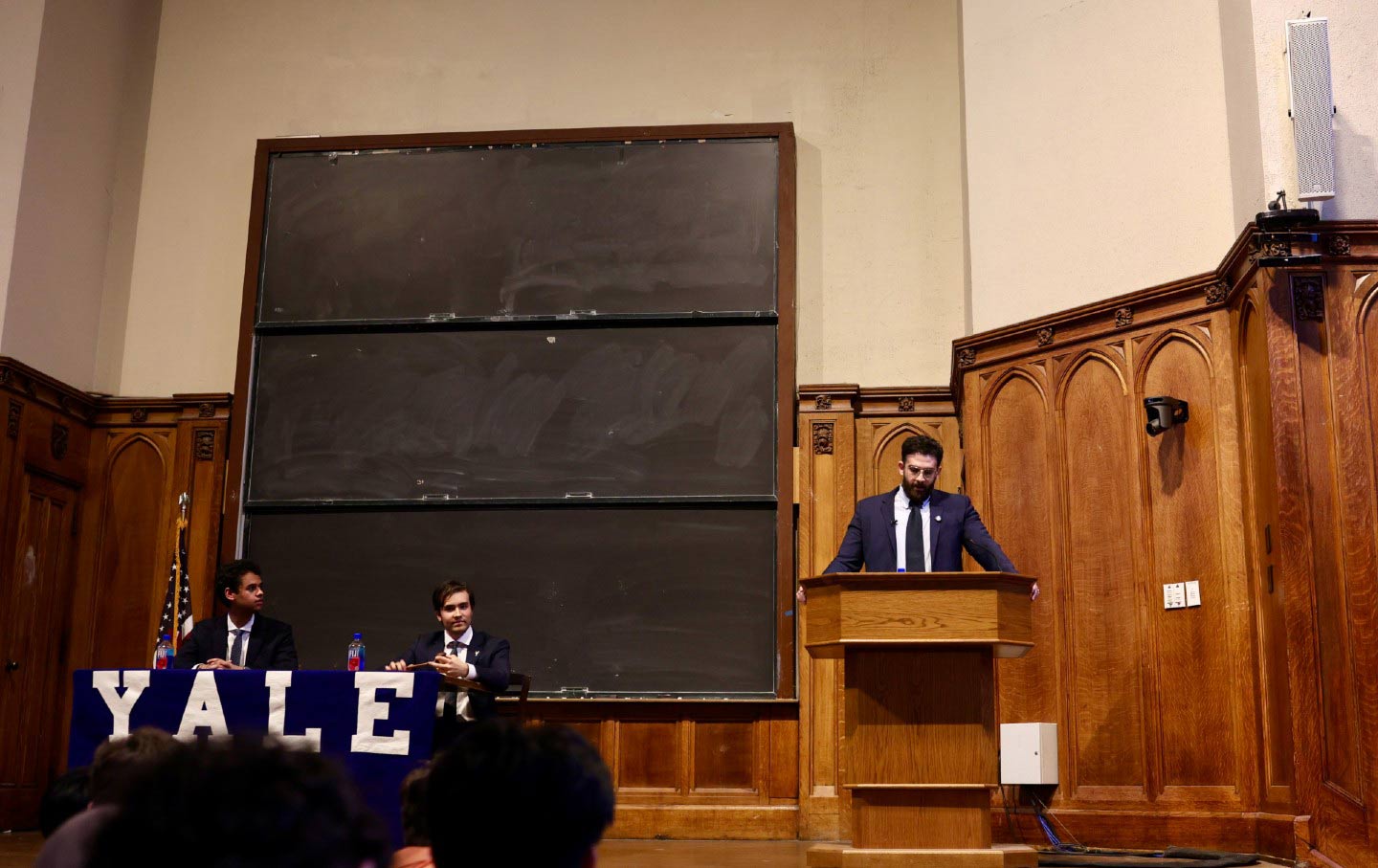
It had been six months, almost to the day, since Florida Senator Rick Scott gave a speech at the Yale Political Union, when, on April 14, the oldest collegiate debate society in the United States heard from Hasan Piker. Piker is a left-wing online streamer who said, in a March 2025 livestream, “If you cared about Medicare fraud or Medicaid fraud, you would kill Rick Scott,” the former CEO of a healthcare company who had overseen a $1.7 billion settlement for Medicare and Medicaid fraud. This was, apparently, the relevant criteria for what Piker would later call “maximum punishment.”
For the first couple of days after the Yale Political Union announced the event, it seemed as though it might pass without any serious backlash. Then Laura Loomer got ahold of the event’s advertisement.
Loomer complained that parents were paying nearly a hundred thousand dollars a year to send their children to a communist indoctrination camp, where they were being taught to destroy America by a Muslim communist streamer who was, she noted, captured on video saying America deserved 9/11. Senator Rick Scott saw Loomer’s post and reshared it. “This is WILD,” he wrote. “I spoke at the Yale Political Union last year.… now they are hosting a guy who said I should be killed.” Scott called for action. “Yale receives billions from the federal government,” he declared. “President Trump and Congress need to IMMEDIATELY revoke it.”
Scott’s words seemed to imply that he wanted federal input on the Yale Political Union’s debate docket. But the group makes those decisions independently of the university, and it does not appear that anyone defrauded by Scott’s company was given any say about Yale Political Union’s decision to host Scott last October.
This spectacle—the announcement, the backlash, Scott’s rallying cry—finally made its way back to Yale when reporters at the Yale Daily News reached the president of the new Turning Point USA chapter on campus, who called Piker’s language anti-American and added, more pointedly, that it was “antithetical” to Yale’s mission to promote free speech.
Before the YDN had received those comments about what was American and what wasn’t, who could have free speech and who couldn’t, the discussion about the debate had been about Piker’s past words. About Scott, about 9/11, about antisemitism. But the Turning Point USA chapter president had come along and added free speech to the spectacle.
Then Piker weighed in.
On Monday, from his stream, Piker scrolled through the Yale Daily News article previewing his visit to Yale—until he reached the relevant quotes at the bottom. He read the words about free speech and anti-Americanism and said, “Charlie Kirk clearly had enough respect for me—he wanted to debate me at Dartmouth,” continuing, “So I don’t know what the fuck this guy is chirping about.”
On Tuesday, Piker began his seven-hour stream, from a hotel room with distracting wallpaper in New Haven, Connecticut. He talked for more than four hours about the news of the day. Then, around 6:45 he left and got into a car heading for Sheffield-Sterling-Strathcona Hall.
Four hundred students sat around me, eyeing the hall’s exit door and backroom entrance, longing for a glimpse of Piker’s arrival. The crowd thought they had spotted him entering a few times and clapped for rank-and-file Yale Political Union members whom they mistook for Piker.
Piker finally walked in about 20 minutes after leaving his hotel room stream and was, according to a post by “StopAntisemitism,” “orgasmically welcomed” by the audience. (Piker, on Wednesday, reshared StopAntisemitism’s characterization of the crowd, asking, “Did you bust?”—a question that was viewed almost 400,000 times.)
Piker’s team, who had arrived before him, started a new stream that was being watched by 15,000 viewers and would go on to be viewed more than 600,000 times. He passed through one of the aisles, and climbed the stairs to the stage, finally settling in a chair between the Yale Political Union’s president and its speaker.
While he was being introduced, several onlookers noticed that Piker tucked a Zyn behind his lip, uncapped a dark shiny pen, and made notes in the margins of his prepared remarks. For a moment, he hadn’t yet looked up at the crowd. Then he did.
“I’m sad to see that Senator Rick Scott did not make it.”
The stomping was almost immediate, as the applause had been when Piker entered the room and when he had been introduced. At the Yale Political Union, approval is stomping and disapproval is hissing, and on this night, there was a raucous, near-constant, demonstration of both—sometimes before the end of a sentence, sometimes before the sentence had begun.
What Piker had come to argue was not exactly the resolution as it had been advertised to the people in the room and the streamers at home: “End the American Empire.” Piker instead argued something adjacent. He argued that the United States is already in terminable decline. He asked, “How do you end something that’s already in the process of dying?”
He quoted Lenin. He quoted Mao. He said Benjamin Netanyahu was the real American president. He said the US maintained roughly 800 military bases abroad, each representing not just a presence but a possible place where it might stage invasions. Then he called the fall of the Soviet Union one of the greatest catastrophes of the 20th century, and the hissing was deafening.
His comment about the USSR had gone viral by the next morning. According to X’s own count, there were more than 59,000 posts about the speech. The people who had most loudly used “free speech” to explain the importance of tolerating campus speakers seemed to have set that aside. Yale is poison, more than one post said. Yale is disgusting, another post said. Yale students have been indoctrinated, more than a few posts said and many more implied. A great many of the posts, for reasons that remain unclear, mentioned tuition. It seemed these people could not believe that students whose parents had spent so much money on their education would choose to attend a political debate at the Yale Political Union.
Popular
“swipe left below to view more authors”Swipe →When Piker’s speech ended, five students split speeches between the affirmative and negative. The first in the negative, Kai-Shan Kwek-Rupp, spoke deliberately, taking the resolution at face value. Ending the American empire, he argued, would not eliminate global domination but change it. Power does not disappear. It is assumed by others. The hissing and stomping still came for Kwek-Rupp, but later than they had come for Piker, at the ends of sentences rather than the middle of them.
When it came time for Piker to conclude, his earlier sympathy for the USSR had become a little sullied, maybe by how long the debate was dragging on for, or maybe by how warm and stuffy the room was getting. Capitalism, he said, had built things worth keeping. Skyscrapers, infrastructure, the Internet. But those things had been built through labor, and the fruits of that labor had not been evenly distributed. He ended with a line that brought raucous applause: “If a dictatorship is inevitable, I’d rather have it be a dictatorship of the proletariat.”
The room did not clear immediately. Students stood in the aisles attempting to rush the stage for photographs. The Yale Political Union’s president, a member of the Party of the Right, told me he was pleased with how the night had gone. In recent weeks, he said, the union had hosted figures from across the political spectrum, including Kevin Roberts, one of the architects of Project 2025. “We have people on the right and people on the left,” he said, “and they stayed until the end and they asked questions and they were respectful.”
By then the members had already voted: 54 to 31 in favor of the resolution. For 53 students at Yale, and Hasan Piker, who also got to vote, the American empire was something to be brought to an end.
The event had drawn to a close. Piker had left the gothic revival hall. The federal government had not cut Yale’s funding. The people who had used “free speech” to argue that a private institution should not allow a speaker to speak had not mobilized soon enough. But everything that had made the spectacle matter remained intact and, certainly, did not conclude with the vote.
Become a Sustaining Donor This September
Between the reemergence of right-wing red-baiting and Donald Trump’s use of the chilling National Security Presidential Memorandum–7 to criminalize left political organizing, we’re seeing McCarthyism reborn before our eyes.
This assault on democracy cannot be ignored or wished away. Resisting it requires bravery in the face of threats and repression, a steadfast commitment to the truth, and the unwavering belief that we can—and will—overcome this darkness.
We must have an independent media that sets the record straight, unearths corruption and abuses of power, and advances a politics of justice and dignity for all if we’re to win this fight.
That’s why I’m writing to you today. This September, The Nation needs to add 100 monthly donors to sustain our progressive journalism. Your contribution makes the next investigative report, the next truth-speaking column, and the next pathbreaking essay all possible.
I hope you’ll support our work with a recurring donation today. If you donate $10 or more a month, we’ll send you a brand new “Hands Off the Free Press!” sticker to recognise your commitment to our cause. Please, donate today.
Onward,
Katrina vanden Heuvel
Editor and Publisher, The Nation
More from The Nation
As Cornell’s Rape Case Draws National Attention, Students Want Accountability. As Cornell’s Rape Case Draws National Attention, Students Want Accountability.
A new lawsuit alleging that a former student was drugged and gang-raped by Chi Phi fraternity members is sparking outrage in the Cornell community

Irish Goalkeeper Gavin Bazunu’s Refusal to Play Against Israel Puts Him on the Right Side of History Irish Goalkeeper Gavin Bazunu’s Refusal to Play Against Israel Puts Him on the Right Side of History
Bazunu’s decision raises the perennial question: Why is a country that is currently committing a genocide allowed to compete in the first place?
The Promises and Compromises of the University of California The Promises and Compromises of the University of California
I grew up in a neighborhood manufactured by the University of California, Irvine. It felt like a utopia for academics—until the university forsook its mission of serving the publi...

Is Platonic Co-Parenting the Future of the Family? Is Platonic Co-Parenting the Future of the Family?
Disillusioned with the nuclear family and apprehensive of tethering their reproductive futures to the bleak hellscape of modern love, young people are seeking a different way.
How Trump’s Crackdown on Speech Has Damaged the Student Press How Trump’s Crackdown on Speech Has Damaged the Student Press
I serve as editor in chief and president of The Stanford Daily. Our newsroom has keenly felt the effects of Trump’s campus crackdown, which is why we sued the federal government.

