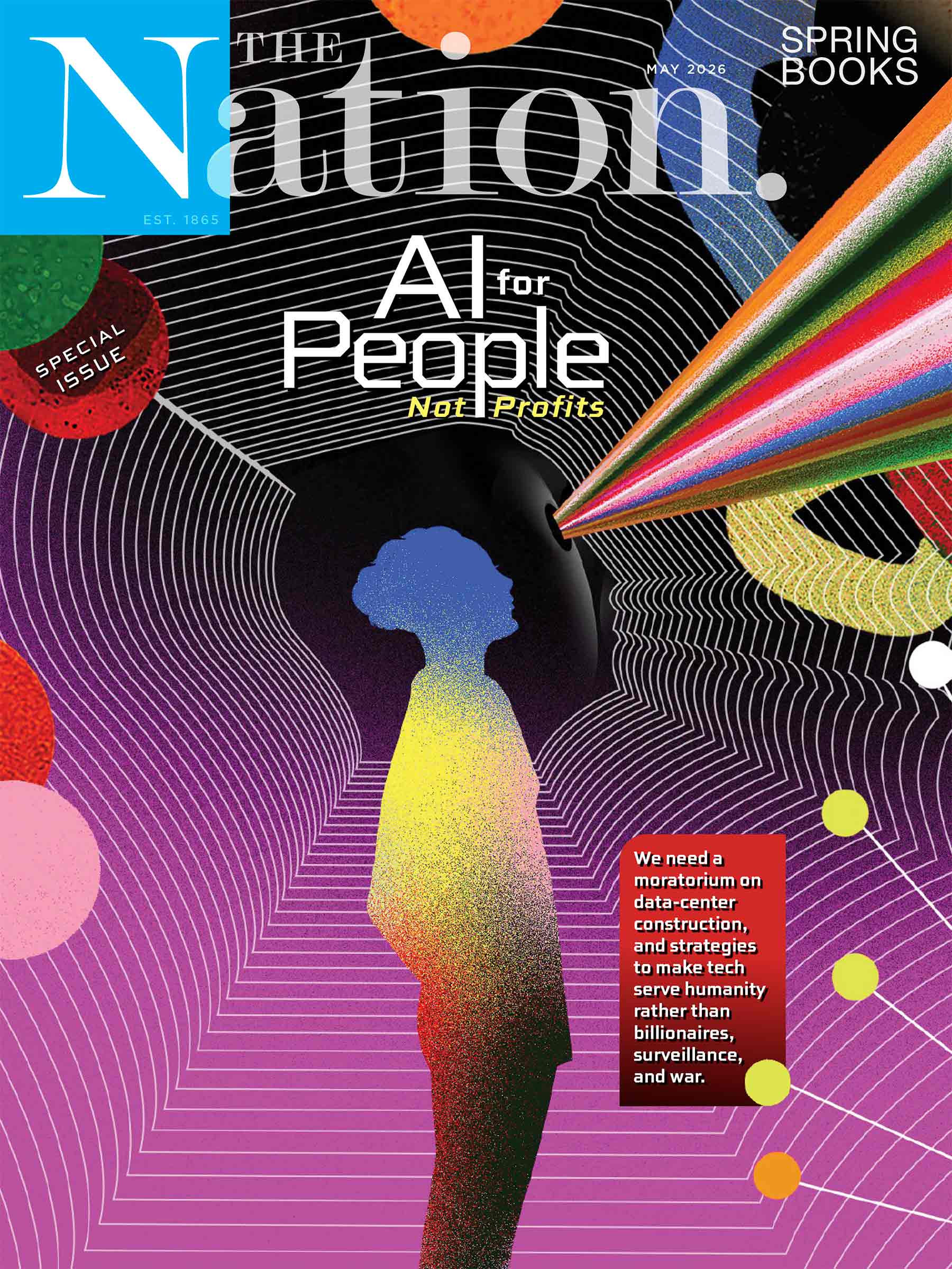
How Iran Won the Meme Wars
While Donald Trump panders to MAGA, Iranian satire is reaching a global audience.

A screenshot from an Iranian video mocking Pete Hegseth.
(via X)On Sunday, as tens of millions of Orthodox Christians around the world observed Easter, the most important holy day on their calendar, Donald Trump launched a series of bizarre, religiously themed attacks. The first was a lengthy Truth Social post assailing Pope Leo, who has become a prominent opponent of Trump’s policies. Trump ranted that “Pope Leo is WEAK on Crime, and terrible for Foreign Policy,” and suggested that “Leo should get his act together as Pope, use Common Sense, stop catering to the Radical Left.” This was followed by another Truth Social post featuring a bizarre AI-generated image that seems to show Trump as Jesus Christ, wearing a robe and healing a sick man, while angelic figures hover in the background. Former Republican representative Marjorie Taylor Greene, not too long ago an ardent Trump supporter, denounced this post as “more than blasphemy. It’s an Antichrist spirit.” Even those who aren’t Christian can agree that the image is shockingly disrespectful of Christianity. (Trump eventually bowed to the outcry, deleting the post on Monday.)
Trump’s posts were part of a larger conflict he’s been having with the Catholic Church, due to criticisms major church leaders, including the pope, have made about his immigration policy and the Iran War. One thing that likely triggered Trump was a Sunday night 60 Minutes segment featuring three American Catholic cardinals, Joseph Tobin, Robert McElroy, and Blase Cupich, who have all been sharply critical of Trump. (At one recent vigil mass for peace, McElroy said, “We are in the midst of an immoral war.”)
During the 60 Minutes segment, Capich strongly condemned social-media posts from the White House that celebrated alleged US victories by mixing together war footage with scenes from triumphalist Hollywood films such as Top Gun: Maverick and Braveheart. He lamented that splicing “movie cuts with actual bombing and targeting of people for the purposes of entertainment is sickening.”
The fact that social media posts by Trump and his administration are alienating religious leaders and former political allies is symptomatic of a larger political trend. Trump rose to the presidency in part through his mastery of social-media trolling. But these days, his unparalleled ability to get people to pay attention to his boorishness is hurting him politically as the world grapples with the mass death and economic upheaval caused by his militarism.
Both Trump and the Iran War are intensely unpopular, with approval for both hovering below 40 percent in Nate Silver’s aggregation of the polls. Even troops don’t want the stench of the war on them; there are signs that the Pentagon is facing a growing retention problem, with soldiers taking early retirement rather than risk fighting in an unpopular conflict. One prominent war supporter, Max Abrahms, an international relations scholar at Northeastern University, has lamented that public opinion is undercutting the war effort.
Social-media posts likening the current conflict to movies starring Tom Cruise and Mel Gibson clearly aren’t working; nor are Truth Social posts showing Trump to be Jesus. The propaganda coming out of the White House is clearly a case of preaching to an ever-shrinking choir. It’s red meat that might feed the MAGA faithful, but only repels the non-MAGA majority.
Yet even as Trump is losing the meme wars, the nation he attacked is proving to be surprisingly adept at using social media to win a global audience. One of the unexpected developments of the war has been Iran’s resilience in both actual warfare and the fight to shape the conflict’s online narrative. Most prominently, a company called Explosive Media, which seems to be loosely affiliated with the Islamic Revolutionary Guard Corps (IRGC), has released a string of AI-generated satirical, Lego Movie–style animated music videos mocking Trump and his main advisers, as well as Israeli Prime Minister Benjamin Netanyahu.
The videos are blunt, vulgar, and undeniably memorable. A recurring theme is that the US is run by the predatory and Satan-worshipping “Epstein class.” One focuses on Defense Secretary Pete Hegseth, detailing his long history of alleged sexual assault and alcoholism. The Hegseth video includes these lines: “We hitting the Baal-worshipping Epstein Island crew, the ones who hurt the kids. Revenge for every American soul you and Trump’s dirty crew oppressed and did. We taking payback for the girls you broke.”
These videos have gone extremely viral, spreading well outside the narrow circles who might pay attention to Iranian diplomatic communications. The conservative-leaning comedian Tim Dillon lamented,
We’re trying to win the war on social media and we’re not even doing that. We’re not even winning the shit talk war…. You’d think America would win that at least, if we’re going to win one thing. We’re getting bodied by Iranian AI in the war of shit talk. Truly How embarrassing. We invented shit talk, and we’re getting lit up.
While the Iranian videos are sometimes dismissed as “slopaganda,” there is no denying the fact that they have achieved a global persuasive power rare in wartime propaganda.
Writing in New York magazine, Narges Bajoghli, a cultural anthropologist who teaches at Johns Hopkins, placed the videos in the larger context of Iranian propaganda. The Islamic Republic has long invested in creating a media infrastructure. In 2024, Supreme Leader Ali Khamenei, whose assassination by the US and Israel kicked off the latest war at the end of February, said, “The media is more effective than missiles, planes and drones in forcing the enemy to retreat and to influence hearts and minds.”
According to Bajoghli, there has been an important generational shift in Iranian social-media production. The older generation, shaped by the 1979 revolution and the Iran-Iraq War of the 1980s, tended to produce material that was culturally specific to Iran, often with religious themes. Bajoghli describes this cultural style as “heavy. Elegiac. Martyrdom rendered in slow motion, set to music designed to make you feel the weight of sacrifice. It moved those who already shared its symbolic vocabulary. It reached no one else.”
Popular
“swipe left below to view more authors”Swipe →Over time, a newer generation of Iranian propaganda makers has emerged, their rise ironically hastened in part by the US and Israeli assassination campaign. This younger generation is more in tune with global popular culture (the new AI videos often feature rap lyrics and are very knowing about Hollywood tropes) and more inclined to frame Iran’s grievances as part of a global anticolonial struggle.
Bajoghli astutely observes that the theme of the “Epstein class” (which is pervasive in the videos) helps give them a universal resonance:
The Epstein thread runs through nearly everything. In one short clip, Trump and Netanyahu stand blood-soaked on the edge of a cliff. Blonde girls carrying folders labeled “Epstein File” march toward them in lockstep alongside Iranian schoolgirls from Minab—their own kind of army of the oppressed. With a single flinch of their eyes, Trump and Netanyahu go over the edge into a river of fire below. The claim embedded in all of this—that the Trump administration launched this war partly to suppress Epstein-file disclosures—is not an argument Iran invented. It was already circulating aggressively in leftist, liberal, and, increasingly, MAGA spaces through Americans who had expected Trump to be the one who finally exposed the network and felt profoundly betrayed by the pivot to war. It resonated in Arab online spaces too, due to the numerous Emirati and Saudi businesspeople and leaders connected to Epstein, merging seamlessly with long-running arguments about the West’s hypocrisy and Arab lackeys.
If Trump’s propaganda is aimed at a narrow circle of hardcore MAGA supporters, Iranian social media influencers have found themes that speak to many different audiences. These competing messages are both religious. Trump’s message in his Sunday post was “I am the new Jesus.” Iranian social media, meanwhile, portrays Trump as a devil-worshipping pedophile war criminal. Perhaps it is not so surprising that the Iranian message is more popular.
More from The Nation

The Deadly Labyrinth of Nigerian Healthcare The Deadly Labyrinth of Nigerian Healthcare
My mother miraculously survived a series of health scares—but she barely survived our country’s hospitals.
In Hungary’s Steel City, Layoffs Hurt Orbán’s Appeal In Hungary’s Steel City, Layoffs Hurt Orbán’s Appeal
Why didn’t Orbán’s government, once a critic of what it called a “bad privatization,” save jobs?
The Ceasefire Just Showed the World That US Military Power Is Obsolete The Ceasefire Just Showed the World That US Military Power Is Obsolete
With the illusion shattered, now is the chance for the US to liberate itself from a broken imperial model.
How the Saudis Keep Sidestepping a Costly Role in the Iran War How the Saudis Keep Sidestepping a Costly Role in the Iran War
The brutal Gulf monarchy has been cheerleading Trump’s insane war off-stage but won’t commit to any direct role in the conflict
Pope Leo Is Speaking Truth to Donald Trump’s Power Pope Leo Is Speaking Truth to Donald Trump’s Power
The pontiff’s Easter address, like so many of his recent statements, countered Trump’s Iran bombast with a cry for peace—and sanity.

