
Tiger Woods Plus Donald Trump: A Tragedy Made in the USA
Woods and Trump’s famous friendship is built on a shared knack for accumulation, vacuousness, and power worship. It’s as American as apple pie.
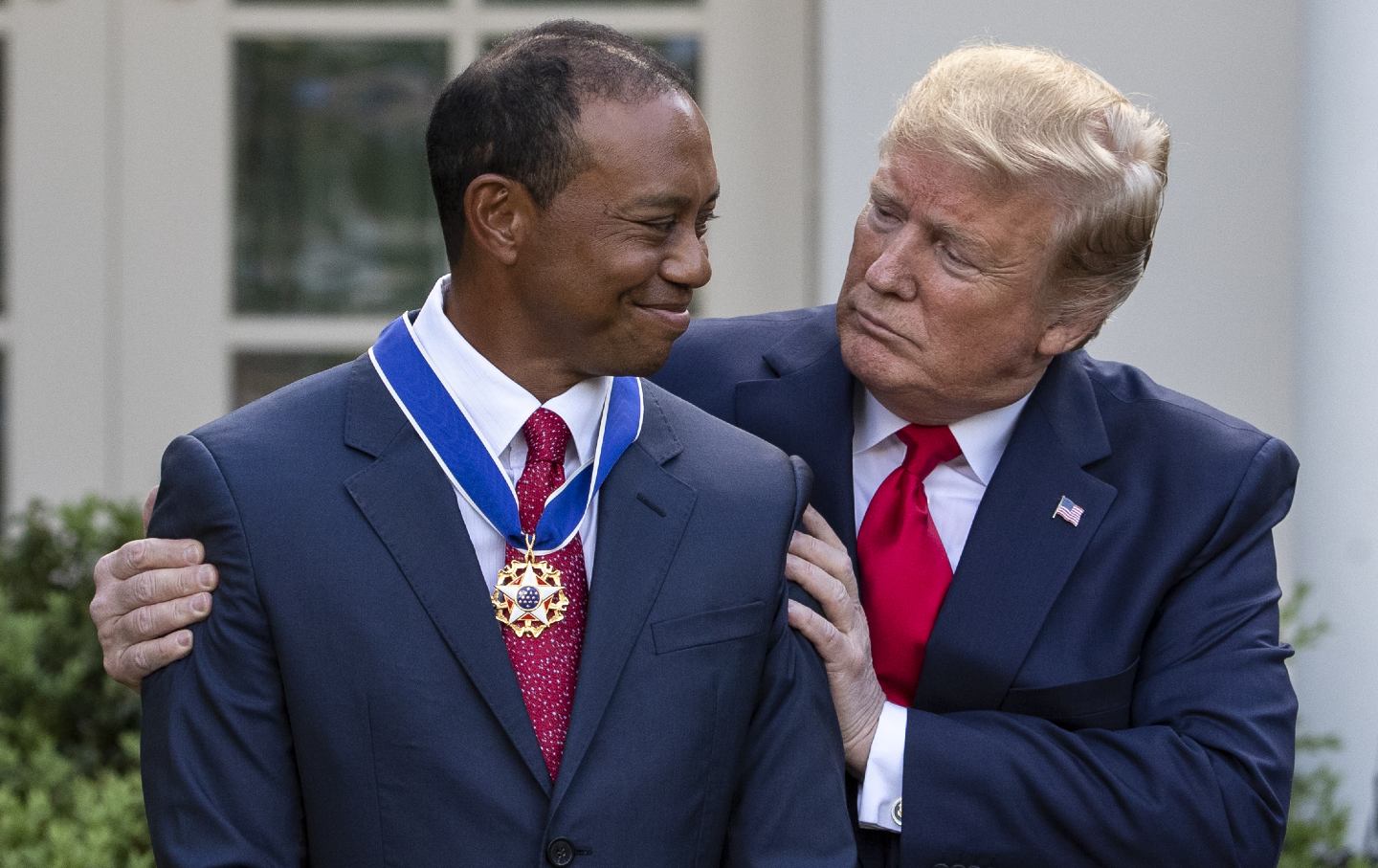
President Donald Trump embraces Tiger Woods after presenting him with a Presidential Medal of Freedom at the White House on May 6, 2019.
(Alex Edelman / Bloomberg via Getty Images)
For anyone who believes that Donald Trump, in his infinite narcissism, has no empathy for anyone other than himself, think again. He may project nothing but apathy or glee concerning the pain he’s inflicted on countless families around the world, including his own damaged, parasitic brood; he may threaten war crimes in a national televised address; he may promise to use federal troops to “force ourselves upon” Los Angeles during the 2026 World Cup; but he does genuinely seem to love golfing legend Tiger Woods.
The feeling is reciprocated. After Woods almost died this week—rolling his car, opioids in his pockets—his first call was to Trump’s direct line. According to police body-cam footage, Woods said that he made this call even before the officer approached his car.
What is this connection about? How does this openly ethnonationalist president—who offered preferential refugee admissions to white South Africans while enacting unprecedented violence against Black and brown immigrants—relate to Woods? Woods, a trailblazing athlete who integrated countless country clubs, used to describe himself as Cablinasian—Caucasian, Black, and Asian. That is, until he got a call from Nike telling him that he was just Black.
After that, you never heard the word “Cablinasian” again. Soon, the shoe giant released a commercial—based upon the iconic slogan of solidarity “I Am Spartacus”—in which a diverse group of children said defiantly: “I am Tiger Woods!” It was rebellion without a cause, rebellion for market share, Jackie Robinson if Robinson had been more interested in brand recognition than in civil rights. In fact, maybe Woods and Trump do have something in common: The vacuous nature of branding for the sake of accumulation isn’t too far off from accumulation for accumulation’s sake. Perhaps this is what drew them together.
Certainly, their attraction is linked to Trump’s obsession with golf. Tiger is the historical apex of a sport that seems to hold Trump’s attention more than the war that has displaced millions of people in Iran and Lebanon, which he illegally launched. Or perhaps it’s because Woods is always appropriately—and humiliatingly—sycophantic in Trump’s presence. He doesn’t challenge Trump. He adores him, and Trump basks in his glow.
It could also be that Woods dates Don Jr.’s ex-wife, Vanessa, whom Trump always seemed to like more than his son. Apparently, Woods’s presence in his life causes Don Jr. no end of distress. In the wake of the DUI arrest, anonymous sources close to Don Jr. told the press, “[Don. Jr.] is furious. Those are his kids. Full stop…. Everyone else gave Tiger the benefit of the doubt. But Don always saw the red flags. Always.” Given Don Jr.’s own erratic public behavior, his concerns feel more like an effort to shame Daddy’s favorite than a protective instinct for the next generation of damaged Trumps.
But what’s most likely is that, as with all of Trump’s relationships, this is also largely transactional. As announced with great fanfare in 2014, Tiger Woods was set to design the Trump World Golf Club in the human rights hellhole that is Dubai. Under orders from Trump, Woods is also now supposed to be redesigning Washington, DC’s public Langston Golf Course, which opened in 1939 as the city’s first course built specifically for Black Americans. There are widespread fears that, following Woods’s makeover, these public courses will go private, shutting out people who can’t afford it and erasing the history of the Black golfers that have used the course for generations. The irony will choke you if you think about it too hard.
But whatever the reason for their mutual affection, Trump took time away from his disastrous war and suffocation of Cuba to express empathy for Woods even before the golfer’s very sad, very glazed-over mug shot hit the press. On hearing the news, Trump stopped threatening universally recognized war crimes, rushed to the nearest phone, and called his old friends at the New York Post to jump to Woods’s defense. He said that Woods “lives a life of pain” from old injuries but is “doing great.” Trump also pointed out that Woods is “under a tremendous physical pressure from his various ailments, you know, the back and the leg.”
Now he cares about people living in pain. The amputees of Gaza, though? Not so much.
Tiger Woods is an American tragedy. He’s the golf wunderkind who was on The Mike Douglas Show, putting for grownups at age 2. He’s the 15-time Grand Slam winner who fundamentally changed the audience of golf, growing it to unprecedented levels. He was the teenager whose future his late father, Earl, said would be comparable to Gandhi’s.
Trump offers no such pressure to be Gandhi or Martin Luther King or Muhammed Ali. Just a smiling brand who dates the mother of his grandchildren. And now Woods has had the kind of fall from grace that mirrors our current culture: rife with performance enhancers, opioids, depression, and decline.
Perhaps that is what’s really at the root of this friendship: the death of hope. Trump is the king of a country where hope goes to die. Woods has become the mascot of a nation’s crumbling greatness. American tragedy? This is American reality.
Become a Sustaining Donor This September
Between the reemergence of right-wing red-baiting and Donald Trump’s use of the chilling National Security Presidential Memorandum–7 to criminalize left political organizing, we’re seeing McCarthyism reborn before our eyes.
This assault on democracy cannot be ignored or wished away. Resisting it requires bravery in the face of threats and repression, a steadfast commitment to the truth, and the unwavering belief that we can—and will—overcome this darkness.
We must have an independent media that sets the record straight, unearths corruption and abuses of power, and advances a politics of justice and dignity for all if we’re to win this fight.
That’s why I’m writing to you today. This September, The Nation needs to add 100 monthly donors to sustain our progressive journalism. Your contribution makes the next investigative report, the next truth-speaking column, and the next pathbreaking essay all possible.
I hope you’ll support our work with a recurring donation today. If you donate $10 or more a month, we’ll send you a brand new “Hands Off the Free Press!” sticker to recognise your commitment to our cause. Please, donate today.
Onward,
Katrina vanden Heuvel
Editor and Publisher, The Nation
More from The Nation
The Promises and Compromises of the University of California The Promises and Compromises of the University of California
I grew up in a neighborhood manufactured by the University of California, Irvine. It felt like a utopia for academics—until the university forsook its mission of serving the publi...
Is Platonic Co-Parenting the Future of the Family? Is Platonic Co-Parenting the Future of the Family?
Disillusioned with the nuclear family and apprehensive of tethering their reproductive futures to the bleak hellscape of modern love, young people are seeking a different way.
How Trump’s Crackdown on Speech Has Damaged the Student Press How Trump’s Crackdown on Speech Has Damaged the Student Press
I serve as editor in chief and president of The Stanford Daily. Our newsroom has keenly felt the effects of Trump’s campus crackdown, which is why we sued the federal government.
Treat Spotify Like a Public Utility Treat Spotify Like a Public Utility
Music streaming platforms have way too much control over musicians and music lovers. It’s time to rein them in.
What’s the Matter With Effective Altruism? What’s the Matter With Effective Altruism?
President Trump has decried the techbro creed for indulging in AI doomerism, but its excesses are far worse than that.

