A Climate Change Novel That Questions Everything
In God and Sex, Jon Raymond has recontextualized timeless novelistic questions—on faith and love—in an era of environmental collapse.
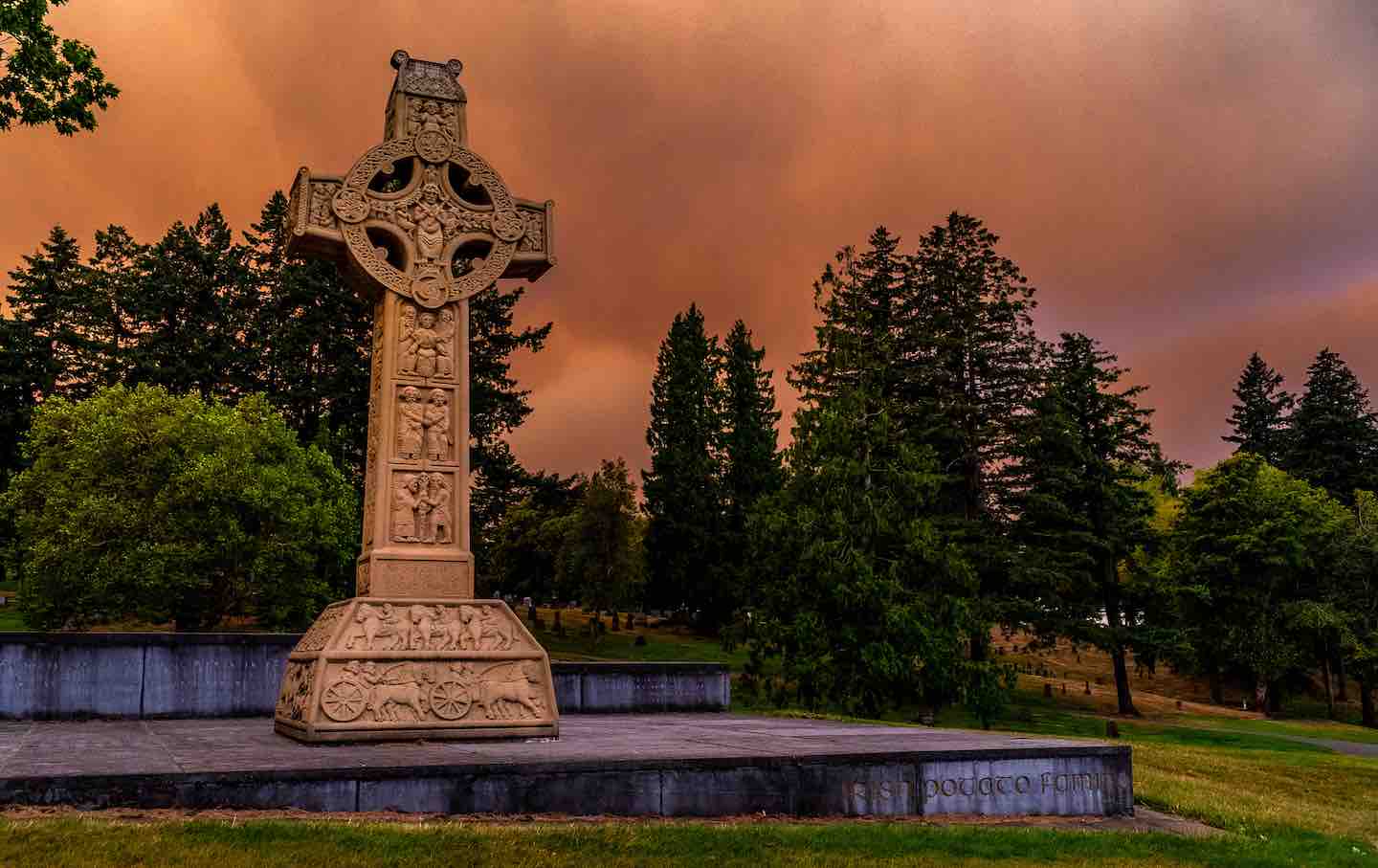
Orange clouds over the west hills of Portland as the light from the sunset and smoke from historic Oregon wildfires mix over Mt. Calvary Cemetery, 2020.
(Diego Diaz / Icon Sportswire).The Faustian myth warns us against making pacts with the devil. To trade something as invaluable as the soul for wealth, fame, and power, the story goes, is to diminish every facet of our existence, to suck the life out of our very core. But to sacrifice earthly glory, even our banal and temporary possessions—to humble ourselves in the eyes of God—for spiritual favor has been celebrated since the Old Testament and thought to restore, revive, and rejuvenate life. What, though, if your sacrifice provides neither earthly nor spiritual benefits?
Books in review
God and Sex
Buy this bookJon Raymond’s novel God and Sex hinges on a pact—a “bargain,” as the protagonist, Arthur, calls it—between him and a higher power. Arthur ventures to the Wy’East Resort in Oregon, where Sarah, the married woman he loves, is spending the next few days on a retreat, to tell her that her husband, Phil, suspects she’s having an affair. A writer who has only ever experienced mediocre book sales but feels on the brink of a bestseller with his new work, Arthur isn’t exactly happy to be giving up precious writing time to make the trip. Returning home, he sees “the fuzz of gray coming over the sky, and the sun going blood-orange,” and his phone alerts him that a forest fire is raging near the retreat. Sarah’s phone goes straight to voicemail numerous times, so he turns around, heading right into the eye of the fire to find her. As he scours the burning forest, he pleads with a God and prays, “I’ll give you the most important thing I can imagine if only you allow her to continue to exist.”
But Arthur can’t leave it at that. “I thought these new words over and over, in different formulations, honing the bargain,” he discloses, as if he can revise, control, and bend the pact to his whims the way he can revise, control, and bend the “Tree Book” he has set out to write and whose composition overlays Raymond’s novel. Or perhaps to revise is to revive. “It was a part of a writer’s job, I believed, to resuscitate,” Arthur asserts. This more self-serving idea about writing is in the service of a book that tries to explore much more: our responsibility in the face of climate change, the relationship between faith and love, and writing’s purpose in times of both global and personal crises.
Arthur has only a cursory knowledge of trees but nonetheless pursues his project with the zeal of a PhD student beginning a dissertation. Before he searches for Sarah in the forest fire, he combs through the website of the local college’s biology department, reads its environmental science newsletter, and clicks through faculty profiles for information and inspiration until he stumbles upon the name Phil French, a “forest ecologist…with a few interesting-sounding publications to his name and some cool class titles.” He writes to Phil and attends his office hours; soon a friendship blossoms, and Phil proves to be full of the knowledge and insights that Arthur needs for his book.
Phil, though, might be too good of a friend to Arthur—always magnanimous, always eager to help, always encouraging, always supportive of his endeavors, even after Phil learns of Arthur’s affair with his wife, Sarah, a librarian. Phil and Arthur live in abstractions—“believe in magic,” as Sarah puts it—attracted to hopefulness and attached to “interesting theories,” but Sarah grounds both men in reality. When they travel to Mount Shasta in Northern California to meet two climate activists, Candy and Merle, for research for Arthur’s book, the men are hooked by “their full spiel” and the “strange histories, odd treatises, obscure manifestos” that have influenced the activists’ larger political project. Sarah is charmed but skeptical. “I think they’re awesome. I just thought their work would be more…I don’t know…real,” Sarah says. “I thought there’d be more reality to it.”
If by “real,” she means tangible, then Arthur’s writing about their “regreening program,” at least from his perspective, might be a solution to that problem. As he tells Sarah,
“I’d frame the regreening program as a form of revision. I’d talk about how small changes can have big effects. How if you move a few words around, or rearrange a paragraph, a lot of energy can suddenly start flowing. A lot of writing is weeding and watering, in my view. I’d probably say something to that effect.”
His idea of revision seems especially apropos, but perhaps his faith in its powers is too great. It could be that his inability to bring everything back to writing—whether when threatened with death or in the face of climate activism—prevents him from engaging in the pragmatic reality Sarah seems firmly rooted in. After all, until he runs headlong into the forest fire, the climate crisis remains abstract for him—it hasn’t directly jeopardized his life or required him to change or sacrifice anything.
These various existential, political, interpersonal, and spiritual threads recall Raymond’s other novels. His first, The Half-Life (2004), follows two unlikely sets of friends who’ve been thrown together by chance: Cookie and Henry, who look to extract castoreum from beaver carcasses to use as a cure-all medicine in the 1820s, and Tina and Trixie, who set out to make a low-budget film on an Oregon commune in the 1980s. Both pairs experience sudden tragedy on the same Northwestern expanse, suggesting that despite physical separation—between friends, across history, amid death—land holds people’s stories together.
Raymond returned to these interpersonal and transhistorical dynamics in Freebird (2017), through the Singer family. Anne, the matriarch, is dutiful, progressive, and committed to the common good in her work for the Los Angeles Office of Sustainability, until a venture capitalist lures her into a scheme that enables her to profit off of the wastewater she manages. Her brother Ben, a former Navy SEAL, is struggling to readjust to civilian life after returning from duty in Afghanistan. And Anne’s son, Aaron, is having trouble deciding whether to go to college, pursue an itinerant life of freedom, or care for his elderly grandfather, a Holocaust survivor. Here, Raymond considers what our duty is to one another, not least of all those we are forced by blood to love, as well as the passive complacency of American life—our unwillingness to inconvenience ourselves even amid familial trauma and the quickness with which we abandon our convictions for selfish rewards.
Denial (2022), meanwhile, channeled Raymond’s political impulses into the climate crisis. Set in 2052 in a world where a Green New Deal is struck and fossil fuel moguls are convicted for crimes against the environment, Denial follows journalist Jack Henry as he tracks down a runaway oil executive, Robert Cave. Jack, operating under an alias, seeks a story but instead finds himself befriending Robert, raising questions, as in Freebird, about our moral responsibility toward others, including our presumed enemies, and whether we can decisively determine who is at fault for climate change.
While God and Sex traverses these themes and then some, I’m reminded more of a book from a different century—Graham Greene’s 1951 novel The End of the Affair. Like God and Sex, Greene’s novel is as much about an affair as it is about writing—as much about one’s relationship to God as it is about where we place our faith and why.
The backdrop in God and Sex is different—the climate crisis rather than World War II. And God, here, is a generic, amorphous, and ambiguous entity rather than the distinctly Catholic one. So is faith. Yet the characters in both novels make bargains with said Gods—offering to do anything if you’ll make them alive—that are met with varying levels of regret. Both protagonists are writers whose writing has flopped. Both of the women they have affairs with are named Sarah and face similar fates. Both novels begin by reflecting on beginnings. “A story has no beginning or end,” reads the first line of The End of the Affair, “arbitrarily one chooses that moment of experience from which to look back or from which to look ahead.” Raymond’s reflection on beginnings, though, doesn’t appear until a few pages in: “That’s one beginning, anyway. Every story has a thousand beginnings, a thousand places you might tip in.”
To write their stories is to “understand anything about the world,” as Arthur puts it to Sarah. But while Maurice Bendrix, Greene’s narrator, positions the end of his affair with Sarah as his story’s beginning, Arthur positions the beginning of his affair as his story’s ending. Bendrix also spends more time than Arthur wrestling with God, working through why Sarah would choose Him over him. Though Arthur does question his faith and discuss with his mother the nature of belief, he nonetheless spends most of his time asserting the value of writing. When a future with Sarah—“the most important thing I can imagine”—seems possible, Arthur doesn’t regret the harm that would befall Phil; he regrets the disruption to his writing life and creative fulfillment. The greatest sacrifice for him, then, isn’t love or friendship or faith, but art. Surely, though, he could still write and have a life with Sarah. His habits would simply need to be reconfigured. He would be only inconvenienced—briefly, temporarily. And yet.
Popular
“swipe left below to view more authors”Swipe →Though not an explicit connection, I’m left thinking about how often what we refer to as sacrifices—especially when it comes to climate change—are more like temporary inconveniences. Paper straws for plastic ones. Electric or hybrid vehicles for gas-powered ones. Biking instead of driving to work. Glass instead of plastic. Reusable instead of single use. Trains instead of planes.
Why is it only in moments of crisis that we are willing to make sacrifices, willing to be inconvenienced? Is it because there is typically a return on investment? I give you a burnt offering—my happiness, my well-being, my kidney, my soul—for something in exchange? Is there, then, inherent selfishness to any pact, whether Faustian or spiritual? Or is it more that global issues such as the climate crisis require sacrifices without a guaranteed, immediate return, and that is why we rebuff suggestions for ways to mitigate its effects: because the results of our habitual changes won’t impact us but only future generations?
The only time Arthur springs into action rather than bask in theories is when he fears he might lose Sarah. He risks his life by entering the burning forest to save hers. And he knows this is the risk he’s taking. But no sooner does he put his life on the line that he recognizes he alone can’t save her. That’s when he turns to prayer and bargains with the God he has decided he believes in, at least in this fleeting moment.
In The End of the Affair, spontaneous conviction transforms into lasting belief. But in God and Sex, when Arthur is torn between re-consummating his affair with Sarah and holding fast to the pact he made with whatever force he thinks saved her, he chooses his carnal impulse over his faith in a higher power. Yet his most ardent attachment still isn’t to Sarah. It can’t be if he went back on his bargain and reclaimed “the most important thing” to him. His most ardent attachment will always be to his writing, to his book “The Tree Life”—to the world of abstraction that protects him from confronting everyday reality, one that he can control and bend to his every whim. If Raymond is showing us anything, it’s that the Faustian bargain in the age of climate change maybe hasn’t changed all that much: We’re still lured by momentary comforts, wealth, fame, and power—our own self-serving motivations—even when the cost of our choices is as great as the longevity of our planet, the very thing that enables those motivations to exist in the first place.
Your support makes stories like this possible
From illegal war on Iran to an inhumane fuel blockade of Cuba, from AI weapons to crypto corruption, this is a time of staggering chaos, cruelty, and violence.
Unlike other publications that parrot the views of authoritarians, billionaires, and corporations, The Nation publishes stories that hold the powerful to account and center the communities too often denied a voice in the national media—stories like the one you’ve just read.
Each day, our journalism cuts through lies and distortions, contextualizes the developments reshaping politics around the globe, and advances progressive ideas that oxygenate our movements and instigate change in the halls of power.
This independent journalism is only possible with the support of our readers. If you want to see more urgent coverage like this, please donate to The Nation today.
More from The Nation
May Day Films to Inspire You With Solidarity May Day Films to Inspire You With Solidarity
From Modern Times to Harlan County, USA.
Are Magazines Failing to Cover the New World Order? Are Magazines Failing to Cover the New World Order?
A conversation with Gavin Jacobson, one of the founding editors of Equator, a new publication that is trying to make sense of the world after the West.
Esther Kinsky’s Celluloid Dreams Esther Kinsky’s Celluloid Dreams
In Seeing Further, a novel obsessed with the tactile feeling of arthouse cinema, the sad state of our moviegoing comes into focus.
Revisiting the Advent of the Abstract Revisiting the Advent of the Abstract
A recent gallery exhibition on abstract art and self-taught artists proposes a new story for the rise of abstraction.

Wolfgang Koeppen—“Poet of Failure” Wolfgang Koeppen—“Poet of Failure”
The German writer’s postwar works were ruthless in their condemnation of a country that, in its inability to reckon with historical atrocity, was beyond reform.
Lea Ypi’s Family Secrets Lea Ypi’s Family Secrets
In the political theorist’s genre-bending book on Albania and historical memory, Indignity, she interrogates how much one family can be implicated in a country’s becoming.

