Revisiting the Advent of the Abstract
A recent gallery exhibition on abstract art and self-taught artists proposes a new story for the rise of abstraction.
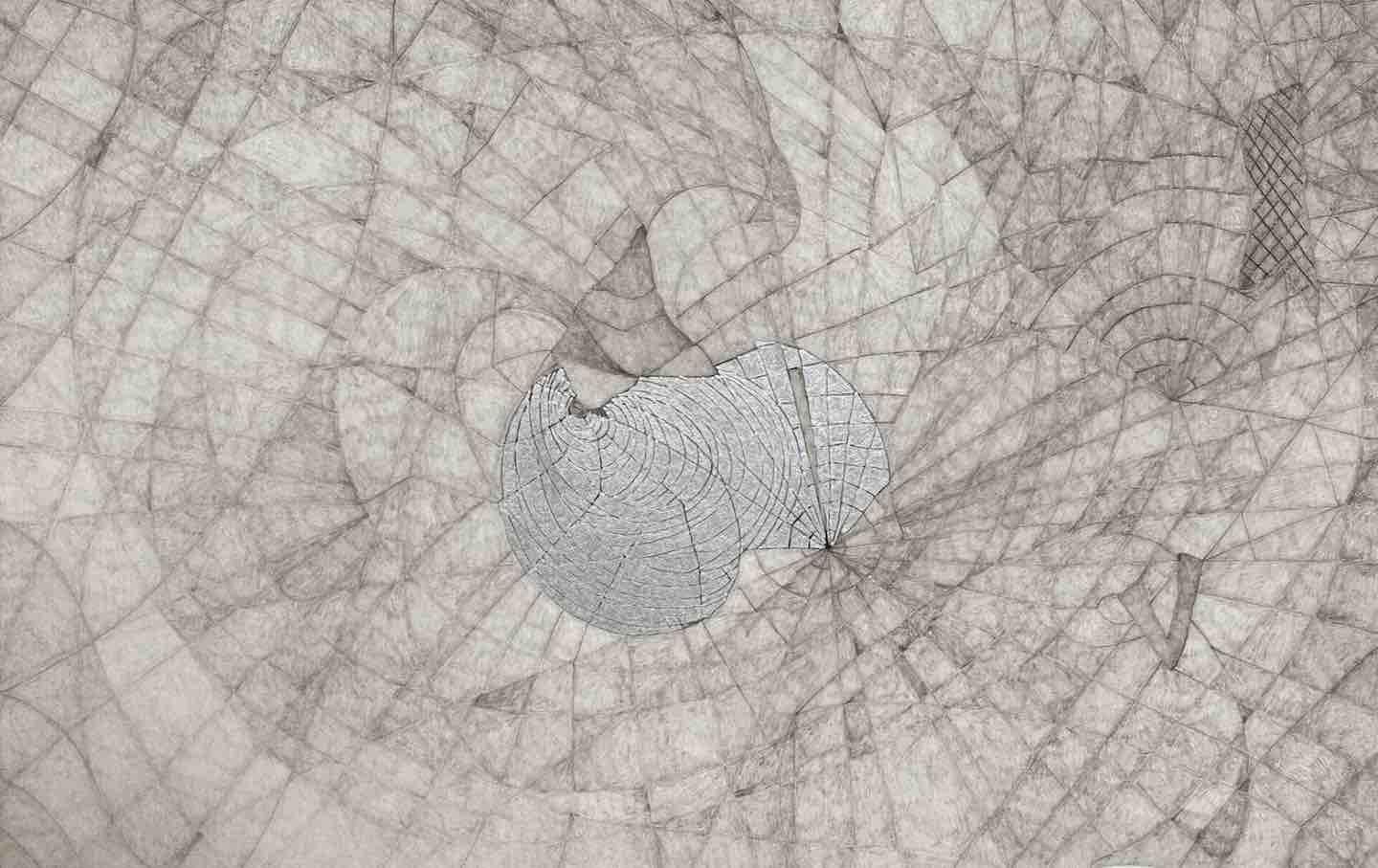
Susan Te Kahurangi King’s Untitled, 2022.
(Courtesy of Shrine)In the winter of 2012, New York’s Museum of Modern Art mounted a blockbuster-scale exhibition titled “Inventing Abstraction, 1910–1925”—a celebration of the centenary of one of the most astonishing turns in European and American art. From the Renaissance on, European fine art had been profoundly oriented toward narrative, illustrating biblical stories, the lives of saints, classical mythology, the triumphs and defeats of rulers and their armies. Sometimes ordinary people got a look-in, too, and there was room for more purely descriptive art forms such as still life and landscape, but storytelling was the main act.
That changed in the early 20th century, when a few artists began to believe that art had no need to depict anything but its own forms and intentions. Tracing the origins of this new theory in the work of painters like Robert Delaunay, Wassily Kandinsky, and Francis Picabia, the show at MoMA rehearsed a history that had long been familiar but, I felt at the time, still succeeded in conjuring an era when this approach “was still a leap, when it affected certain people like love or revolution.” The advent of abstract art aroused the most vehement resistance, and yet it spread with a rapidity we’d now call viral, from Munich and Paris to Moscow, New York, and beyond.
This winter, Shrine, a small gallery in Tribeca, hosted a similarly titled show whose subtitle tells a very different story. Curated by Jay Gorney, “Inventing Abstraction: Nonrepresentational Self-Taught Art” situated abstract art against its two conventional origins: as either the product of a militant avant-garde intent on overthrowing the old verities, or a historically minded endeavor to maintain and extend what the critic Harold Rosenberg called “the tradition of the new.” Instead, the exhibition showed abstraction as a practice of artists with a closer eye on their own immediate situation—or on the judgment of God—than on the flow of art history. Gorney, who owned one of New York’s most influential galleries in the 1980s and ’90s, contends that for self-taught artists (or, as they are sometimes called, “outsider artists”), “there is nothing to mimic, adulate, or reject; abstraction emerges as a primary visual language.” I’m not convinced that most so-called outsiders are quite as outside the flow of art history as all that—but let’s concede that they have a different relation to it than those who have been socialized and accredited by the art-educational system.
Who is or isn’t an outsider artist? What counts or doesn’t count as self-taught art? These are unresolved questions. Some of the most “inside” artists of all have never been to art school. Maurizio Cattelan—he of the gold toilet and the banana taped to the wall—is one. Another was the pioneering conceptual artist Lawrence Weiner, who dropped out of Hunter College in his freshman year, never studied art, and once told me that he owed his education to the New York Public Library. “There is no such thing as outsider art,” Weiner said to the artist-writer Brainard Carey. “It’s a category of people who wanted to discover things that were not part of their structure.” That means people who become artists, perhaps even unknowingly, because of their need for discovery—but it also means the people who are in a position to “find” artists where there were never supposed to be any. The notion of the outsider romanticizes the artist’s discoverer—the one who is in a position to bring attention and value to works that had previously been ignored—as much as it does the artist who is discovered. And yet, Weiner insisted, “an artist is an artist is an artist.”
The whole point of art, as Weiner understood, was to somehow step outside habitual forms of perception and being: “Every work of art is supposed to give somebody that sense that there’s a moment in their day, in their life, where they’re outside of jurisdiction because of what they see and because of where they are, and somebody built it for them. Somebody made it for them.” The appetite for the outsider has to do with this need; we have to experience a point of view that escapes our own internalized cultural strictures. When we cross the path of someone following the beat of a different drummer, we become more aware of our own assumptions, and maybe more critical of them. In that sense, all artists are somehow on the outside, but those who are recognized as such have been ushered inside a reigning structure of perception and thinking, and thereby alter it to some degree.
So despite my deep reservations about such categorizations—despite my sympathy for Weiner’s “an artist is an artist is an artist” dictum—I am willing to use the word outsider (which in the end seems to me a little more descriptive than the ostensibly neutral and nonjudgmental “self-taught”) for those cases where I sense that someone’s way of seeing things is so radically distinct from my own that I’m not even sure I can understand it; where, as I’ve said before, I can’t help responding to it even though I’m not sure if my response has any real connection to what the artist had in mind.
That many of the artists in Gorney’s exhibition had unconventional ways of seeing the world would be evident from the art they produced, but this idiosyncrasy is further underlined by the biographical notes he has provided on the gallery’s website. Emery Blagdon, for instance, “believed his creations generated electromagnetic energy with immense healing properties.” A delicately intricate hanging construction of wire and bits of metal might look like a sanitorium for a colony of pet crickets; Blagdon’s paintings, by contrast, are bluntly diagrammatic, loosely brushed designs that seem to map the interactions of unnamable energies. Minnie Evans reflected that her art may have “come from the nations, I suppose, that might have been destroyed before the flood,” while Madge Gill, one of the most renowned of outsider artists, “believed that a spirit guide named ‘Myrninerest’ guided her hand and authored her drawings.”
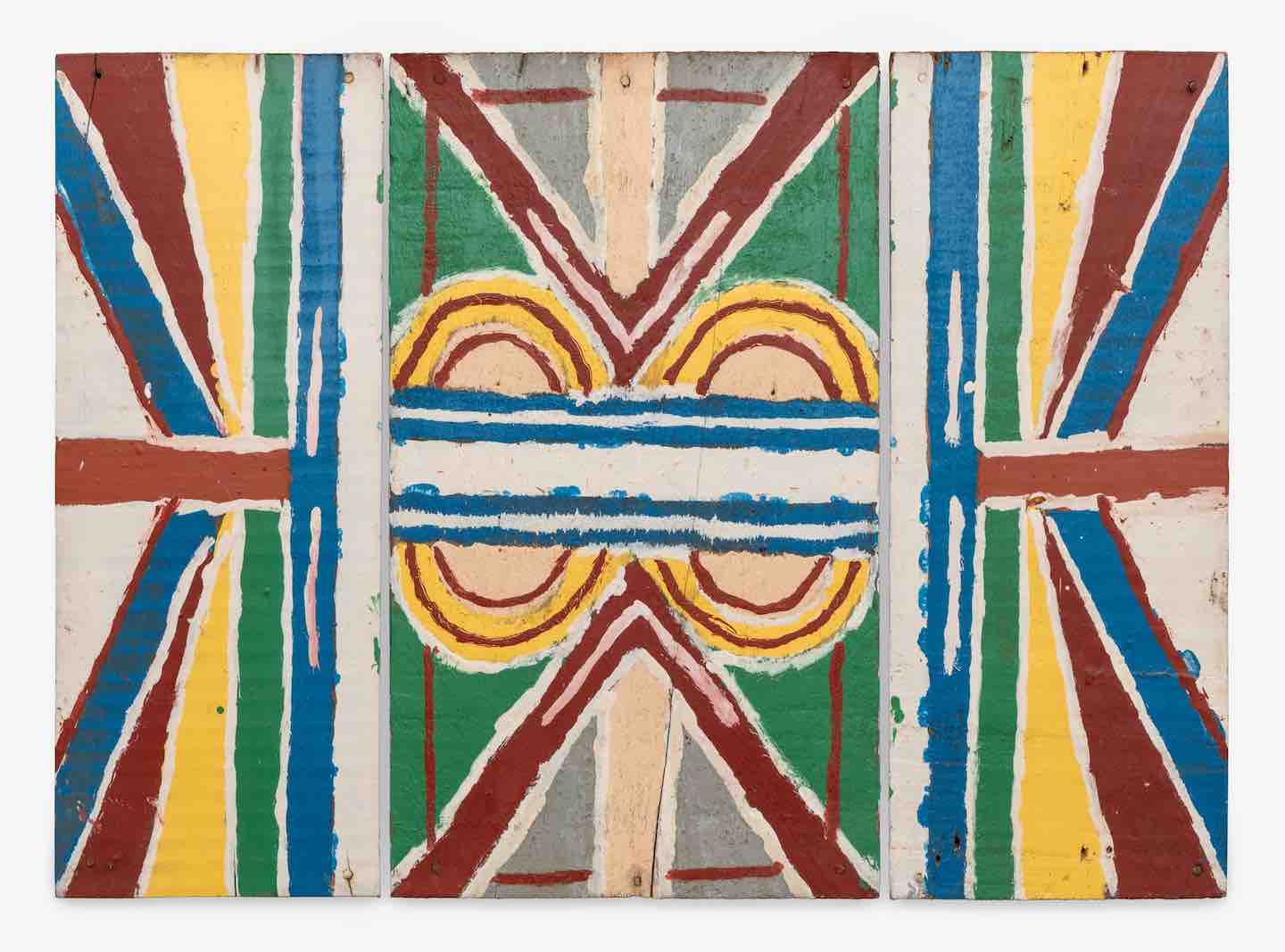
Evans, working in North Carolina, and Gill, in London, both made drawings whose hypnotically rhythmic patterning is subject to mercurial, unexpected shifts; those by Evans are relatively spare while Gill’s are dense, but both are cognizant of the power of visual rhythms to transport the viewer to some mysterious elsewhere. If I’m not inclined to accept the electromagnetic healing properties, antediluvian visions, or helpers from the beyond in which these creators believed, does my disbelief falsify or condescend to the art that was made with those convictions? And what about the fact that Blagdon “considered his works and overarching project a ‘healing machine’ and did not regard his assemblages as art”? Evidently, Gorney can’t see things Blagdon’s way any more than I can. And as far as I’m concerned, whatever Blagdon may have thought, his sculptures and paintings are nothing if not art.
There were others in the exhibition whose thoughts project an alterity that we can never really know we understand. Judith Scott, a very great artist in my estimation, was deaf, mute, and had Down syndrome. She never learned to sign or write. In 1987, at the age of 43, Scott was introduced to the Creative Growth Art Center in Oakland, California, where she began making complicated and highly varied sculptures by wrapping various objects in yarn and strips of fabric. What and how she thought about what she was doing, and why she did it, are as impossible to reconstruct as what it might have meant to her, but the intensity of thinking invested in her art is patent. The show’s other artists included Nenna Kalu, last year’s winner of the Turner Prize for best exhibition by a British artist, who is autistic and described as having limited verbal communication, and Susan Te Kahurangi King, a New Zealander who stopped speaking at the age of 4. Such artists leave little to no record of how they conceptualize their work—but that their intentions are clear and determinate is incontestable from the visual evidence. And then there’s the complete unknown: the artist dubbed the Philadelphia Wireman (though we have no reason to assume it was a man), whose works, about 1,200 small sculptures, were found in boxes and bags on a street corner one trash-collection night, it’s said, in 1982 (or, according to other sources accepted by Gorney, the late 1970s). Any conjectures about who might have made them or why are completely speculative. What we can say in all these cases, though, is that their art reflects a fundamental need to work on the world as it’s been given, to intervene in it, to transform something in it, and to communicate the need that their art embodies. Working with what often feels like the bare minimum, the leftovers of daily life, these artists create their own homemade worlds.
To jump from an exhibition of outsiders—people who often lived in poverty and mostly had little or no art-historical information or contact with the art market, people who in some cases never thought of exhibiting their work or even calling it “art”—to a show of paintings by the most renowned and probably the most influential of living American artists, someone who has been an object of fascination for critics, collectors, and fellow artists ever since his first solo exhibition at the age of 27, may seem like an unlikely leap. But bear with me: There’s more in common between Jasper Johns and the outsiders in Gorney’s show than might be apparent.
For one thing, Johns was no more the product of a conventional art education than Weiner or Cattelan, and little more than Gorney’s outsiders. True, he was not entirely lacking in formal instruction: He had three semesters at the University of South Carolina and one at the Parsons School of Design. But his education was interrupted by the draft; there was a war going on in Korea, though Johns didn’t see combat. Upon returning to New York, rather than picking up where he had left off in school, Johns started trying to figure out for himself how to make a painting, what art could be. And he went about it in pure DIY fashion. Moreover, he did not, at first, take his imagery from the history of art but from his surroundings and his dreams. His sources, as the critic Lawrence Alloway observed, were “the communications network and physical environment of the city”: letters and numbers, targets, the American flag. The things Johns painted, in the early part of his career, should be considered signs rather than images. The works that first made him famous are peculiarly neither abstract nor, in any traditional sense, figurative. They didn’t show people, objects, or landscapes—the things that paintings have depicted for millennia—but they did present things almost anyone can recognize. These things, these signs or symbols, were not represented in an imaginary three-dimensional space but on the flat plane of the canvas itself. This is what they shared in common with some abstract art.
But there’s something about that flag in particular—it’s not just one of those everyday things that Johns was interested in because they were “seen and not looked at,” like the numbers and the rest. Because the flag came to him as a kind of vision: “One night,” he has said, “I dreamed that I painted a large American flag, and the next morning I got up and went out and bought the materials to begin it.” Like Minnie Evans, Madge Gill, and many other self-taught artists, Johns accepted the image he painted as a message from somewhere outside himself. And in order to pass that message-image along, he conscientiously “built” his paintings as much as he painted them. Johns reinvented for himself a technique that would not have been taught at any art school of the time, encaustic painting (or painting using a hot-wax medium), which was found in classical Roman and Byzantine art but mostly ignored in Western art until Johns revived it. And he painted his famous 1954 Flag, a longtime attraction at the Museum of Modern Art, not on canvas but on a cut-up bedsheet affixed to a plywood board; the stripes are not painted directly, but rather have been formed from strips of fabric and newsprint imbued with the encaustic and then collaged on the surface. All of this is to say that, like so many self-taught artists, Johns began by making his work not with conventional art materials and using handed-down methods but by montaging his paintings out of the salvaged materials of daily life, with an aesthetic of reuse and making-do, ingenuity, and reinvention.
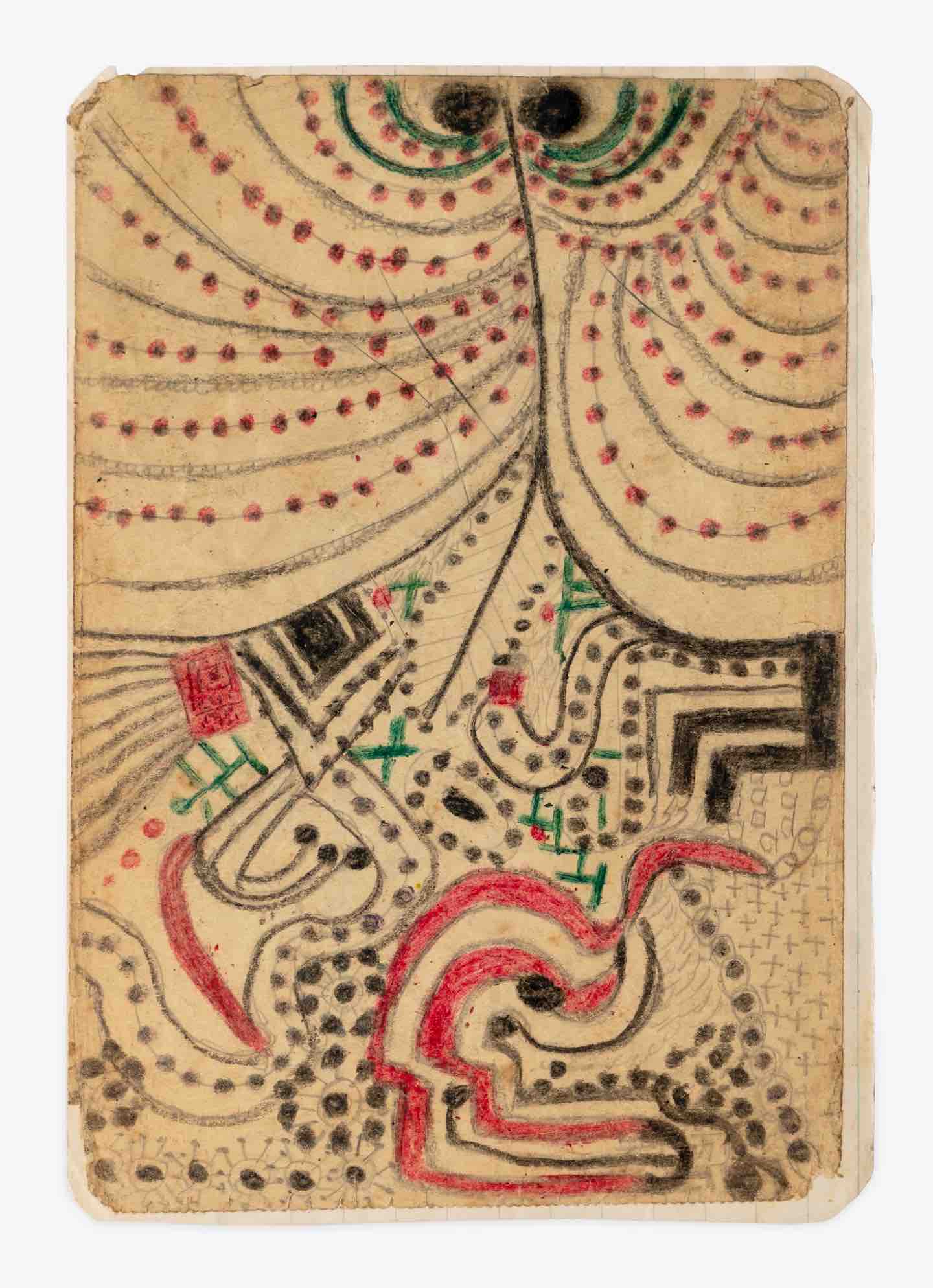
A current Johns show at Gagosian in New York, “Between the Clock and the Bed,” features paintings and works on paper produced, for the most part, between 1974 and 1984 (with a few outliers from later on)—one of those museum-quality explorations of recent art history that the biggest galleries have been recurrently pulling off in recent years. This phase of Johns’s art represents a turning away from the aesthetic of signs that he’d been pursuing for 20 years, starting with that first dream-inspired flag painting. In these years, Johns was venturing—newly for him—into abstraction. But like his previous works, his abstractions also involve memory and metaphor, and the dreamlike intertwining of the known and familiar with something more elusive. In the 1950s, Johns had stood aside from the triumphal narrative of abstraction as the culmination of what Clement Greenberg called a “process of self-purification” in modern art. Far from pure, Johns’s art was deeply imbued with the quotidian, and by the 1970s, he would find himself ready to make an everyday form of abstraction with, as he said, “all the qualities that interest me—literalness, repetitiveness, an obsessive quality, order with dumbness, and the possibility of a complete lack of meaning.”
The earliest of the paintings in the Gagosian show, Corpse and Mirror (1974), consists of two vertical canvases joined side by side to form a single horizontal painting using little color. On the left, we see an irregular pattern of small patch-like areas, each formed from a few (usually five) parallel black lines; the changing direction of these sets of lines gives the work a variegated appearance that belies its highly reduced pictorial content. The right-hand canvas seems to be a mirror image of the left one, but with more white, pink, and gray added, somewhat obscuring the pattern of lines: It’s as though one were seeing a reflection through the glare of a bright light. As well, Johns has added to the right-hand canvas a large X at the top, as if crossing something out, and, near the right edge, the imprint of an iron (presumably evoking its use as a tool to heat the encaustic paint he’s used in this work along with oil paint).

It’s easy to understand the canvas on the right as a mirror, but why is the left one a corpse? It’s certainly very active for a cadaver—the interaction of the lines gives it a distinctly vibratory energy, in fact. But for all that, the reduction to black and white makes it feel like the skeleton of a painting that might somehow be fleshed out in color. And something like that begins to happen with another self-mirroring painting, Corpse and Mirror II (1974–75), where the groups of lines are painted in red, yellow, and blue. But even those primary colors can feel like no more than a schematic skeleton for the full range of chromatic experience. It’s not exactly that color is absent—even in the first of these paintings, the nearly grisaille one—as that it’s been held in reserve, disguised rather than declared, since the visual richness of these paintings comes from coloristic nuances that are only implied.
These understated nuances soon enough become explicit in Between the Bed and the Clock, the paintings that give the show its title—seven canvases by that name, made between 1981 and 1983. Still using the same pattern of parallel hatchings, Johns has gone far beyond the reduced color palettes of the Corpse and Mirror paintings to layer in multitudes of chromatic nuance, producing a rich, resonant luminosity. Johns borrowed his title from a painting by the Norwegian modernist Edvard Munch, Self-Portrait Between the Clock and the Bed (1940–43). The lower right of Munch’s painting is occupied by the aforementioned bed, and it’s covered by a blanket with a pattern of parallel red and blue lines very much like the hatchings Johns had been using for several years. Which is to say, perhaps, that Johns was turning his abstract patterning back into an image of sorts—or, in any case, that he was now working with the realization that the difference between abstraction and representation might be a difference of context more than of essence. The decorative pattern on a bedspread may not be considered fine art, but somehow, when it makes its way into a painting, it takes on a different value.
Even so, the everyday pattern remains tied to a vernacular reality. It’s significant that Johns’s venture into abstraction did not take off from this citation from Munch, but rather found an echo there after the fact. Instead, it took its inspiration from the simplest marks that an artist could possibly make: straight lines. Perhaps reminiscent of the parallel bands of red and white that Johns had painted before in the guise of the US flag, the lines in these paintings of the 1970s and ’80s have been liberated by the artist from such specific references without denying a broader sense of referentiality. It’s not just that they could so easily recall something as commonplace as the design of a bedspread. It’s that the intricacy of the compositional structures Johns could build out of these multidirectional arrays of simple lines—full of mirrorings and inversions, like a modernist 12-tone musical composition made by manipulating a single tonal row—suggests an almost obsessive fixation on some unfathomable implication that might be secreted in these arrays of brushstrokes. One feels that the artist is at once encoding and trying to decode something that he can’t quite put his finger on. If Johns were to claim they might be messages from antediluvian civilizations, I wouldn’t entirely be surprised—but instead he keeps a wise silence. He’s another of those artists who know how to work with the absolute minimum and make a vast world of it.
More from The Nation

The Carnival of Venice Biennale The Carnival of Venice Biennale
That so much of the art of “In Minor Keys” is muted in effect is ironic, because so much of it is overproduced, aspirationally eye-catching, and so big.

America Without the NFL America Without the NFL
Chuck Klosterman’s Football is a eulogy for the sport on the eve of its decline.
Edward Said: Between Worlds Edward Said: Between Worlds
A new film biography depicts the Palestinian writer as still out of place—and ahead of his time.

Imani Thompson’s Grad-School Thriller Imani Thompson’s Grad-School Thriller
In Honey, the novelist offers a different take on the campus satire.