
The Immigration Crackdown Hurts More Than Just International Students
Universities are raising their tuition, offering fewer classes, and axing extracurricular programs to compensate for the dip in international student enrollment.
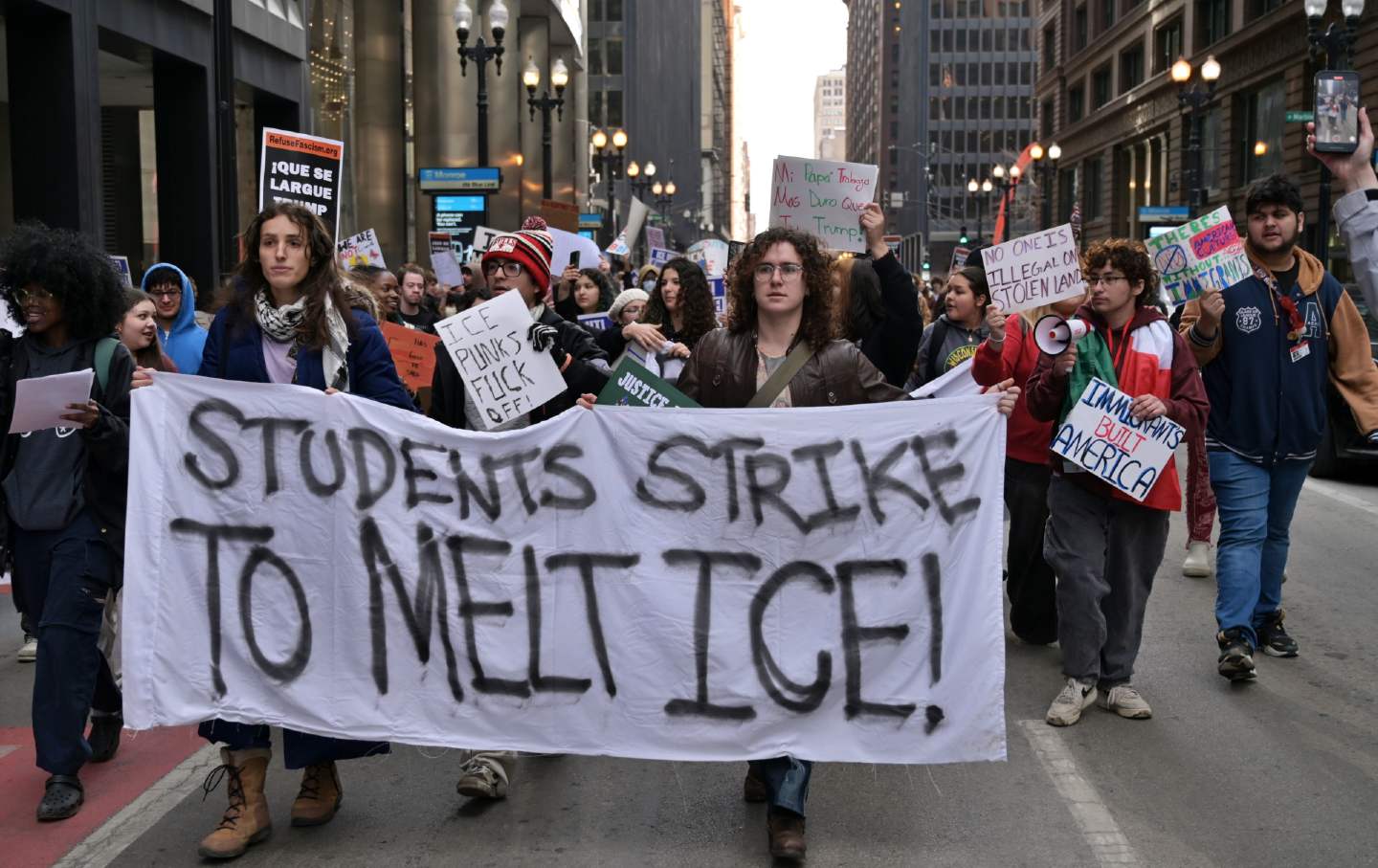
Students from across Chicago, including representatives from the School of the Art Institute of Chicago, gather to protest ICE.
(Jacek Boczarski / Anadolu via Getty Images)University of Illinois Chicago kinesiology professor Tim Koh used to receive at least 10 e-mails a week from international students around the world seeking research positions in his lab. Now he’s lucky to see one or two.
“For most of these countries, you have to be extremely bright to be able to come overseas,” said Koh. “For me and for my colleagues, international students have always been an extremely valuable part of the program.”
As federal visa restrictions tighten and immigration enforcement has escalated, new international student enrollment has decreased 17 percent nationally, leading to budget shortfalls and staff layoffs.
The shift in who’s reaching out has been just as telling as the drop in volume. Koh said the e-mails he still receives are largely from international students already in the United States—people in American master’s programs looking for PhD positions or PhD students hunting for postdocs, for example—rather than from abroad. The pipeline of students willing to cross an ocean for a research opportunity has begun to dry up. “They’re probably concentrating in other places,” he said. “Not in the US.”
There’s also the question of retainment. A former postdoctoral student in Koh’s lab now works in Australia, a move influenced by political uncertainty over the last couple of years, according to Koh. “She saw the writing on the wall and decided this wasn’t a place she wanted to be because of all the uncertainty and essentially how immigrants are being treated.”
Koh also pointed to the lack of support for international students, noting that offices at many schools are understaffed and unable to provide the resources and support that students need. At UIC, he said, the Office of International Students is “just overwhelmed,” and the school has seen a nearly 5 percent decrease in international student enrollment. He said that even as staff are busy trying to understand changes in processes, they are also trying to juggle the sheer number of issues cropping up for students needing support.
The “reformulation of visas” and changes to the timeline and process have led to fewer graduate workers in particular, according to Soleil Smith, copresident of the UIC Graduate Employees Organization. The university has also “threatened” to cut funding for campus cultural centers, which she said are important to supporting international students. “The university has been pretty clear in its actions, if not in its words,” said Smith. “It is not really that interested in turning the tide on losing international graduate students.”
Universities have long relied on international students financially since they often pay higher tuition. “It’s kind of ironic,” said Koh, “that a lot of universities were trying to attract foreign students for financial considerations, because they tend to pay more money, right?”
In response to the changes and threats from the Trump administration, the University of Illinois has raised tuition system-wide—an attempt, according to Graduate Employees Organization (GEO) organizers, to offset losses from declining federal research grants and shrinking graduate enrollment—even as graduate workers have seen their appointments reduced or eliminated entirely. At UIC, a hiring freeze last spring has also complicated efforts to fill open faculty and staff positions.
At the School of the Art Institute of Chicago, the financial shock of even a small decline in international enrollment can hit fast.
In an October e-mail obtained by The Nation, SAIC administrators told faculty that a sharper-than-expected drop in enrollment after the add/drop deadline—especially among international students, whose share of the student body fell from 29 percent to 25 percent—had deepened a financial shortfall and prompted a new round of spending cuts, including freezing merit increases for senior administrators, reducing full-time faculty searches from 12 positions to just three and exploring the sale of campus property.
In an e-mail on November 12, the SAIC administration announced that the school was facing “a significant financial shortfall” attributed to enrollment decline, “particularly among international students,” along with increases in tuition discounts and other costs. This necessitated “structural changes” to “ensure the long-term health of SAIC,” the e-mail read—including reducing classes due to lower enrollment and the elimination of 20 full-time staff positions.
Eric Leonardson, an adjunct professor who has taught at SAIC since 1997, said the school’s budget is especially sensitive to enrollment changes because it operates primarily on tuition revenue rather than research grants. SAIC boasts a student population of just 3,323—split between 2,737 undergraduates and 538 graduate students. According to Sidne Gard, an editor at campus publication F Newsmagazine, the school’s size means that any changes in staffing or enrollment are felt “significantly.”
In a December e-mail Leonardson received from Judd Morrisey, the chair of the Art & Technology/Sound Practices department informing him that his spring class would be canceled, Morrisey wrote, that he too had “a class on the chopping block,” and was “preparing to get [his] own taste of SAIC’s cancellation policies.”
Leonardson said SAIC administrators told faculty in an e-mail that international student enrollment had dropped about 3 percent, and that the school was facing a roughly $7.7 million budget deficit in the fiscal year ending June 2026. The figure surprised him. “Three percent doesn’t seem all that severe,” Leonardson said, noting that without more context about the institution’s overall budget, the response felt disproportionate.
These budget shortfalls have also impacted student life, with club funding stretched thin, according to F Newsmagazine. The publication itself has been affected by the personnel cuts. According to Gard, the publication’s design adviser was one of the SAIC staff laid off. In late January, administrators announced another round of cuts—this time, 16 non-tenure-track faculty, or 2 percent of SAIC faculty,” would not have their contracts renewed. “F has existed for 40 years,” Gard said, “and for that entire 40 years, we’ve had a design adviser.”
In Chicago and across the country, schools have had to grapple with both campus safety fears and the administrative burden of navigating rapidly shifting federal policy. During Operation Midway Blitz last fall, hundreds of federal agents conducted raids and detained roughly 4,500 people across the Chicagoland area, according to the Department of Homeland Security.
The immigration enforcement climate has also changed the experience of international students in Chicago who now have to worry about their basic safety
In one class, Leonardson said, an international graduate student who served as his teaching assistant left mid-semester and returned to her home country after immigration enforcement activity was reported in their neighborhood. Leonardson said the student’s departure left him without a TA for the remainder of the course—and she was in her final semester before graduation. He said he’s lost touch with her.
“When I’m talking to students, I’m talking to the students that are here, and I’m not talking to the students who aren’t here because of the pressures or the obstacles that are present now about coming to the US,” Leonardson said.
The UIC GEO said they tried to include protections for international students in their latest contract negotiations, including clearer institutional commitments to protect students from immigration enforcement actions on or near campus. Union organizers also pushed for faster authorization for off-campus employment when on-campus jobs are unavailable and university payment of federal work authorization fees.
However, they have failed to gain the headway with administration that they’d hoped for.
“When we try to talk to them at the table about ICE or international workers or anything, they seem exasperated. They seem annoyed that it comes up,” Smith said. “They generally are like, ‘We’re not interested in talking about this. We’re not interested in putting this in writing. We are not interested in putting this in a labor contract’—which is troubling.”
GEO outreach chair Macy Miller said the union has been trying to work with campus organizations to protect international students and other marginalized groups from ICE, which she emphasized was a key concern in Chicago—and across the country.
“We’ve been trying to push the university to actually establish real protections to keep our campus community safe, and we’ve been very frustrated with the kind of pushback that we’ve gotten on that from all angles,” Miller said.
In a September announcement to faculty and staff, DePaul president Rob Manuel emphasized the precarious position of the school’s budget, citing that international enrollment overall had decreased by 755 students compared to the last academic year, a significant drop.
According to DePaul American Association of University Professors member Marcy Dinius, the subsequent staffing cuts have reshaped basic student services. DePaul’s downtown Loop campus library, she said, is now down to a single staff member serving multiple colleges—forcing staff to commute from Lincoln Park and even requiring someone in the provost’s office to fill in after being trained to check out books. The university’s Writing Center, she added, is being refocused away from serving all students toward triaging only those most at risk, after the coordinator for workshops and digital resources was cut. The honors program, Dinius said, lost its associate director—the main adviser for honors students—and even administrators have not been given a complete list of who was laid off.
The result, she said, is daily operational confusion where e-mails go unanswered, offices scramble to figure out who is still employed, and remaining staff are often doing “three or four different jobs” at once. “They’ve made cuts, I think, that they’ve intended to make for a long time, very dramatically, under the cover of this loss of international students,” Dinius said.
The closure or limitation of visa services in countries such as Russia and Iran has also further complicated enrollment pipelines. Kasra Tabrizi, a second-year sociology PhD student at UIC from Iran noted that several countries—including Afghanistan, Syria, Iran, Somalia, and Sudan—do not currently host functioning US embassies where students can reliably obtain visas.
Under recent federal policy changes, some students must obtain new visas from the country of their citizenship rather than applying in a third country, narrowing their options if diplomatic services are unavailable.
Popular
“swipe left below to view more authors”Swipe →Tabrizi said the uncertainty doesn’t just deter prospective students—it can trap current ones, too. If a student has to leave the US to renew a visa, he said, they may not be able to return at all if visa services are inaccessible in their country of citizenship.
Graduate student contracts at UIC run nine months, leaving summers unguaranteed—a gap that international students once bridged by returning home to family or temporary work abroad. That option has largely disappeared. With visa renewal uncertain and reentry from certain countries nearly impossible, many international students now find themselves stranded in Chicago over the summer with no contract or income. “If they cannot go back, and if they don’t have a job here,” Tabrizi said, “I don’t know how they can pay rent, how they can buy groceries.”
For students from countries facing political instability or economic crisis, returning home is not always feasible, Tabrizi added. He said the climate has raised broader questions about UIC’s ability to maintain its research output and standing as an R1 institution in what he described as a “main hub” for international students.
According to Tabrizi, his department does not have any international students in its new graduate cohort this year. In his own cohort two years ago, he said he was the sole international student.
“People are afraid that their visa might vanish at any time, at any point—and that if they have to go back to their home country to obtain a new visa, it’s not possible for them,” Tabrizi said.
Tabrizi described the administration’s strategy thus far as “total disengagement.” He criticized the Office of International Service’s lack of response, noting that he e-mailed twice about his own visa status and received no reply.
In the fall, Tabrizi joined roughly 20 fellow students at the OIS office to ask for information about visa revocations. There was just one worker there, who asked the gathered students why there were there and accepted a letter from them—a document that Tabrizi said contained general demands such as responding to e-mails and providing resources for international students. He described the visit as “very symbolic,” with the goal of asking why the administration was willing to engage with students’ concerns.
They never received a response.
“We did that because the UIC admin was telling us that there’s not anything that we can do for you, and it’s OIS’s responsibility to be responsive to you,” Tabrizi said.
Support The Nation’s June Fundraising Campaign
With the midterm elections now firmly upon us, the question is whether Democratic candidates will do more than merely occupy ballot lines as mild alternatives to the red-hot crisis that is Donald Trump.
As Trump spends over $1 billion a day on a globally destabilizing war on Iran and admits that he doesn’t “think about Americans’ financial situation,” millions across the country are struggling with the surging costs of essentials. Democrats must seize this moment and advance bold, small-“d” populist ideas—not settle for cynical caution that once again snatches defeat from the jaws of victory.
The Nation elevates progressive ideas, movements, and elected officials achieving real change across the country into the national conversation. At the same time, our journalists are exposing how crypto and AI-funded super PACs are spending hundreds of millions of dollars to knock out candidates they oppose, reporting on the devastating impact of the Supreme Court’s evisceration of the Voting Rights Act, and sounding the alarm on attempts by red states to quickly redraw electoral maps, disenfranchising Southern Black voters.
We can play this critical role because of support from readers like you. This June, we’re raising $20,000 to power The Nation’s independent journalism in the run-up to November’s immensely consequential elections.
It’s in our power to build a more just society, and your support at this critical moment brings us closer to that bold vision. I hope you’ll donate today.
Onward,
Katrina vanden Heuvel
Editor and Publisher, The Nation
More from The Nation
We’re Having the Wrong Conversation About College Graduates We’re Having the Wrong Conversation About College Graduates
Workers with college degrees are constantly being pitted against workers without one. But such a zero-sum debate obscures the need to protect everyone in every workplace.

They’re Coming for Abortion, Only After the Midterms They’re Coming for Abortion, Only After the Midterms
The administration may be reluctant to further undermine abortion rights before November, but the abortion-rights movement must stay vigilant.

Abortion Has Always Been an American Tradition Abortion Has Always Been an American Tradition
More than one founding father knew that to be truly free, women needed control over their reproduction.

We Were Founded on Anti-Monopoly Principles We Were Founded on Anti-Monopoly Principles
The premises of the American democratic vision must be applied to the economy if we are to be free in all alreas of life.

American Dream, American Nightmare American Dream, American Nightmare
This nation’s DNA is a double helix of beauty and brutality.

The "Heated Rivalry" Paradox The "Heated Rivalry" Paradox
What does it mean that TV's biggest hit is a mega-steamy gay romance at the same time as anti-queer hatred rages out of control?

