
Bad Faith
Tucker Carlson’s conversion story
What Happened to Tucker Carlson?
The transformation of a once promising, if conservative, magazine journalist into a conspiracy-minded talking head.
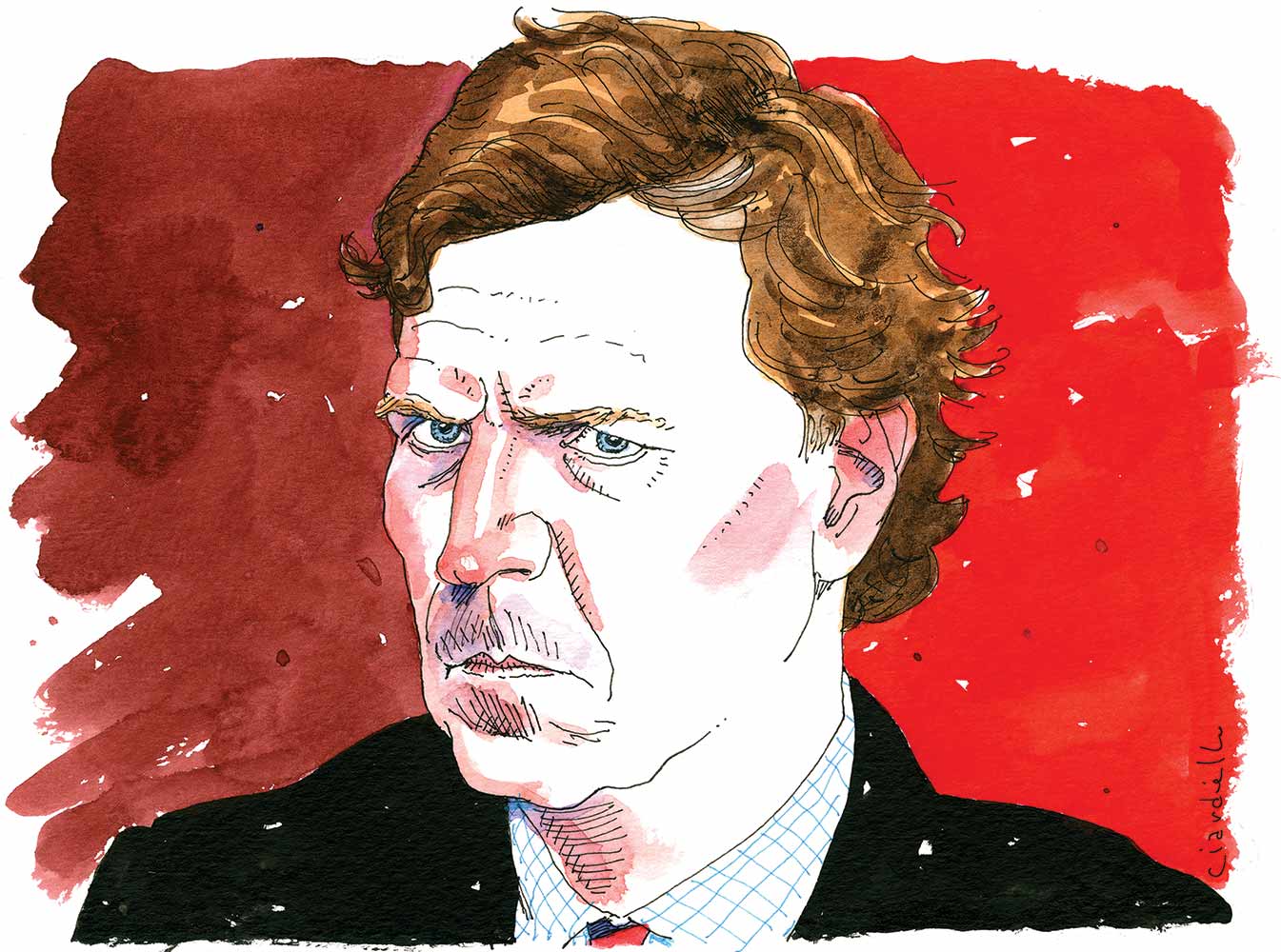
Back in the George W. Bush years, my then-wife and I had dinner in New York City with Tucker Carlson. At the time, he was settling in as cohost of CNN’s Crossfire after a rocky tour through the cable-hosting wars and savoring his re-anointment as a political insider and media gatekeeper. Over drinks, he sounded off on the invasion of Iraq, which he was then souring on (along with much of the rest of the country) after having enthusiastically supported it. He also derided the GOP’s all-in crusade against gay marriage, which would prove by some accounts key to Bush’s subsequent reelection in spite of the Iraq debacle. And he regaled us with media gossip, recounting the tale of a prominent cable talking head whom he’d heard clumsily trying to burnish his standing as a political junkie by announcing his eagerness to cover the “Iowa primary” and the “New Hampshire caucus.”
Books in review
Hated by All the Right People: Tucker Carlson and the Unraveling of the Conservative Mind
Buy this bookSuch encounters weren’t all that remarkable for the time, particularly as the Bush White House sank into greater chaos and corruption, and its erstwhile fellow travelers strained to distance themselves from its crimes and imperial folly. Yet as my then-wife and I compared notes afterward, we agreed that Carlson seemed to be verging on a significant revision of his worldview; he appeared to be aligning with the then-trendy-in-DC niche movement of “liberaltarianism.”
Well, that was then. And here we are now. After a few more turns of cable TV’s wheel of fortune, Carlson landed in the heart of Fox News’ prime-time lineup, hymning the MAGA project of national reclamation to his increasingly right-wing audience while peddling ghoulish campfire tales about the plagues of wokeness, critical race theory, open borders, and other damning specimens of anti-American liberal groupthink. Even after his unceremonious dismissal from Fox, Carlson continued his strange trajectory ever more rightward. Setting up permanent shop in the fever swamps of the conspiracy-minded far right, he palled around with Vladimir Putin and Viktor Orbán and lent his podcasting platform to the Nazi-Groyper influencer Nick Fuentes—a move that inadvertently sparked a still-raging civil war within the Heritage Foundation, the right’s most influential think tank.
Carlson’s transformation from an ingratiating bow-tied pundit into a plaid-and-khaki-clad Nazi enabler is the subject of Jason Zengerle’s Hated by All the Right People, a chronicle of Carlson’s career that is meant to double, as the book’s subtitle suggests, as a broader account of how the intellectual project of American conservatism has gone off the rails. As a straight media biography, Zengerle’s book is an instructive study in the amoral rounds of ambitious striving in the greenrooms and studio sets of cable TV—a kind of What Makes Sammy Run? for the chattering classes of the new millennium. But as a saga of the right’s intellectual decline, it’s less persuasive—not because Carlson isn’t a representative movement intellectual, but because the American right has long since parted company with political life as a forum of ideas. The watchword for the US conservative movement, at least since the rise of Newt Gingrich in the 1990s, has been partisan bloodsport and the promotion of an unappeasable and demagogic politics of cultural grievance. Carlson’s descent, then, isn’t the “unraveling” that Zengerle posits it to be so much as a fulfillment of political destiny: In order to become the maximal Trumpist mouthpiece that he is today—and, indeed, an oft-rumored successor to Trump—Carlson had to relinquish the skeptical and heterodox cast of mind he was trying out during his Crossfire incarnation and become instead a hard-line culture warrior of the MAGA blood-and-soil vintage.
What’s striking about this shift is that it was not accompanied by any notable bouts of introspection and self-doubt or by a conventional political conversion narrative; it simply involved his reading from a different set of teleprompters. In the end, Carlson is not someone who relishes the hatred of others but rather is an inveterate people pleaser. Even in his most hate-filled diatribes, he tends to convulse with giggles and revert to his natural preppy, back-slapping mien. That he does so while indulging Nazis, white nationalists, dictators, and assorted edgelord authoritarians is an indictment of our mediasphere, our collective moral compass, and our political imaginations, but it’s largely the same Tucker Carlson at the center of the squalor.
All that said, Carlson’s public career, as Zengerle recounts it, is a compelling story. He grew up in Southern California as the eldest son of the TV journalist Dick Carlson, who would go on to head the Voice of America under Ronald Reagan. Carlson’s parents divorced after his father left Los Angeles for a job in San Diego and his mother, Lisa, stayed behind to savor the 1970s bohemian scene in Laurel Canyon. Dick would soon get custody of Tucker and his brother, Buckley (named for the conservative media icon William F. Buckley Jr.), after Lisa failed to show up for the hearing.
Carlson remained estranged from his birth mother for the remainder of her life, but his father loomed large in his upbringing, schooling his sons in the aristocratic comportment while also ensuring they were well versed in alpha-male exploits. Zengerle writes that Dick would put his sons atop the roof of his station wagon “as he gunned the land yacht’s V-8 engine and careened down a dirt road.” In addition, “the nannies he hired were usually men—including a former Korean intelligence officer whom Tucker and Buckley addressed as Colonel Kwon and who instructed the boys on how to disembowel someone. Dick’s etiquette advice wasn’t just about the proper way to write thank-you notes, but also included tips like how, in prison, ‘the cigarette pack is your friend.’”
Carlson’s upbringing, in short, was quirky but privileged. After his parents’ divorce, his father married Patricia Swanson, heir to the eponymous TV-dinner fortune, and the couple packed the high-school-age Tucker off, first to an abortive stint at a Swiss boarding school and then to St. George’s School in Rhode Island. At St. George’s, Carlson acquired a “reputation as both a conservative and a contrarian” while also cultivating a hybrid prepster-hippie lifestyle, getting high and listening to the Grateful Dead as he dated the headmaster’s daughter, Susie Andrews, whom he would go on to marry.
Picking up the first whiff of potential inner conflict in Carlson’s biography, Zengerle pounces. Carlson’s alliance with Andrews, and his dutiful attendance at the Episcopalian services led by her dad, who was also a priest in the faith, seemed to signal Carlson’s search for a “stability sorely lacking in his own family”—but “when that stability became stifling, he returned to his group of male friends to play Hacky Sack, listen to the Dead, and smoke pot and drink Kool-Aid mixed with vodka. Indeed, Carlson seemed almost to suffer from a double consciousness.”
Nor was that all, Zengerle theorizes. Carlson’s lackluster academic performance at St. George’s—already a “second-tier” New England prep school—foreclosed admission to an Ivy League college, and so he landed instead at another second- tier institution of the WASP aristocracy: Trinity College in Connecticut. Another proto-MAGA marker was thus laid down: “His failure to gain entrée to the Ivy League gnawed at him,” Zengerle writes, “and would, decades later, serve as a touchstone for his populist ideology.” These labored forays into psychological portent are a sign not only that Zengerle wasn’t able to land Carlson’s cooperation for his biography, but also that Carlson’s life story isn’t long on inner turmoil. Its psychodynamics are all on the surface.
In this regard, Carlson’s life story has many points of affinity with that of the man he’s now most commonly linked with: Donald Trump. Both men came of age in exceedingly comfortable circumstances, and both adopted grievance-driven public personas as a means of dampening the impression that they were Little Lord Fauntleroy–style scions of privilege. Their self-advertised “contrarian” streaks have, over time, proved to be at best elite affectations, and at worst alibis for their rampaging egos. In neither case are they a matter of great psychological interest.
Nonetheless, Carlson, unlike Trump, did eventually become something interesting: a talented and dedicated magazine journalist. When William Kristol, the former chief of staff to the first George (H.W.) Bush’s vice president, Dan Quayle, launched The Weekly Standard in 1995, he tapped Carlson, who had recently quit his job as an editorial writer for the Arkansas Democrat-Gazette, to become a staff writer. Kristol had initially turned Carlson down for the job after interviewing him, but Mark Gerson, a former colleague of Carlson’s during his postcollegiate internship at the Heritage Foundation, prevailed on Kristol to give him another shot. (Carlson had landed the Heritage internship via the good graces of his dad—so much for the career arc of this young proto-populist.)
Carlson instantly took to the gig. “I thought, ‘Jesus, it’s like it’s come out of the womb full grown,” Carlson’s former Standard colleague Andrew Ferguson told Zengerle. “He needed no grooming or tutoring or anything. He was just ready to go out of the box.” Carlson was also moving beyond his facile prep-school “contrarian” profile into gratifyingly unpredictable territory, publishing a withering takedown of the anti-tax advocate Grover Norquist for The New Republic and a damning profile of the anointed 2000 GOP primary front-runner George W. Bush for Tina Brown’s short-lived magazine Talk. (It was around this time that I initially crossed paths with Carlson; when I was working as an op-ed editor at Newsday, I quickly learned that some of the best sources for informed critical appraisals of the GOP were writers from the Standard.) At the height of his tour as a print journalist, Carlson even wrote an impassioned defense of his trade, standing athwart the well-flogged demonology of journalism on the American right:
I couldn’t be sicker of hearing how Ordinary People, Folks Outside the Beltway, Average Working Americans (insert your favorite euphemism for the Great Unread here) have contempt for journalists. (My gut response, seldom voiced, is: Good, now we’re even.) The problem is particularly acute in some conservative circles, where belief in the liberal media conspiracy is part of the catechism. Polls I keep reading about claim to indicate that most people consider journalists inaccurate and arrogant, if not simply evil. This bugs me, and not merely because it’s me they’re talking about. I don’t like the perception mainly because it isn’t true.
At the same time, though, Carlson’s ambition propelled him toward the more lucrative, high-visibility world of television. Zengerle conveys some of Carlson’s early drive for self-advancement in the book’s prologue, when he recalls his first encounters with Carlson when he was still at the Standard. In the late 1990s, Zengerle was an intern at The New Republic, and Carlson came by the magazine’s office for a standing lunch with the TNR writer and editor Stephen Glass, who was later exposed as a serial fabricator and forced to abandon his journalism career. Like many Beltway-adjacent writers, Zengerle sees alliances like that of Carlson and Glass as a relic of the bygone era of civility and professional fraternity among political journalists: “For all the partisan rancor” that ideological opposites like Carlson and Glass aired in the pages of their home magazines, “there was a LARPing quality to all of the political fighting. In print, writers at TNR and the Standard were waging ideological war. In real life, they were meeting for lunch.”
Yet such gauzy evocations of the old DC bonhomie gloss over a more revealing factor in the friendship between Glass and Carlson: the drive to be noticed—and celebrated—by the widest possible audience at virtually any cost. In Glass’s case, the results of this craving proved disastrous, since they involved the complete destruction of his credibility and career. In Carlson’s case, they were simply bathetic, as he laid aside his accomplished writing career to be a barking head in a long regress of pandering TV gigs. This preening impulse was emblazoned in his origin story as a TV pundit: In 1995, he obliged a CBS booker for the network’s newsmagazine show, 48 Hours, to do a conservative-leaning hit on the O.J. Simpson trial. Carlson got the gig not because of his Simpson expertise—he was indeed distinguished by “knowing nothing about the Simpson case,” Zengerle writes—but because the rest of the Standard’s staff was out to lunch when the booker called the office. After delivering an “unremarkable and utterly forgettable” take on the case, Carlson was nonetheless initiated into the great secret fraternity of camera-ready take-dispensers: “Once you’ve been booked, you’re bookable,” he would later explain. “The process is self-authenticating.”
Sure enough, Carlson was invited to supply another Simpson hit for CBS’s morning show the following day, and he eventually swung into the regular pundit rotation on CNN during the Monica Lewinsky scandal. Six months into that seamy episode, a political tip sheet calculated that Carlson had clocked the second most Lewinsky hits, after the indefatigable greenroom habitué David Gergen but leading James Carville.
Gergen, Carville, and the legions of more lurid talking heads flogging the Lewinsky scandal, such as Nancy Grace and Geraldo Rivera, were disconcerting company to be keeping if, as Carlson’s longtime Standard colleague and close friend Matt Labash attested, his professional dream had been “to become a war correspondent for The New York Times, or to write some twenty-thousand-word [John] McPhee-style piece on the New Jersey Turnpike for The New Yorker.” But for Carlson, the hits—and the lucrative TV contracts—kept on coming. Come the new century, he’d landed a cohost gig on CNN’s late-night politics show The Spin Room. After eight months of lackluster ratings, the network canceled the show—but it then enlisted Carlson to replace Carville’s wife, Mary Matalin, on its prime-time jousting-pundits show Crossfire when Matalin decamped to work for the Bush White House. Carlson’s Crossfire tour ended disastrously in 2004, when he and cohost Paul Begala devoted an episode to Jon Stewart, who castigated the show’s fatuous pugilism for “hurting America” and Carlson in particular for being an actual “dick” while also playing one on TV.
The new head of CNN, Jon Klein, took Stewart’s words to heart and placed Crossfire on hiatus. Carlson remained under contract and, ever ingratiating, tried out for a news-reading spot on the network’s 10 pm show NewsNight while its main host, Aaron Brown, took a week off over the Christmas holiday. At the time, Carlson also had an offer from MSNBC to host a new show there, but mindful of CNN’s higher prestige and larger reach, he was trying to salvage a spot at the network. The gambit didn’t work, even though the audition went fine. (“I was not particularly worried that he would somehow damage us in prime time” was Klein’s wan appraisal.) On the first business day of 2005, Klein announced that Crossfire was officially canceled and Carlson’s contract wouldn’t be renewed.
Carlson’s acrobatic efforts to accommodate his CNN network boss again drives home how off-base it is to imagine him as a connoisseur of the hatred of others. You couldn’t begin to picture his cohost Begala (a true partisan hack), let alone other cable-anointed merchants of right-wing vituperation like Robert Novak—a longtime Carlson detractor on ideological grounds—or Bill O’Reilly, going for a spin in the news anchor’s chair to cling to their contracts. Carlson’s next career chapter—a woeful turn at MSNBC as the host of The Situation With Tucker Carlson (later desperately rebranded as Tucker by the flailing network suits after it had bombed in a variety of time slots)—further showcased Carlson’s thwarted will to achieve mass approval. When the network pivoted to a more superficially liberal identity under the influence of its popular omni-ranting host Keith Olbermann, Carlson was again out in the cold: Correctly sensing that he was about to be muscled out at MSNBC, he opted for the greatest possible pandering opportunity: a spot on ABC’s Dancing With the Stars. Never had John McPhee seemed farther away.
Carlson bombed there as well—he was the first contestant voted off the show, with one of the judges summing up his team’s performance with this terse appraisal: “What an awful mess.” Yet, ever dogged and ingratiating, he filmed a pilot for a prime-time game show for CBS called Do You Trust Me? (speaking of the self-authenticating rites of media belonging). But even after the network had taped six episodes, Carlson again was on the outs: CBS passed on the pilot and instead green-lighted a game show called The Singing Bee, Zengerle writes, “a karaoke-style competition that was hosted by Joey Fatone, a former member of the boy band NSYNC.” Carlson returned to MSNBC purgatory, only to have Tucker canceled a few months later, in March 2008.
In the wake of these defeats, Carlson retreated to DC political journalism, launching the right-wing news site The Daily Caller in 2010, after delivering an impassioned speech at the Conservative Political Action Conference declaring the need to revive accurate and accountable journalism in the house of American conservatism. But neither the American right nor the American Web was primed to accommodate such aims, and the Caller was reduced shortly after its launch to desperately courting links from Matt Drudge, who had long harbored a recondite anti-Carlson grudge of his own. Eventually, relations between the Caller and the Drudge Report mother ship thawed, but the site that Carlson captained was on the losing side of that Faustian bargain, chasing increasingly ephemeral Beltway scooplets to maximize clicks, while recruiting a staff that was openly flirting with the white-nationalist and proto-Groyper obsessions that would later overtake the online right.
In the meantime, Carlson continued to court TV renown, albeit at great cost to his ’90s-era self-respect: He signed on as a contributor at Fox News, a network that he had once derided as “a mean, sick group of people.” Carlson may have turned to Fox as a last resort, but by this point in his career he was also ready for the right-wing-grievance go-round. Soon he began appearing on the 6 pm Special Report with its new host, Bret Baier, a policer of right-wing orthodoxies who liked to cosplay as an actual news anchor. Baier hosted a chatter segment on the show that bore a similarly quasi-comic sobriquet: the “All-Star Panel,” which regularly featured old colleagues of Carlson’s like National Review Online founding editor Jonah Goldberg and Standard writer Stephen Hayes, an old fraternity brother of Baier’s. But standing in the way of Carlson’s ambition was yet another grudge-holding executive: Fox News CEO Roger Ailes, who had only half-playfully called Carlson a “loser” when he offered him a contract as a contributor and, in the words of one former Fox suit, “loved kicking Tucker down the stairs and beating him up.” So Carlson mainly drew duty as a flunky on the weekend segments of Fox’s quasi-happy-talk franchise Fox & Friends, where he’d alternate standard agitprop outbursts with time-filling stunts like getting behind the wheel of a go-kart or playing cowbell with Blue Öyster Cult.
Still, over time, Carlson became a valued Fox asset. His Fox & Friends fill-in gig became a full-time hosting one, and when Donald Trump was elected president in 2016, Tucker Carlson Tonight debuted in the 7 pm slot the following week. Within six months, Fox prime-time mainstay Bill O’Reilly had been yanked from the lineup in the wake of a series of damning and expensively settled sexual harassment charges, and Carlson was suddenly the most influential voice both on Fox and in the new MAGA political order. Soon he was tailoring his show to be a Trumpian messaging delivery system, bringing ardent promoters of alt-right and white-nationalist ideology onto his writing staff, and devoting long editorial segments to the pillaging of Real America at the hands of Democrats, globalists, and a rotating cast of faithless, predatory elites. Even as he emerged as the premier media backer of the MAGA agenda, Carlson sought to keep an arm’s-length distance from Trump himself, perhaps out of deference to his background in print journalism. It didn’t matter, though; when Trump, at a Florida campaign rally, name-checked a fringe conspiratorial claim that the Swedish government was covering up a massive crime wave carried out by Muslim immigrants, it turned out that he had watched a Carlson interview on the subject the night before. Carlson was shocked to discover that he’d become one of the most powerful voices in Donald Trump’s head, simply by beaming out MAGA-grade propaganda on his show. (This revelation had to have hit Carlson’s Fox News colleague Sean Hannity especially hard, since Hannity had been frenetically lobbying Trump and his retinue behind the scenes to land the chief of staff’s job in the first Trump White House.)
In Zengerle’s account, Carlson’s prime-time carnival of MAGA grievance helped translate Trump’s own motley array of persecution complexes and revenge fantasies into “a populist-nationalist ideology that was far more coherent than anything being offered by Trump himself.” And it’s certainly true that Carlson retained a core narrative gift in his new role: He managed to present the hollowing-out of the manufacturing heartland as a tragic betrayal of a key constituency of forgotten Americans and, in one of his most effective monologues, drew a parallel between the callous abandonment of white working-class communities and the perennial effort to pathologize and oppress their Black counterparts throughout our history.
Popular
“swipe left below to view more authors”Swipe →Yet just as often, and arguably far more often, Carlson was as incoherent and conspiracy-driven as Trump. He devoted several reports to publicizing the fake story that South Africa’s Black-led government was unilaterally seizing land from white farmers. In other segments, Carlson flatly declared that white supremacy was “a hoax” and “actually not a real problem in America.” Like Trump, he delighted in the demonization of immigrants, complaining in one infamous segment that American elites claim that “we’ve got a moral obligation to admit the world’s poor…even if it makes our own country poorer, dirtier, and more divided.” These hate-filled episodes might have helped Carlson grow his audience—by 2020, Tucker Carlson Tonight was receiving the highest ratings of any cable show in history—but they don’t really find him translating this politics of fear into an ideology so much as pandering to viewers much in the way that Trump does: deftly seeking out the greatest points of outrage in his audience’s collective psyche and giving them ready-made scapegoats—immigrants, Black Americans, university professors, feminists, Jewish financiers, and globalists.
A more cynical observer might wonder how much Carlson, in his heart of hearts, really even believes all of this rudderless bigotry—particularly after the discovery phase of the Dominion lawsuit against Fox turned up texts from Carlson professing his thoroughgoing hatred for Trump and his relief at Trump’s election defeat in 2020. But perhaps one of the most damning things about Carlson’s career is that, upon examining it closely, one begins to realize that what he believes never really seems to matter much to Carlson himself. Bolstering Trump’s white-nationalist appeal while secretly despising the man is a bit like a tobacco executive donating to the American Cancer Society: Your inner personal misgivings don’t make you any less a part of the problem. Again, the figure of Trump is useful here not as a gauge of Carlson’s actual beliefs but rather as a career model. Carlson’s drift into Groyper conspiracy-mongering is of a piece with Trump’s racist diatribes against Somalis and his justifications of ICE’s executions of protesters like Renée Good. Each man relies on bigotry to strategically conceal his own elite pedigree; Trump and Carlson both castigate remote and ill-defined elites spearheading shadowy plots to purloin the economic and cultural birthrights of white America. And each of these MAGA demagogues has exponentially enriched himself by monetizing online hatred while courting the same corporate backers they profess to despise in the abstract.
The most telling thing about the former glad-handing preppy magazine scribe with New Yorker ambitions making a fortune as a MAGA surrogate is that Carlson is now mired in a world of total intellectual stagnation. Much like pornographers, right-wing hate merchants can only continue getting a charge out of their mass audience by ratcheting up the outrage quotient in their content. So since Carlson was abruptly canned by Fox in the wake of the 2023 settlement of the Dominion suit, he’s been a virtual random-search engine for hyperventilating grievance theater on the right. His fawning two-hour interview with Nick Fuentes, which left Fuentes’s deranged antisemitic outbursts both unchallenged and indulged, was but the latest (if also the most justly notorious) specimen kicked up by this ugly business model. On his YouTube show, Carlson has interviewed a leader of the white-nationalist group VDARE, Holocaust denier Darryl Cooper, and fellow conspiracy-monger Alex Jones, who surrendered his own lucrative Infowars gig after losing a $1.4 billion defamation suit brought by the families of victims in the 2012 Sandy Hook school massacre, which Jones dubbed a deep-state “false flag operation.” That’s all on top of uncritically platforming authoritarian figures like Putin, Orbán, and Iranian President Masoud Pezeshkian.
As a seeming corollary of Carlson’s accelerating intellectual self-enclosure, he has also become besotted with the apocalyptic political theology of the New Apostolic Reformation movement, despite his continued identification with the Episcopalianism of his prep-school youth. Zengerle makes only glancing mention of this spiritual turn, citing an interview that Carlson gave to a Christian podcaster in which he described being attacked in bed by “a demon.” But Carlson has also interviewed the right-wing evangelical pundit Santiago Pliego, as well as the NAR-adjacent Calvinist pastor Doug Wilson, an avowed champion of theocratic rule. At the 2024 Republican National Convention’s Heritage Foundation policy confab, Carlson warned of a coming “spiritual battle” pitting righteous Republicans against Democrats who stand determined as a body to “eliminate” Christians. Carlson’s embrace of the most militant wing of the evangelical MAGA movement has grimly borne out his former Standard colleague Andrew Ferguson’s view that Carlson had become “the Father Coughlin of the twenty-first century”—a peddler of ugly bigotries dressed up as the pseudo-populist vindication of the forgotten man. And since bathos is never far offstage for the former stunt correspondent on Fox & Friends, Carlson also hosted an event in 2024 where accused sexual assaulter and rapist Russell Brand made his first major public profession of the Christian faith.
It’s easy, Lord knows, to make sport of such blatantly transactional avowals of faith, but the followers of Carlson’s improbable career should by now be well aware that he is an exceedingly savvy early adopter of media and political trends. In the airless room of self-authenticating reactionary MAGA politics, Carlson is charting a new quest for absolute conviction and certainty. Let us pray.
Become a Sustaining Donor This September
Between the reemergence of right-wing red-baiting and Donald Trump’s use of the chilling National Security Presidential Memorandum–7 to criminalize left political organizing, we’re seeing McCarthyism reborn before our eyes.
This assault on democracy cannot be ignored or wished away. Resisting it requires bravery in the face of threats and repression, a steadfast commitment to the truth, and the unwavering belief that we can—and will—overcome this darkness.
We must have an independent media that sets the record straight, unearths corruption and abuses of power, and advances a politics of justice and dignity for all if we’re to win this fight.
That’s why I’m writing to you today. This September, The Nation needs to add 100 monthly donors to sustain our progressive journalism. Your contribution makes the next investigative report, the next truth-speaking column, and the next pathbreaking essay all possible.
I hope you’ll support our work with a recurring donation today. If you donate $10 or more a month, we’ll send you a brand new “Hands Off the Free Press!” sticker to recognise your commitment to our cause. Please, donate today.
Onward,
Katrina vanden Heuvel
Editor and Publisher, The Nation
More from The Nation
The Promises and Compromises of the University of California The Promises and Compromises of the University of California
I grew up in a neighborhood manufactured by the University of California, Irvine. It felt like a utopia for academics—until the university forsook its mission of serving the publi...

Is Platonic Co-Parenting the Future of the Family? Is Platonic Co-Parenting the Future of the Family?
Disillusioned with the nuclear family and apprehensive of tethering their reproductive futures to the bleak hellscape of modern love, young people are seeking a different way.

How Trump’s Crackdown on Speech Has Damaged the Student Press How Trump’s Crackdown on Speech Has Damaged the Student Press
I serve as editor in chief and president of The Stanford Daily. Our newsroom has keenly felt the effects of Trump’s campus crackdown, which is why we sued the federal government.
Treat Spotify Like a Public Utility Treat Spotify Like a Public Utility
Music streaming platforms have way too much control over musicians and music lovers. It’s time to rein them in.
What’s the Matter With Effective Altruism? What’s the Matter With Effective Altruism?
President Trump has decried the techbro creed for indulging in AI doomerism, but its excesses are far worse than that.

