
Getting Iran Wrong, to the Nth Power
Trump’s unhinged war in Iran is but an escalation of our willful misapprehension of the country’s history and makeup.
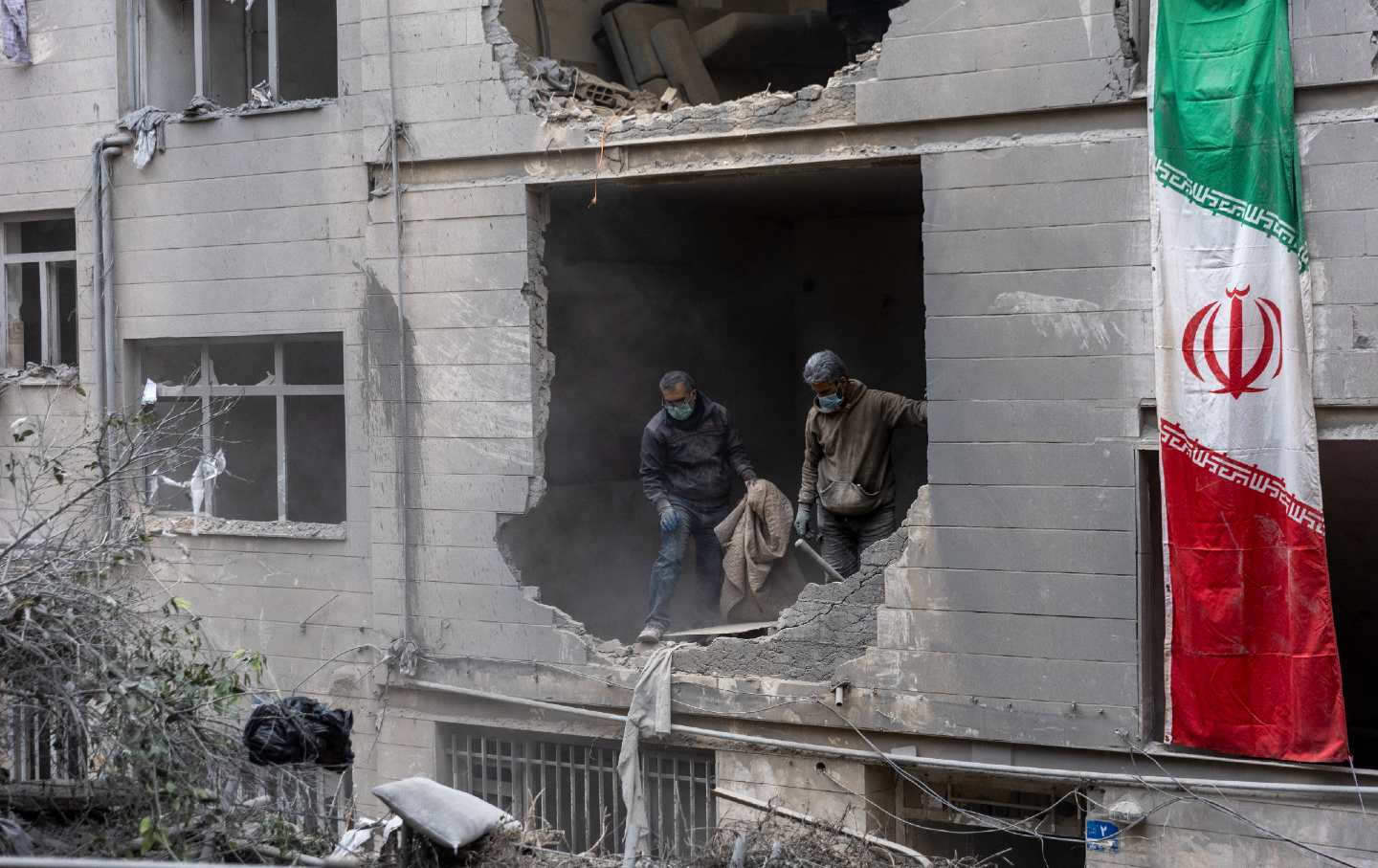
People clear rubble away from a Tehran apartment bombed in the US/Israel war on Iran.
(Majid Saeedi / Getty Images)President Donald Trump has plunged the United States, and the global economy, into turmoil with his impulsive, reckless, and illegal decapitation of Iran’s senior leadership and the ensuing, indefinite military “excursion.” Contrary to the surreal press conference hallucinations of self-styled Secretary of War Pete Hegseth, the war increasingly looks like a bewildering strategic blunder whose costs will only escalate the longer it staggers on.
Trump is hardly the first American president to misunderstand the capacities, motivations, fears, and grievances of Tehran’s theocratic regime—but he is the first one stupid enough to start an actual shooting war on the basis of those delusions. The reasons past presidents had been reluctant to take this fateful step should now be painfully obvious. (And yes, I’m aware of Trump’s desperate effort to conjure a plainly imaginary past commander in chief to approve of his demented lurch into Iran.)
Still, the long history of basic misapprehension of Iran in American policy and military circles bears fresh scrutiny—as not merely the broader context for Trump’s unhinged invasion but also a way to take stock of the grim options now before the United States. In the midst of a volatile, unpredictable military action upsetting the Middle East’s balance of power, it is more important than ever for our leaders to understand the sources of Iran’s behavior—especially how the regime’s seemingly self-defeating decision-making is driven primarily by a very well-justified fear of the United States of America.
The Iranian government is undeniably one of the worst on the planet, a clique of amoral, self-dealing, repressive fanatics who have done incalculable damage to their own society. Iran’s fundamentalist regime has accomplished very little of substance in close to 50 years other than its own entrenchment. But American commentators truly seem to relish spoon-feeding their readers the same litany of Iranian aggression, in a historical timeline that always magically begins in 1979. This fable of outraged American innocence kicks off with that year’s hostage crisis at the American embassy, then duly proceeds along a tidy neoconservative timeline: the 1982 Hezbollah Marine barracks bombing in Lebanon, the attacks on US troops during the first Iraq War, the 2002 revelations of secret nuclear facilities, and the support for malign terrorist proxy militias across the region, including Hamas.
As Eliot A. Cohen, a former State Department hand for George W. Bush, wrote in The Atlantic after reciting more or less this exact laundry list, “from its inception, the Islamic Republic has been irrevocably hostile to the United States and dedicated to the destruction of the state of Israel. It is a rabid regime.” For neocon hawks like Cohen, Iran’s deep-seated hostility to America is innate and pathological—and the need for a more-or-less permanent American military garrison to protect the region’s natural resource wealth from Iran is almost self-evident.
The problem with all of the absurdly one-sided history bouncing around the US media ecosystem is not merely that it willfully disregards the American horrors and policy errors that helped stoke the fundamentalist seizure of power in Iran. The far more damaging weakness of this school of analysis—long dominant among serious policy intellectuals—is its basic failure to account for broader structural forces shaping the regime’s paranoid behavior, which would influence how any conceivable successor regime interacts with the United States as well.
Anyone who has seen Argo surely knows that the CIA overthrew the country’s democratically elected prime minister, Mohammad Mossadegh, in 1953 and replaced him with an authoritarian monarch who spent the next 26 years brutalizing dissidents with our blessing and backing. But do they also know that when Saddam Hussein’s Iraq launched a completely unprovoked war of conquest in 1980 against Iran, the United States eagerly supplied arms and intelligence to Baghdad for years, even when we knew that Saddam was deploying chemical weapons, including horrific nerve agents, against both Iranian civilians and combatants? This was, of course, before the United States decided that even the suspected pursuit of such weapons by Iraq constituted a casus belli for a unilateral invasion of Iraq.
That’s just for starters. At one point, America was supporting both sides during the eight-year Iran-Iraq War by covertly selling weapons to Iran and using the proceeds to back right-wing rebels in Nicaragua.
Casual readers of today’s headlines from Iran also aren’t likely to know that this isn’t the first time the United States has felt the need to escort oil tankers through the Strait of Hormuz. During the 1987–88 Operation Earnest Will (ah, how quaint to name a military operation after something other than apoplectic rage!), a US destroyer, the USS Vincennes, blew an Iranian civilian airliner out of the sky, killing 290 innocent people. The ship’s captain was awarded the Legion of Merit and no apology has ever been issued, even after the US government agreed to pay Iran millions in compensation. In the 1980s, the America also embarked on a flurry of military base-building and expansion in the Persian Gulf, encircling a comparatively weak country that has never launched a conventional war against its neighbors.
After 9/11, when Iran was informally collaborating with the United States against their mutual Taliban enemy in Afghanistan, the regime approached the Bush administration with the outline of a comprehensive settlement. Rather than exploring that diplomatic opening, the Bush White House raced to include Iran in its famed “Axis of Evil,” together with North Korea and Iraq. Indeed, many of the same hawkish commentators high-fiving each other today urged President Bush to just point his occupying army east and overthrow the Islamic Republic in the heady days immediately after Saddam’s regime was deposed in 2003. That insane proposal helped spark a fateful blowback effect, when Iran’s leaders concluded that the only way to avoid Iraq’s fate was to convince Americans that the cost would be too high by supporting the insurgency in Iraq.
As for the nuclear crisis that is the ostensible reason for today’s mayhem, it is almost old enough to legally rent a car in the United States and has seen plenty of betrayals and broken promises from Tehran’s perspective. Forget for a second the baseline hypocrisy of the only country ever to use these appalling, genocidal weapons in combat telling other sovereign countries that they can’t join the nuclear club. After a reformist president, Hassan Rouhani, was elected in 2013, the Obama administration negotiated a painstakingly detailed agreement with Iran that put real, verifiable constraints on Tehran’s pursuit of nuclear weapons. It was working just fine when Trump himself capriciously destroyed it in 2018. The damage to America’s reputation and future negotiating efforts—as well as the discrediting of the Iranian soft-liners who put their lives and reputations on the line to sign the deal—played zero role in Trump’s petty and feckless decision.
Not content with merely destroying a perfectly functional diplomatic compromise, Trump also ordered, seemingly out of nowhere, the assassination of Qassem Suleimani, the leader of the Iranian Revolutionary Guard Corps in January 2020. This very recent history of unapologetic American backstabbing made it virtually impossible for the Biden administration to negotiate any kind of new agreement with Iran. And twice now in the second Trump administration, the United States has attacked Iran right in the middle of ongoing diplomatic negotiations——the geopolitical equivalent of a sucker punch that carries grave implications for future American policymakers.
You don’t have to carry water for the Iranian regime to ask yourself a simple question: How would you feel about all of this if you were in charge of Iran? The greatest military behemoth in recorded history, itself now led by a deranged autocrat ordering one lawless attack after another (Trump has bombed seven different countries just since January 2025) keeps pretending to negotiate with you, changing its mind, breaking its promises, murdering your leadership and acting with what appears to be total impunity over your skies. This is precisely why Iran was considering building nuclear weapons in the first place.
Outside of a brief window during Obama’s second term, American policymakers have simply refused to accept the reality of the Islamic Republic’s existence. They elected instead to get high on their own supply, believing that they could achieve their desired outcomes either by somehow hastening the Iranian regime’s collapse or by making the pain of its obstinance unbearable. That refusal has meant that it is impossible for much of the American public to see or understand that the regime itself has security needs, and that one consequence of constantly making their worst fears a reality is condemning ourselves to this cycle of eternal recurrence. As the late international relations scholar Robert Jervis argued in an influential 1968 article, “there is an overall tendency for decisionmakers to see other states as more hostile than they are,” rendering them unable to understand that “others may be reacting to a much less favorable image of themselves than they think they are projecting.”
Popular
“swipe left below to view more authors”Swipe →US policymakers invariably see themselves as the righteous, peaceful guarantors of Gulf security and Iran as an aspiring regional hegemon meddling darkly in the affairs of its neighbors. In this slapdash Middle Eastern version of the roundly discredited “domino effect,” Iran is out to build some kind of “Shi’a Crescent” and pursue nuclear weapons so that someday it might commit suicide-by-Israel or something. Iran’s clerics, on the other hand, have seen an implacably hostile global superpower perched on Iran’s borders, constantly preparing to unleash devastating violence at any moment to wipe them out. Were they wrong?
The default Democratic response to the events of the past few weeks has been to criticize the inexplicable lack of planning that went into Operation Epic Fury, which has left the president begging NATO allies he has spent the past year gratuitously pissing off for help to reopen the Strait of Hormuz. But it is also a perfectly reasonable position—and indeed may be a more electorally resonant one—to highlight the moral and imaginative failings of the Iran war over its (admittedly ghastly) procedural miscues. It’s possible for the opposition party to affirm that the Iranian regime is a horror and point out that the US-imposed grifter-capitalist status quo centered around the corrupt Gulf Arab tyrannies and benefiting an unapologetically brutal and expansionist Israel isn’t so great either. What’s more, the prospect that the Middle East’s already rickety American-backstopped order could be spiraling toward violent collapse courts the absolute worst-case outcome. A single madman in Mar-a-Lago is now poised to wreak a level of havoc in the region that the most hard-line Iranian clerics could have only dreamt of. If there was one thing we should have learned from the disastrous imperial errands America undertook in the early 2000s, it was that you don’t need to spend trillions deploying the US military—a highly inefficient economic instrument—to maintain access to oil, or to protect Israel, a country perfectly capable of defending itself.
By some estimates, the direct and indirect costs of America’s post-9/11 forever wars will eventually exceed $6 trillion, more than the value of all the oil imported into the United States between 1980, when President Jimmy Carter deemed the free flow of energy out of the Persian Gulf a vital US national security interest, and 2012. But our foreign policy mandarins apparently still believe that our own meddling in the affairs of these distant, dysfunctional countries is so important and effective that it’s worth incinerating another generation’s worth of national wealth to keep at it.
That disastrous risk calculus came about via a century-long American failure to honestly assess the Iranian regime and its actual capabilities and intentions. And in stumbling headlong into this needless war, President Trump has single-handedly precipitated the energy crisis that nearly 50 years of failed, wildly expensive American policy in the Gulf was designed to prevent. At some point, Americans are going to have to decide whether they want to create a durable security architecture in the Persian Gulf that includes the odious Iranian regime. The other option would be to continue down the present disastrous course—doing the same insane thing over and over again, hoping that the Islamic Republic will conveniently disappear.
Support independent journalism that does not fall in line
Even before February 28, the reasons for Donald Trump’s imploding approval rating were abundantly clear: untrammeled corruption and personal enrichment to the tune of billions of dollars during an affordability crisis, a foreign policy guided only by his own derelict sense of morality, and the deployment of a murderous campaign of occupation, detention, and deportation on American streets.
Now an undeclared, unauthorized, unpopular, and unconstitutional war of aggression against Iran has spread like wildfire through the region and into Europe. A new “forever war”—with an ever-increasing likelihood of American troops on the ground—may very well be upon us.
As we’ve seen over and over, this administration uses lies, misdirection, and attempts to flood the zone to justify its abuses of power at home and abroad. Just as Trump, Marco Rubio, and Pete Hegseth offer erratic and contradictory rationales for the attacks on Iran, the administration is also spreading the lie that the upcoming midterm elections are under threat from noncitizens on voter rolls. When these lies go unchecked, they become the basis for further authoritarian encroachment and war.
In these dark times, independent journalism is uniquely able to uncover the falsehoods that threaten our republic—and civilians around the world—and shine a bright light on the truth.
The Nation’s experienced team of writers, editors, and fact-checkers understands the scale of what we’re up against and the urgency with which we have to act. That’s why we’re publishing critical reporting and analysis of the war on Iran, ICE violence at home, new forms of voter suppression emerging in the courts, and much more.
But this journalism is possible only with your support.
This March, The Nation needs to raise $50,000 to ensure that we have the resources for reporting and analysis that sets the record straight and empowers people of conscience to organize. Will you donate today?
More from The Nation

Trump’s National Security Strategy Is a Blueprint for White Nationalism Trump’s National Security Strategy Is a Blueprint for White Nationalism
Trump’s foreign policy reasoning mirrors the crackpot logic of a runaway authoritarian.
The Iran War Is America’s Own Suez Crisis The Iran War Is America’s Own Suez Crisis
The recent US military assault on Iran looks like past desperate bids to reclaim fading imperial glory.
Is Macron Greenlighting a New US-Led Nuclear Arms Race? Is Macron Greenlighting a New US-Led Nuclear Arms Race?
As the global arms control regime collapses, France plans to expand and Europeanize its nuclear arsenal.

Canada’s Left Is in Crisis. Can Avi Lewis Revive It? Canada’s Left Is in Crisis. Can Avi Lewis Revive It?
As Mark Carney’s deceptive centrism pushes the country to the right, Avi Lewis offers a compelling alternative.
Why Is There No Anti-War Movement? Why Is There No Anti-War Movement?
Exploring what might help us move to start building one.

