
How the Israeli Tail Wags the American Dog
The US attack on Iran may be less about American security than about the priorities of Israel’s government.
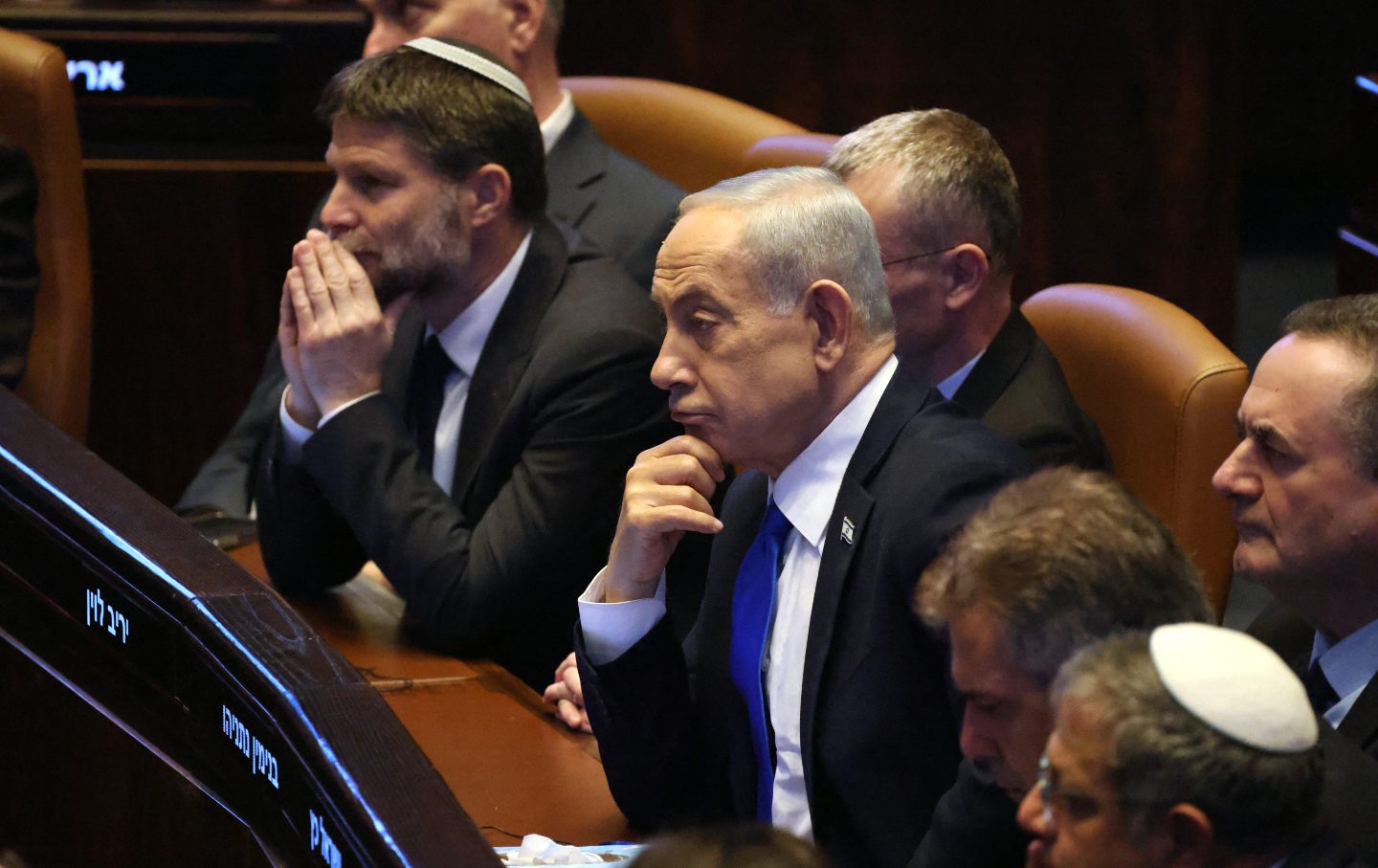
One prominent rationale for the Israeli-American attack on Iran is to bomb the country into friendliness to the US and Israel. Very few believe this will succeed. Iran, a country as big as Germany, Britain, and France combined, has a population of 93 million, more than triple that of Iraq when the United States tried, even with a massive army, to transform it into a US ally. We all remember how that worked out.
President Trump ran two successful presidential campaigns with a populist foreign policy platform of promising “I’m not going to start a war. I’m going to stop wars” and denouncing the “endless wars” pursued by his predecessors in Iraq and Afghanistan. He now appears to have jettisoned his “America First” foreign policy with no strategic rationale. But understanding this war as rational means believing it was launched as a means to achieve some particular end for Americans. Yet, despite President Trump’s claims to the contrary, Iran’s long-range missile program posed no foreseeable threat to the US according to US intelligence assessments. This forces our attention to its real origins and beneficiaries, in Israel.
Secretary of State Marco Rubio acknowledged that the primary answer to the question of “Why [attack Iran] now?” was that US war-making decisions were effectively being driven by Israel. “We knew that there was going to be an Israeli action, we knew that that would precipitate an attack against American forces, and we knew that if we didn’t preemptively go after them before they launched those attacks, we would suffer higher casualties and perhaps even higher those killed, and then we would all be here answering questions about why we knew that and didn’t act,” he said on March 2.
The first part of Rubio’s answer, that Israel was planning to attack Iran and that Iran would retaliate against US targets, is a statement of a real problem: Israel’s behavior imposes security and economic costs on the United States. Successive US presidents supplied Israel with billions of dollars of military aid, political cover in international forums and tirelessly worked to shield Israel from accountability for its war on Gaza and long-running occupation of the West Bank. Israel has become accustomed to acting with impunity and disregarding US interests, particularly with respect to presidents Obama, Biden, and Trump’s stated priorities of refocusing US foreign policy toward the challenges of a rising China.
But the Trump administration’s solution, as explained by Rubio, was simply to acquiesce to Israel and join a deadly war of choice against Iran that is predictably sowing chaos in the region, killing Iranian civilians, and promising, much like George W. Bush’s ill-fated Iraq War, quick regime change to a US- and Israel-friendly democracy.
The real goals of Trump’s war cannot be found in his strategic vision, which is overshadowed, if it even exists, by a pinwheeling embrace of postures that serve his vanity and his short-term political interests. While most combat operations have been undertaken by the US military, at considerable risk to US service members and costs borne by American taxpayers, the war was born, planned, and insisted upon by Israel, and its long-serving Prime Minister Benjamin Netanyahu.
“I have tried to persuade successive American administrations to take firm action [against Iran], and President Trump did,” Netanyahu told Fox News, acknowledging his own efforts to push the US into yet another war in the Middle East. Netanyahu famously overpromises what US interventions will achieve. In 2002 he told Congress, “If you take out Saddam, Saddam’s regime, I guarantee you that it will have enormous positive reverberations on the region.”
While commanding one of the most potent nuclear arsenals in the world, he has, for decades, railed against Iran as posing an existential threat against Israel simply by developing the capacity to build a nuclear weapon. The real reason for Netanyahu’s obsession, however, is the role it has played, against so much evidence, to promote himself as “Mr. Security”—as the one leader in Israel willing and able to do what is necessary to defend Jews against the Hitler of the age.
Facing the prospect of criminal conviction and prison if he ever leaves office, Netanyahu has a great deal at stake. Until now it has been the campaign for war that has helped him, but now that he has his war, and has killed the Iranian dictator, what is his plan? The best way to answer this question is to consider what he has sought to do and has done in Gaza.
After the Hamas-led attacks on Israeli settlements near the Gaza Strip on October 7, 2023, Netanyahu launched a war of destruction and punishment whose declared objective, the elimination of the Hamas regime there, was neither its actual objective nor what was achieved. Nearly three years of pulverization and the killing or wounding of more than 10 percent of Gaza, Palestinians have failed to remove the Hamas regime. But that war, prolonged and conducted in a way to preserve Netanyahu’s hold on office and his prospects in upcoming Israeli elections, has created Gaza as a field of suffering and chaos and a kind of free-fire zone for the Israel Defense Forces. That is, more or less, what is in store for Iran and it will, again, serve Netanyahu more than any other plausible US security or geopolitical interests.
To be clear, Israel is dependent on the US for military aid, as well as protection at the UN and the International Criminal Court when these multilateral institutions attempt to hold its leaders accountable for war crimes in Gaza, and could not execute its wars in Gaza, Lebanon, Syria, and Iran without the support of our country.
The costs of the war in Iran remain uncertain, but we can already conclude that the human and financial costs will be enormous and entirely avoidable. Beginning to address the policy failures that brought the US to this juncture requires an interrogation of how a putative client state gained such overwhelming control over the foreign policy of a superpower.
In 2001, Benjamin Netanyahu made his vision of Israel’s influence over America crystal clear in a hot-mic moment, telling Israeli far-right activists, “I know what America is. America is a thing you can move very easily, move it in the right direction. They won’t get in the way.”
Israel’s lobby—spearheaded by a small bipartisan group of Israeli-American and American billionaires who prioritize the ambitions of Israel’s right-wing government—is once again poised to flood the campaign finance system for the 2026 midterms. Meanwhile, the United States is being drawn into a long-sought Israeli war on Iran with no clear US national security rationale. It’s easy to dismiss Donald Trump as yet another American president manipulated by Netanyahu. But Trump, unlike his predecessors, has a feature that sets him apart: He sometimes says the quiet part aloud.
Popular
“swipe left below to view more authors”Swipe →Speaking before the Israeli Knesset in October 2025, Trump himself appeared to acknowledge the grip Israel’s lobby has on US foreign policy. He singled out Israeli-American billionaire Miriam Adelson, one of the biggest funders of Israel’s lobby and the largest campaign donor in the entire American political system.
“Miriam? Look at Miriam. She’s back there. Stand up now. Stand up,” said Trump. Concluding his friendly riff on the Adelsons, Trump, speculated where the allegiances of his biggest, and most influential, donor lay. “I actually asked her, I’m gonna get her in trouble with this, but I actually asked her once, I said, ‘So, Miriam, I know you love Israel. What do you love more, the United States or Israel?’ She refused to answer. That means, that might mean, Israel, I must say.”
Eli Clifton and Ian Lustick are the authors of the forthcoming book Israel’s Lobby: America in the Grip of a Foreign Power (One Signal). Available for pre-order here.
More from The Nation
"LULA!" Progressives Hail Brazil's Stunning Election Result "LULA!" Progressives Hail Brazil's Stunning Election Result
“The people united will never be defeated!” declares Zohran Mamdani.

Israel’s Extremist Election Israel’s Extremist Election
The run-up to the vote on Tuesday is exposing the façade of Israeli democracy—and the fealty of the country's so-called opposition when it comes to matters of Jewish supremacy.

“NAZA” and Israel’s History of Automated Warfare “NAZA” and Israel’s History of Automated Warfare
As violent technologies like spyware, predictive targeting algorithms, and 2,000-pound warheads become ordinary instruments of military rule, once-abhorred practices become routin...

Brazil’s Workers’ Party Is Not Stopping Brazil’s Workers’ Party Is Not Stopping
With just a few days remaining before the runoff election, supporters of Lula’s party are doing everything possible to rally support behind the president.


Brazil’s Decision Brazil’s Decision
The moral compass and basic humanity of political leaders really does matter.

