Graham Platner Had a Much Better Primary Result Than Lindsey Graham
The anti-establishment Democrat in Maine won much bigger than the establishment Republican in South Carolina.
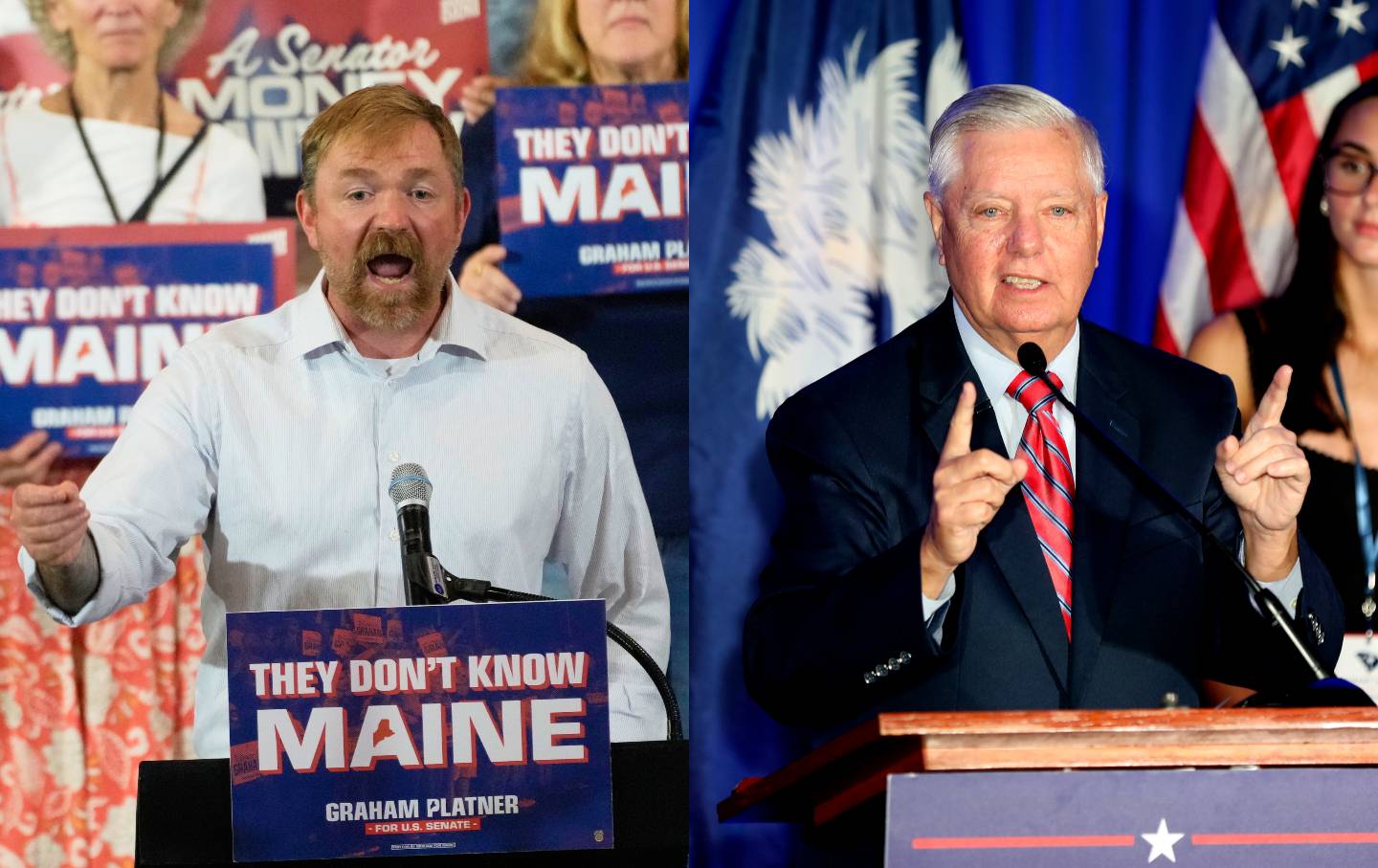
Two high-profile Grahams faced voters in US Senate primaries this week: Graham Platner, the outsider Maine Democrat mounting his first campaign; and Lindsey Graham, the insider incumbent seeking a fifth term, in a South Carolina Republican contest.
Graham Platner had been the subject of intense national scrutiny and late-breaking headlines about personal controversies—what Maine Public media described as “a withering blitz of unflattering revelations and ongoing attempts by Republicans and some Democratic operatives to weaken his candidacy.” The attention was bruising enough that Maine Governor Janet Mills, who had suspended her own Senate campaign after trailing Platner badly in the polls, delivered a high-profile, pre-primary reminder that she was still on the ballot and still eligible for votes. Platner’s populist campaign against billionaire elites, which attracted enthusiastic support from small donors and grassroots volunteers, also faced 2024 Democratic US Senate nominee David Costello, a veteran state and federal official, who was actively campaigning.
Lindsey Graham, the onetime critic of Donald Trump who now enjoys strong support from the president, looked to be in a far better political position. He was running with the backing of the Republican political establishment in a red state where the party has grown into a muscular force over the 62 years since segregationist Democratic US Senator Strom Thurmond switched his allegiance to the GOP. Graham also, according to Politico, enjoyed an enormous financial advantage, “combining with his allies to spend over $18 million in television and digital ads touting his record and endorsement from President Donald Trump” to overwhelm the campaigns of self-funding right-wing businessman Mark Lynch and several other rivals.
So what were the results?
In South Carolina, Lindsey Graham won with 56.8 percent of the vote—a victory, but an unspectacular one for such an ostensibly powerful figure. Indeed, he looks to have lost two of the state’s more sizable counties—Greenville and Spartanburg—to Lynch.
Meanwhile, in Maine, Graham Platner carried 72 percent of the Democratic primary vote, sweeping every county and inspiring headline writers to describe a “decisive,”“landslide” win.
There is no question that Graham Platner, who promises to be “a senator for the people who cannot afford to buy a senator,” will face a tough fall contest with Lindsey Graham’s Republican colleague, Susan Collins, an enormously well-funded, corporate-aligned incumbent who is seeking her sixth term in a Senate where she votes 95 percent of the time with Trump. Collins brings what the BBC described as “a political war chest that has more than $20 million between her campaign and affiliated committees.” She’s expected to relentlessly attack Platner’s history of ugly social-media posts and multiple reports about the “toxic,” “volatile” and physically “intimidating” past relationships of the Democratic nominee, an Iraq War veteran who acknowledges that he went through “a very dark period of my life, when I struggled with undiagnosed PTSD.”
The Maine race will get major attention in a political season where control of the Senate is at stake. But perhaps some attention might also be spared for the South Carolina race involving the other Graham.
South Carolina Democratic US Senate nominee Annie Andrews, a pediatrician whose energetic campaign won her own party’s nomination with a notably higher percentage of the vote than Lindsey Graham took in his GOP primary, has long argued that the incumbent is vulnerable in a year where frustration with Washington is running high. In light of Tuesday’s results, Andrews may be on to something when she says, “It is clear to me that people in South Carolina are ready for something different. Lindsey Graham is a career, corrupt, cowardly politician. He’s been our senator for 23 years now. And people understand that he really has abandoned South Carolinians.”