
Is Graham Platner Fit to Be a US Senator?
The Democrats of Maine answered that question.

For a week, I’ve watched the commentators and the party line up to tell me Graham Platner is too compromised for the United States Senate. Last night, the Democrats of Maine answered them. He’s on track to win his primary with about 72 percent of the vote, carrying nearly every county in the state. This is not the outcome for a candidate distrusted by the voters; in fact, it’s the opposite. It’s a landslide.
Every time I hear a pundit call his behavior “disqualifying,” or read another opinion piece about the horrendous human being that is Graham Platner, I can’t help thinking about the people already in the Senate. How are they handling power? Are they showing us the upright moral high ground?
While Israel was dropping white phosphorus on people in Lebanon, The New York Times called it a munition that “can be extremely harmful.” White phosphorus burns through skin to the bone. They called it “harmful.” Like cholesterol. Like skipping the gym.
This is the same paper that spent two months interviewing women who dated Graham Platner, hunting for something disqualifying. White phosphorus on civilians gets “can be extremely harmful.” Graham’s private life gets a microscope.
The media and the Democratic establishment have been scouring his personal struggles and trying to equate them with his fitness to serve. Relationships that ended badly. Texts he regrets. The years he spent drinking, trying to outrun what he brought home from Ramadi and Fallujah. He’s a Marine who came back with PTSD and a drinking problem and did the work to come out the other side. That’s not a disqualification. In most of America, that’s the story of a man growing up. But run for office as a regular guy, and every private wound becomes a headline.
And all that pressure has made him into something rare. He’s already survived the worst they can do to a person out in the open, which means there’s nothing left to hold over his head. You can’t blackmail a man whose flaws are already on the table, and you can’t scare him off a fight by threatening to expose him.
Sure, sexting with a woman while you’re married isn’t admirable. But that has never been the test of whether someone can be trusted with power.
The test is how you conduct yourself when you have it. And by that test, the Senate Platner wants to join is morally bankrupt. The senators our media holds up as the moral, dignified ones get to sit in a hearing and debate the merits of binding our military and our intelligence even tighter to a government that’s carrying out a genocide, and that gets called sober and serious. Just policy. Just pragmatism. Working hand in hand with people committing war crimes gets called statesmanship.
Chuck Schumer voted for the war in Iraq. Hundreds of thousands of people died. He leads the Senate Democrats now, and he’s never once had to sit where Platner’s sitting. He keeps his leadership and his reputation as a statesman because he didn’t personally drop the bomb. He was just part of the machine that did, and nobody in the machine is ever responsible. And it isn’t just him. Dozens of them, in both parties, voted for that war or funded the ones that came after, and not one has answered for a single death. Platner, though. Platner pressed “Send.” Platner was “unsettling.”
I don’t feel betrayed by Platner. I feel betrayed by the people sitting in judgment of him. John Yoo wrote the legal memos that authorized torture, and he teaches law at Berkeley, and the same crowd that finds that perfectly normal clutches its pearls over a man’s text messages. Half the Senate calls itself moral because they never yelled at a girlfriend, while they vote to arm and fund the killing of tens of thousands of children.
These are the people we’re told are the best of us. The paragons. The ones Graham Platner isn’t fit to sit beside. And they’re quiet, or they’re cheering, while we starve ordinary Cubans to force a regime change. They were quiet while we bombed Caracas and kidnapped a sitting head of state. They’re quiet while we blow boats out of the water in the Caribbean and kill everyone aboard because maybe there were drugs and maybe there weren’t. They were quiet when a school full of girls got hit in the opening hours of our war on Iran, 165 children dead, and the official position of the United States government is that we’re still investigating whether it was us.
A few weeks ago, Israel seized an aid flotilla in international waters, and its national security minister, Itamar Ben-Gvir, posted video of himself taunting the activists while they sat zip-tied on the ground. When they were released, at least 15 of them reported being sexually assaulted, with accounts of rape and forcible penetration with a handgun. Italian prosecutors opened an investigation. You probably barely heard about it.
That’s the whole game. You can do anything, as long as you do it with decorum. In a good suit. Without raising your voice. Commit your atrocity with class and grace and you stay respectable forever. Struggle with something human in front of people, and you’re finished.
Popular
“swipe left below to view more authors”Swipe →He calls the genocide a genocide. He says out loud that tens of thousands of Americans die every year because they can’t afford a doctor. He looks at our wars and our economy and names what they cost and who pays. That isn’t a flaw to be managed. That’s moral clarity, and it’s the one qualification not a single one of the dignified ones can claim.
So spare me. Spare me the lecture about Graham Platner’s character.
A man who came home from a war these people voted for, who faced down his own demons and came out clearer than the people judging him, is not the threat here. The threat is the chamber full of people who kept their hands clean and their voting records bloody, and the writers who keep deciding the dirtbag is the scandal and the war criminal is a colleague.
The real risk for Democrats was never Platner’s past. It’s running one more cautious, poll-tested candidate nobody believes in.
Graham Platner is more likely than not to increase the morality of the United States Senate. That’s not a joke, and it’s not because the bar is low, though it is. It’s because he sees clearly what they’ve spent careers refusing to see.
Become a Sustaining Donor This September
Between the reemergence of right-wing red-baiting and Donald Trump’s use of the chilling National Security Presidential Memorandum–7 to criminalize left political organizing, we’re seeing McCarthyism reborn before our eyes.
This assault on democracy cannot be ignored or wished away. Resisting it requires bravery in the face of threats and repression, a steadfast commitment to the truth, and the unwavering belief that we can—and will—overcome this darkness.
We must have an independent media that sets the record straight, unearths corruption and abuses of power, and advances a politics of justice and dignity for all if we’re to win this fight.
That’s why I’m writing to you today. This September, The Nation needs to add 100 monthly donors to sustain our progressive journalism. Your contribution makes the next investigative report, the next truth-speaking column, and the next pathbreaking essay all possible.
I hope you’ll support our work with a recurring donation today. If you donate $10 or more a month, we’ll send you a brand new “Hands Off the Free Press!” sticker to recognise your commitment to our cause. Please, donate today.
Onward,
Katrina vanden Heuvel
Editor and Publisher, The Nation
More from The Nation


Can These 4 Working-Class Populists Win In November? Can These 4 Working-Class Populists Win In November?
We’re keeping an eye on their races to find out. Here’s where things stand.
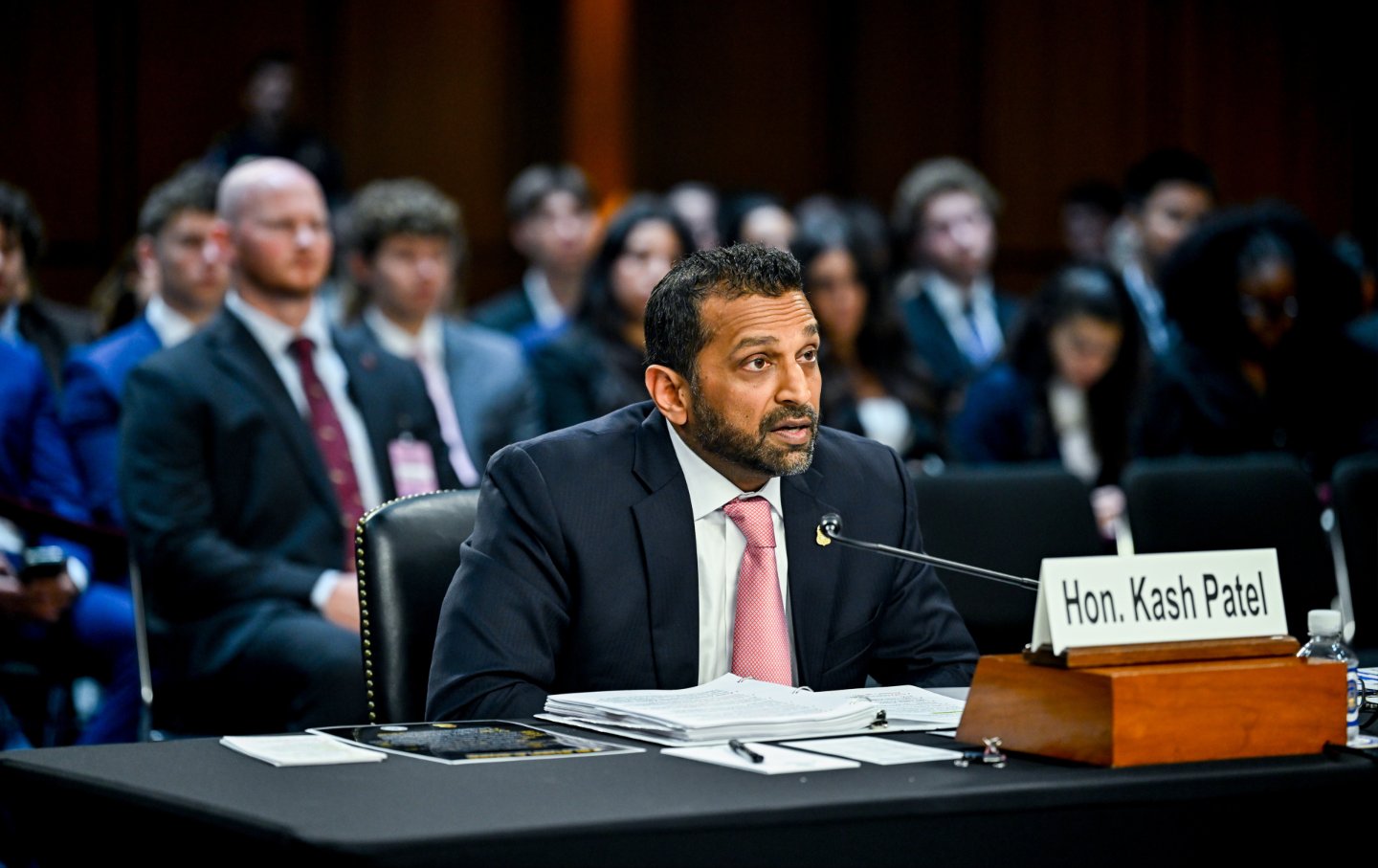
Kash Patel Stands Up for “Victims” of Bestiality Kash Patel Stands Up for “Victims” of Bestiality
In a bizarre Senate committee hearing, the FBI director defends his tenure and disrespects Democrats.

Remembering Jina Mahsa Amini and the Woman, Life, Freedom Movement Remembering Jina Mahsa Amini and the Woman, Life, Freedom Movement
In 2022, Amini was murdered by Iran’s Morality Police for removing her hijab in public.
Populists Can’t Be Populist if They Suppress the Vote Populists Can’t Be Populist if They Suppress the Vote
The crusade against ballot access, like virtually every other facet of Trump’s agenda, does nothing to serve the interests of “the people,” but our press is too brain-dead to noti...

The Gaping Hole at the Heart of Financial Journalism The Gaping Hole at the Heart of Financial Journalism
Beyond the Epstein scandals.

