
America’s Gaza
The bombing of Tehran.
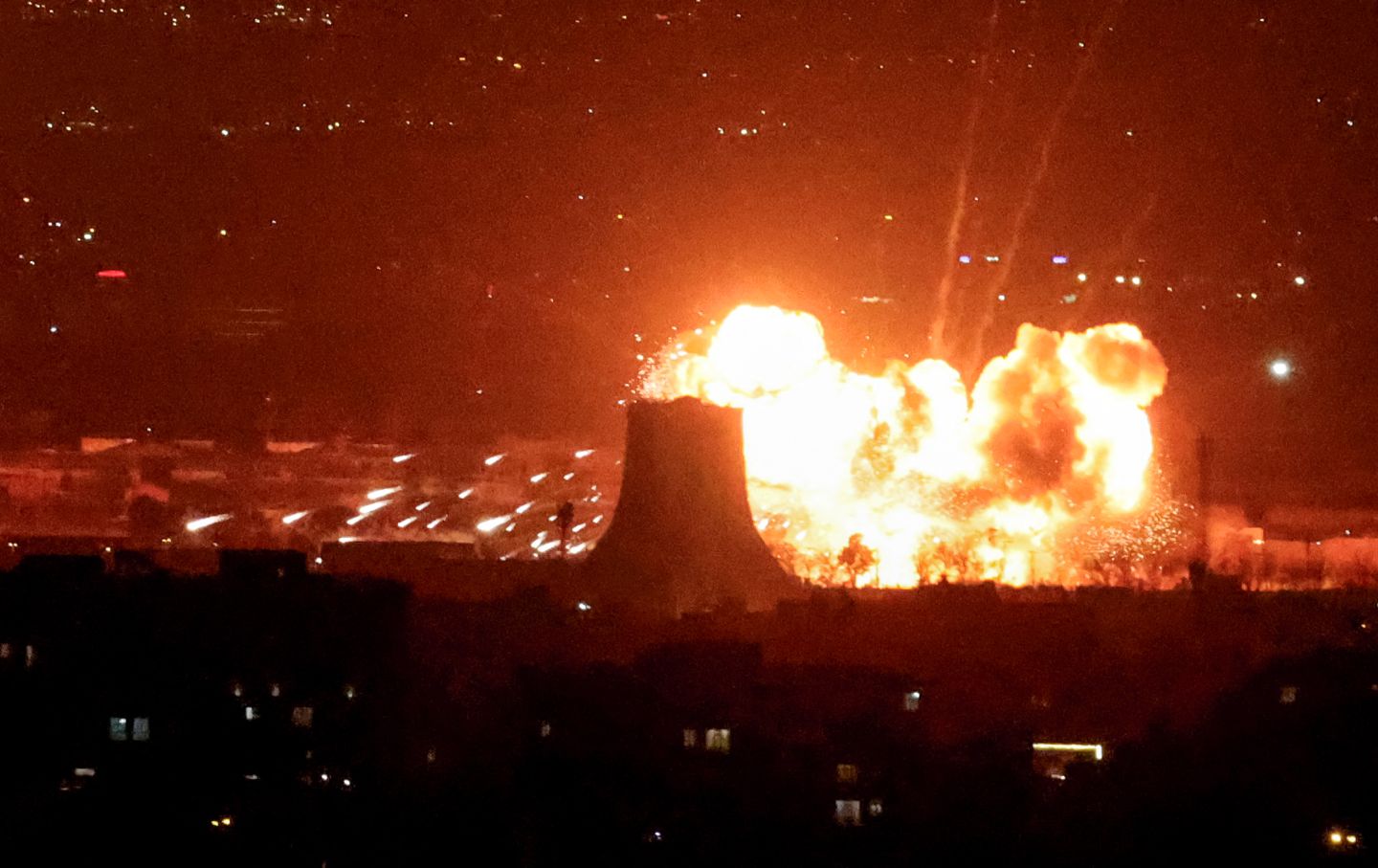
The United States is not, so far as can be determined from afar, intentionally targeting schools, hospitals, and residential buildings in Tehran and other Iranian cities, no more than it can be conclusively determined from afar that Israel is intentionally targeting schools, hospitals, and residential buildings in Gaza. Rather, both claim that their adversaries—Hamas in Gaza, the Islamic Revolutionary Guards Corps and Basij militia in Iran—are either embedded in those civilian structures or situated close by. But the outcome, in both cases, is the same: attacks supposedly aimed at enemy combatants are resulting in massive damage to civilian infrastructure, with a huge toll in human life.
What ties the Iran war to Gaza—and to the current Israel campaign against remnants of Hezbollah in Beirut—is the fundamentally urban nature of the fighting along with the overwhelming use of airpower to combat highly dispersed paramilitary forces. This combination, as many previous wars attest—think Guernica, Hue, Falluja—inevitably results in the wanton destruction of civilian structures said by the attackers to house, or be located in the vicinity of, enemy militants. For those civilians unable to flee the bombing targets—which could be almost anywhere—the outcome is usually death, injury, or homelessness.
Israeli and American military officials consistently claim that the bombs being used in their attacks on urban targets in Gaza, Lebanon, and Iran are precision-guided munitions capable of striking their intended targets with a very high degree of accuracy, sparing nearby civilian structures. When Israel was charged with the indiscriminate bombing of residential structures in Gaza, the army’s chief spokesman, RADM Daniel Hagari, stated, “We choose the right munition for each target—so it doesn’t cause unnecessary damage.” When it became evident that the US bombed an elementary school in southern Iran, killing over 175 people (most of them children), US Secretary of Defense Pete Hegseth declared, “We, of course, never target civilian targets.”
Hagari and Hegseth may believe what they say: that Israel and the US do not “target civilian targets.” But they can never be certain that their intelligence on adversary locations is accurate to begin with or that aircraft traveling hundreds of miles per hour can deliver munitions with 100 percent accuracy, so they accept—as an unfortunate but necessary logic of war—the decimation of civilian neighborhoods.
The evidence of this, so far as Gaza is concerned, is plain to see: block after block of collapsed schools, offices, and high-rise apartments. As of January 2025, an estimated 70 percent of all structures in the Gaza Strip had been damaged or destroyed, along with 92 percent of all housing units, according to a report by Doctors Without Borders. And these percentages are certain to have risen since then, as Israel has continued its attacks on suspected Hamas hideouts.
The damage in Iran is not yet that extreme, but major cities, including Tehran, have begun to experience the same destruction of urban targets. “Rows of apartment buildings near collapse. Block after block littered with mangled metal, shards of glass and shreds of paper. A hospital room with its windows blown out, bricks and debris covering the bed.” This was a description of central Tehran on March 2 by Farnaz Fassihi of The New York Times.
As Fassihi pointed out, Tehran is a sprawling metropolis of 10 million people with governmental buildings tightly interspersed with residential blocks and other civilian structures, so any sustained air attacks on the former are destined to strike many of the latter. “Like many cities,” he observed, “Tehran…is densely populated and does not separate commercial, government and military zones from residential areas. That leaves civilians especially vulnerable as the United States and Israel expand their target list from missile and nuclear facilities to government structures, state broadcasting offices, and security and police headquarters.”
As the attacks have multiplied—as of March 6, the United States had struck over 3,000 targets in Iran, damage to civilian structures has increased, more civilians have been killed, and panicked residents of Tehran and other cities have attempted to flee—either to remote areas of the country or, in some cases, to neighboring Turkey. “It’s dangerous right now,” said one Iranian traveler of conditions in Tehran, while another described living in constant anxiety. “We sleep in fear and wake up in stress.”
These are the people, in Donald Trump’s twisted imagination, who supposedly will rise and overthrow the existing regime, replacing it with one more attuned to Trump’s agenda. “When we are finished, take over your government. It will be yours to take,” Trump told the Iranian people after launching the war, suggesting that the US will crush the existing regime. But an air campaign of the sort being waged in Iran—however successful in destroying instruments of the regime—is also destroying the civic infrastructure of Tehran, driving out its residents, and alienating the very people who supposedly will carry out the revolt envisioned by Trump and install a new, Trump-friendly government.
This raises troubling questions about the future trajectory of the US-Iran conflict: If the air campaign fails to dislodge the remaining leadership of the theocratic regime and the Iranian population is too cowed by falling bombs to do anything but hide and flee, some key objectives of the US offensive will remain unfulfilled. What then?
Two possibilities come to mind, neither very appealing from Washington’s (or the world’s) point of view: Trump could end the war, claiming he eliminated Iran’s nuclear and missile capabilities, while leaving the reconstituted clerical-military regime to cope with a massive humanitarian catastrophe and widespread lawlessness; or, all other options having been exhausted, he could send US troops into Iran to restore order and pave the way for the imposition of a US client regime, perhaps headed by Reza Pahlavi II, the son of the former king and dictator.
Administration officials have insisted that only the former option is being considered—but have not ruled out the latter. “No stupid rules of engagement, no nation-building quagmire, no democracy building exercise,” Hegseth said at a March 2 Pentagon press conference. Asked if there were currently US boots on the ground in Iran, Hegseth said, “No, but we’re not going to go into the exercise of what we will or will not do.”
Speculation that the US is preparing to send ground troops to the Middle East has been fueled by reports that the 82nd Airborne Division’s Immediate Response Force—a unit configured for rapid deployment to overseas conflict zones—has been ordered to prepare for possible assignment abroad.
This scenario inevitably brings to mind the 2003 US invasion of Iraq and America’s subsequent engagement in a protracted counterinsurgency conflict there. When preparing for the invasion, Vice President Dick Cheney and Secretary of Defense Donald Rumsfeld famously refused to prepare for a post-invasion Iraq, claiming the Iraqi population would welcome American soldiers as liberators and then install a pro-US government without any further need for US soldiers. But after destroying vestiges of the Saddam Hussein government and dismantling its military and civil service, the US occupation apparatus found itself under attack from a powerful insurgency, resulting in a lasting US military presence.
Popular
“swipe left below to view more authors”Swipe →“This is not Iraq. This is not endless,” Hegseth fervently declared on March 2, hoping to silence critics of the war in the MAGA movement who detest the notion of another “forever war” in the Middle East. But how can he be so sure of this when the very nature of the war he’s commanding is increasing the odds that boots on the ground will be necessary to achieve the president’s objectives? Today, nearly three years after Israel began its intensive bombing of Gaza, the Palestinian population still lives in constant fear of air attack and Israeli troops are still fighting and dying there. If the US persists with its air campaign in Iran, we could, in the months and years ahead, be witnessing a similar urban catastrophe and the same unwelcome, hazardous presence of US troops.
More from The Nation

Israel’s Extremist Election Israel’s Extremist Election
The run-up to the vote on Tuesday is exposing the façade of Israeli democracy—and the fealty of the country's so-called opposition when it comes to matters of Jewish supremacy.

“NAZA” and Israel’s History of Automated Warfare “NAZA” and Israel’s History of Automated Warfare
As violent technologies like spyware, predictive targeting algorithms, and 2,000-pound warheads become ordinary instruments of military rule, once-abhorred practices become routin...

Brazil’s Workers’ Party Is Not Stopping Brazil’s Workers’ Party Is Not Stopping
With just a few days remaining before the runoff election, supporters of Lula’s party are doing everything possible to rally support behind the president.


Brazil’s Decision Brazil’s Decision
The moral compass and basic humanity of political leaders really does matter.
Albanian Student Strikes Spur a Political Crisis Albanian Student Strikes Spur a Political Crisis
A new round of protests against the ruling party’s corruption has Prime Minister Edi Rama giving cops bonuses to crack down on dissent.

