
Why Does the Supreme Court Treat Trump Like a “Regular” President?
The emperor is stark naked, but thanks to a misguided legal doctrine, the Republican justices keep insisting he’s fully clothed.
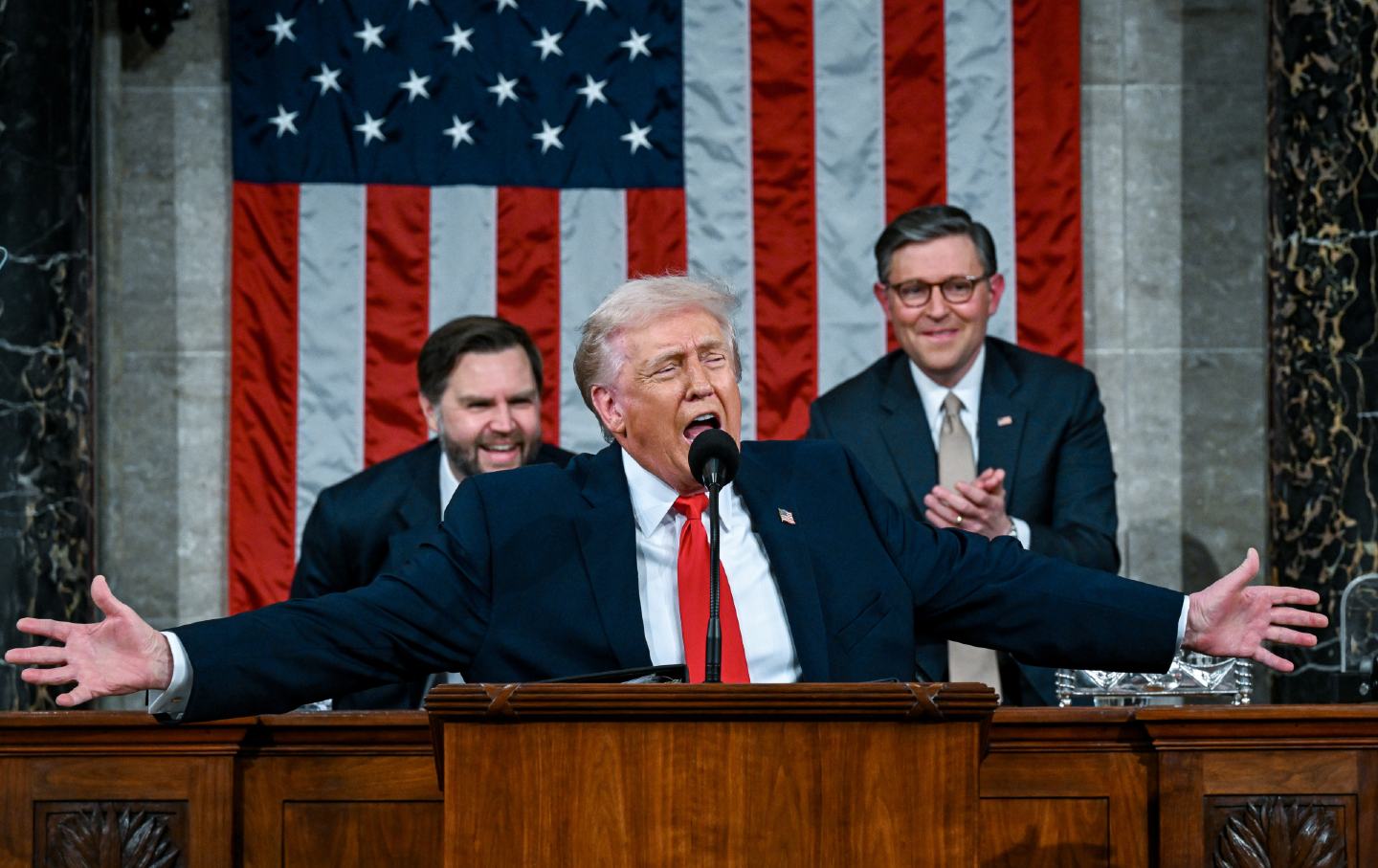
“The greatest trick the devil ever pulled was convincing the world he didn’t exist.” Apparently, this famous quote was written by the 19th-century French poet Charles Baudelaire, but I first heard the line in the movie The Usual Suspects. I think about it often, as it encapsulates Donald Trump’s relationship with the Republicans on the Supreme Court.
The Donald Trump who exists in the real world—the racist, fascist sexual predator who happily tweets out the illegal and unconstitutional motivations for his policies—does not exist according to the Supreme Court. Instead, the court has invented a different Trump, one who does not speak, does not lie, and adheres to the well-established norms regarding the use of executive power. It has dreamed up a normal US president, grafted this creation onto Trump’s legal filings, and then ruled as if this fiction were reality.
There is a legal doctrine that explains what I believe the Supreme Court is doing: the “presumption of regularity,” which dates at least as far back as 1926. This doctrine instructs courts to assume that members of the executive branch have acted properly and in good faith. An administration is presumed to have bona fide reasons for its actions, and those actions are assumed not to be “pretextual,” meaning that courts are not supposed to act like the administration has invented a plausibly legal reason to justify its plainly illegal actions. The presumption of regularity is afforded to members of the executive branch and no one else. Only they can waltz into court and expect people to take them at their word.
We hear the Supreme Court invoke the presumption of regularity all the time, especially during oral arguments, when the justices talk about giving “deference” to the administration. This administration deserves no deference, because it lies all the time. But the presumption of regularity instructs the court to defer to the administration and assume it is telling the truth.
The result is that the court presumes Trump had a good reason for shutting down DEI programs, even when there is clear evidence of the flagrant racism behind such actions. It presumes the administration tried its best to follow the rules before taking a chainsaw to the administrative state—even though it was a private billionaire who did the cutting, in violation of all the rules. And it presumes there’s a real national emergency simply because the president said so—never mind that the only national emergency is the armed goons invading our cities.
In embracing this doctrine, the Supreme Court is asking us to do something patently insane—and one of the many ways we know this is that many other courts are refusing to fall for the trick. A study released by the digital law journal Just Security last November found more than 60 cases in which lower courts called out the Trump administration for basing its arguments on misinformation, and it cited numerous instances of lower-court judges castigating the Trump administration for “bad faith” conduct, “manifestly unreasonable” or “contrived” legal arguments, and supplying the court with “mischaracterized,” “misleading,” or “intentionally false” evidence and information.
Lower courts have, in essence, rejected the presumption of regularity. They are no longer treating this administration as normal. But the problem is that they are consistently overruled by the Supreme Court.
This, however, may be changing. The Supreme Court has played Trump’s game for a decade, but two recent cases suggest that even Trump’s handpicked justices might be getting sick of his treating them like idiots.
In December, in an unsigned “shadow docket” opinion, the Supreme Court rejected Trump’s attempt to deploy the National Guard to Chicago. Trump argued that he should be allowed to deploy the Guard because the regular police forces in Chicago couldn’t uphold the law. The majority didn’t buy his argument—which predictably pissed off the justices who think Trump should be treated as a god-king. In dissent, Justice Samuel Alito (joined by Clarence Thomas) wrote: “[T]he President said unequivocally that he had ‘determined that the regular forces of the United States are not sufficient to ensure the laws of the United States are faithfully executed…in Chicago.’… Not only is this statement sufficient on its face, but under the presumption of regularity, the Court must presume that the President properly arrived at his determination.” (Emphasis mine.)
Not long after, the court heard a case challenging the firing of Lisa Cook, a member of the Federal Reserve Board of Governors. During oral arguments, alleged attempted rapist Brett Kavanaugh, of all people, pointed out that Trump’s stated reason for firing Cook (that she lied on a mortgage application) was pretextual. He suggested that the administration had made up a reason for firing her since it couldn’t admit it was doing so because of policy disagreements. (Fed commissioners can only be fired “for cause.”) Kavanaugh described the administration’s process as tantamount to “let’s find something, anything, about this person, and then we’re good.”
As of this writing, the court has yet to rule on Cook’s firing, so Trump could still win this one. But whatever happens, the question of whether the court continues to treat Trump as normal will be the defining issue of all the legal fights involving the administration—from tariffs and birthright citizenship this term to whatever else Trump tries to pull, including rigging the midterm elections. How the court chooses to answer this question will determine whether it will try to sane-wash Trump and allow him to rule over the republic like a dictator—or try to stop him. Ignoring what Trump says is the first step toward justifying what Trump does. His regime cannot hold if people just listen to what he actually says.
This isn’t just true of the Supreme Court. I’d argue that the signature failure of the mainstream media in the Trump era is its insistence on treating Trump like a normal president. The same goes for their treatment of the entire MAGA movement. Their insistence on treating the MAGA cultists as regular people who just happen to strongly believe in white supremacy, the subjugation of women, and the elimination of the LGBTQ community is part of the same failure. It’s how we get endless interviews with Trump supporters in diners, and how Ezra Klein ends up telling us that Charlie Kirk “was practicing politics the right way.”
None of this is normal. It’s not normal to have masked federal agents murdering people in the streets—it’s not even normal for federal agents to wear masks. It’s not normal to abduct foreign leaders. It’s not normal to create concentration camps out of Big Lots warehouses and hold people there without hearing or trial. None of this is regular, and none of it is okay.
If the Supreme Court would just start treating Trump as the real person he is instead of the fake person it wishes he were, it might also encourage other institutions that Trump has cowed to do the same. We are in a full “the emperor has no clothes” situation. The most impartial thing the Supreme Court could do at this moment is simply to acknowledge it. That’s what is happening, in fact, in many other courtrooms across the country.
If I were on the Supreme Court, I’d start every hearing by saying: “Your client is naked, Mr. Solicitor General. Let’s talk about that before we get to why he wants to light the Constitution on fire.”
Become a Sustaining Donor This September
Between the reemergence of right-wing red-baiting and Donald Trump’s use of the chilling National Security Presidential Memorandum–7 to criminalize left political organizing, we’re seeing McCarthyism reborn before our eyes.
This assault on democracy cannot be ignored or wished away. Resisting it requires bravery in the face of threats and repression, a steadfast commitment to the truth, and the unwavering belief that we can—and will—overcome this darkness.
We must have an independent media that sets the record straight, unearths corruption and abuses of power, and advances a politics of justice and dignity for all if we’re to win this fight.
That’s why I’m writing to you today. This September, The Nation needs to add 100 monthly donors to sustain our progressive journalism. Your contribution makes the next investigative report, the next truth-speaking column, and the next pathbreaking essay all possible.
I hope you’ll support our work with a recurring donation today. If you donate $10 or more a month, we’ll send you a brand new “Hands Off the Free Press!” sticker to recognise your commitment to our cause. Please, donate today.
Onward,
Katrina vanden Heuvel
Editor and Publisher, The Nation
More from The Nation

As Morale Sags, More Military Service Members Are Having a Crisis of Conscience As Morale Sags, More Military Service Members Are Having a Crisis of Conscience
According to multiple GI rights organizations, service members are inquiring in unprecedented numbers about seeking conscientious objector status.

What Remains of Riis? What Remains of Riis?
A new members’ club has revived Riis Park’s long-vacant bathhouse, reopening old questions about whom the People’s Beach is really for.

When Texas Sex Ed Falls Short, Gen Z Women Turn to Social Media When Texas Sex Ed Falls Short, Gen Z Women Turn to Social Media
A 2025 study found that 70 percent of adolescents sought reproductive health information through social media platforms.

Justice for Macklemore Justice for Macklemore
The rapper has been dumped from Ed Sheeran’s tour for saying “free Palestine.” That’s a disgrace.
We Are Living Under Roy Cohnian Logic We Are Living Under Roy Cohnian Logic
The political fixer created a career for himself as a self-promoting, ubiquitous hustler. Like Trump, he got away with it by having the right friends.
Time Has Run Out for AI Risk Deniers Time Has Run Out for AI Risk Deniers
The recent spate of reports about the technology’s destructive power underline two prime directives: Be afraid, and regulate aggressively.

