Larry Summers, We Knew Ye Too Well
The former Harvard president and Treasury secretary has resigned over humiliating disclosures in the Epstein files. But will that be enough to keep an ardent neoliberal down?
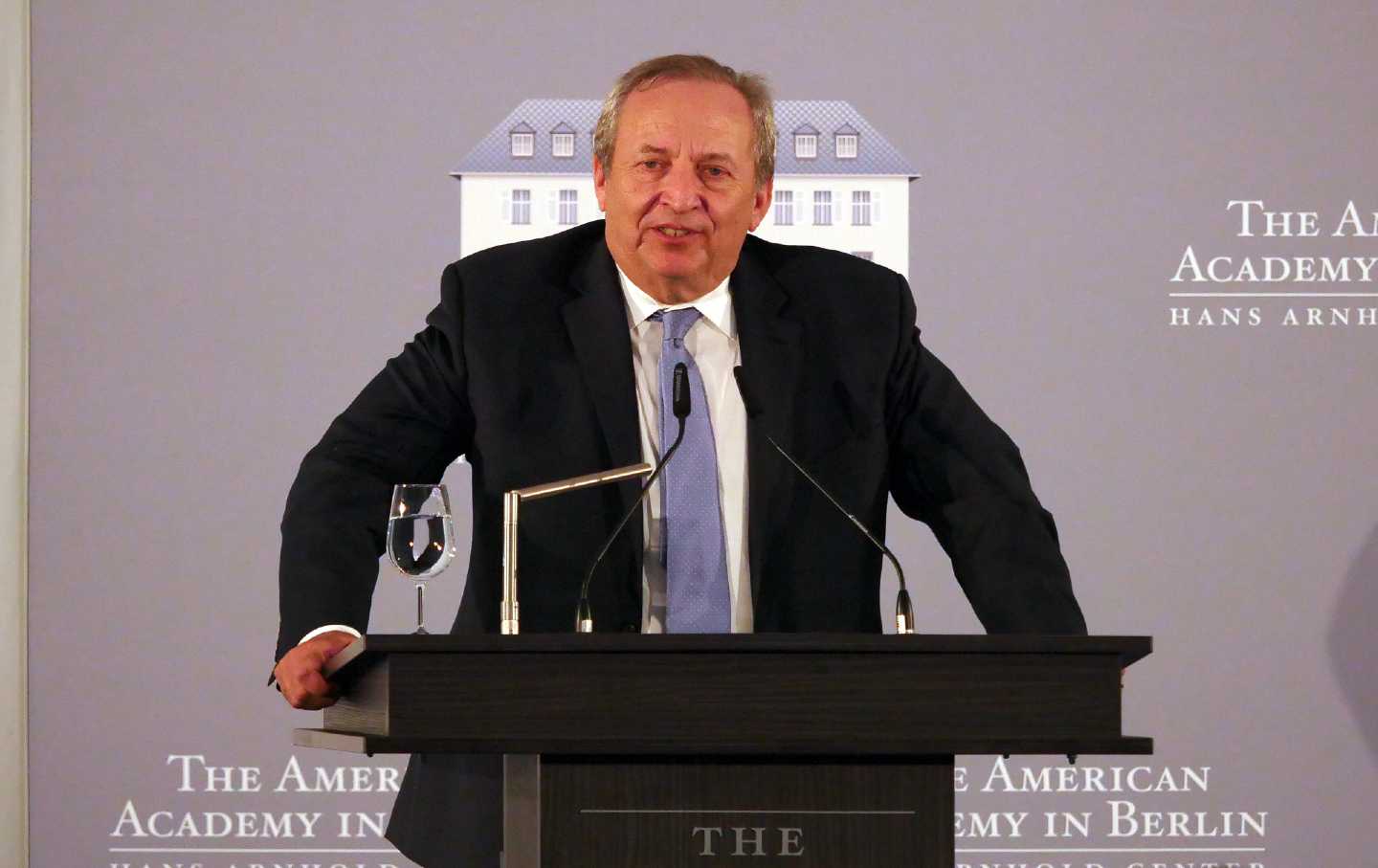
At the austerity pulpit: Former treasury secretary Larry Summers delivers the laudation for German Finance Minister Wolfgang Schäuble, the recipient of the 2017 Kissinger Prize, at the American Academy of Berlin.
(Chad Buchanan / Getty Images)On the occasion of Larry Summers’s latest, and seemingly comprehensive, resignation from Harvard in disgrace, it’s instructive to look back at his first one, which he announced exactly 20 years ago last week. It was said to be a response to institutional revulsion over a thing he’d said more than a year earlier about women’s “intrinsic inaptitude” for math and science.
But the precipitating event behind his departure did not actually have much to do with his edgelord misogyny, or his decision to antagonize the celebrity professor Cornel West. The episode revolved around Andrei Shliefer, a close friend, vacation partner, and protégé Summers had sent to Russia on behalf of the World Bank in 1991 to oversee a program to rapidly privatize 225,000 state-owned enterprises. A 22,000-word magazine feature that an anonymous gadfly had mailed in manila envelopes to several senior faculty members showed how Shleifer had exploited the job and the inside information that came with it to turn himself into a mid-level oligarch while the country literally starved.
The fallout was so near-ruinous for Summers he turned to his good friend Jeffrey Epstein for assistance, according to emails the sex- trafficking pedophile of mystery sent his other disgraced friend Peter Mandelson as the two men were frantically lobbying to water down post-crisis financial reforms in 2010. Headed to Davos, Mandelson mentioned he’d be seeing Summers, and Epstein offered cryptic advice: “when larrys close friend ANDRE Schleifer [sic], had trouble at harvard I played the role you play for me. support -friendship-advice.suggest to him you play the same role as I did with Andre Shleifer, if he is not jet lagged he will then open up to you.” Mandelson replied that he was bringing a financial regulator to the meeting and Epstein pressed, “great, is [then Chancellor of the Exchequer alistair] darling more under control? but you should take the opportunity to mention andre, he will then know he can trust you.” A few months later, now giving mild blackmail-lite vibes, Epstein brought it up a third time: “don’t forget to mention ANDRE [sic] SHLEIFER to Larry. his friend got himself in trouble at Harvard, I was there for him 1000%. Larry will then understand , our friendship.” Mandelson, by now perhaps a little creeped out, replied: “Remember I did mention at Davos and he was rather embarrassed.”
And for good reason, though we surely only know the vague contours of the case: Shleifer was, like Summers, a wunderkind economics professor. By 1992, he was running a whole Moscow-based Harvard-sponsored economic Seal Team Six backed by tens of millions of dollars in congressionally appropriated USAID funding intended to help transform Russia into a sophisticated, well-oiled market economy. By 1994, Shleifer and wife, who worked for hedge-fund billionaire Tom Steyer, had partnered with then-unknown financier named Len Blavatnik (current estimated net worth: $30 billion) to invest in Gazprom, a Russian operator of the country’s telecom monopoly, together with a constellation of aluminum smelters and countless other former assets of the Soviet state. Shleifer was directly overseeing Gazprom’s privatizing raid on behalf of Harvard, and the merger documents for the Harvard deal were drafted pro bono by a Shleifer deputy in exchange for gaudy perks like first crack at the company’s stock offerings (in his father’s name) and special treatment for his new girlfriend’s mutual fund. The Harvard boys deputized a summer intern to analyze obscure data on oil and gas prices and liquidity—ostensibly because oil and gas were “at the forefront of privatization” but actually to guide their own black-market stock purchases. It was all an orgy of frenzied state plunder and insider trading—eerily portentous of the one that took shape in the first days of the second Trump term under the direction of Scott Bessent, George Soros’s main captain of Eastern Bloc economic sabotage during the 1990s.
By 1997, the whole Harvard crew had been kicked out of Russia in disgrace; a vendor reported its activities to USAID, which suspended its funding as an investigation proceeded. While the Harvard boys had been blowing their government funds on limo drivers and girlfriends’ tennis lessons, the Russian GDP, laid waste by mobsters and marauders bearing fancy credentials, shrank to half its 1991 size, and Boris Yeltsin’s approval rating plummeted to 3 percent. It was clearly time for an exit strategy: Summers began laying the groundwork for casting his protégé as some kind of post–Cold War econometric sage—a “predictor” of the financial chaos he had so shamelessly micromanaged for his own financial benefit. A 1995 paper Shleifer had cowritten on arbitrage, we were told, had prophesied the collapse of the hedge fund Long Term Capital Management that almost triggered a trillion-dollar global financial meltdown. As Shleifer slinked away from the gilded wreckage of the Russian economy, Summers was busy verbally abusing a female regulator who, having actually predicted the crisis, had attempted to centralize and force transparency upon the trade of the unregulated derivatives in which LTCM had recklessly trafficked. In 1999, Shleifer won the prestigious John Bates Clark medal, in what the award’s governing body called a “continuation of the empirical tradition that really started with Lawrence Summers.” Two years later, Summers was named the youngest-ever president of Harvard, a perch from which he felt more than comfortable ordering academic underlings to “protect” his protégé from naysayers and federal snoops. Litigation over the Russia debacle would ultimately cost Harvard tens of millions of dollars. “I expressed to Dean Knowles,” Summers testified in a 2002 deposition, “that I was concerned to make sure that Professor Shleifer remained at Harvard because I felt that he made a great contribution to the economics department…and expressed the hope that Dean Knowles would be attentive to that.”
Indeed he was: Andrei Shleifer is a Harvard professor to this day! But Summers is—and it’s hard to wrap my mind around this—somehow not. It was just a few months ago that the Democratic Party’s $50 million-a-year brain trust at the Center for American Progress was tapping the endlessly discredited economist as a lead architect of an initiative it called “Project 2029.” This was meant to be the Democrats’ answer to the dystopian blueprint for extralegally eradicating federal regulation that the Trump administration began to enact at a dizzying pace following Elon Musk’s successful hacks into the Treasury Department’s payment systems. Project 2025 comprehensively destroyed the Consumer Financial Protection Bureau, commenced the abolition of most public health and disaster relief programs, gutted staffs charged with monitoring weather patterns and infectious disease epidemics and employment and inflation and air traffic, nearly halved the workforce dedicated to auditing the tax returns of the affluent, eliminated virtually all of the personnel devoted to policing corruption and fraud within federal agencies, and vaporized the agency formerly known as USAID. The explicit goal of Project 2025 was to inflict “trauma” on federal workers in retaliation for the elevated rates at which they historically voted for Democrats; the obvious ulterior motive was the bargain-basement usurpation of publicly owned assets ranging from taxpayer data to riverfront real estate on the Potomac. But the overall effect was much broader and existential: the abolition of government, or any institutions whatsoever, from ever-expanding swaths of public life. No attempt to genuinely improve the material conditions of American voters will be possible until the country launches an almost incomprehensibly ambitious crusade to rebuild that capacity to govern. And to mastermind this Herculean endeavor, the Democrats seriously chose… Larry Summers? A man whose intellect seems genuinely invigorated by a debate with his billionaire sex offender buddy over the costs and benefits of first-class versus NetJet?
Even his defenders surely grasp that rebuilding gutted institutions is just conspicuously not Larry Summers’s thing. During the Clinton years, he heartily cheered the mass shuttering of assembly lines from Appalachia to El Segundo, the disposal of toxic waste on Third World countries, and the repeal of the New Deal laws that transformed American banking from a hodgepodge of pyramid schemes into a reliable and safe fraud-resistant financial system that was the envy of the world. As that financial system stood on the precipice of an unprecedented bank run triggered by the secret mass-replication of unregulated derivatives pegged to $125,000 homes lavished with $600,000 valuations, Summers wrote a fawning ode to Milton Friedman, the late “great liberator” who had “convinc[ed] people of the importance of allowing free markets to operate.” Cribbing Friedman’s own encomium for John Maynard Keynes, Summers wrote that “any honest Democrat will admit that we are all now Friedmanites.”
After the 2008 crisis, Summers bullied colleagues who accurately blamed the calamity on the deregulation he and Clinton Treasury Secretary Robert Rubin had fomented while single-handedly negotiating the proposed federal stimulus package down to $800 billion worth of mostly tax cuts from a more ambitious $1.3 trillion. This larger package would have funded more transportation projects, and the finance-addled Summers bore a bizarre personal animus toward these undertakings that former Democratic Representative Pete DeFazio of Oregon summed up bluntly: “Larry Summers hates infrastructure.”
Thirteen years later, when Congress and Joe Biden were hammering out the $1.9 trillion Covid-19 stimulus bill, Summers made the cable news rounds to argue the package was three times bigger than it should have been. He then took an endless series of gloating victory laps when inflation began to materialize, deputizing surrogates like his former student Catherine Rampell and longtime minion Jason Furman to malign the notion that inflation was opportunistically caused by corporate price gouging as a “conspiracy theory.” It took Elon Musk wielding a chain saw under the influence of a battery of controlled substances for Larry Summers to so much as consider that there might be a toxic level of austerity that he might not approve of. And even when he did acknowledge that DOGE might be destroying democracy, his heart was clearly elsewhere: He spent much of 2025 as he had the year before, posting on the scourge of American “antisemitism” and the “moral weakness” displayed by Harvard University students protesting the genocide in Gaza. There were, in short, few individuals as singularly unsuited to formulating a blueprint for recovering from the domestic version of “How Harvard Lost Russia” as Larry Summers—which is of course why Democratic Party elites were hell-bent on giving him the job.
Even when his diabolically embarrassing series of e-mails to Jeffrey Epstein about a younger extramarital conquest he nicknamed “Peril” (she is the daughter of a longtime Chinese Communist Party official) were made public late last year, it seemed certain that Summers’s lucrative career spouting elite conventional wisdom at Davos and on various media properties owned by David Ellison would survive the cringemaxxing. But then the news emerged that Harvard had launched an investigation into… two students who had posted about his final lecture on social media. That’s right: The more urgent moral lapse here, in the view of Harvard’s overseers, wasn’t Summers’s own depraved personal and professional transgressions; no, it was improperly publicizing Summers’s own comments.
This Mafia-like reflex speaks volumes about the world Larry Summers prospered in, and it bodes ill for the durability of his recently announced retirement. I would like to believe that Summers’s resignations from OpenAI and Harvard represent a clean break between him and the institutions that have enabled his tyranny over the federal budget and the national discourse. But it’s far more likely that this determined survivor of the pillaging of the Russian economy and the disastrous financialization of the American one sees in the fallout from his self-administered “Peril” a chance to lie low before resuming his familiar rounds at Davos and in cable green rooms. Our financial elites are old hands, after all, in downplaying and burying indelicate personal scandals—and they need obliging and nominally Democratic stooges to continue hymning the glorious revival of American Friedmanomics.