
In the Trump Era, Celebrating Black History Month Feels Radical Again
After putting on their very best performances of solidarity every Black History Month, this year corporate marketers have seemed at a loss for words.
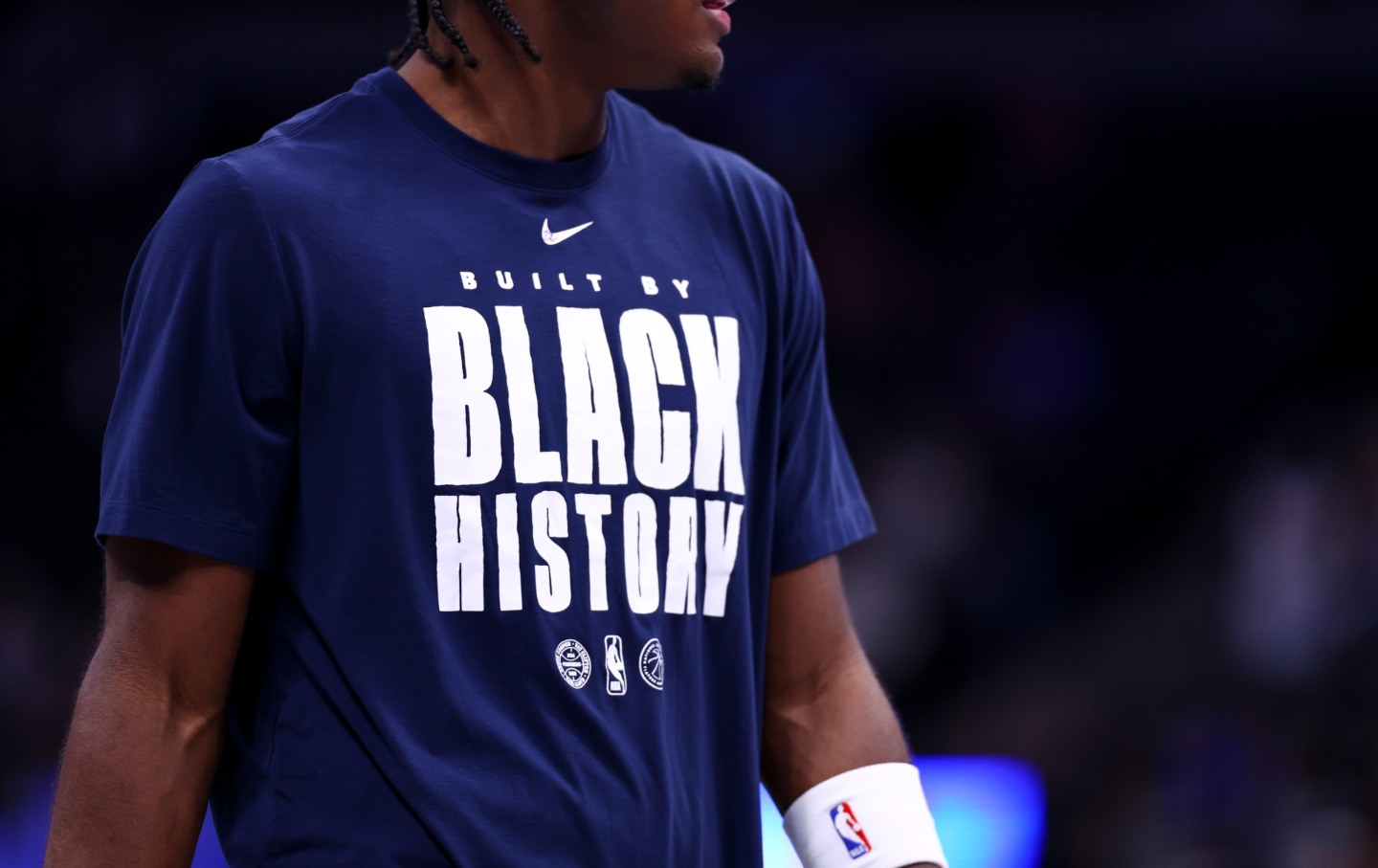
Black History Month arrived this February, just as it does every year — except a lot quieter.
Streaming services featured fewer ads with voiceovers celebrating “Black excellence” and “Black girl magic.” Brand social media accounts — once quick to flood timelines with MLK and Maya Angelou pull quotes — were noticeably hushed. After years of putting on their very best performances of solidarity every Black History Month, corporate marketers have seemed at a loss for words this year. Ironically, that silence says far more about capitalism, cowardice, and complicity than any of their performative displays ever did.
Those displays peaked in the aftermath of George Floyd’s May 2020 murder, as corporations fell over themselves in a collective rush to perform grief and solidarity? During Black History Month 2021, Nike observed the month by reworking the color schemes of some of its more popular sneakers for limited-edition styles and announced plans to distribute half a million dollars to nonprofits serving predominantly Black communities. Target launched an HBCU student-design challenge, offered a special collection by Black designers, and touted its new commitment to increase the number of Black workers by 20 percent — all of which followed the launch of its Racial Equity Action and Change, or REACH, initiative, which committed to spending more than $2 billion with Black businesses. And roughly 100 globally-recognized brands “mentioned Black History Month or used the hashtag #BlackHistoryMonth 122 times on the social media site formerly known as Twitter,” according to Adweek.
By February 2025, just two of those same brands — Spotify and Ralph Lauren — mentioned Black History Month even once on the platform.
The silence was neither coincidence nor accident. The years since 2020 have borne witness to one of the most vicious white backlashes to Black demands for liberation since Reconstruction. In short order, the right launched a cynical misinformation campaign around “critical race theory,” the Supreme Court’s conservative supermajority struck down affirmative action, and the idea of racial equity as anti-white “reverse-racism” gained renewed traction. Books by Black and LGBTQ authors were being banned and burned. Bans on the teaching of Black history were codified in at least 18 states. And Donald Trump was reelected — itself a testament to festering white racial resentment — ushering in a wave of anti-DEI policies.
Trump turbocharged efforts to erase Black history. In March 2025, he signed an executive order, “Restoring Truth and Sanity to American History,” which took direct aim at the National Museum of African American History and Culture, an institution he would later complain is too focused on “how bad slavery was.” The Naval Academy library purged 400 books it claimed promoted DEI, including Maya Angelou’s autobiography I Know Why the Caged Bird Sings — although it retained two copies of Adolph Hitler’s Mein Kampf. In Mississippi, at the National Monument Home of Medgar and Myrlie Evers in Mississippi, National Park Service employees removed brochures referring to Ever’s murderer, a known Klansman, as “racist.” This past January, at the former Philadelphia home of George Washington, federal workers were ordered to take down an exhibit that looked at the lives of those he enslaved. Those panels were reinstalled just days ago, Feb. 19, under orders of a judge who noted the Orwellian echoes in their removal.
Brands made big shows of celebrating Blackness when it was fashionable and, above all, safe. Then they cravenly retreated. One month after Trump moved back into the White House, in February 2025, users noted Google had quietly wiped all recognition of Black History Month — and Women’s History Month, Pride Month, Holocaust Remembrance Day, and Indigenous Peoples Month — from its calendar’s default listings. When pressed for an explanation, Google blamed technical issues related to scalability, a contention that might have seemed more believable had it not announced just the week prior that it was ditching DEI efforts to comply with Trump executive orders. (“In 2020, we set aspirational hiring goals,” a Google in-house memo noted, “but in the future we will no longer have aspirational goals.”) The metaphor of erasing Black history and existence from time itself was almost too on the nose.
Amazon had promoted products by Black makers every February since 2021. But weeks before Trump’s second inauguration, the company scrubbed the phrase “Equity for Black people” from its website and announced it was “winding down outdated programs,” thinly-veiled code for DEI. Meta — which during Black History Month 2022 had even infused its virtual and augmented reality Metaverse with content centering the black American experience — cited the “shifting legal and policy landscape” in the Jan. 2025 memo announcing its DEI withdrawal. One of Target’s eight Instagram posts during Black History Month 2024 labeled the month “sacred.” And yet less than a year later, the company announced it was dropping its Racial Equity Action and Change, or REACH initiative, including the 2021 pledge of $2 billion to black businesses — one of the largest corporate DEI rollbacks amidst a season full of them.
While those reversals made headlines, it was brands’ public displays of Black support that had been anomalous — not their retreat. For a brief national moment after George Floyd’s murder, public opinion embraced racial justice, with multiple polls finding a majority of Americans, including a plurality of white Americans, supported the movement for Black lives — a consensus that led corporations to recognize its profit potential. All this was a textbook example of an actual principle of critical race theory — as opposed to the panicked distortion that would seize white America shortly thereafter — known as “interest convergence.” Developed by late Harvard legal scholar Derrick Bell, the principle holds that racial progress happens when it aligns with white interests, not in spite of them. Brands are happy to court new audiences as long as the effort only requires hashtags, playlists and altered color palettes. Political inconvenience, not so much. Capitalism exists to follow power, not buck it.
Having brands back away from Black History Month actually recalls the month’s origins and original intent. The reason for the season was not to provide marketing opportunities to corporations. It was a celebration born of struggle during a period now known to historians as “the nadir of American race relations.” In 1926, during that dark era amidst a revived Ku Klux Klan, Lost Cause revisionism and endless white terror violence, Carter G. Woodson insisted on a week dedicated to the truth of Black history in a nation committed to forgetting.
And this year, on the 100th year of Black History Month, America remains much the same. As the Atlantic’s Adam Harris notes in an essay this month, “Black History Month is sometimes treated as little more than an opportunity for corporate branding and, maybe, school assemblies; but in the face of such erasure, observing it this February feels radical.”
Black History Month doesn’t need corporate validation. It’s already survived a century of segregation, degradation, and attempted erasure. It will also survive America’s latest effort to make Black history disappear. Despite a Jan. 31, 2025, Department of Defense declaration stating all “Identity Months Dead,” Trump still issued a Black History Month declaration on Feb. 3 this year. However begrudgingly.
Popular
“swipe left below to view more authors”Swipe →There are still some brands showing up. It might not be surprising that Ben & Jerry’s — which is currently suing parent company Unilever for allegedly trying to shush its support of Gaza — has remained a vocal Black History Month supporter. The Gap not only partnered with Harlem’s Fashion Row — an agency that represents up-and-coming Black designers — but also launched a new denim collection from 5 young Black designers, and held a much-hyped pop-up event in Times Square. And there were social media posts from brands that have publicly stated their refusal to abandon DEI goals, including Costco, Delta and Apple, the latter of which again launched its annual Black Unity Collection.
But perhaps more importantly, there are stories that highlight how non-corporate commitments will always be more important. Illustrator and activist Danielle Coke Balfour created her “Oh Happy Dani” stationary and card brand based on art she’d created for Black History Month 2020. By 2021, Balfour was working with Target, and her line was featured in its stores nationwide. But when the company announced its DEI rollback last year, Balfour decided to pull her items from the store’s inventory. “Our brand has always been built on the very principles that have recently been rolled back by” Target, she explained in a social media post. (In another message, Balfour would also rightly describe Target’s move as “a signal of the dangerous trajectory we’ve been on for years as a result of the backlash to racial equity efforts.”) Balfour’s online store sold out, and she posted an update showing that the customer support she saw in just the week after severing ties with Target wiped out the losses she’d expected to incur over the following year. Where corporate America failed her, the community rallied to fill in, and made the gap overflow. The story feels instructive, and needed, at this moment.
As for Target, the company faced multiple backlashes from Black consumers and the “Latino Freeze” movement. As of this writing, its stock price has plummeted 61 percent since its 2021 peak. So, Happy Black History month, to those who celebrate.
More from The Nation

What’s It Like Inside a Data Center? What’s It Like Inside a Data Center?
Northern Virginia is laden with structures that house data for Fortune 500 companies. I went inside just one of those monstrosities that bothers its neighbors.
What Trump and Tucker Carlson Have in Common What Trump and Tucker Carlson Have in Common
Carlson has broken with Trump largely over the war in Iran. But on Ukraine and immigration, the two speak very much the same language.

The Jewish Case Against AI The Jewish Case Against AI
Haredi rabbis and the secular left agree: This technology is a threat to the entire social fabric.
The Fight for Educational Equality Is Also a Fight for a Just Supreme Court The Fight for Educational Equality Is Also a Fight for a Just Supreme Court
The court has severely weakened our ability to make an education system that fulfills the promise of Brown.
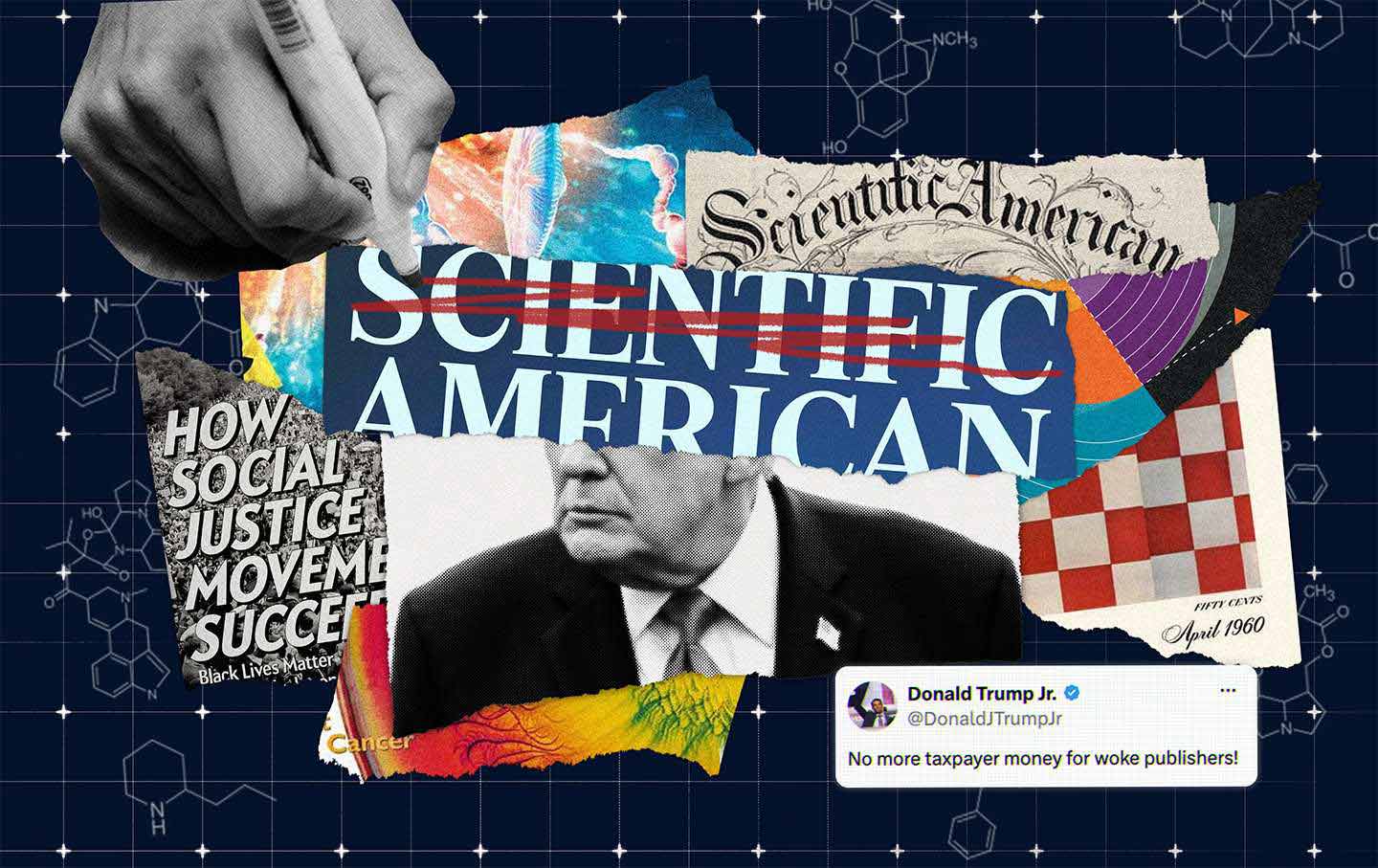
The Fall of “Scientific American” The Fall of “Scientific American”
When the beloved science publication got too political, its corporate owners stepped in. Now its future is uncertain.

The Bookstore Revolution in Taiwan’s Conservative Heartlands The Bookstore Revolution in Taiwan’s Conservative Heartlands
After Taiwan legalized same-sex marriage, gender-themed bookstores are working to build the social acceptance that the law alone couldn’t deliver.

