Where Climate Coverage Goes to Die
The very notion of public service journalism is under assault at precisely the moment that it’s most needed.
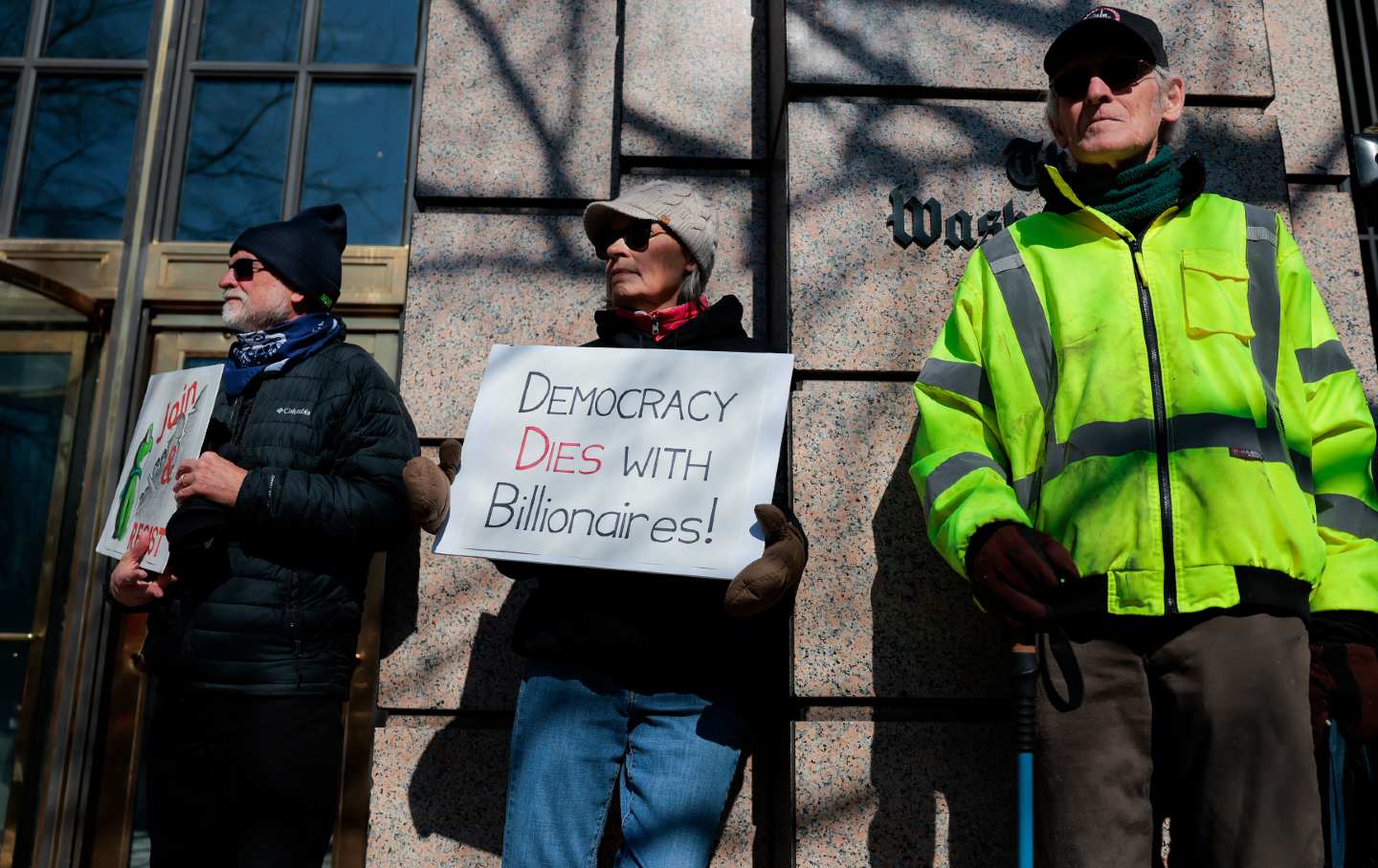
NewsGuild members are joined by other protesters during a rally outside the Washington Post office building on February 5, 2026, in Washington, DC.
(Heather Diehl / Getty Images)It was Jeff Bezos, the Amazon billionaire, who came up with the tagline “Democracy Dies in Darkness” for The Washington Post. According to a memoir by the paper’s former editor, Martin Baron, Bezos greenlighted the “democracy” line after an internal staff favorite was rejected by his then-wife, MacKenzie Scott.
In his book Baron admits to initially being impressed by the new owner, now the world’s third-richest man. “Everything I’ve heard and seen tells me that Bezos honestly believes in an essential role for journalism in a democracy,” Baron wrote.
That didn’t turn out so well. Baron has left the Post, Bezos has cozied up to Donald Trump (Amazon bankrolled the recent propaganda film about Melania Trump), and it’s the Post that’s dying, bleeding out from a thousand paper cuts. Recent layoffs at the paper gutted, among others, its metro coverage, its international reach, its book section, and, not least, the climate team. One of the country’s great newspapers now lives in very dubious company, among other media outlets including CBS News and the Los Angeles Times, that were undercut by their own bosses.
In the United States, the very notion of public service journalism is under assault, at precisely the moment that it’s most needed. And climate journalism is a case in point.
Sammy Roth, who reported on climate for the Los Angeles Times and now writes his own newsletter, “Climate-Colored Goggles,” has documented Bezos’s thrashing of the Post’s climate work, which had often been first-rate. Fourteen climate journalists—including editors, reporters, and data and video journalists—were among the more than 300 Post employees to lose their jobs in the bloodletting. The challenges facing the Post’s remaining climate team have become an order of magnitude harder.
The cutbacks come as the Post editorial page has become a destination for climate apologia, including an op-ed from climate skeptic Bjørn Lomborg, and a signed editorial applauding Trump’s trashing of the “endangerment finding,’ which had given the US Environmental Protection Agency legal authority to regulate planet-warming pollutants. As Roth noted, the Post editorial questioned whether the “modest benefits of regulating greenhouse gases outweigh the considerable economic costs.” People around the world who are seeing their lives upended by a warming earth won’t see the effects of higher emissions as “modest”; but it would take reporters on the ground to tell that story.
CBS is tacking in the same direction. The network, owned by the billionaire Ellison family, also has cut back on its climate team, laying off all but one of its climate journalists last year under its new leader, The Free Press founder Bari Weiss. Roth reviewed the Free Press coverage of climate when Weiss was there and found a common thread. “Again and again, Weiss has published pieces insisting liberals have an unhealthy obsession with climate change, and that phasing out fossil fuels is unrealistic and harmful.”
CBS’s new worldview is oozing beyond the newsroom. This week, late-night talk-show host Stephen Colbert accused CBS of censorship after the network pulled his interview with a Democratic Senate candidate in Texas. “Let’s just call this what it is,” Colbert said on his show. “Donald Trump’s administration wants to silence anyone who says anything bad about Trump on TV, because all Trump does is watch TV.”
And so it goes around the country. Reporters at outlets of all sizes report waning interest, if not outright antagonism, to the climate story among newsroom executives. This ambivalence is exactly what Trump and his allies want. It also is a dereliction of journalistic duty. Audiences need to know what is happening in the world around them. And they say, again and again, that they care about climate change and its solutions. Why abandon them now?
The answer is this: The people who own much of the world’s media do not regard coverage of climate change to be in their economic interest. As a result, the rest of us are left in darkness.