Environment / January 8, 2026

The US Is a Violent Petro-State

Trump’s attack on Venezuela illustrates fossil fuels’ many perils.
Mark Hertsgaard

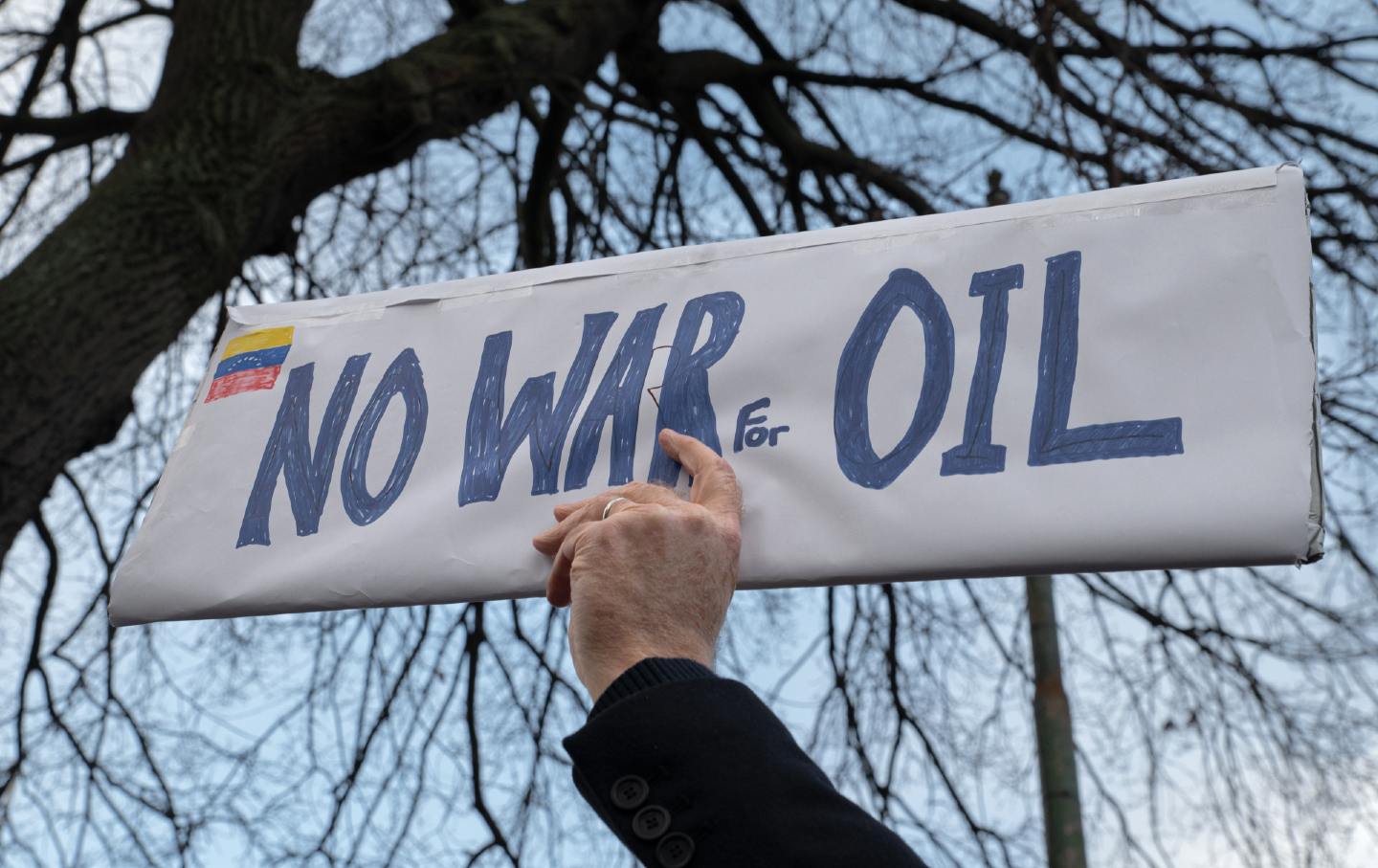
A man holds a plaque reading “No War for Oil” in front of the US Embassy in Dublin.

(Natalia Campos / Getty Images)

“Petrostate” is a term usually applied to countries like Saudi Arabia, Russia, or Nigeria, where the production and, crucially, the export of oil and gas are fundamental to the domestic economy and foreign policy. Rarely, however, is the term applied to the world’s oldest, richest, and mightiest petro-state. That distinction belongs to the United States, which a few days ago attacked a fellow petro-state, Venezuela, with the announced aim of seizing control of its oil operations. Oil is clearly at the heart of the Venezuela story, which means that climate change is as well.

Although most coverage has neglected the climate angle, a Guardian article published on January 6 offered an illuminating exception. Noting that Venezuela holds the world’s largest known oil reserves, The Guardian reported that “even raising production to 1.5m barrels of oil a day from current levels of around 1m barrels would produce…more carbon pollution than what is emitted annually by major economies such as the UK and Brazil,” citing University of California, Santa Barbara, professor Paasha Mahdavi. That, Mahdavi said, would be “terrible for the climate.”

The United States has been a petro-state since long before Donald Trump came to power, under Democratic and Republican presidents alike. It was under Democratic Presidents Barack Obama and Joe Biden that the United States regained its position as the largest annual producer of oil and exporter of gas. Oil company CEOs populated the cabinets of Republicans George H.W. Bush and George W. Bush (whose family wealth was built on fossil fuels).

Current Issue

Cover of April 2026 Issue

“The United States is as much of an OPEC nation as most OPEC nations are.” So said Everett Ehrlich, who chaired the interagency deliberations on climate change in Bill Clinton administration’s, in an interview for my 2010 book, Hot: Living Through the Next Fifty Years on Earth. Ehrlich was explaining why a government that boasted Al Gore as vice president was much more timid about cutting greenhouse gas emissions than its European and Japanese allies were. “The US is more like an OPEC nation—an energy producer—while the Europeans and Japan are energy-consumer nations,” Ehrlich added.

The United States’ vast oil reserves have been key to its superpower status for more than a century. During World War I, the United States supplied most of the oil that helped Britain and France prevail over Germany. US oil companies have worked alongside the White House, the State Department, and other US agencies ever since, at home via pro-monopoly regulation that pushed prices above free-market levels and abroad via such collaborations as the Red Line Agreement, which in the 1920s gained US companies access to Middle Eastern oil.

Discoveries of massive deposits in Texas, Oklahoma, and California in the 1930s reinforced the country’s dominance; unlike any of the Axis or Allied powers, the United States had its own oil to fight World War II. Its abundant domestic supply also transformed the US economy after the war, enabling Americans to buy more cars, move to expanding suburbs, and drive on new interstates. Building all those cars, suburbs, and highways propelled a decades-long economic boom that ranks among the most spectacular in human history.

But the climate crisis underscores a truism about petro-states: Oil can be more a curse than a blessing. Scholars and journalists have documented that most petro-states are plagued by blatant corruption and inequality. Elites grab the revenues; poverty engulfs the masses. Violence is another byproduct: Since 1973, one-fourth to one-half of the world’s wars have been “connected to oil interests,” according to Jeff D. Colgan of the Harvard Kennedy School’s Belfer Center for Science and International Affairs. And, of course, burning oil is a primary driver of climate change.

The US attack on Venezuela is but the latest example of these destructive tendencies. Journalists need to help audiences understand the attack’s connections to oil, as well as what scientists have long warned: Humanity’s future depends on rapidly phasing out fossil fuels.

Support independent journalism that does not fall in line

Even before February 28, the reasons for Donald Trump’s imploding approval rating were abundantly clear: untrammeled corruption and personal enrichment to the tune of billions of dollars during an affordability crisis, a foreign policy guided only by his own derelict sense of morality, and the deployment of a murderous campaign of occupation, detention, and deportation on American streets. 

Now an undeclared, unauthorized, unpopular, and unconstitutional war of aggression against Iran has spread like wildfire through the region and into Europe. A new “forever war”—with an ever-increasing likelihood of American troops on the ground—may very well be upon us.  

As we’ve seen over and over, this administration uses lies, misdirection, and attempts to flood the zone to justify its abuses of power at home and abroad. Just as Trump, Marco Rubio, and Pete Hegseth offer erratic and contradictory rationales for the attacks on Iran, the administration is also spreading the lie that the upcoming midterm elections are under threat from noncitizens on voter rolls. When these lies go unchecked, they become the basis for further authoritarian encroachment and war. 

In these dark times, independent journalism is uniquely able to uncover the falsehoods that threaten our republic—and civilians around the world—and shine a bright light on the truth. 

The Nation’s experienced team of writers, editors, and fact-checkers understands the scale of what we’re up against and the urgency with which we have to act. That’s why we’re publishing critical reporting and analysis of the war on Iran, ICE violence at home, new forms of voter suppression emerging in the courts, and much more. 

But this journalism is possible only with your support.

This March, The Nation needs to raise $50,000 to ensure that we have the resources for reporting and analysis that sets the record straight and empowers people of conscience to organize. Will you donate today?

Mark Hertsgaard

Mark Hertsgaard is the environment correspondent of The Nation and the executive director of the global media collaboration Covering Climate Now. His new book is Big Red’s Mercy:  The Shooting of Deborah Cotton and A Story of Race in America.

More from Mark Hertsgaard Mark Hertsgaard Illustration

Donald Trump looks over Japanese Prime Minister Sanae Takaichi as she speaks to US Navy personnel aboard the USS George Washington aircraft carrier at Yokosuka naval base on October 28, 2025.

Japan’s New Climate Bomb—in the US Japan’s New Climate Bomb—in the US

Bloomberg Green reveals the climate costs of the US-Japan trade deal.

Mark Hertsgaard

Winter Olympic Committee Press Conference

The International Olympics Committee Is Urged to Drop Oil Company Sponsors The International Olympics Committee Is Urged to Drop Oil Company Sponsors

Global warming means the future of Winter Games “is literally melting away.”

Mark Hertsgaard

Minnesotans film a federal law enforcement agent during a patrol in Minneapolis, Minnesota, on January 11, 2026.

Citizen Journalists Are Minneapolis’s Unsung Heroes Citizen Journalists Are Minneapolis’s Unsung Heroes

Without their videos of ICE shootings, we wouldn’t know what is really happening.

Mark Hertsgaard

Climate Stories Are Everywhere

Climate Stories Are Everywhere Climate Stories Are Everywhere

Why do many news outlets ignore the connections between climate change and the struggle for democracy?

Mark Hertsgaard

Homes burn as powerful winds drive the Eaton Fire on January 7, 2025, in Pasadena, California.

Climate Hushers Need to Get Real Climate Hushers Need to Get Real

Political realism doesn’t outweigh scientific realism.

Mark Hertsgaard

Chris Packham addresses the audience at a National Emergency Briefing on the climate and nature crisis, at Central Hall Westminster on November 27, 2025, in London, England.

The UK’s Climate National Emergency Briefing Should Be a Wake-Up Call to Everyone The UK’s Climate National Emergency Briefing Should Be a Wake-Up Call to Everyone

The briefing was a rare coordinated effort to make sure the media reflects the science: Humanity’s planetary house is on fire, but we have the tools to put that fire out.

Mark Hertsgaard