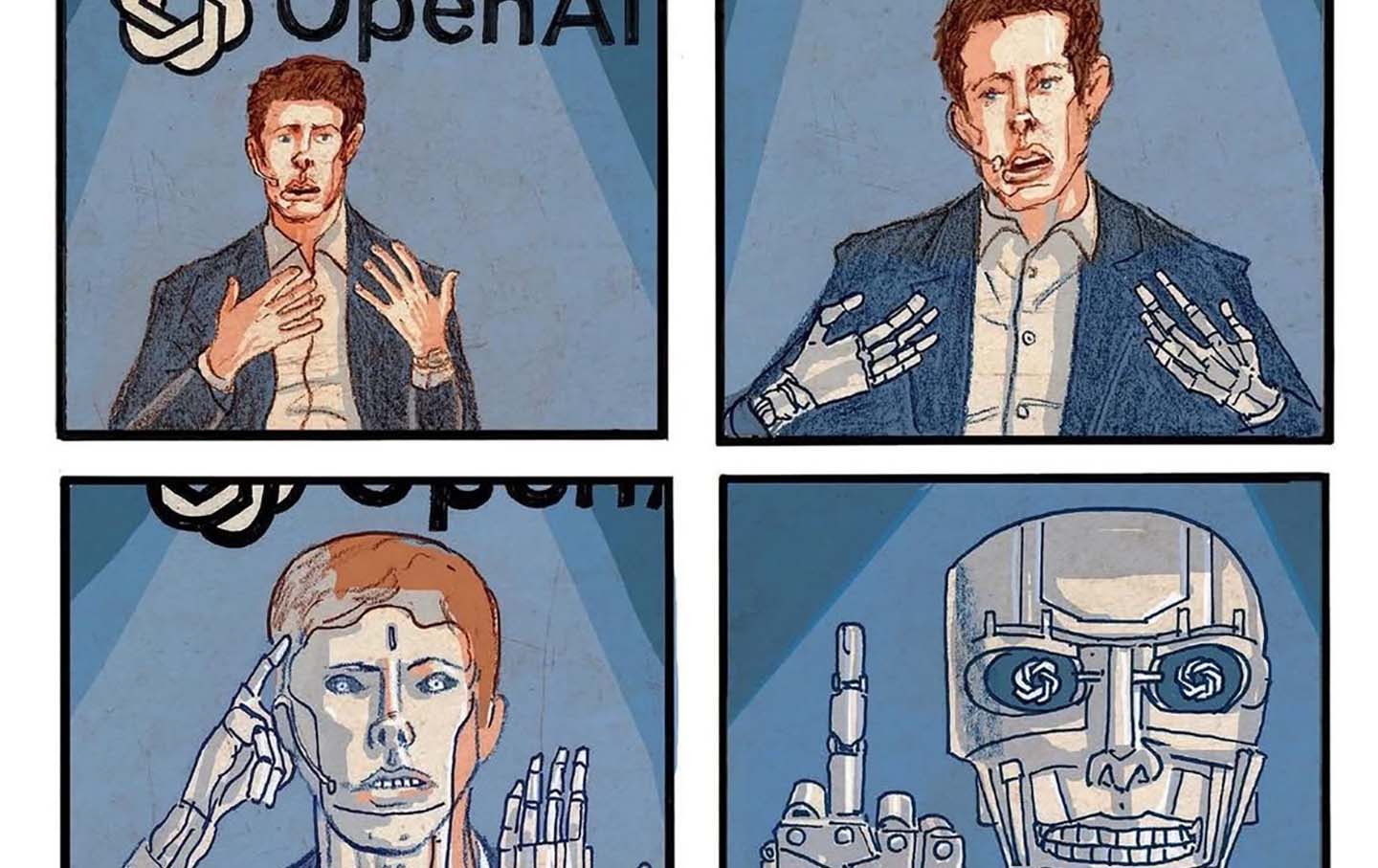
How Milk Became a Battleground in Trump’s War on “Woke”
The administration claims its whole-milk reversal is about children’s health, but the policy may only serve to advance its political agenda.
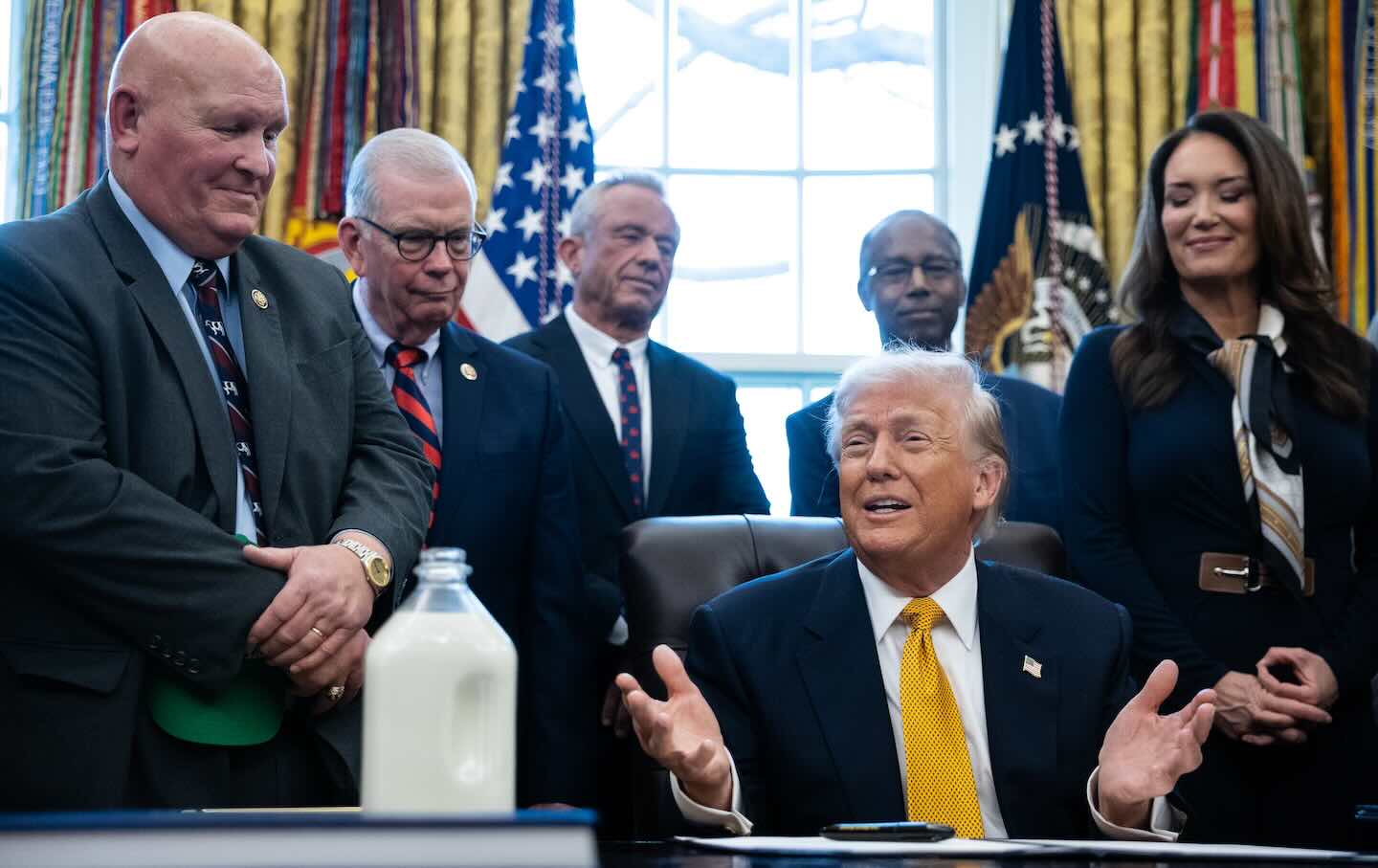
President Donald Trump speaks during a signing ceremony in the Oval Office of the White House on January 14, 2026. Trump signed legislation allowing schools that participate in a federal lunch program to serve whole milk.
(Francis Chung / Politico / Bloomberg)A10-foot pink latex udder is dangling from the ceiling as the smoke machine kicks back on. A remix of “Never Too Much” by Luther Vandross is hitting. A mirror reflects a sea of all-white outfits.
Last year, I found myself at a milk-themed basement dance party. At the time, perhaps, I should have turned around on the dance floor: I could have found an AI-generated Robert F. Kennedy Jr. behind me, swaying while sipping a glass of the white stuff.
The exclusive invite for the party featured a black-and-white portrait of a gaunt child in wartime hugging bottles of milk. It wasn’t hard to find an older version of the boy in the room, dancing poorly to house music in a milkman costume, grinding on the milkmaid.
A year later, Donald Trump would deploy a version of the same imagery to proclaim his nationwide plan to “Make Whole Milk Great Again.”
In January, President Trump signed a bill allowing schools that participate in federal lunch programs to once again serve whole milk and 2 percent milk, reversing Obama-era restrictions aimed at reducing childhood obesity by limiting options to skim and low-fat. What followed was a rapid-fire public relations blitz: government agencies, conservative lawmakers, and wellness influencers declaring that milk—real milk—was back.
The whole-milk policy is not so much a nutritional correction as a political calling card. It is an intentionally low-stakes move that, in a matter of weeks, performatively flipped years of public-health guidance to signal alignment with Trump’s voting bloc: agribusiness, Make America Healthy Again fundamentalists, biohackers, and reactionaries.
“Trump has been able to get all these people in this large coalition [that] have no connection,” said Fabio Parasecoli, professor of food studies at New York University. “Except for the fact that through Trump, they get access to power.”
Just days earlier, the Health and Human Services secretary flipped the food pyramid literally upside down, placing whole milk (and meat) near the top. As The New York Times reported, at least three of the nine experts who helped RFK Jr. make the new pyramid had financial ties to dairy industry organizations, including the National Dairy Council.
The effort to push dairy—especially to children—is only the latest chapter in the relationship between the US government and milk producers.
After World War II, dairy production surged to support the war effort, then overshot demand once peace arrived. The National School Lunch Act of 1946 helped absorb the surplus, embedding milk into the daily lives of American children.
In the 1970s, facing yet another glut, the federal government began purchasing excess milk and converting it into cheese; within a decade, it was sitting on hundreds of million pounds of it. Unable to find a market solution, the government distributed the surplus—sometimes moldy—to food pantries and low-income families.
But as time went on, Americans still kept drinking less and less milk per day. The United States Department of Agriculture estimates that between 1970 and 2019, milk consumption per day dropped nearly 50 percent. Milk drinking overall decreased more than 10 percent in just the decade between 2014 and 2024, with the steepest drop in consumption coming from children, according to the agency.
Popular
“swipe left below to view more authors”Swipe →In recent years, plant-based alternatives surged in coffeeshops and grocery aisles, leading the dairy lobby to launch a counteroffensive. The dairy checkoff—an industry-funded marketing apparatus—leaned into influencer culture, recruiting a “Dairy Dream Team,” including Mr. Beast. Protein-packed brands like Fairlife have been recast as functional wellness products.
It may have made a dent. In 2024, consumption of whole milk rose 3.2 percent, while plant milk consumption dropped nearly 6 percent, marking the third consecutive year of decline.
The increase in milk sales comes on the heels of fearmongering around the consumption of milk alternatives, particularly for men. Around 2017, the derogatory term “soy boy,” meant to mock men who consumed soy products, rose to popularity on Internet forums and chatrooms. Scientifically dubious but well publicized studies associate the consumption of soy-based products like tofu, edamame, and soy milk with a decrease in testosterone levels and feminization. Nondairy milk became shorthand for wokeness.
In recent years, as politicians and the mainstream media fermented fear around a crisis of masculinity, “milk became the expression of that,” said Parasecoli. “It’s a good example of what I call ‘gastronativism,’ when food is used in politics as an ideological tool to create boundaries between us and them.”
The pattern is not new. In the 19th century, some American doctors boasted that the American diet of eggs, milk, and dairy products was a panacea for a lack of “intellectual vigor” found in the “effeminate rice-eaters” of the non-Western world. In 1884, J. Leonard Corning, who played a role in inventing the epidural, prescribed milk and meat for “cerebral exhaustion” for those outside of the Anglo-Saxon race.
In 1923, future president Herbert Hoover proclaimed while addressing the World Dairy Congress that the dairy industry, more than any other of the food industries, is essential not only for public health but for the “very growth and virility of the white race.”
Milk is white in color and often in consumption. Approximately 68 percent of the world’s population has some degree of lactose intolerance. Those from Northern Europe digest milk with the most ease.
But to declare that milk consumption in and of itself is racist is a type of culture war decoy.
Not long after the term “soy boy” went mainstream in 2017, dairy made headlines after white supremacists took over Shia LaBeouf’s anti-Trump social experiment livestream project and chugged gallons of milk on camera while chanting racist, homophobic, and antisemitic slogans. Trump supporters began bringing milk to rallies and alt-right allies like Richard Spencer added milk-bottle emojis to their online profiles. Those who “can’t drink milk” should “go back,” wrote 4chan users. Another cultural touchstone that linked milk with racism symbolically that year was Jordan Peele’s Get Out, which showcased its villain eating her cereal dry and drinking her milk separately through a straw.
Trump’s whole-milk policy is a decoy not unlike the honeypot in Peele’s movie—culturally legible to those primed to hear it.
In response to the USDA’s #DrinkWholeMilk promotional video, users online were quick to point out the eerie feel of solemn-looking white children, spilling milk on their drab, gray wartime-style garb.
Derek Beres, author of Conspirituality: How New Age Conspiracies Became a Health Threat, sees the milk push as part of a broader pattern within the administration.
“That’s Kennedy’s MO. That’s Children’s Health Defense,” said Beres, referring to Kennedy’s antivax nonprofit. “They say it’s about their health, but they’re really using them as cudgels for their own political agenda,” as the health secretary has already done by rolling back many vaccines indiscriminately for children.
MAHA-aligned groups have already celebrated the whole-milk reversal as a proof of concept. Since Trump’s election and RFK Jr.’s failed presidential run, companies like Sweetgreen and Steak ’n Shake have accommodated the movement’s demands, rolling out beef-tallow fries and seed-oil-free ranch dressing. Kennedy has stopped short of endorsing raw milk outright—he declined to appoint Raw Milk Institute founder Mark McAfee to an FDA advisory role—but the power of the MAHA and Trump coalition is clear.
“MAHA is just one letter away from MAGA,” Beres said. “The tactics are the same: flood the zone, confuse people, and keep them from focusing on the fact that tens of millions are about to lose health coverage.”
More from The Nation
Trump Is in His Own Universe—but He’s Still Wrecking Ours Trump Is in His Own Universe—but He’s Still Wrecking Ours
Give the man a second opportunity to address the nation, and it’s entirely possible he could throw the whole world into a Great Depression.

Hasan Piker Threatens the Establishment. That’s Why They Want to Destroy Him. Hasan Piker Threatens the Establishment. That’s Why They Want to Destroy Him.
Critics are leveling baseless charges of antisemitism and bigotry at the mega-streamer. But they’re really scared of the challenge he poses to their power.
Trump’s Iran Speech Showed the Desperation of a Loser Trump’s Iran Speech Showed the Desperation of a Loser
The president’s war is an ever-escalating disaster. He is increasingly reviled. And his speech won’t change either of those things.
What Made This Seder Different From Any Other Seder? What Made This Seder Different From Any Other Seder?
Answer: The presence of New York’s first Muslim mayor.