What Marjorie Taylor Greene Doesn’t Understand
Her advocacy for Epstein’s victims is inspiring. But what about the rights of other women?
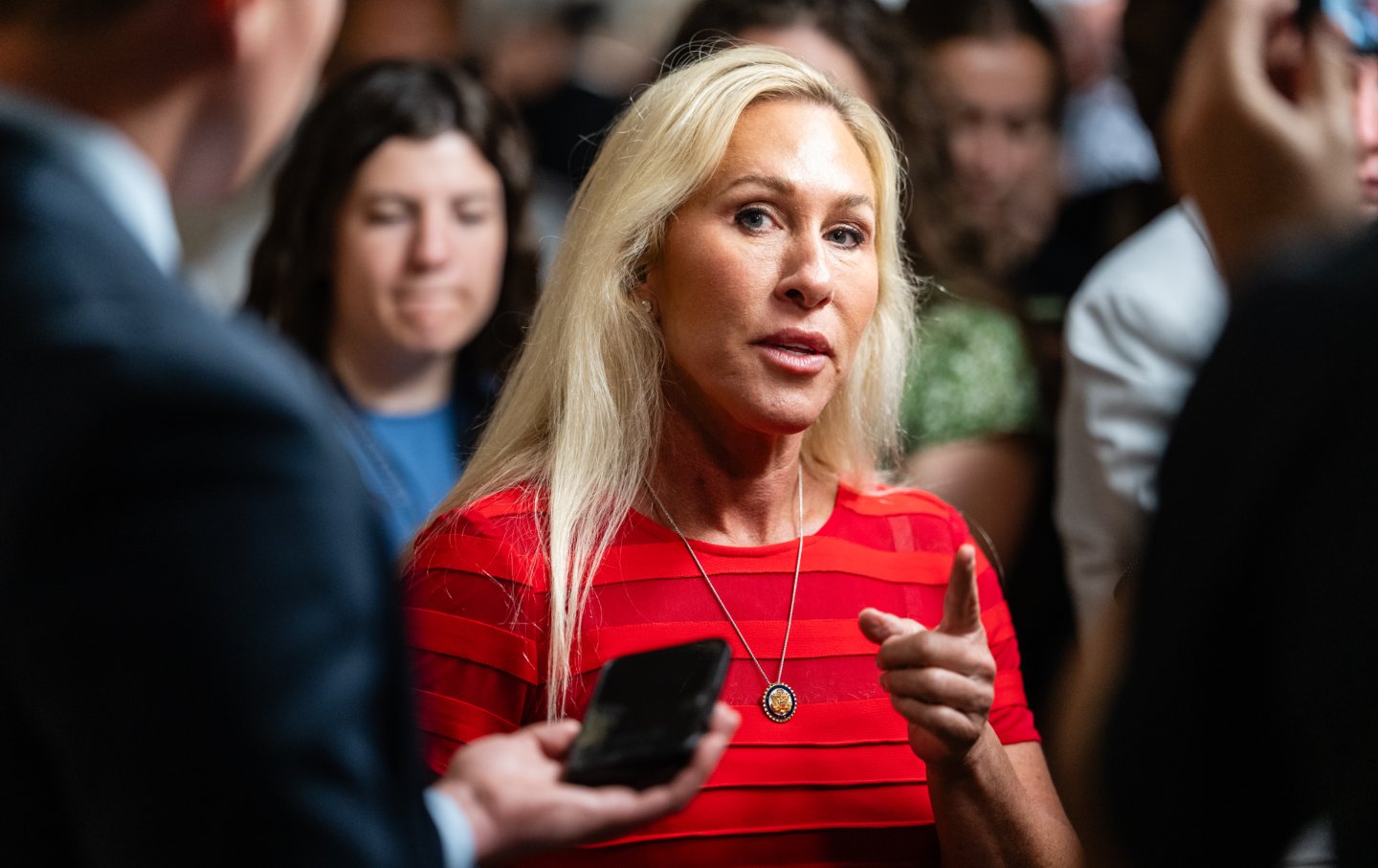
Representative Marjorie Taylor Greene talks with reporters in the Capitol on April 8, 2025.
(Tom Williams / CQ-Roll Call, Inc via Getty Images)Earlier this month on The View, Marjorie Taylor Greene said something that progressives might once have found astonishing: that “the Republican Party has a woman problem.” It’s part of her rebranding as an advocate of women, following her recent split from Donald Trump. The former MAGA loyalist, who recently resigned from the House of Representatives, joined Republican Tom Massie and Democrat Ro Khanna in a high-profile campaign to force the Department of Justice to release its files on Jeffrey Epstein. On November 19, both the House and Senate passed the Epstein Files Transparency Act, which mandated that “all unclassified records, documents, communications, and investigative material” be released to the public.
Greene hasn’t stopped there. In December, she proposed inviting Epstein’s victims to the Oval Office, something Trump refuses to do. The files, she laments, represent “everything wrong with Washington.” And as a woman, she considers it particularly personal. “Greene herself had never been sexually abused, but she knew women who had,” wrote The New York Times’ Robert Draper, after he conducted two lengthy interviews with her. “In her own small way…she could understand what it was like for a woman to stand up to a powerful man.”
Related Articles
In those same interviews, Greene cited Trump’s handling of the Epstein case, and his bullying of female members of Congress, as emblematic of “why women overwhelmingly don’t vote Republican.” She added that “there’s a very big message here.”
But how sincere is Greene’s newfound concern for the rights and experiences of women? If she really believes that “how women in leadership present themselves sends a message to younger women”—including her own two daughters—why does she continue to support policies that tell young women they should live without bodily autonomy? While her advocacy for Epstein’s victims is inspiring, she has failed to defend sexual assault survivors when their alleged assailants were prominent Republicans. In June 2024, more than a year after a New York jury found that Trump had sexually assaulted writer E. Jean Carroll, Greene compared him to Jesus Christ. When Dr. Christine Blasey Ford recounted, in horrifying detail, how Trump’s Supreme Court nominee Brett Kavanaugh pinned her to a bed, Greene didn’t speak up for her. Pete Hegseth, Trump’s secretary of war, has been credibly accused of sexually assaulting a woman in a hotel room in 2017. According to a 22-page report by the Monterey Police Department, he allegedly “block[ed] the door with his body” in order to prevent the woman he assaulted from fleeing. But when Hegseth was confirmed, Greene declared—without irony—that “every American is safer with [Hegseth] leading.” In December 2024, the House Ethics Committee found “substantial evidence” that former Republican representative Matt Gaetz engaged in “sexual activity” with a minor, including the possibility of “statutory rape.” Greene responded on X that she “has proudly defended Matt Gaetz from the beginning,” and that “he has done nothing wrong.”
If Greene hasn’t consistently defended women’s right to protect their bodies from predatory men, she also hasn’t defended their right to protect their bodies from the state. When Roe v. Wade was overturned in June 2022, she tweeted that it was a “great victory for God and the unborn.” A few months later, in a heated discussion with a Democratic voter, she remarked sarcastically that she “appreciates your interest in women’s rights, but killing an unborn baby is not a woman’s right.”
She proudly supported the law passed by Texas legislators in 2021 to criminalize abortion once the fetus has a heartbeat, which can appear after five to six weeks, when most women don’t know they are even pregnant. The “Heartbeat Protection Act” has since been replicated in more than 10 other states. The consequences of this law can be fatal. In 2021, Josseli Barnica, a Texas mother pregnant with her second child, experienced a high-risk delivery. The medical professionals at HCA Houston Healthcare Northwest would have normally acted to speed up the birth and prevent an infection in the uterus. But because of the Heartbeat Protection Act, doing so could have been a crime. Until the heartbeat of the fetus was undetectable, the doctors couldn’t do anything. Barnica died three days later from sepsis. Experts who reviewed a timeline of her treatment created by ProPublica concluded that there was a “good chance she would have survived” if the law had allowed doctors to intervene.
This is not the only such story. In 2022, Georgia resident Amber Nicole Thurman needed a procedure to expel the remnants of fetal tissue from her uterus, according to ProPublica. Because of Georgia’s Heartbeat Protection Act, any physician who performed this surgery would have risked jail. After 20 hours of her lying in a hospital bed waiting for surgery, Thurman’s organs failed. According to an official state committee composed of 10 doctors, she died a “preventable” death. She was 28. This evidence did not move Greene, however. She tweeted that Kamala Harris was “lying to women” about Thurman’s death, claiming that she “died from taking abortion pills!”
Greene’s recent criticism of the way Donald Trump’s Republican Party treats women is a step toward making amends for her sycophantic past. But her efforts are shallow. The GOP’s problem with women stems from far more than Trump’s sexist comments and his allies’ misdeeds. It is bound up with his party’s policies, which deny women the most basic right: bodily autonomy. Until Greene challenges those policies, her self-perception as an advocate for women’s rights will remain undeserved.