
Why Did Indiana University Axe Its Award-Winning Print Newspaper?
If the administration can censor the Indiana Daily Student—one of the most acclaimed student publications in the nation—then student journalism everywhere is at risk.
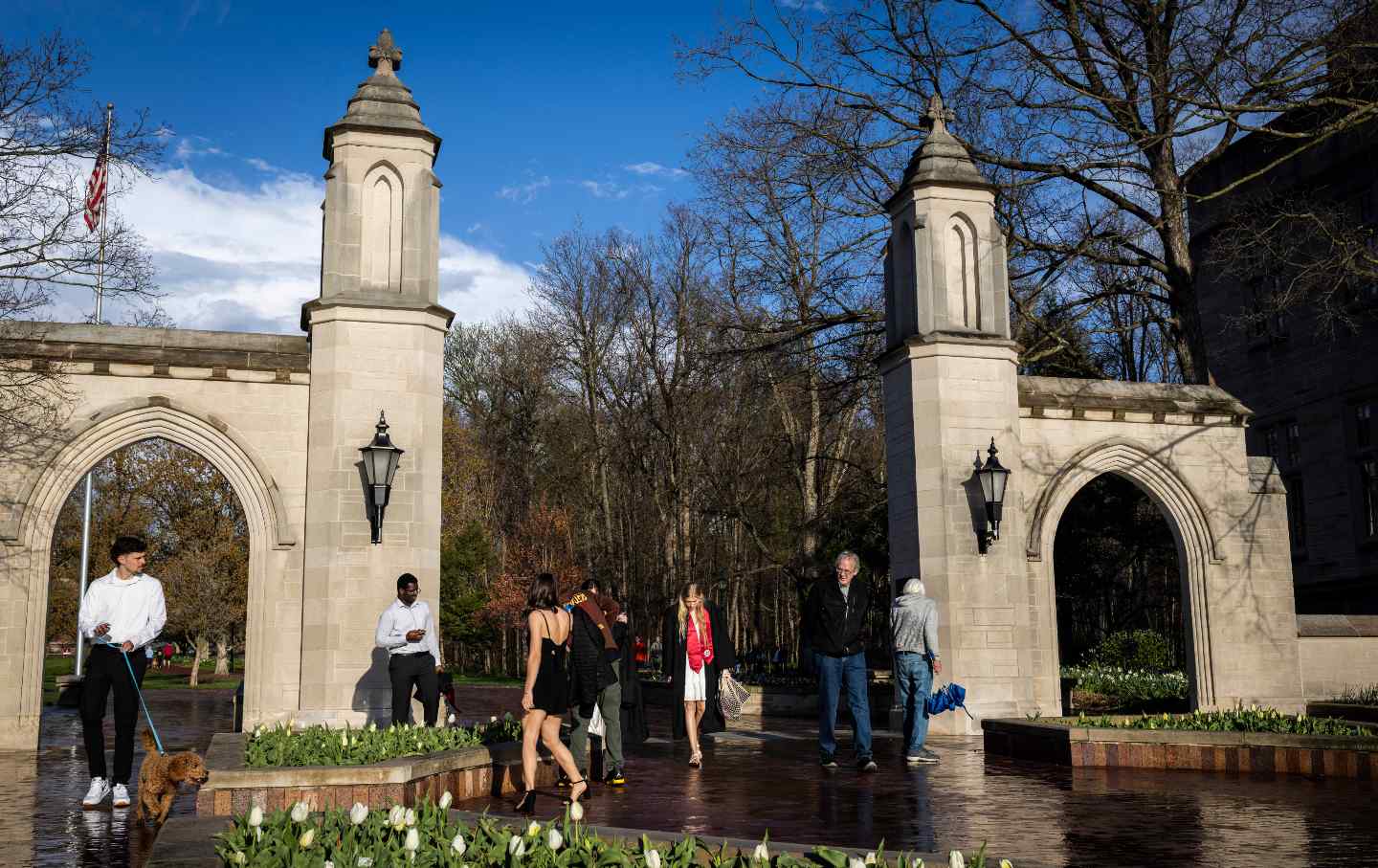
Pedestrians on the campus of Indiana University–Bloomington in Bloomington, Indiana.
(Chet Strange / Getty)
On street corners across Bloomington, Indiana, newspaper boxes sit empty. Nearly two weeks ago, on October 14, Indiana University cut the award-winning print version of the Indiana Daily Student—just hours after firing the paper’s adviser—ending 158 years of print journalism two days before the next edition was set to publish.
These decisions came after weeks of discussions with IDS adviser and student media director Jim Rodenbush, during which Media School administrators told him that they expected the IDS’s printed newspapers to refrain from reporting any news.
The IDS editors in chief called it censorship. The Student Press Law Center and the Foundation for Institutional Rights and Expression have agreed. Mike Hiestand, senior legal counsel at the Student Press Law Center, told ABC News it was a “bizarre” decision from the university: “This is coming out of a place that absolutely should know better,” Hiestand said.
I work on the news desk at the IDS as the climate beat reporter (as a student fellow for The Nation, I’m writing this as an independent reporter and not on the IDS’s behalf). This isn’t the first time IU has cut the paper’s print edition. In 2024, the Media School put together a plan they said would solve the paper’s ongoing financial problems, which have put the paper at a deficit since 2021. The Media School’s plan, released in October 2024 without final input from journalism faculty or student editors, eliminated the weekly print edition of the IDS. Instead the paper would print just its special editions, which typically run regular content alongside a sleeve of articles following a theme on campus life and events, such as the university visitor’s guide or the housing and living guide.
Students continued printing those special editions in the spring. But in the fall semester, Rodenbush said that he learned the university provost was frustrated about seeing newspapers in the stands. Those concerns accelerated after that semester’s second edition, which featured a front-page story covering local Labor Day protests against Trump and IU.
Rodenbush said administrators told him they wanted the IDS to publish special editions containing no news, only content following the special themes on university life: the upcoming homecoming guide, for example, was to contain only information about the university’s homecoming. An assistant dean at the Media School asked in a September 25 meeting: “How do we frame that, you know, in a way that’s not seen as censorship?”
In meetings spaced over several weeks, Jim Rodenbush said he repeatedly told Media School administrators that under the First Amendment and the IDS’s charter, which established editorial freedom, he couldn’t tell students what to publish in the paper. “If I had done that, I would have failed my journalism education, the mentors that I’ve had along the way, and like, at this point, the literally thousands of students that I’ve had over my years,” Rodenbush said.
On October 14, after both Rodenbush and IDS co–editors in chief Andrew Miller and Mia Hilkowitz argued that restricting the content in the print edition to a theme on campus life would amount to censorship, the Media School fired Rodenbush effective immediately. They completely eliminated the IDS’s print edition, including the special editions, a few hours later. IU did not respond to a request for comment.
Chancellor David Reingold told NBC that IU was committed to the paper’s editorial independence. He said cutting the IDS’s print edition was a business decision: The IDS has run on a financial deficit since 2021, and IU has forgiven nearly a million in debt. In 2024, the Media School planned to keep the special editions for their “high revenue.” But Reingold said that cutting print entirely would further address the paper’s financial deficit.
The three print editions this year have run almost $11,000 in profit, according to the IDS’s editors. An online copy of the unprinted October 16 paper—shared to Instagram with the caption “The paper you weren’t supposed to see”—lists the lost ad revenue on large black squares where the advertisements would have been.
Rodenbush said the paper was already following the financial plans laid out by the Media School in 2024. “We were following that business decision,” Rodenbush said. “We were continuing to publish special sections, and they were continuing to be revenue generators, so the business part of that had already been taken care of.”
In an interview for Indiana Public Media’s Noon Edition, IDS co–editor in chief Mia Hilkowitz said that the Media School’s actions weren’t really about print: “They can argue all they want this is a business decision, but this is really about content,” Hilkowitz said.
According to reporting by IndyStar, IU administrators had previously obstructed Rodenbush from using over $400,000 from the paper’s donation fund, more than the newspaper’s current deficit. A lot of that money came from Mark Cuban, IU’s richest alum, who responded to the print edition’s being cut on Wednesday. “Not happy,” Cuban posted to X: “Censorship isn’t the way.”
IU was recently ranked the nation’s third-worst college for free speech by the Foundation for Institutional Rights and Expression, and in May, a judge issued a preliminary injunction blocking a campus policy restricting “expressive activity” between 11 pm and 6 am, on the grounds that it may have violated the First Amendment.
Rodenbush said he doesn’t know why the Media School made the call to cut news from the IDS’s print edition, but he wonders if IU felt pressured to keep negative news off campus in order to avoid attention at the state level.
In November 2024, after the IDS published a front page featuring an illustration of then-President-elect Donald Trump surrounded by critical quotes from former political allies, Indiana Lieutenant Governor Micah Beckwith criticized the cover on X. “This type of elitist leftist propaganda needs to stop or we will be happy to stop it for them,” Beckwith wrote.
State and local media outlets have noticed that IU leadership appears to avoid engaging with the press. As the state legislature recently passed laws reducing faculty’s role in major decisions, closing university degree programs, and enabling the state governor to fire and replace university trustees, WFYI Indianapolis reported that the IU administration kept quiet.
Popular
“swipe left below to view more authors”Swipe →Meanwhile, WFYI reporters found that the Board of Trustees has repeatedly made important votes suddenly and with little transparency, including the choice to reelect controversial IU President Pamela Whitten. Amid allegations that Whitten plagiarized her dissertation, IU announced that it had commissioned an independent review that found the allegations to be without merit. But in September, the IDS reported that IU had refused to release further information or details from that review, including identifying the law firm that completed the report.
Former trustee Vivian Winston, who was removed from the board by Governor Mike Braun in May, has been vocal with her concerns about administrative transparency and accountability. Winston publicly criticized Whitten in the months leading up to her removal, and the IDS reported that she told attendees at a Bloomington Press Club meeting she’d seen changes at IU install a “culture of fear.”
IU’s decision to eliminate the IDS’s print edition falls in with a larger trend. Student journalists have increasingly seen federal policies or attitudes towards the free press mirrored at the local level, where they have acute consequences for college papers and reporters. Earlier this year, IU’s in-state rival Purdue University cut ties with its student paper, citing “institutional neutrality.” Similar changes have been happening across the country: More than half of student news outlets receive funding from their universities, but a rising number of universities have been slashing that support.
Rodenbush said that if censorship can happen at the IDS, one of the most acclaimed student newspapers in the nation, that spells bad news for student journalism everywhere. “This should be a warning that all bets are off in terms of overreach and oversight of a university,” Rodenbush said. “I think it’s one where everyone should be paying attention.”
Become a Sustaining Donor This September
Between the reemergence of right-wing red-baiting and Donald Trump’s use of the chilling National Security Presidential Memorandum–7 to criminalize left political organizing, we’re seeing McCarthyism reborn before our eyes.
This assault on democracy cannot be ignored or wished away. Resisting it requires bravery in the face of threats and repression, a steadfast commitment to the truth, and the unwavering belief that we can—and will—overcome this darkness.
We must have an independent media that sets the record straight, unearths corruption and abuses of power, and advances a politics of justice and dignity for all if we’re to win this fight.
That’s why I’m writing to you today. This September, The Nation needs to add 100 monthly donors to sustain our progressive journalism. Your contribution makes the next investigative report, the next truth-speaking column, and the next pathbreaking essay all possible.
I hope you’ll support our work with a recurring donation today. If you donate $10 or more a month, we’ll send you a brand new “Hands Off the Free Press!” sticker to recognise your commitment to our cause. Please, donate today.
Onward,
Katrina vanden Heuvel
Editor and Publisher, The Nation
More from The Nation
What’s the Matter With Effective Altruism? What’s the Matter With Effective Altruism?
President Trump has decried the techbro creed for indulging in AI doomerism, but its excesses are far worse than that.
As Morale Sags, More Military Service Members Are Having a Crisis of Conscience As Morale Sags, More Military Service Members Are Having a Crisis of Conscience
According to multiple GI rights organizations, service members are inquiring in unprecedented numbers about seeking conscientious objector status.
What Remains of Riis? What Remains of Riis?
A new members’ club has revived Riis Park’s long-vacant bathhouse, reopening old questions about whom the People’s Beach is really for.
When Texas Sex Ed Falls Short, Gen Z Women Turn to Social Media When Texas Sex Ed Falls Short, Gen Z Women Turn to Social Media
A 2025 study found that 70 percent of adolescents sought reproductive health information through social media platforms.
Justice for Macklemore Justice for Macklemore
The rapper has been dumped from Ed Sheeran’s tour for saying “free Palestine.” That’s a disgrace.
We Are Living Under Roy Cohnian Logic We Are Living Under Roy Cohnian Logic
The political fixer created a career for himself as a self-promoting, ubiquitous hustler. Like Trump, he got away with it by having the right friends.

