
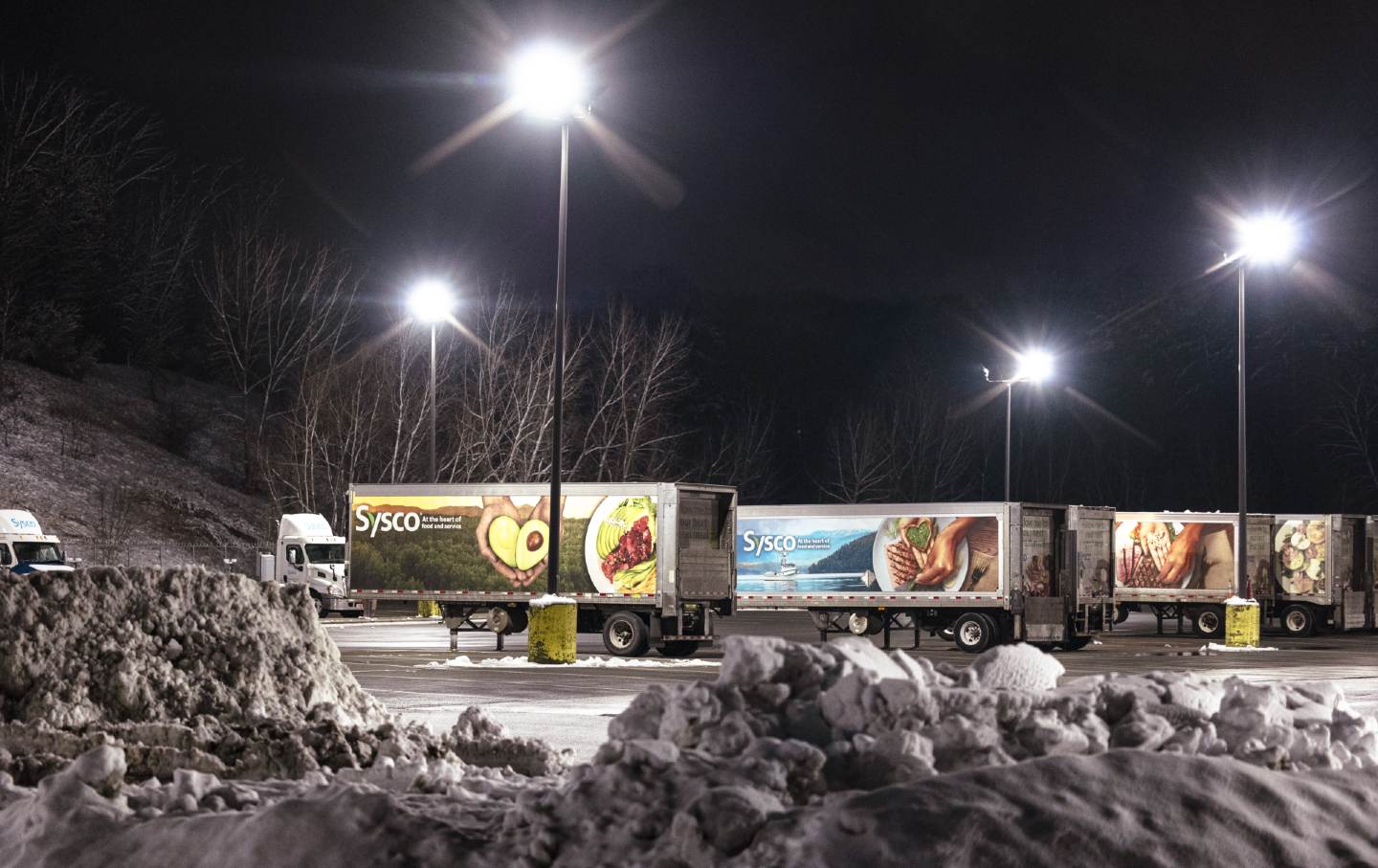
Tonight’s Dinner Fell Off the Sysco Truck
Sysco’s market dominance means that something essential is being lost. As local businesses fade away, a sense of a distinct regional and local identity disappears with them.
One of my favorite restaurants is Milk & Honey in Harlan, Iowa, a small town in the western part of the state. The restaurant is run by Ellen Walsh-Rosmann, who is also a farmer and a mother. Milk & Honey has a delicious homemade strawberry jam that’s way better than the normal mediocre corn syrup-based jam packets served at most diners. Their skillets include chorizo made from pork raised on Ellen’s farm. It’s one of the best breakfasts I’ve had, and on top of it, it’s basically the same price as a McDonald’s breakfast meal. Quality and price can go hand in hand when done locally.
But places like Milk & Honey are fighting an uphill battle. Mirroring broader trends in the American economy, the largest chains are even consolidating their hold on the restaurant industry. In 2023, the largest ten chains represented 44 percent of all Top 500 chain restaurant sales. It’s why every interstate exit increasingly seems to offer the same options.
There’s even been consolidation among owners of chains. A large number of food options in and around American malls trace back to one private equity firm named for the main character in Ayn Rand’s novel The Fountainhead. The group, which is based in Atlanta, owns stakes in Arby’s, Auntie Anne’s, Baskin-Robbins, Buffalo Wild Wings, Carvel, Cinnabon, Carl’s Jr., Culver’s, Dave’s Hot Chicken, Dunkin’, Hardee’s, Jamba, Jim ‘N Nick’s Bar-B-Q, Jimmy John’s, McAlister’s Deli, Miller’s Ale House, Moe’s Southwest Grill, Nothing Bundt Cakes, Schlotzsky’s, Seattle’s Best International, SONIC Drive-In, and Subway.
Meanwhile, the number of local restaurants, especially full-service sit-down restaurants, are becoming proportionately less common in America. The irony is that many of the chains play into our desire for local with family restaurant aesthetics and slogans like “Eatin’ Good in the Neighborhood” and “When You’re Here, You’re Family.”
The Covid pandemic accelerated this trend. With restaurants closed for prolonged periods and hemorrhaging money, Congress passed the Restaurant Revitalization Fund with the goal of offsetting some of their losses. Senator Chuck Schumer, the New York Democrat and party leader, referred to this $28.6 billion as “a down payment” and “that the fund would be replenished as needed.”
But for many restaurants, that support never came, because a far greater number of place applied for assistance than could be supported with available funds. The Senate couldn’t muster the votes to replenish the fund. The Washington Post estimated that 70,300 establishments had closed as of June 2022. Numerous news stories documented many local restaurants whose applications the government rejected while noting numerous chains that received millions.
There are a lot of reasons why the restaurant industry has consolidated so much, and it’s not fair to pin the blame on Sysco alone. But massive consolidation by one company in a sector pushes others to consolidate as a “get big or get out” mentality takes hold. That’s what happened to the broadline distributor my mom used. It got swallowed up by a broadliner attempting to keep up with Sysco.
In face of this consolidation, Sysco has been growing at a steady clip, gaining more and more market share because of its acquisitions. As the pie has shrunk, Sysco is getting a bigger piece of it. Sysco, through its subsidiary, SYGMA, is one of the largest chain distributors in the country. It supplies massive chains like Wendy’s, Arby’s, and Olive Garden to name a few, as well as chains owned by the Coffee Barons like Panera Bread.
But even much of the food being served at local restaurants is from Sysco. It’s why you hear the phrase “tonight’s dinner fell off the Sysco truck.” For local restaurants, relying on Sysco is often necessary to compete against the big boys. Restaurateurs have repeatedly told me that Sysco has the lowest prices for the ”center of the plate,” which is industry speak for meat or fish, the centerpiece of most meals. These low prices function as a sort of loss leader to get customers in the door. And in an ironic twist of baron fighting baron, Sysco has been engaged in lawsuits with various meatpackers, including the Slaughter Barons, over allegations of price gouging.
That phrase—“tonight’s dinner fell off the Sysco truck”—also implies a low-quality meal. In the food world, Sysco is universally known for being cheap, but also for having the lowest quality. As one chef remarked, “When I see a Sysco truck delivering to a restaurant, I assume that they’re not trying very hard to be any good.”
The Milkweed reported that one Pennsylvania diner noticed that the burger patties it bought from Sysco weren’t frying the same on the grill. When the owner looked closely at the label, he discovered that the patties contained soy protein as a filler. Sysco sells the cheapest option possible, which naturally means a downward spiral for quality.
I see the poor quality in Sysco bagels, which my college provided as a breakfast option. Those things were like hockey pucks, and I swear I saw more end up in the trash can than actually being eaten. I wouldn’t learn until years later, on my first trip to New York City, how chewy and fluffy a good bagel could be.
This race to the bottom is best seen in seafood. An investigation by the St. Petersburg Times found that the company was selling mislabeled fish (grouper in this instance). Meanwhile, the Associated Press reported that the company sold shrimp from India processed in grueling labor conditions. Recent media investigations have also noted the use of forced North Korean and Uyghur-region labor in processing seafood sold by Sysco.
Sysco is also lobbying to expand industrial fishing in the United States, which is analogous to the production models used by the Hog Barons and the Dairy Barons. In 2023, the company was even found to be distributing products from a factory under investigation for potential child labor violations. The company does not generally audit its US suppliers. Like the Berry Barons, its ignorance to abuses is one of its selling points.
Sysco’s international distribution system does not favor fresh or local food. The company prefers to work with companies like the Berry Barons because they engineer their berries for durability and can produce enough volume to supply Sysco warehouses across the country. Sysco would rather not deal with a different berry supplier for each of its warehouses, even if the supplier can produce a better-tasting local option. That explains why there’s not usually any crab from Maryland in dishes sold as “Maryland Crab Cakes.”
Popular
“swipe left below to view more authors”Swipe →This low-quality reputation is far from the original company that John Baugh built. In fact, quality was one of his key principles. Back before frozen food became common, he worked to overcome the standard view at the time that frozen food was of lower quality. He even did demonstrations for customers so they could compare and see the difference. He also worked hard to make sure he had the best of a crop.
But his zealousness for frozen food was taken too far. There’s a difference between frozen ingredients and pre-made meals. As far back as 2000, The Wall Street Journal reported that Sysco sold pre-made frozen appetizers that were assembled in Mexico. It might be cheaper for a local restaurant to serve a jalapeño popper made offshore (or nearshore in this case) than it is to stuff one in the kitchen, but some degree of quality is sacrificed.
With Sysco’s dominance driving food procurement decisions, you see how a lot of restaurant food quickly starts to taste the same. It is why home fries are the same at every breakfast place in town. They’re likely serving the same Sysco frozen bag. The only difference is often how long they cook the potatoes.
This conformity turns every independent diner into an off-brand Denny’s. None of the food is bad. None of it is amazing. It’s all just OK. But this interchangeability undermines local restaurants the most. It means that their specialness is gone. This phenomenon is especially bad in nonurban areas where Sysco’s dominance is greatest.
A common theme in concentrated industries is that innovation and quality declines. As one restaurateur told me, “Sysco is like Walmart with its poor customer service and cheap, low-quality food.” But given how concentrated the marketplace is, it’s hard to fault local restaurants for relying on Sysco. These spots are running uphill against the largest chains, which can lock in lower prices from suppliers and leverage preferential treatment from landlords. Against this backdrop, Sysco is often the only option for a local restaurant trying to stay afloat.
Ellen Walsh-Rosman, the owner of Milk & Honey, tried to circumvent the company by creating her own small distribution company. She realized that it was the only way for family farmers like her to get market access to restaurants in Omaha and Des Moines. But she will be the first to tell you that she wouldn’t do it again knowing what she knows now and the money her family lost on the endeavor. In Sysco’s early years, a city like Chicago would have around 300 suppliers for restaurants. But that robust marketplace is long gone.
Sysco’s dominance means that something essential is being lost. As local businesses fade away, a sense of a distinct regional and local identity disappears with them. The breakfast menu at a diner in northern Maine looks the same as one in the Texas Panhandle. As independent restaurants disappear in record numbers, we’re losing a core part of our culture.
Disobey authoritarians, support The Nation
Over the past year you’ve read Nation writers like Elie Mystal, Kaveh Akbar, John Nichols, Joan Walsh, Bryce Covert, Dave Zirin, Jeet Heer, Michael T. Klare, Katha Pollitt, Amy Littlefield, Gregg Gonsalves, and Sasha Abramsky take on the Trump family’s corruption, set the record straight about Robert F. Kennedy Jr.’s catastrophic Make America Healthy Again movement, survey the fallout and human cost of the DOGE wrecking ball, anticipate the Supreme Court’s dangerous antidemocratic rulings, and amplify successful tactics of resistance on the streets and in Congress.
We publish these stories because when members of our communities are being abducted, household debt is climbing, and AI data centers are causing water and electricity shortages, we have a duty as journalists to do all we can to inform the public.
In 2026, our aim is to do more than ever before—but we need your support to make that happen.
Through December 31, a generous donor will match all donations up to $75,000. That means that your contribution will be doubled, dollar for dollar. If we hit the full match, we’ll be starting 2026 with $150,000 to invest in the stories that impact real people’s lives—the kinds of stories that billionaire-owned, corporate-backed outlets aren’t covering.
With your support, our team will publish major stories that the president and his allies won’t want you to read. We’ll cover the emerging military-tech industrial complex and matters of war, peace, and surveillance, as well as the affordability crisis, hunger, housing, healthcare, the environment, attacks on reproductive rights, and much more. At the same time, we’ll imagine alternatives to Trumpian rule and uplift efforts to create a better world, here and now.
While your gift has twice the impact, I’m asking you to support The Nation with a donation today. You’ll empower the journalists, editors, and fact-checkers best equipped to hold this authoritarian administration to account.
I hope you won’t miss this moment—donate to The Nation today.
Onward,
Katrina vanden Heuvel
Editor and publisher, The Nation
More from The Nation

In Memoriam: Beautiful Writers, Influential Editors, Committed Activists In Memoriam: Beautiful Writers, Influential Editors, Committed Activists
A tribute to Nation family we lost this year—from Jules Feiffer to Joshua Clover, Elizabeth Pochoda, Bill Moyers, and Peter and Cora Weiss

Trump’s Anti-DEI Crusade Is Going to Hit White Men, Too Trump’s Anti-DEI Crusade Is Going to Hit White Men, Too
Under the Trump administration’s anti-DEI directives, colleges would be forced to abandon gender balancing, disadvantaging men.
Why We Need Kin: A Conversation With Sophie Lucido Johnson Why We Need Kin: A Conversation With Sophie Lucido Johnson
The author and cartoonist explains why we should dismantle the nuclear family and build something bigger.
Bari Weiss’s Counter-Journalistic Crusade Targets “60 Minutes” Bari Weiss’s Counter-Journalistic Crusade Targets “60 Minutes”
The new editor in chief at CBS News has shown she’s not merely stupendously unqualified—she’s ideologically opposed to the practice of good journalism.

The Remaking of Trump’s Washington, DC The Remaking of Trump’s Washington, DC
The ballroom and his other proposed building projects are many things, but they are not exactly works of architecture.

Are Cell Phones to Blame for the Youth Loneliness Epidemic? Are Cell Phones to Blame for the Youth Loneliness Epidemic?
David Landes argues that cell phones represent an isolated life whereas Kimberly Hassel blames the loneliness crisis on a society unable to support or protect its youth.

