“We Deserve Life”: Students Speak Out From Gaza
Hours once used to write essays or prepare for exams are now spent waiting in line for food and water. But many students still cling to their books and laptops.
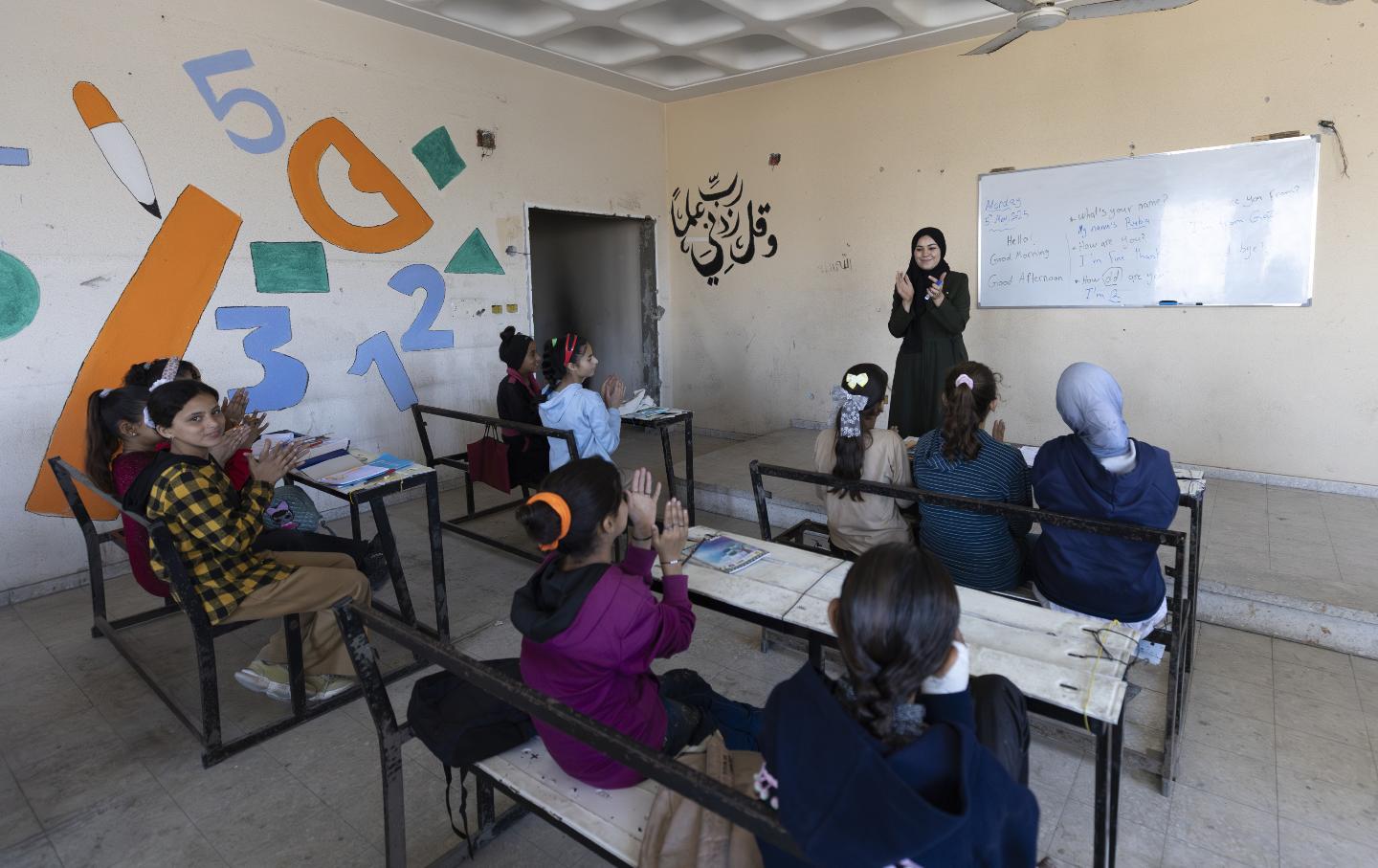
Displaced Palestinian teacher Dina Ukkashi gives courses in the damaged halls of the Islamic University in Gaza Strip in May 2025.
(Mahmoud Abu Hamda / Getty)
At dawn in southern Gaza, Hasan Barghouth wakes to the call of the muezzin. He steps out of the tent where his family lives and makes his way past rows of plastic shelters to the shade of an olive tree, where he has set up a wooden desk. The ground crawls with insects, but here he escapes the mess of daily tent life. He brings a laptop wired to a solar panel, with no battery. “Something only people in Gaza know how to do,” he says. Before the heat of the sun becomes unbearable, Hasan works through his lessons.
As of May 2025, UN agencies estimate that at least 95 percent of Gaza’s schools are incapacitated or destroyed. UN experts report that more than 5,400 students, 261 teachers, and 95 university professors have been killed, with the numbers rising daily. Higher education has been, in the words of France24, “wiped off the map” as all 12 of the city’s universities lie in ruins. More than a decade ago, the Palestinian scholar Karma Nabulsi coined the word scholasticide to describe the deliberate dismantling of the institutions, people, and processes that make education possible. Today, Gaza is the most complete manifestation of the term.
Hasan should be preparing for the Tawjihi, a high-stakes exam that determines college placement across Palestine, but the war has postponed the test indefinitely. Though versions of the Tawjihi are still administered outside the strip, high schooler Anas AlSous, like tens of thousands of other students, has not been able to take the exam. According to OCHA, more than 76,000 students have missed the test across two academic years, and UNICEF reports that nearly 40,000 students in Gaza missed it in 2024 alone. A small online session this year reached about 1,500 candidates.
Gaza’s shortages are too familiar: electricity, water, food, and, critically for students, Internet access. Many walk miles to find a signal to download lectures and join lessons, gathering in online networks of students trying to preserve a sense of high-school community. Notebooks are so hard to come by that some students solve their math problems on the backs of flyers. Many of Hasan’s peers have given up on their lessons, instead spending their days in the search for food. “They drop their pens,” he said, “to either eat or get shot.”
The right to education is guaranteed under human rights treaties like the ICESCR and the Convention on the Rights of the Child. Article 50 of the Fourth Geneva Convention also obliges an occupying power to facilitate the proper working of all institutions devoted to the care and education of children. But Israel rejects both, claiming that only the narrower framework of humanitarian law governing active hostilities applies in Gaza, recasting the systematic dismantling of Gaza’s education system as collateral damage of war. Even under humanitarian law, Israel is required to distinguish civilians from military targets and to preserve basic civilian infrastructure, yet it has shown no proportionality or restraint in its assault; Sean Carroll, CEO of the American Near East Refugee Aid, has described such targeting as “an attack against the right to education for a whole generation.”
Eighteen-year-old Menna Abu Imara remembers the morning her schooling ended on October 7, 2023. “In a few seconds, everything was paused. The war started, and schools closed their doors,” she said. Within days, her house was bombed, killing her father, uncles, and grandparents. She survived, deeply wounded, alongside her mother and siblings. Menna has not completed 11th or 12th grade. She earned a scholarship abroad but lost it; no one can leave Gaza, and even if she could, she cannot travel alone, as her right arm remains disabled.
“I feel like I am betraying the dead by pretending life goes on, as if the simple act of studying is a kind of lie,” said 18-year-old Yara Nasser, who cowrote the book Gaza, Held in Time with Tareq AlSourani. “How can I scribble down equations when my neighbor’s child was buried yesterday?” she asks. “But to give it up feels like surrender. Like we’re giving up the future.”
Students told us that hours once used to write essays or prepare for exams are now spent waiting in line for food and water. “My ultimate goal of securing admission to a university turned into a mission of survival,” said AlSous.
In weeks of conversations over e-mail and letters, we have heard accounts from dozens of students in Gaza and in exile that are uniformly grim. Yet many continue to pursue their education, apply for scholarships, dream of careers, and imagine futures knowing full well they may never reach them; they understand that to keep studying is to insist on a future the war is trying to deny them.
The word scholasticide captures this double reality: the destruction of classrooms and faculty, but also the theft of opportunity. It is a way of ensuring that Palestinians cannot rebuild, cannot produce professionals, cannot narrate their own story. But even under exhaustion and starvation, students cling to their books and laptops in an assertion that life itself is still possible.
Under an olive tree, Hasan explains why he studies. Why, when food lines eat up much the day, and when the chances of using his lessons are slim, he insists on continuing his education. His answer is brief. “We study,” he says, “not because we have the privilege to dream, but because it’s the only way we can scream that we deserve life.”
Become a Sustaining Donor This September
Between the reemergence of right-wing red-baiting and Donald Trump’s use of the chilling National Security Presidential Memorandum–7 to criminalize left political organizing, we’re seeing McCarthyism reborn before our eyes.
This assault on democracy cannot be ignored or wished away. Resisting it requires bravery in the face of threats and repression, a steadfast commitment to the truth, and the unwavering belief that we can—and will—overcome this darkness.
We must have an independent media that sets the record straight, unearths corruption and abuses of power, and advances a politics of justice and dignity for all if we’re to win this fight.
That’s why I’m writing to you today. This September, The Nation needs to add 100 monthly donors to sustain our progressive journalism. Your contribution makes the next investigative report, the next truth-speaking column, and the next pathbreaking essay all possible.
I hope you’ll support our work with a recurring donation today. If you donate $10 or more a month, we’ll send you a brand new “Hands Off the Free Press!” sticker to recognise your commitment to our cause. Please, donate today.
Onward,
Katrina vanden Heuvel
Editor and Publisher, The Nation