
How Fossil Fuel Mad Men Have Aided and Abetted the Industry’s Climate Denial
But even the ad world isn’t immune to the groundswell of climate organizing.
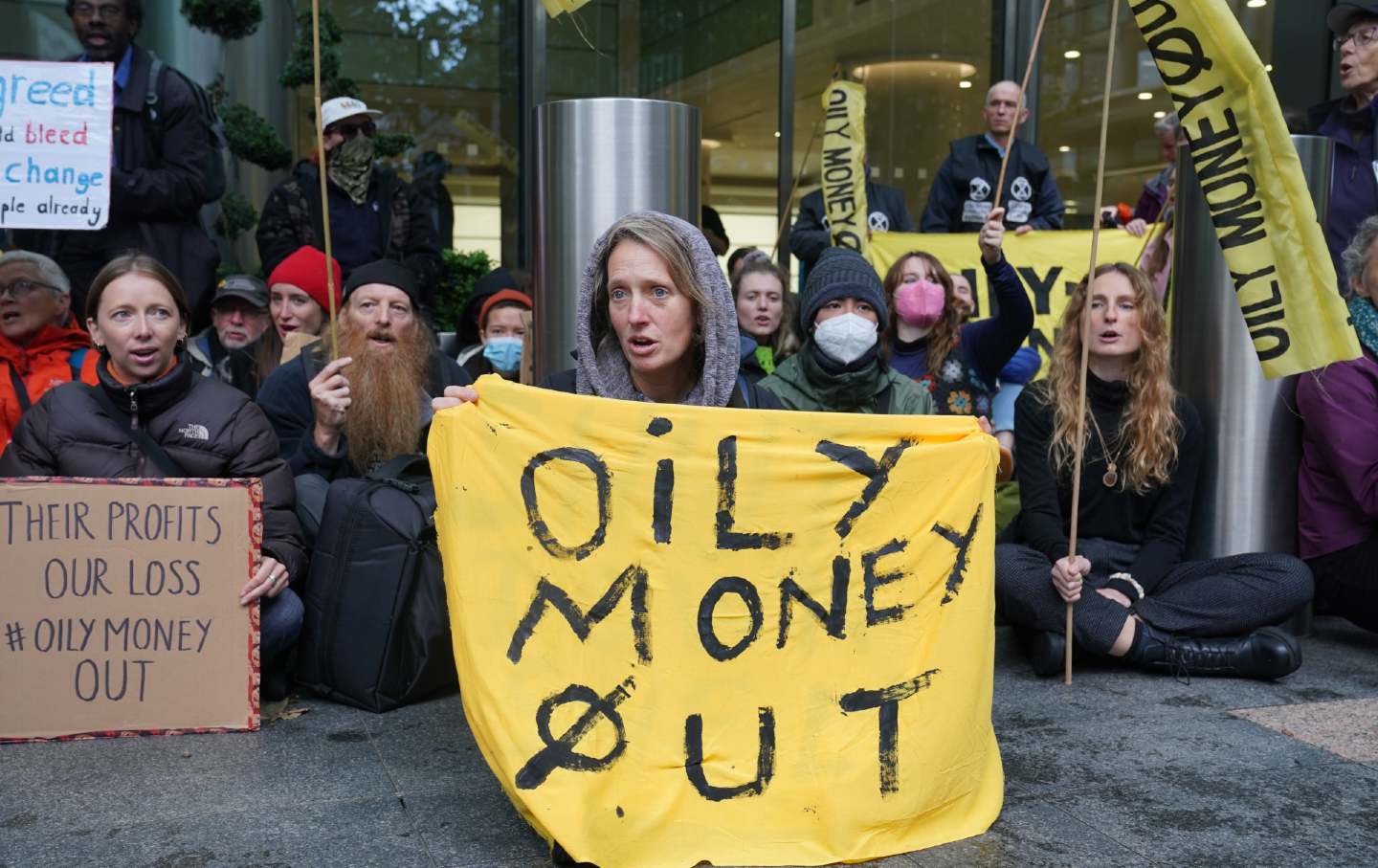
“Mad Men fueling the madness.” Nodding to the hit American TV show, that’s what UN Secretary General António Guterres last year called the advertising agencies that have “aided and abetted” the fossil fuel industry’s climate denial. This May, the UN rapporteur on human rights and climate change went a big step further: Not only should fossil fuel advertising be banned, Elisa Morgara said in a detailed report to the General Assembly, but criminal penalties should be imposed on anyone spreading climate change disinformation. The call to restrict fossil fuel ads have been embraced by almost 50 jurisdictions around the world, including such major cities as The Hague, Edinburgh, Sheffield, and Sydney.
Meanwhile, the fossil fuel Mad Men are also facing pushback within their own ranks, as some of their fellow “creatives” blow the whistle and join with outside activists to confront their industry’s role in helping propel humanity toward a chaotic, deadly breakdown of the climate system. As of June 2025, more than 1,400 advertising agencies around the world have signed the “Clean Creatives” pledge to “decline any future contracts with fossil fuel companies, trade associations, or front groups.”
A climate movement in… advertising? That might seem ironic for an industry whose core purpose is to spur consumption. But like all spheres of society, the world of advertising has not been immune to the groundswell of climate organizing that emerged in the late 2010s, when demonstrations like Fridays for Future took center stage in global social movements.
In a 2019 open letter, the activist network Extinction Rebellion took the industry to task: “You can do anything you want and you can shift mass behavior in a heartbeat. One of the reasons we’ve got here is because you’ve been selling things to people that they don’t need. You are the manipulators and architects of that consumerist frenzy. Imagine what would happen if you devoted those skills to something better.”
“That was really good copy,” said Lucy von Sturmer of the 2019 letter—“good copy” being high praise in the ad industry where von Sturmer used to work. An industry “creative” who volunteered with Extinction Rebellion, von Sturmer ultimately founded Creatives for Climate, which offers “anti-greenwashing” trainings and “climate literacy” workshops for industry workers.
“Advertising plays a massive role in removing the burden of responsibility from corporations,” said Polina Zabrodskaya, who was suspended from her job at the London-based global ad agency AMV.BBDO in 2023 after expressing doubts about the sustainability claims made by one of the firm’s clients, the Mars company. “If you create this illusion that everything is sustainable and everything is environmentally friendly, people are lulled into a false sense of safety. Don’t worry about it. The oceans are fine. Children are going to school. Look, a happy child is running to school in West Africa. Buy chocolate!” said Zabrodskaya, who later left AMV.BBDO and is currently suing the firm for “belief discrimination.”
“Whistleblowers are vital in forcing change within the advertising industry,” said Gabriel Bourdon-Fattal, codirector of Climate Whistleblowers, a Paris-based NGO providing legal and strategic support in Zabrodskaya’s case. “In an industry as opaque and unregulated as this, insiders are stepping up to sound the alarm.”
Clean Creatives, the nonprofit that organized the pledge not to work for fossil fuel companies that has attracted 1,400 signatories, also publishes an “F-list” of agencies that do still work with oil and gas companies. The F-list aims to make it harder for such agencies to hire and retain quality employees, said Duncan Meisel, the executive director of Clean Creatives. “The best [employees] are not going to want to work at the agencies that are fossil fuel branded,” Meisel told The Nation. “If you can’t recruit that talent pool, you don’t have a future as an agency.”
But there are limits to how far an insider, “creative”-focused strategy can really change the industry. For every agency that turns down a contract with the likes of BP or Exxon, there’ll be a firm out there willing to do the dirty work. As the Financial Times has reported, there’s also the risk that the page may already be turning on the push to change the industry from within, as advertising readapts to a political and cultural mood set by the far right. In short, there’s likely no substitute for external, legal restrictions on what can be publicized and where.
An obvious precursor to today’s calls to ban fossil fuel ads are the bans the US government imposed on tobacco advertising—first in 1970, when such ads were banned on TV and radio, and then in 1995, when all tobacco advertising was banned (except for “point of sales” ads—for example, inside retail shops). But activists see relying on today’s Congress or president to limit fossil fuel advertising as a nonstarter. “There’s a lot of existing law that could be really powerful when applied,” said Meisel. “But we don’t pass laws in Congress anymore.”
Headway is being made in Europe, however, where cities such as Sheffield and Edinburgh have restricted public billboard advertising for SUVs and airline travel. Paris has moved to ban screen-projected advertisements in public space. A 2023 ordinance approved in Lyon, France, has likewise moved to restrict the size of publicity screens and billboards in public areas. According to Philippe Guelpa-Bonaro, a vice president at the Lyon metropolitan authority who’s charged with the collectivity’s advertising regulations, the law will limit by up to 64 percent the scope of advertising in the city’s public spaces.
But the most damaging advertising, whether for the environment or an individual’s physical and psychological health, can only be “regulated by national law,” Guelpa-Bonaro said. “We don’t quite have the level of political courage we need in parliament. Maybe that day will come, and we’re working for that, but we must be lucid and acknowledge we’re not there yet.”
That national regulatory push may be in its early steps, though. France’s 2021 Climate and Resilience Law includes a ban on advertisements for gasoline products and fossil fuels. But France’s administrative courts have paused implementation of the rules, citing the vagueness in the legislation’s formulation. A bill currently before French parliament would likewise restrict publicity for “fast fashion” clothing.
And in the Netherlands, a court ruling in April greenlighted a municipal ban on publicity for fossil fuel advertising including combustion-engine cars, airline travel, and cruise ships. Rejecting the usual free speech argument from corporations and lobbyists, the judges accepted the argument for bans on advertisements that could prove detrimental to the health of citizens or the environment. A slate of other Dutch cities, including Utrecht and Nijmegen, have since followed suit.
The Hague’s ordinance is being billed as the world’s first city-level blanket ban, one that’s more important because it goes beyond mere restrictions on advertising for oil and gas companies to confront some of the most carbon-heavy products that they depend on. “If we compare the fossil fuel industry [with] the tobacco industry, then cruise [ship] travel and airplanes are like cigarettes,” a kind of delivery mechanism, said Femke Sleegers, an activist based in The Hague and founder of Reclame Fossielvrij (Fossil-Free Advertizing).
Popular
“swipe left below to view more authors”Swipe →Not surprisingly, pushback from the advertising industry is stiff. Activists in Hamburg, Germany’s second-largest city, failed this May to win the requisite number of signatures to force a citywide referendumto restrict most digital billboards and the size of outdoor advertising slots. The ad firms contracted by the city—JCDecaux and Ströer, a German company—mobilized to kill the initiative, projecting advertisements on their network of billboards showing smiling citizens grateful for the information provided by the advertisers.
“If you put a cash value on the counter-campaign, I think it would have added up to an enormous sum of money spent against us,” said Martin Weise, an activist with Hamburg Werbefrei (Ad-Free Hamburg), the collective behind the referendum initiative. “We, on the other hand, only had a €30,000 budget.”
Industry lobbyists have argued that such fossil fuel ad bans could have unintended consequences, depriving media organizations and localities from a needed revenue stream, even as more and more advertising shifts towards digital spaces not under the purview of local ordinances or national laws and regulations.
“If you make a rule, it needs to apply to everyone,” said Antoine Ganne, Delegate General of the Alliance Des Médias TV et Vidéo, an industry representative and lobbying group. “We can’t just push for rules on television advertising, which is already the most diligent actor on these questions.”
“People are more radical than one might think,” said Camille Aboudaram, a climate campaigner for the French organization Résistance à l’Aggression Publicitaire. She pointed to polls suggesting that over 80 percent of French people are in favor of bans on meat advertising. “People could of course continue to buy what pleases them,” Aboudaram told The Nation. “But they’d be less incited towards certain products.”
“Attempts to do right by the climate often get overwhelmed by the systems we live in and the pressures of everyday life,” said Veronica Wignal of the UK-based group Ad Free Cities. “That’s why advertising bans or restrictions are so powerful—because it’s not directly asking people to change their behaviors. It’s just reducing a behavioral nudge and then making space and clearing the view for wider change in the right direction for the climate.”
Become a Sustaining Donor This September
Between the reemergence of right-wing red-baiting and Donald Trump’s use of the chilling National Security Presidential Memorandum–7 to criminalize left political organizing, we’re seeing McCarthyism reborn before our eyes.
This assault on democracy cannot be ignored or wished away. Resisting it requires bravery in the face of threats and repression, a steadfast commitment to the truth, and the unwavering belief that we can—and will—overcome this darkness.
We must have an independent media that sets the record straight, unearths corruption and abuses of power, and advances a politics of justice and dignity for all if we’re to win this fight.
That’s why I’m writing to you today. This September, The Nation needs to add 100 monthly donors to sustain our progressive journalism. Your contribution makes the next investigative report, the next truth-speaking column, and the next pathbreaking essay all possible.
I hope you’ll support our work with a recurring donation today. If you donate $10 or more a month, we’ll send you a brand new “Hands Off the Free Press!” sticker to recognise your commitment to our cause. Please, donate today.
Onward,
Katrina vanden Heuvel
Editor and Publisher, The Nation
More from The Nation

Big Oil’s Origin Story Big Oil’s Origin Story
Amy Westervelt’s new book, Brought to You By, exposes the deep history of today’s “information pollution.”

Two Years After Helene, North Carolina’s Unsettled Recovery Two Years After Helene, North Carolina’s Unsettled Recovery
The state has become a testing ground under an eviscerated FEMA and a missing-in-action “recovery czar,” Michael Whatley, with big political ambitions.

A Reckoning Comes for Nepal A Reckoning Comes for Nepal
A year after its Gen Z uprising, Nepal faces a struggle not only for democracy and human rights but for climate survival.

How a Creative Mind Lives in Nature How a Creative Mind Lives in Nature
Working in the wilderness could not satiate my intellectual impulses. But for the protagonist of Hothouse Bloom, the binary between mental and physical labor is what calls her.
Is Nepal a Turning Point in Climate Coverage? Is Nepal a Turning Point in Climate Coverage?
Even CBS News and Bari Weiss, who fired the outlet’s entire climate unit, have used Nepal as a watchword for environmental disaster.
How Will Nepal Pay for the Latest Climate Disaster? How Will Nepal Pay for the Latest Climate Disaster?
An interview with Nepali UN climate expert Manjeet Dhakal on what the massive Himalayan flood will cost Nepal.

