From KGB Cells to Alligator Alcatraz: How Authoritarians Normalize the Grotesque
During a recent trip to Tallinn, I visited the horrific manifestations of an unredeemable totalitarian regime. A similar system is unfolding in Trump’s America.
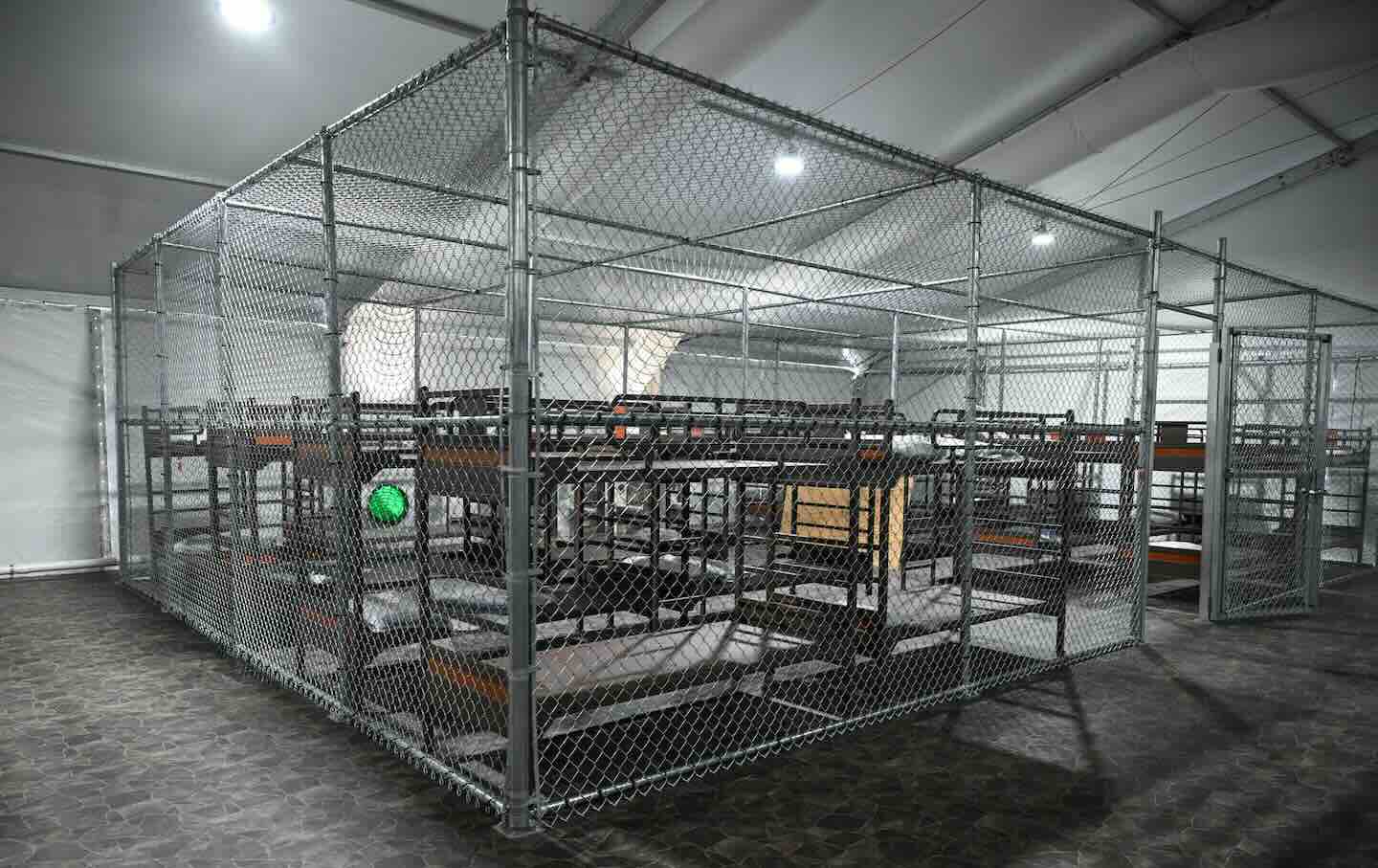
Beds are seen inside a migrant detention center, dubbed “Alligator Alcatraz,” located at the site of the Dade-Collier Training and Transition Airport, as President Donald Trump tours the facility in Ochopee, Florida, on July 1, 2025.
(Andrew Caballero-Reynolds / AFP)Visiting Tallinn, Estonia, last week, I saw old KGB interrogation cells, now converted into a basement museum in the medieval core of the city. They were dingy cells, damp, dark. In corners of the basement were isolation units, essentially small wooden cupboards in which prisoners were left for days on end, unable to lie down, or even to fully stand up.
Dissidents, free thinkers, political leaders, academics, and others who were deemed a danger to the Soviet state were placed into those cells in 1940, in the days after Estonian independence was snuffed out by the infamous pact between the Soviets and Nazi Germany, and again from 1944 onward, when the Soviets recaptured Estonia from the Nazis after a three-year German occupation following the collapse of that pact. Many were tortured in the KGB basement, some executed, others deported to the far corners of the Soviet Union, to places where they didn’t speak the language or know the culture.
The KGB cells in Tallinn are, rightly, viewed as horrific manifestations of an unredeemable totalitarian regime. More broadly, the decades of Soviet rule over Estonia—a reign that ended in 1991, as the USSR imploded—are viewed by the state, now a valued member both of NATO and of the European Union, as a period during which fear dominated, dissent was ruthlessly punished, and humiliation rituals were normalized.
There is on the outskirts of town a memorial wall to many of the victims of Soviet rule: officers killed in Stalin’s purges and ordinary citizens deported to labor camps in the sprawling gulag system. Peepholes drilled into the wall contain photographs of individual victims whose stories were truncated, people who were deemed by the powers that be to be enemies against whom the full might of the security state should be directed, simply for being at the wrong end of brutal, sometimes irrational, historical forces.
In the evenings after walking around Tallinn, I returned to my hotel room in an elegant old building a couple doors down from the Russian embassy. The exterior of the embassy is now lined with banners and posters decrying Putin’s war against Ukraine, with teddy bears and strips of linen that appear to be blood-soaked.
I read the news about the rapid expansion of “Alligator Alcatraz,” a concentration camp in all but name in Southern Florida, built at speed in the mosquito-ridden Everglades swamps, paid for by Florida taxpayers, run by the state of Florida, and now housing somewhere in the region of 1,000 immigrant detainees. These detainees are repeatedly described by Trump’s people as the worst of the worst, degenerate criminals, savages. In fact, analyses of the lists of detainees indicate that two-thirds have absolutely no criminal record, and many who do have a criminal record are simply low-end offenders. Children as young as 15 have been included among the facility’s occupants.
The prisoners are housed in stacked cells, the walls of which are beefed-up chain-link fences. Dozens of people share each of these boxes-cum-cages. Detained people use the toilets in front of all their fellow prisoners. Faucets for drinking water are attached to the toilets. Those housed there receive inadequate supplies of food, are bedeviled by mosquitoes and oppressive heat, and have almost no opportunity to go outside or to shower. Everything about their incarceration is designed to dehumanize, terrorize, and humiliate—and to provide visual props for a White House determined to take America down a stupendously authoritarian road.
Such treatment of immigrant-detainees isn’t limited to Alligator Alcatraz. Last week, The Guardian reported on another facility in Florida, this one run by ICE in Miami, where detainees were handcuffed with their hands behind their backs, then made to kneel and eat their food like dogs. This is the sort of sadism exhibited by guards at the Abu Ghraib detention center in Iraq more than 20 years ago; they’re not too different from torments inflicted by storm troopers in early Nazi Germany and Austria—years before the Holocaust began —when Jews were forced to scrub sidewalks on their hands and knees in front of mocking crowds. In New York City, 26 Federal Plaza is also racking up allegations of abuse and deliberate neglect of migrants’ basic needs. So, too, are other holding facilities dotted around the country and now housing, cumulatively, more than 57,000 immigrant detainees.
The list of what can only be called atrocities in the United States continues.
There’s the 82-year-old Guatemalan man who had been granted political asylum nearly 40 years ago, and who went to his local immigration offices to try to get a replacement for the green card that he had lost. Instead of getting that card, he was secretly deported to Guatemala, without his family even being told what had happened to him.
A month ago, the Supreme Court greenlighted the deportation of immigrants to third countries, even if they are third countries that have an appalling human rights record. Shortly afterward, eight detainees were dumped in South Sudan. More recently, five immigrant detainees were spirited into prisons in the small, landlocked African absolute monarchy of Eswatini.
This week, the administration confirmed that it was deputizing 2,000 National Guard troops from a slew of states to assist ICE in processing the ever-greater number of immigrant detainees. In the near future, the Defense Department is also likely to approve a request that DHS put out in May for more than 20,000 National Guard troops to be used in their anti-immigrant hunts. Thanks to Congress, ICE has received an additional $75 billion in funding to continue kidnapping people and committing the worst kinds of human rights abuses in broad daylight.
Popular
“swipe left below to view more authors”Swipe →The KGB cells and the memorial wall in Tallinn showcase a brutal system that relied on mass deportations, humiliation rituals, and wholesale dehumanization of entire groups to achieve its goals. Today in Trump’s America, a similar spectacle of the grotesque is unfolding. The government hasn’t yet reached a point of mass killings—and hopefully it never will. But it has embraced many other techniques that would have been all too familiar to the political leaders and their bureaucratic security state enforcers in the Soviet Union and in fascist Europe.
One day, there will be museums and memorials to the victims of this degraded moment. There will, I hope, be lists of shame, in which are named the designers and staff members of places like Alligator Alcatraz, the agents who masked up each morning and then kidnapped immigrants and hurried them onto deportation flights, and the political architects and enforcers of the immigration wars.
The officials who ran the KGB cells at Pagari 1, in Tallinn, thought their day would never end. So, too, I suspect, Stephen Miller, Tom Homan, and Kristi Noem cannot imagine a time when their names are held up in infamy. But eventually they will be—of that I have no doubt.
One day, tourists will wander through the cellblocks constructed under this administration and marvel to themselves at the creativity of Trump’s sadism and the moral myopia of those who rallied to his movement.