His Name Was Obeida—and He Died Seeking Food for His Family
Like hundreds of Palestinians, Obeida was killed while waiting for aid distributed by the Gaza Humanitarian Foundation.
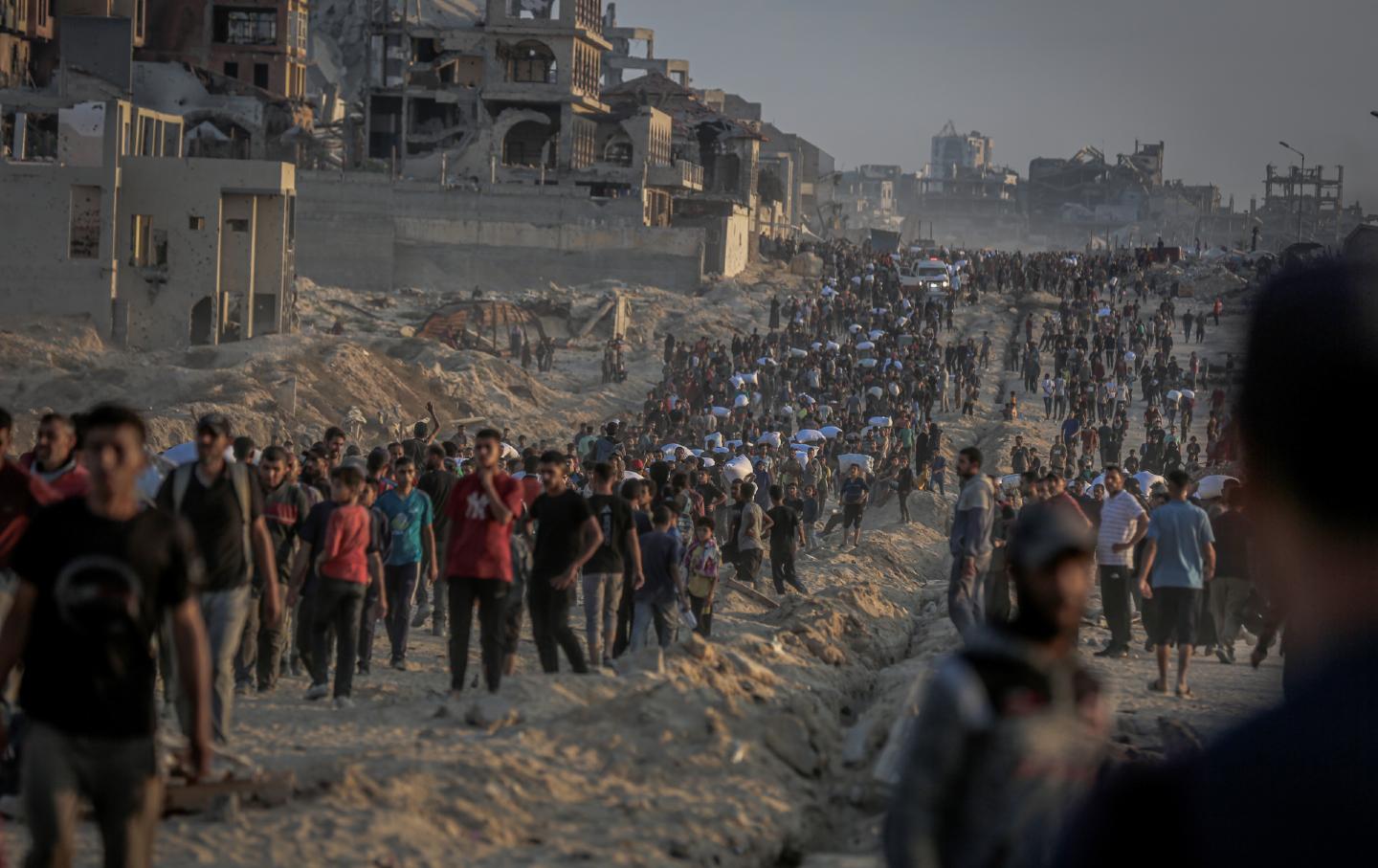
Palestinians flock to the aid center set up by the US and Israeli-created Gaza Humanitarian Foundation on the Coastal Road in the Sudaniya area.
(Saeed M. M. T. Jaras / Anadolu via Getty Images)His name was Obeida. He was 18. He was the eldest son of my wife, Sabah’s sister. She had six children: three sons and three daughters.
Obeida is dead. He was killed in these Hunger Games that Israel is making us play in the real world.
In Gaza, the game consists of asking young people to fetch humanitarian aid, with the risk of being killed if they go too far to the right or to the left, in a space whose limits only the occupier knows.
Obeida was forced to play that game because neither he nor his family had eaten anything for three days. Obeida’s family is from Shuja’iyya, a district in eastern Gaza City. Like most of its inhabitants, they had been forced to move several times, winding up in a tent in a Gaza City schoolyard. Obeida went almost every day to try his luck at a distribution center organized by the Gaza Humanitarian Foundation, the now-infamous US-Israeli food-distribution organization. Each time, he hoped to bring back a bag of flour or a food parcel for his family.
On that particular day, his eldest sister, Bara, who had gotten married a month or two earlier, came to visit her family in their tent. He said to her, “Today, they say there are chickpeas in the packages. I’m going to try to grab some to make you some qdama.” That’s what we call baked or fried chickpeas. He wanted to give them to his sister, who was very fond of them. It was the only gift he could give her on her first visit after her marriage. Traditionally, a visit like this is the occasion for a feast; there are lots of guests, big meals are cooked, the young bride is presented with her favorite dishes. Of course, that’s impossible today in Gaza. Celebrations are reduced to almost nothing. Bara was married hurriedly, in a school classroom where hundreds of displaced people had found shelter.
But Obeida was keen to make his qdama as a symbolic act. And to get a bag of flour, to bake bread for the bride’s return.
So on the evening of June 10, he went to the GHF distribution center. But as he waited, a shell fired from a tank exploded next to him. He was hit in the head by a piece of shrapnel.
He was still conscious as they took him to the hospital. All along the way, a paramedic said, he begged them to ask his mother to forgive him. He knew he was going to die, and he wanted his mother to forgive him for trying his luck. Unfortunately, Gaza hospitals are lacking in everything—medicine, equipment, basic supplies—and they couldn’t save him. His only crime was wanting to feed his family.
Obeida had his whole life ahead of him. He wanted to go to college, in the Gaza tradition, where education is prized above all. An Israeli tank gunner decided otherwise.
“Why won’t you give me any bread?”
Two days after Obeida died, Sharif, one of my neighbors, was killed for the same reason. His story is typical of the descent into poverty of his neighborhood, inhabited by the middle- and upper-middle classes of Gaza.
Sharif was 35, married, with three children—two boys and a girl, ages 3 to 12. He lived in a “family building,” a five-story structure next to my tower block, which housed, as is frequent in Gaza, several households from the same family. The building had been bombed at the beginning of the war because of the many solar panels on the rooftop, which supplied the building and the nearby convenience stores. They were high-priority targets for Israel, since they were determined to destroy all our sources of electricity.
The top two floors of the building were destroyed, and Sharif’s cousins who lived there had to move into tents in front of the building. Sharif and his family stayed, as their apartment was still more or less habitable. After the death of his father some 10 years earlier, he had taken on the responsibilities of head of the family. He ran a company which repaired air conditioners and refrigerators. But for the last couple of years, no electricity meant that no AC or fridges worked, so there was no business for him. And Sharif had spent all his savings. One evening, his 3-year-old son told his mother he was hungry. He wanted some bread. And he was angry with his mother: “Why won’t you give me any bread?”
It was hearing this that made Sharif decide to go with a cousin to the place that he knew was a trap, that center “for the distribution of humanitarian aid,” where the Israelis watch people rush to get something to eat and kill them in cold blood. Sharif and his cousin used a method quite common in Gaza: They left in the evening and stretched out on the sand to sleep so as to be among the first in line when the doors opened. During the night, they were targeted by a tank. Sharif was hit in the head and died instantly. His cousin was severely injured and is still in hospital. Sharif left a wife and three kids. His only crime was wanting to give his children something to eat.
The whole world is watching
We are living a genocide, that word many refuse to use, considering it to be the property of only one people. I can certify that we are experiencing a gazacide, Palestinocide, a special Palestinian genocide, with killing and butchering methods never seen before, bombings around the clock, night and day. An unprecedented military arsenal that kills people in their homes, in their tents, in schools and hospitals, in the streets. That forces displacements from one neighbourhood to another, from north to south, from west to east, from east to west, from west to south. That starves people, destroys the health system, lets the seriously ill and wounded die slowly without treatment.
Just as in The Hunger Games, the whole world is watching. Except that this time it’s for real. We’re dying here, physically, psychologically. The children are malnourished. We drink dirty water. We have no clothes, no hygiene products. We have nothing left to eat, no more money. People who still have money in their bank account in Ramallah have to go through money-changers to get cash—war profiteers who now take a 50 percent cut. The Israelis have destroyed the schools and universities to make us a population of paupers, humiliated and ignorant, barbarians, animals scrambling after packages of food.
But we’re human beings. Obeida and Sharif “chose” to risk their lives because their children were starving, like hundreds of other people from every walk of Gazan life. Men and women, entrepreneurs, doctors, architects, engineers. All human beings like the rest of us, who experience the worst feeling a mother or a father can experience the day we hear our children say “I’m hungry” and we can’t give them anything to eat.
No one can understand that suffering if they haven’t experienced it themselves. When your son hasn’t eaten for three days and begs you simply for a crust of bread, which you can’t give him, you want the earth to open up and swallow you; you want to stop existing. So people go to those “zones,” where they know they’re going to be killed by the shells from the tanks, by the quad drones, by the snipers. They know it, and they go anyway. Because in either case, they’re going to die. Killed by the Israeli army or dead from being unable to feed their children.
Popular
“swipe left below to view more authors”Swipe →The people of Gaza are living death. We smell death. We hear death. We touch death. We breathe death. Death is everywhere. Yet we are trying to stay alive because we want to give our children some life. At the same time, we are in search of death, because we know that in those zones where they distribute humanitarian aid, we are going to be shot, bombed, killed. And yet we try. Life has become a mixture of death and life.
I often hear journalists say, “There are no words to describe what is going on here.” And yet, it’s their job to describe things in words. And those words exist. They mustn’t be afraid to use them. They have to name this genocide. The Israelis are destroying a people, its homes, its hospitals, its universities, its schools, its agriculture, its archaeological history, its infrastructures. And its human beings. Their intention is crystal clear: to weaken us to such a degree that we will accept exile, or exterminate us—or both. But we are still here.
It is true that we are sometimes at a loss for words. I don’t know how to describe the pain I feel watching a child starve, or a relative or a neighbour starve, and not being able to help them. I don’t know how to express the powerlessness, the paralyzing sensation that comes from the impossibility of doing anything at all in response to this collective punishment, this non-life in death. We have seen shots of wounded people being taken to hospital, clutching in their arms a bag of flour stained with their blood, because that bag is three or four days of life for their children. Bread has become our main staple. At least it gives the impression of being full.
The only thing people talk about, night and day, is the distribution centres. “Are they open or closed today? Is the aid getting through?” People don’t even ask any more if there’s going to be a truce, if the war is going to stop.
Everything I’m telling you here, you can’t really understand. You’ve never known what it’s like not to be able to give life to a child. You can’t really understand those images of tens of thousands of people rushing to get food—some food, any food—where the strongest win out in the stampede but may lose the game in the end.
It’s the worst way to kill and humiliate. The worst way to exterminate.
Disobey authoritarians, support The Nation
Over the past year you’ve read Nation writers like Elie Mystal, Kaveh Akbar, John Nichols, Joan Walsh, Bryce Covert, Dave Zirin, Jeet Heer, Michael T. Klare, Katha Pollitt, Amy Littlefield, Gregg Gonsalves, and Sasha Abramsky take on the Trump family’s corruption, set the record straight about Robert F. Kennedy Jr.’s catastrophic Make America Healthy Again movement, survey the fallout and human cost of the DOGE wrecking ball, anticipate the Supreme Court’s dangerous antidemocratic rulings, and amplify successful tactics of resistance on the streets and in Congress.
We publish these stories because when members of our communities are being abducted, household debt is climbing, and AI data centers are causing water and electricity shortages, we have a duty as journalists to do all we can to inform the public.
In 2026, our aim is to do more than ever before—but we need your support to make that happen.
Through December 31, a generous donor will match all donations up to $75,000. That means that your contribution will be doubled, dollar for dollar. If we hit the full match, we’ll be starting 2026 with $150,000 to invest in the stories that impact real people’s lives—the kinds of stories that billionaire-owned, corporate-backed outlets aren’t covering.
With your support, our team will publish major stories that the president and his allies won’t want you to read. We’ll cover the emerging military-tech industrial complex and matters of war, peace, and surveillance, as well as the affordability crisis, hunger, housing, healthcare, the environment, attacks on reproductive rights, and much more. At the same time, we’ll imagine alternatives to Trumpian rule and uplift efforts to create a better world, here and now.
While your gift has twice the impact, I’m asking you to support The Nation with a donation today. You’ll empower the journalists, editors, and fact-checkers best equipped to hold this authoritarian administration to account.
I hope you won’t miss this moment—donate to The Nation today.
Onward,
Katrina vanden Heuvel
Editor and publisher, The Nation
More from The Nation
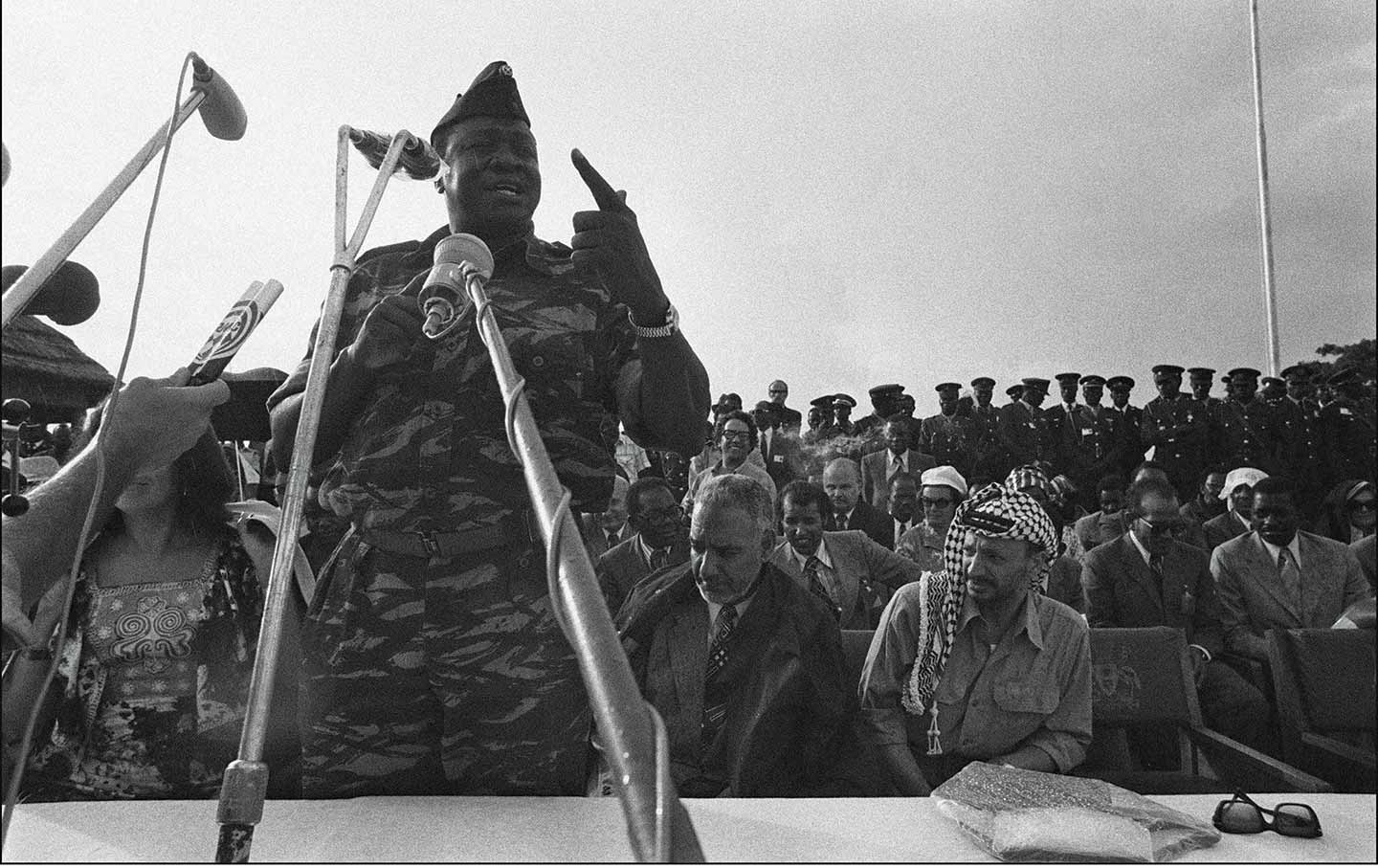
Mahmood Mamdani’s Uganda Mahmood Mamdani’s Uganda
In his new book Slow Poison, the accomplished anthropologist revisits the Idi Amin and Yoweri Museveni years.

The US Is Looking More Like Putin’s Russia Every Day The US Is Looking More Like Putin’s Russia Every Day
We may already be on a superhighway to the sort of class- and race-stratified autocracy that it took Russia so many years to become after the Soviet Union collapsed.
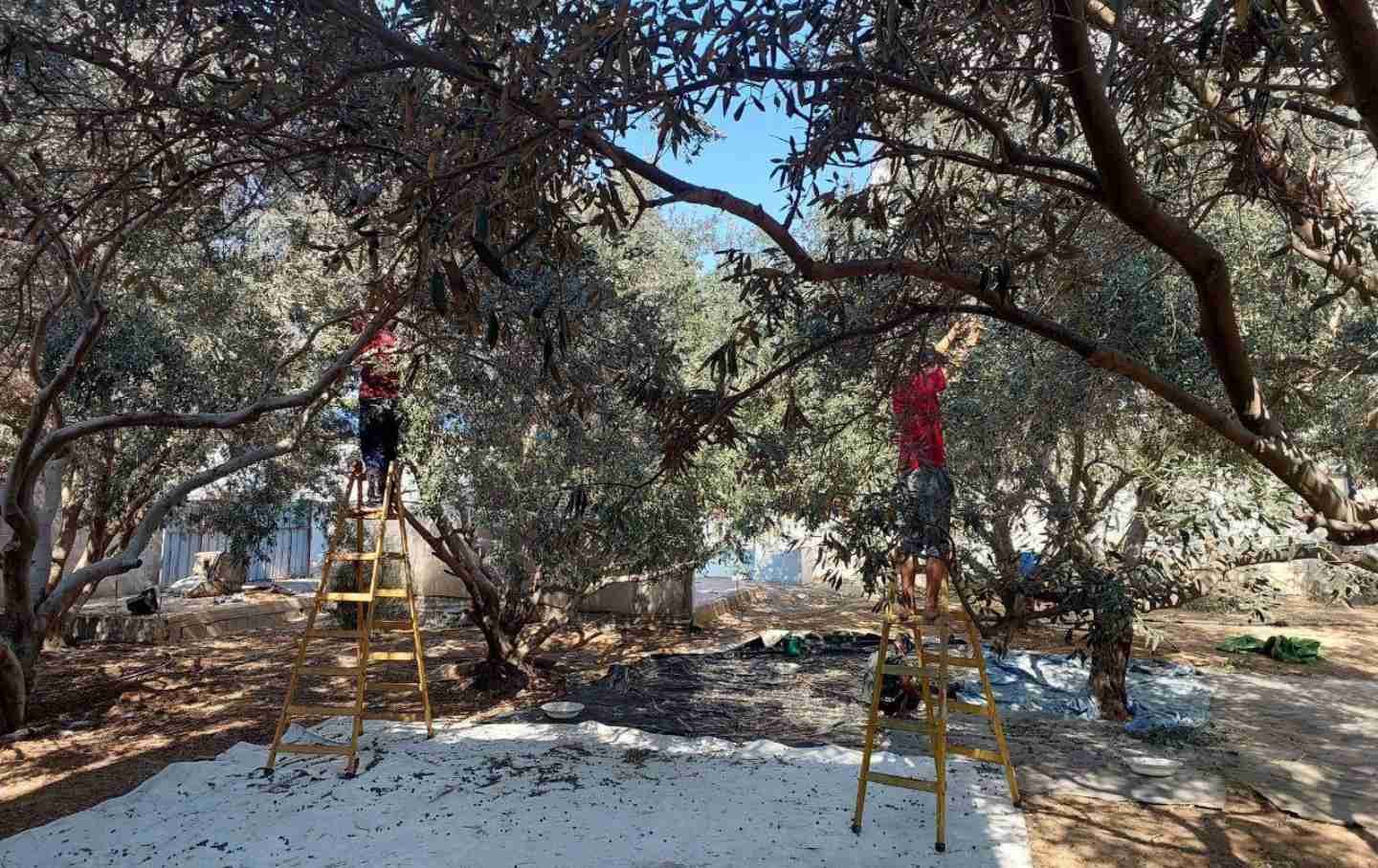
Israel Wants to Destroy My Family's Way of Life. We'll Never Give In. Israel Wants to Destroy My Family's Way of Life. We'll Never Give In.
My family's olive trees have stood in Gaza for decades. Despite genocide, drought, pollution, toxic mines, uprooting, bulldozing, and burning, they're still here—and so are we.
Trump’s National Security Strategy and the Big Con Trump’s National Security Strategy and the Big Con
Sense, nonsense, and lunacy.

Does Russian Feminism Have a Future? Does Russian Feminism Have a Future?
A Russian feminist reflects on Julia Ioffe’s history of modern Russia.
Ukraine’s War on Its Unions Ukraine’s War on Its Unions
Since the start of the war, the Ukrainian government has been cracking down harder on unions and workers’ rights. But slowly, the public mood is shifting.

